What Is a Short Sale? A Delaware Home Buyer’s Guide
Delaware home buyer overview: A short sale is a home sale for less than the seller owes on the mortgage, so the seller’s lender has to approve the price before it can close. You can buy one with an FHA, VA, USDA or conventional loan, but the bank’s approval sets the pace. On a Fannie Mae-owned loan, the servicer must answer a complete offer package within 30 calendar days. Delaware’s realty transfer tax is figured on the actual price paid. Current as of November 2026.
You found a house you like, the price looks good, and the listing says “short sale.” Maybe you’re wondering what that means, why it could take a while, or whether it’s worth the trouble. I’m John Thomas, NMLS #38783, and I’ve helped Delaware families buy homes for more than 20 years. On this page I’ll explain what a short sale is, how buying one works step by step, how to finance it and make a strong offer, what Delaware’s transfer tax looks like on the sale, and what owners weighing a short sale should know. For the full list of buyer topics, start at the Delaware home buyer information hub.
Quick Answer for Delaware Buyers: A short sale is a sale for less than the seller owes, so the seller’s lender must approve your offer. You can use FHA, VA, USDA or conventional financing. Expect a wait, an as-is home and a firm closing deadline in the approval letter. Get fully underwritten first, and keep your inspection and deposit protections.
Looking at a short sale?
We’ll get your loan ready before you offer, plan your rate lock around the bank’s approval, and make sure you can close inside the approval letter’s deadline.
Table of Contents
What Is a Short Sale?
A short sale is a home sale where the price won’t cover what the seller still owes on the mortgage, so the seller’s lender agrees to take less than the full payoff. Because the lender takes the loss, it has to approve the sale and price before the deal can close. The seller owns the home until settlement.
The Consumer Financial Protection Bureau describes a short sale as a type of loss mitigation: a sale of your home for less than what you owe on your mortgage. Fannie Mae’s Selling Guide uses the term “preforeclosure sale” for the same thing and says the sale has to be “pre-approved by the servicer.” You’ll hear both names. They mean the same deal.
For a buyer, the big difference from a normal sale is that the seller’s signature isn’t the final yes. The seller can accept your offer, but the seller’s lender, and often a second lender, a mortgage insurer or both, still have to agree to the numbers. Until they do, you have an accepted offer, not a deal you can count on.
How I set up a short sale purchase
When a buyer tells me the house they love is a short sale, I plan the loan around the seller’s bank instead of the calendar we’d use for a normal purchase. That means a full underwrite before the offer goes in, a lock strategy that doesn’t burn days while the bank is still deciding, and a check-in with the listing agent on which lenders have to sign off. My job is to make sure our side is ready the day the approval letter shows up, so the deadline in that letter is the only clock we’re racing. – John Thomas, NMLS #38783
Short Sale vs. Foreclosure vs. Bank-Owned Home
In a short sale, the owner still holds the title and sells with the lender’s approval. In a foreclosure, the lender takes the home through a court process and it’s sold at a sheriff’s sale. A bank-owned home, often called REO, is one the lender already took back and now sells itself. Each one is bought differently.
| Short sale | Foreclosure (sheriff’s sale) | Bank-owned (REO) | |
|---|---|---|---|
| Who sells | The homeowner, with the lender’s approval | The sheriff, after a court action | The lender that now owns the home |
| Who has to approve your offer | The seller, then the seller’s lender or lenders | Highest bidder at the sale | The lender’s asset manager |
| Can you use a mortgage? | Yes, on the normal timeline once the bank approves | Usually cash or fast funds; check the sale terms | Yes |
| Inspections and access | Usually allowed, home sold as-is | Often little or no access before the sale | Usually allowed, home sold as-is |
| Main risk for a buyer | Waiting on the bank and a possible no | Buying sight-unseen with title and occupancy questions | Bank addenda and repair limits |
In Delaware, a lender that wants to foreclose files in the Superior Court of the county where the home sits. The procedure is set out in Title 10, Section 5061 of the Delaware Code. That court step takes time, and it’s one reason some owners who can’t keep the house choose a short sale instead.
For an owner, the difference matters too. A short sale ends with a sale the owner arranged and the lender approved. A foreclosure ends with the lender taking the home. Mortgage programs also treat them differently when that owner wants to buy again, which we cover further down.
How Does Buying a Short Sale Work?
You make an offer, the seller signs it, and the seller’s agent sends it to the seller’s lender with the seller’s hardship file. The lender values the home, then approves, counters or turns the offer down. Once you have a written approval letter, your own loan and settlement run much like any other Delaware purchase.
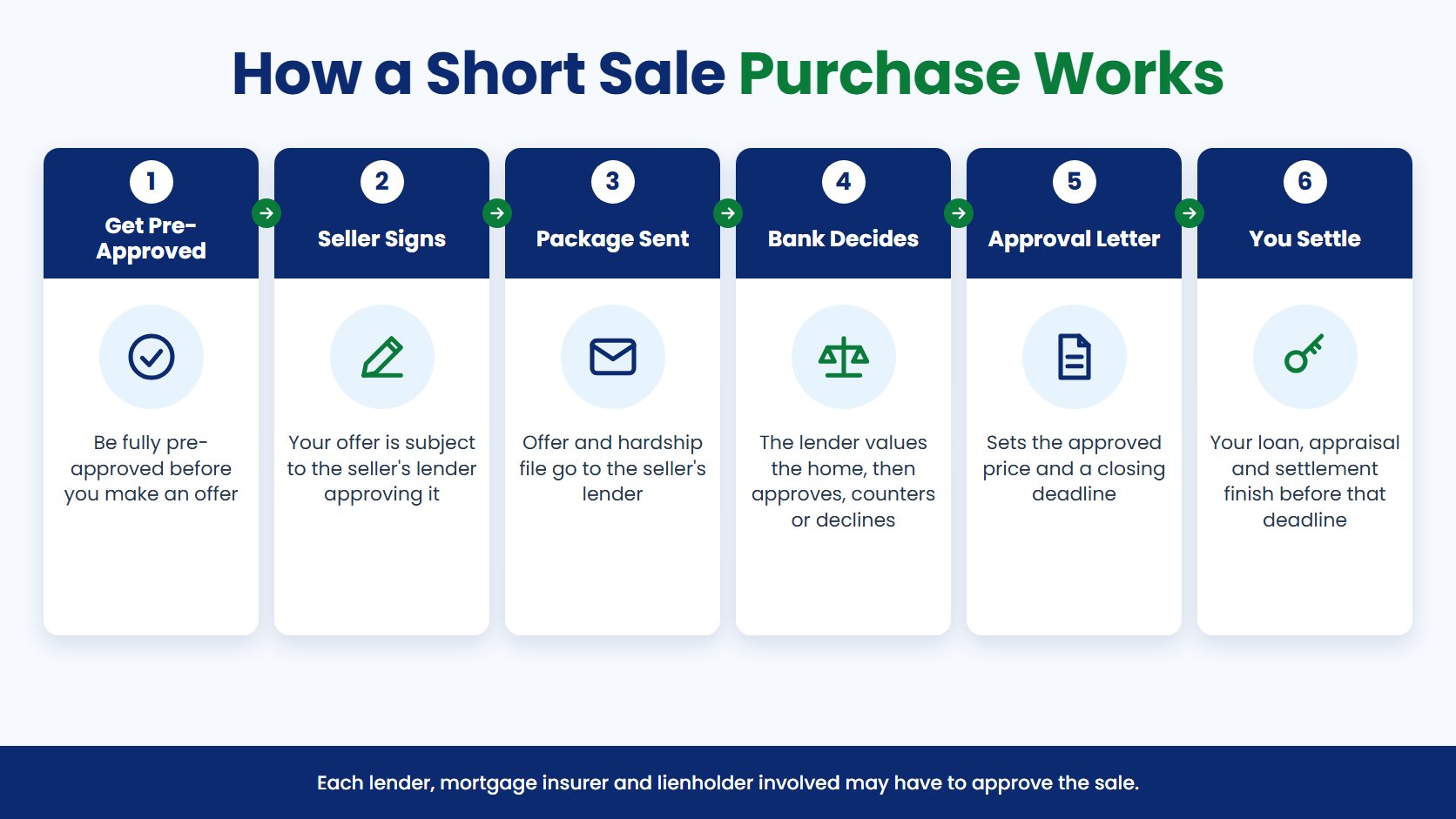
Here’s how the steps usually go:
- Get fully pre-approved first. A short sale listing agent has to send your offer to the bank, and a strong pre-approval letter makes that offer easier to defend.
- Write the offer. Your agent writes an agreement of sale with an addendum that makes it subject to the seller’s lender approving it. Read what that addendum says about your deposit and your right to walk away while you wait.
- The seller’s agent sends the package. The seller’s lender needs your signed offer and the seller’s hardship paperwork, usually income, bank statements and a hardship letter.
- The lender values the home. The bank orders its own opinion of value. If your price is well under that number, expect a counteroffer.
- Every lienholder signs off. A second mortgage, a home equity line or a mortgage insurer may each have to agree, and each one can add time. Unpaid condo or homeowners association dues usually have to be cleared at settlement too, so the association’s payoff matters.
- You get the approval letter. It sets the approved price, what the seller’s lender will pay at settlement, and a date the sale has to close by.
- Your loan finishes. Your lender orders your appraisal, underwriting clears, and you settle with a Delaware settlement attorney before the approval letter’s deadline.
On a loan that Fannie Mae owns, the servicer has to sign off at settlement in a specific way. The Fannie Mae Servicing Guide says all parties involved in the short sale must sign a Short Sale Affidavit (Form 191) at closing. Your settlement attorney will tell you if your deal needs one.
How Long Does a Short Sale Take?
There’s no set timeline. It depends on how complete the seller’s file is, who owns the loan, how many lenders have to agree and whether the bank counters. Fannie Mae sets response deadlines for its servicers, but loans owned by other investors follow their own rules. Plan for weeks of waiting before your own loan clock even starts.
Fannie Mae is one of the few investors that publishes its servicers’ deadlines. Under the Fannie Mae Servicing Guide, on a Fannie Mae-owned loan the servicer has to:
- Acknowledge an offer within 5 business days.
- Respond in writing within 30 calendar days of receiving a complete hardship package, if one is required, and the initial short sale offer.
- Decide on a revised offer within 10 business days.
- Expect the sale to close within 60 days of the approval.
Those deadlines start only once the seller’s package is complete, and they cover only the Fannie Mae loan. If there’s a second mortgage, a mortgage insurer or a loan owned by a private investor, each can take longer. We don’t put a typical number of months on this page because it varies too much from one file to the next. The approval letter’s closing date matters too. If it’s about to pass, the seller’s agent can ask for an extension, but the lender doesn’t have to grant one, so we plan your loan to meet the original date.
What this means for you: Ask the listing agent three questions before you offer: Who owns or services the first mortgage? Is there a second loan or a home equity line? Has the seller’s hardship package already been sent? The answers tell you more about the wait than any average.
Once the approval letter arrives, its closing date is the one that counts. Use the planner below to work backward from it.
Enter the closing date from the seller’s lender approval letter. The planner works backward to a target settlement date and the date you need your Closing Disclosure, which the lender must give you at least three business days before you close (CFPB). Your entries stay in your browser: nothing is sent to us or saved.
Can You Use a Mortgage to Buy a Short Sale?
Yes. FHA, VA, USDA and conventional loans can all be used to buy a short sale. The catch is timing. Your pre-approval, rate lock and any assistance you’re using have their own expiration dates, and the bank’s approval can take longer than any of them. Your loan also needs its own appraisal to support the price.
A few things work differently when the home is a short sale:
- Your appraisal is separate from the bank’s value. The seller’s lender values the home for its own decision. Your lender orders your appraisal for your loan. If it comes in under the approved price, our guide to the home appraisal in Delaware explains your options.
- Rate locks have expiration dates. Locking the day your offer is accepted can mean the lock runs out before the bank answers. We usually wait for the approval letter, or close to it, before locking, and we talk through that risk with you first.
- Pre-approvals and documents expire. Pay stubs, bank statements and credit reports go stale during a long wait. Expect to send updated ones before closing.
- The home is sold as-is. FHA, VA and USDA appraisals still have property standards, so a home with real repair problems may need a different plan. Get an inspection. Our guide to why you need a home inspection covers what to check.
- Down payment assistance has its own rules. If you’re using Delaware down payment assistance, ask how long the assistance can be held for your purchase, so a long bank approval doesn’t outrun it.
Your down payment sets your loan-to-value the same way it does on any purchase. The short sale price is the price. There’s no special short sale loan program for buyers.
How to Make a Strong Short Sale Offer
Get fully underwritten before you offer, price the offer close to what the bank is likely to accept, keep the terms simple, put the bank’s approval deadline in your plans, and keep your inspection and deposit protections. A clean offer is easier for the seller’s lender to approve, and easier for you to walk away from if it drags on.
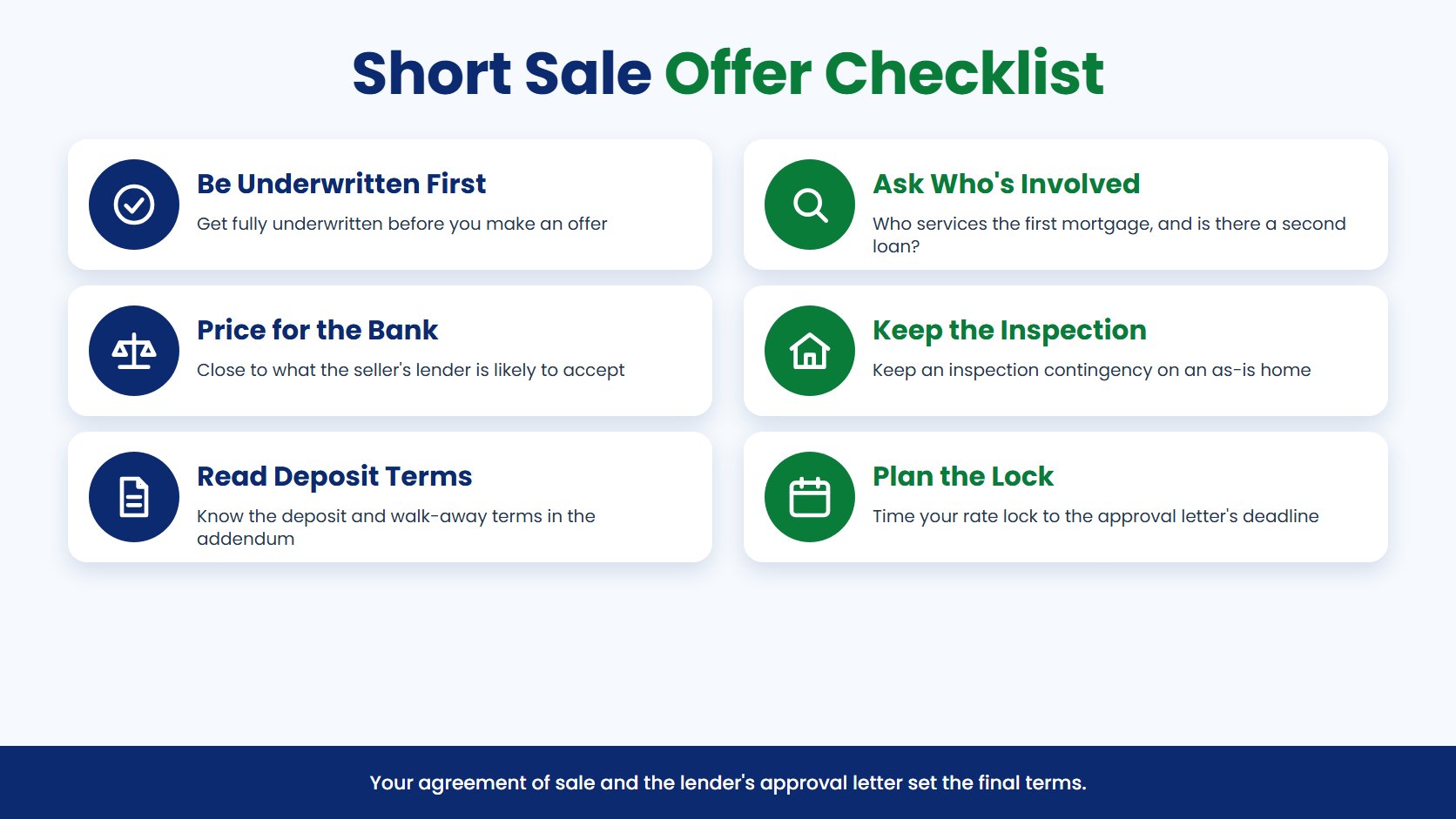
- Be fully underwritten. With a Platinum Pre-Approval, an underwriter reviews your full file before you make an offer, so the listing agent can send the bank a buyer who is ready. The appraisal and final approval still remain.
- Ask who’s involved. Find out who services the first mortgage, whether there’s a second loan or home equity line, and whether the seller’s package has gone in.
- Price for the bank, not just the seller. The seller may accept a low number, since the seller usually isn’t getting money from the sale. The bank’s own value decides what it accepts. Your agent can pull recent sales to set a realistic price.
- Keep your protections. As-is doesn’t mean you skip the inspection. Keep an inspection contingency so you can learn what you’re buying.
- Read the deposit terms. Your agreement of sale and the short sale addendum decide what happens to your deposit if the bank says no or takes too long. Know that before you sign.
- Plan the lock around the deadline. The approval letter’s closing date is firm. We plan your lock and underwriting so you can close inside it.
Check off what you already have in place. It shows what to line up before you write the offer. Your answers stay in your browser: nothing is sent to us or saved.
Buying a short sale works best when you aren't on a hard deadline of your own, like a lease that ends next month. If you are, our buy vs. rent comparison can help you weigh renting a bit longer against a faster purchase.
Is Buying a Short Sale Worth It?
It can be, if the price is right and you can wait. A short sale may be priced below similar homes, and you usually get to inspect it. But the bank may counter or say no, the wait can be long, and the home is sold as-is. It suits a patient buyer more than one who must move soon.
| Pros for a buyer | Cons for a buyer |
|---|---|
| The price may be below similar homes, since the seller's lender wants to limit its loss | The seller's lender, not the seller, makes the final call, and it can counter or decline |
| You can usually inspect the home and use normal financing | The wait can outlast your rate lock, pre-approval documents or lease |
| The lienholders that approve the sale release their liens at settlement, so the title can transfer | The home is sold as-is, and the seller usually won't pay for repairs |
| Less competition from buyers who won't wait | Another lender, a mortgage insurer or a lienholder can hold up the deal |
When a Short Sale Isn't Worth the Wait
I'm just being honest with you: a short sale is a bad fit if your lease ends in six weeks, if you're counting on a rate lock you already paid for, or if the house needs more work than you can afford after closing. In those cases, a regular listing at a fair price usually costs you less than waiting on a bank that may still say no. If you have time and the house is the right one, the wait can pay off. Just go in knowing that.
Delaware Transfer Tax and Closing Costs on a Short Sale
Delaware's realty transfer tax is figured on the actual price paid for the property, and the exemption for lenders in default covers a transfer to the lender, not a short sale to a buyer. Who pays which share is set by your agreement of sale, and the seller's lender decides which seller costs it will pay.
Under 30 Del. C. Section 5401, the value used for the tax is "the amount of the actual consideration" paid, including liens on the property. The same section exempts a conveyance to a lender holding a mortgage that is genuinely in default, such as a sheriff's sale or a deed in lieu. A short sale is a sale to a new buyer, so plan for the tax as you would on any purchase. If you're a first-time buyer, read about the Delaware first-time home buyer transfer tax exemption to see whether your share qualifies.
On the seller's side, the approval letter usually lists the seller costs the bank will allow at settlement. A cost the bank won't pay doesn't disappear. Someone has to cover it, so your agent and settlement attorney will want to see the approval letter early. Your own closing costs show up on your Loan Estimate and Closing Disclosure the same way they do on any purchase.
Thinking About a Short Sale on Your Own Delaware Home?
Talk to your servicer, a HUD-approved housing counselor and a Delaware attorney before you list. Ask whether the lender will waive the rest of what you owe, called the deficiency. Canceled debt can count as taxable income, so talk to a tax professional too. Delaware's foreclosure mediation program and counselors can help at no charge.
The deficiency
The CFPB explains that the deficiency is the difference between what the home sells for and what you still owe, and that a waiver of deficiency means the lender gives up the right to collect it. Don't assume a short sale wipes it out. On a loan Fannie Mae owns, its Servicing Guide tells the servicer to release the borrower from the deficiency on the Fannie Mae loan once the short sale is complete, but that release has conditions when there's mortgage insurance, and the servicer may first ask the owner to contribute money toward the loss. Other investors have their own rules. Read the approval letter's deficiency language word for word, and have a Delaware attorney read it with you before you sign.
Taxes on canceled debt
Forgiven mortgage debt can be taxable income. The IRS says in Topic 431 that the exclusion for canceled debt on a main home covers debt discharged before January 1, 2026, or under a written arrangement made before then. IRS Publication 4681 adds that you may be able to leave canceled debt out of income to the extent you were insolvent right before it was canceled. If your lender forgives debt, you may get a Form 1099-C. We don't give tax advice, so talk to a tax professional before you agree to the sale.
Where Delaware homeowners can get help
- Foreclosure mediation. Delaware's Automatic Residential Mortgage Foreclosure Mediation Program, set up under 10 Del. C. Section 5062C, covers owner-occupied one- to four-family homes and gives you a face-to-face meeting with your lender. The Attorney General's office lists a short sale as one of the possible outcomes. There's no charge to take part. Call (800) 220-5424.
- Office of Foreclosure Prevention. The Attorney General helps Delaware homeowners in financial distress or facing foreclosure, can contact your servicer for you, and investigates foreclosure scam complaints.
- Housing counselors. The Delaware State Housing Authority lists HUD-approved housing counselors who can walk through a short sale, a loan modification and your other options.
Watch for scams: Be careful with anyone who asks for money up front to save your home or to get your short sale approved, or who tells you to stop talking to your lender. Check with the Attorney General's office before you sign anything.
How Soon Can You Buy Again After a Short Sale?
It depends on the loan. Conventional loans sold to Fannie Mae generally need 4 years from the short sale, or 2 years with documented extenuating circumstances. FHA generally needs 3 years from the title transfer, with exceptions. USDA looks at 36 months. VA has no fixed short sale period. Your credit since the sale matters for all of them.
| Loan type | Waiting period after a short sale | Source |
|---|---|---|
| Conventional (Fannie Mae) | 4 years from the completion date; 2 years with documented extenuating circumstances | Fannie Mae Selling Guide B3-5.3-07 |
| Conventional (Freddie Mac, manually underwritten) | 48 months from the completion date; 24 months with extenuating circumstances. Within 7 years, the new loan is limited to a primary-home purchase at no more than 90% LTV, or a no cash-out refinance | Freddie Mac Guide 5202.1 |
| FHA | Generally 3 years from the date title transferred. Exceptions: every mortgage and installment payment made within the month due for the 12 months before the short sale, or documented extenuating circumstances beyond your control (divorce doesn't count) | HUD Handbook 4000.1 |
| USDA | A short sale closed more than 36 months before the application isn't adverse credit; within 36 months, some files need a credit exception | USDA HB-1-3555, Chapter 10 |
| VA | No fixed waiting period in VA's credit rule; the lender reviews your credit and what happened | 38 CFR 36.4340 |
The FHA exception for buyers who stayed current is worth a close look. If you sold short but made every mortgage payment and every installment payment within the month it was due for the 12 months before the sale, HUD Handbook 4000.1 treats you as eligible without the 3-year wait. On an FHA file, a short sale within 3 years also means the loan gets underwritten by hand instead of by the automated system. Our Delaware FHA loans guide covers the rest of FHA's rules.
If the short sale came with a bankruptcy or other late payments, our guide to a Delaware mortgage after bankruptcy walks through how lenders measure from the most recent event, and the Fresh Start Loan Program is a non-QM option for some buyers who can't wait out the agency periods. Rebuilding credit in the meantime helps, and our page on the five factors of credit scoring shows where to start.
Your Next Steps With a Short Sale
Here's how I'd handle it if you were sitting across from me:
- Get fully pre-approved, ideally underwritten, before you write an offer on a short sale.
- Ask the listing agent who services the first mortgage, whether there's a second loan and whether the seller's package has been sent.
- Read the short sale addendum's deposit and walk-away terms with your agent before you sign.
- Hold off on locking your rate until the approval letter is in sight, and talk through that choice with us.
- Get an inspection, since the home is sold as-is.
- When the approval letter arrives, send it to us and your settlement attorney the same day so we can work to its deadline.
Our guides to the property survey and home warranties cover two more topics that come up between contract and settlement, and the Delaware home buyer information hub links every buyer topic in one place.
Short Sale FAQ for Delaware Buyers
What is a short sale in real estate?
A short sale is a home sale where the price won't cover what the seller owes on the mortgage, so the seller's lender agrees to accept less than the full payoff. Because the lender takes the loss, it has to approve the sale and the price before the deal can close.
Is a short sale the same as a foreclosure?
No. In a short sale, the owner still holds title and sells the home with the lender's approval. In a foreclosure, the lender takes the home through a court process. In Delaware, that court action is filed in the Superior Court of the county where the home is.
Can I buy a short sale with an FHA, VA or USDA loan?
Yes. FHA, VA, USDA and conventional loans can all be used to buy a short sale. Your loan needs its own appraisal, the home still has to meet the program's property standards, and your rate lock and documents need to stay current while you wait for the seller's lender to approve.
How long does it take to buy a short sale?
There's no set timeline. It depends on how complete the seller's file is, who owns the loan and how many lenders have to agree. On a Fannie Mae-owned loan, the servicer must respond in writing within 30 calendar days of a complete package and initial offer, but other investors follow their own rules.
Is a short sale better than a foreclosure?
For many owners, yes. In a short sale, the owner arranges the sale with the lender's approval instead of losing the home through a Delaware court action. Mortgage programs can also treat it differently later. For example, Fannie Mae's waiting period after a short sale is 4 years, shorter than its wait after a foreclosure. The right choice depends on your situation, so talk to a HUD-approved housing counselor.
Are short sales a good deal for buyers?
They can be. A short sale may be priced below similar homes, and you can usually inspect it and use normal financing. But the bank may counter or decline, the wait can be long, and the home is sold as-is. It suits a patient buyer better than one on a tight deadline.
Can I get my deposit back if the bank rejects a short sale?
Your agreement of sale and the short sale addendum decide what happens to your deposit if the seller's lender says no or takes too long. Read those terms with your agent before you sign, so you know when you can walk away.
Who pays the Delaware transfer tax on a short sale?
The agreement of sale sets who pays which share. Delaware's realty transfer tax is figured on the actual price paid, and the exemption for a lender in default covers a transfer to the lender, not a short sale to a new buyer. First-time buyers should check whether their share qualifies for the state exemption.
Do you owe taxes on a short sale?
You might. Forgiven mortgage debt can be taxable income. The IRS says the exclusion for canceled debt on a main home covers debt discharged before January 1, 2026, or under a written arrangement made before then. Other exclusions, like insolvency, may apply. Talk to a tax professional before you agree to the sale.
How long after a short sale can you buy a house?
It depends on the loan. Fannie Mae generally requires 4 years, or 2 years with documented extenuating circumstances. FHA generally requires 3 years from the title transfer, with exceptions for owners who stayed current. USDA looks at 36 months, and VA has no fixed period.

John R. Thomas has helped Delaware families buy homes for more than 20 years and is Branch Manager and Division Vice President of the John Thomas Team in Newark. He taught physics and physical science at Delcastle High School for more than ten years before lending full time, which is why he plans a short sale buyer's underwriting and rate lock around the seller's lender approval and its closing deadline.
He holds a BS in Physics Education from the University of Delaware and an MS in Curriculum and Instruction from Delaware State University, and has been a Certified Mortgage Planner since 2008. John wrote Your Guide to Buying Your First Home in Delaware, the basis of our Delaware first-time home buyer guide, and teaches the first-time home buyer seminars himself. State licensing: Look up John R. Thomas, NMLS #38783, on NMLS Consumer Access. Read his loan officer bio page or meet the John Thomas Team.
Years 3,000+
Buyers Helped 1,000+
First-Time Buyers DE & MD
Service Area CMP
Certified Mortgage Planner
John Thomas Team with AnnieMac Home Mortgage
248 E Chestnut Hill Rd, Newark, DE 19713 | 302-703-0727 | team@johnthomasteam.com
Schedule Appointment (30 min)
See John Thomas Team on Google for reviews, directions, and local office information.
YouTube | Facebook | Instagram | TikTok | X / Twitter | LinkedIn
- Within 4 business hours you'll hear from us by phone, text and email, and we keep following up for 14 days (the 4-14-24 standard).
- Once your documents arrive, a licensed loan officer reviews them for pre-approval within 24 hours.
- With a Platinum Pre-Approval, an underwriter reviews the full file before you make an offer; the appraisal and final approval remain.
- A single Loan Concierge handles your file from contract to closing and sends a Tuesday status email to everyone involved.
- New calls are answered Saturday and Sunday from 9 AM to 4 PM, for buyers writing offers on the weekend.

Ready to make an offer on a short sale?
Get pre-approved and underwritten before you offer, and we'll plan your rate lock and settlement around the seller's lender approval.
Last Updated: November 2026 · John Thomas Team with AnnieMac Home Mortgage · Mortgage content reviewed by John R. Thomas, NMLS #38783.
John R. Thomas, NMLS #38783 | John Thomas Team with AnnieMac Home Mortgage | AnnieMac Home Mortgage NMLS #338923 | 248 E Chestnut Hill Rd, Newark, DE 19713 | 302-703-0727 | delawaremortgageloans.net
AnnieMac Home Mortgage is an Equal Housing Lender. State licensing: Look up John R. Thomas, NMLS #38783, on NMLS Consumer Access.
(c) Copyright John R. Thomas, All Rights Reserved.
