Delaware Manufactured Home Loans (2026 Guide)

Quick Answer: A Delaware manufactured home loan helps buyers finance a HUD-code factory-built home in New Castle, Kent, or Sussex County. If the home is permanently attached to land you own, it may qualify for FHA Title II, VA, USDA, or Conventional financing. If the home is on leased land, a chattel loan or FHA Title I loan may be needed. Some Delaware buyers may also qualify for DSHA down payment assistance when the home, credit score, income, and loan program meet DSHA rules. Call John Thomas, NMLS #38783, at 302-703-0727.
Hey, I’m John Thomas, NMLS #38783, and I’ve been helping Delaware buyers finance manufactured homes for over 20 years. Manufactured homes are one of the most affordable paths to homeownership in our state — but the financing rules are different enough that it helps to work with a lender who handles these loans regularly. On this page I’m going to walk you through every loan program available for Delaware manufactured homes in 2026, exactly what makes a property eligible, and how to pair these loans with DSHA down payment assistance. When you’re ready to talk through your situation, call me at 302-703-0727 or schedule a time below.
Ready to Buy a Manufactured Home in Delaware?
Get a real answer from a DSHA-approved lender in one phone call.
Table of Contents
What Is a Delaware Manufactured Home Loan?
A Delaware Manufactured Home Loan is a mortgage or financing product specifically designed for factory-built homes that meet the federal HUD Code construction standard set on June 15, 1976. “HUD-code” means the home was built after June 15, 1976, to federal manufactured housing construction and safety standards. These homes are built on a steel chassis in a controlled factory environment, transported to your site, and installed on a permanent foundation. With Delaware median home prices well above $300,000 in most of the state, a manufactured home is one of the most affordable ways to own — and the John Thomas Team can help you finance a single-wide, double-wide, or multi-section home in FHA, VA, USDA, Conventional, or Chattel across all three Delaware counties — New Castle, Kent, and Sussex.
New home shipments of manufactured homes have been increasing steadily since 2011, and roughly 18 million Americans live in some form of manufactured dwelling. According to the Manufactured Housing Institute, the average cost per square foot for a new manufactured home runs 35–50% less than comparable site-built construction. In Delaware, that price gap is what makes a manufactured home so attractive — especially for first-time buyers and retirees relocating to Sussex County.
What Is the Difference Between Mobile, Manufactured, and Modular Homes?
Most people use “mobile home” and “manufactured home” interchangeably, but these are three legally distinct categories — and the lender treats each one completely differently. Getting the classification right is the single most important step before you start shopping.
| Home Type | Building Code | When Built | Financing Available? |
|---|---|---|---|
| Mobile Home | No federal standard | Before June 15, 1976 | Cash only in most cases |
| Manufactured Home | Federal HUD Code | After June 15, 1976 | FHA, VA, USDA, Conventional, Chattel |
| Modular Home | State / Local IRC Code | Any (no chassis) | Treated as site-built — all programs |
Mobile homes are factory-built homes constructed before June 15, 1976. Because they predate federal HUD safety standards, almost no traditional lender will finance them. In most cases, the only way to buy a true mobile home is with cash or a personal loan.
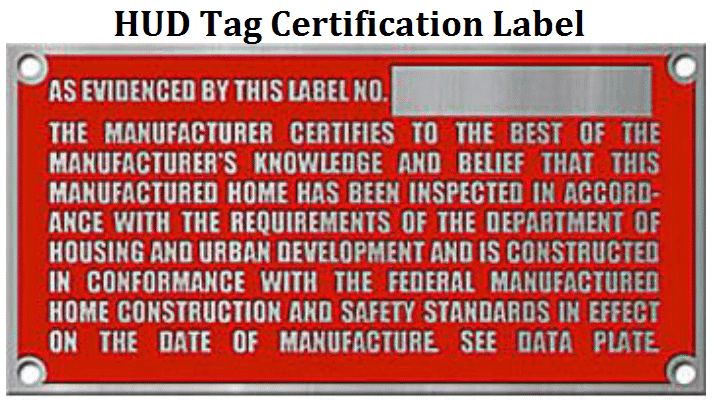
Manufactured homes are factory-built homes constructed on a permanent steel chassis after June 15, 1976. They are built to the National Manufactured Housing Construction and Safety Standards Act of 1974 (the federal HUD Code), administered by the U.S. Department of Housing and Urban Development. Every manufactured home carries a red HUD Certification Label on the exterior of each section and a Data Plate inside the home documenting its build specifications. These are the homes that qualify for FHA, VA, USDA, and Conventional financing in Delaware.
Modular homes are also built in a factory but follow the International Residential Code (IRC) — the same code used for site-built houses. They are never placed on a chassis. Sections are transported and assembled on a permanent foundation at the property. To FHA, Fannie Mae, and Freddie Mac, a modular home is legally indistinguishable from a stick-built home — no special manufactured housing rules apply, no foundation certification, no extra documentation.
The big takeaway: the most consequential thing you can do before applying for a loan is to confirm the home’s classification in writing with the seller, the dealer, and the title. If a lender or appraiser misclassifies a modular home as manufactured, you’ll trigger weeks of unnecessary documentation. If they misclassify a true mobile home as manufactured, the loan will fall apart at underwriting. Get this right at the front end.
What Loan Programs Are Available for Delaware Manufactured Homes?
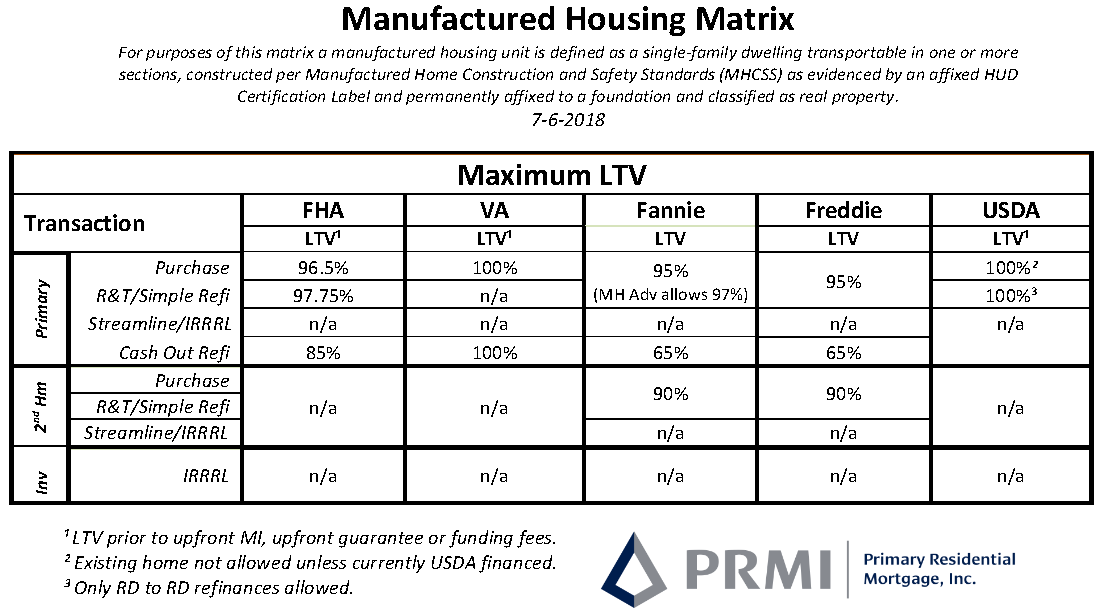
You can finance or refinance a single-wide or multi-wide manufactured home in Delaware through several government-insured loan programs, conventional loans backed by Fannie Mae and Freddie Mac, and portfolio chattel loans. Here’s the side-by-side comparison most national lenders won’t show you, with current 2026 numbers:
| Program | Min. Down | Min. Credit | Max Loan / Limit | Land Required |
|---|---|---|---|---|
| FHA Title I | 5% | 580 | Up to $237,096 (multi-section + lot) | Lease OK (3+ yrs remaining) |
| FHA Title II | 3.5% | 580 (500 with 10% down) | $630,200 NCC / $541,287 Kent & Sussex | Yes — must own land |
| VA Manufactured Home | 0% | No VA minimum | No VA loan limit (full entitlement) | Yes — must own land |
| USDA Rural | 0% | 600 | No max — income-limited | Yes — must own land |
| Conventional (Fannie/Freddie) | 5% | 620 | $832,750 (2026) | Yes — must own land |
| Chattel | 5–20% | 550 | Lender-specific | No — leased land OK |
Which Manufactured Home Loan Is Best for My Situation?
The right starting point depends on whether you own the land, whether you’re a veteran, where the home is located in Delaware, and your credit profile. Use this matrix as a starting point — then call to confirm the right path for your specific scenario:
| Buyer Situation | Best Starting Point | Why |
|---|---|---|
| Buying manufactured home + land | FHA Title II, VA, USDA, or Conventional | Treated as real estate when titled correctly |
| Buying in a mobile home park | Chattel or FHA Title I | Land is leased, not owned |
| Veteran buyer | VA Manufactured Home Loan | May allow 0% down if eligible |
| Rural Sussex or Kent County buyer | USDA | May allow 0% down if income and property qualify |
| Buyer using DSHA assistance | FHA with DSHA review | DSHA rules can be strict for manufactured housing |
| Strong-credit buyer (700+) | Conventional | PMI may be removable later at 20% equity |
FHA Manufactured Home Loans (Title I & Title II)
FHA Manufactured Home Loans are the most popular path for Delaware buyers. FHA splits manufactured home financing into two distinct programs. Title II treats the manufactured home as real property — the home is permanently affixed to land you own, titled as real estate, and financed with a standard 30-year FHA mortgage at 3.5% down with a 580 minimum credit score. Title II uses the standard county FHA loan limits, which for 2026 are $630,200 in New Castle County and $541,287 in Kent and Sussex Counties. Title I is FHA’s home-only program — you can finance the home, the lot, or both, and the home doesn’t need to be on land you own (a lease with at least 3 years beyond the loan maturity date works). HUD increased Title I limits effective March 29, 2024 for the first time since 2008. The current Title I limits are $105,532 for a single-section home-only loan, $193,719 for a multi-section home-only loan, $148,909 for a single-section home + lot loan, and $237,096 for a multi-section home + lot loan. Title I is more restrictive than Title II in some respects, but it’s the only FHA path for buyers in mobile home parks. We service our own loans, so I can go down to a 500 credit score with 10% down on FHA.
VA Manufactured Home Loans
VA Manufactured Home Loans offer 100% financing for eligible veterans and active-duty service members. The VA has no minimum credit score set by the agency itself — most lenders set their own minimums around 580–620, but we can work with lower scores when the rest of the file is strong. The home must be permanently affixed to land you own, must meet HUD code, and must pass the VA appraisal. The VA is the only program that will allow financing on a manufactured home that has been previously moved from its original site. If you’re a Delaware veteran, this is almost always the best loan option for buying a manufactured home.
USDA Manufactured Home Loans
USDA Rural Development Manufactured Home Loans offer 100% financing for eligible rural properties in Delaware. Most of Kent and Sussex Counties qualify for USDA, and so do parts of southern New Castle County. There are household income limits based on county and family size, and since May 2025 the home can be new (manufactured within 12 months of closing) or existing (manufactured within 20 years of closing and never moved to another site) – our guide to Delaware USDA manufactured home loans covers the full rules. USDA also requires the home to be on a permanent foundation with the chassis-side wheels and hitch removed before closing. With 0% down and a 0.35% annual fee that runs below FHA’s monthly mortgage insurance, USDA is often one of the lowest out-of-pocket options when the property, income, and borrower qualify.
Conventional Manufactured Home Loans
Conventional Manufactured Home Loans through Fannie Mae’s HomeReady and Freddie Mac’s Home Possible programs allow as little as 5% down with reduced mortgage insurance. The 2026 conforming loan limit is $832,750. Conventional is the only path that allows a manufactured home to be financed as a second home — FHA, VA, and USDA are all primary residence only. The minimum credit score is 620, and the home must be permanently affixed to land you own and titled as real property. For buyers with strong credit (700+), conventional often produces the lowest payment because PMI cancels at 20% equity, unlike FHA where mortgage insurance lasts the life of the loan.
Chattel Loans (Manufactured Home on Leased Land)
Chattel Loans are how you finance a manufactured home in a Delaware mobile home park or on any leased land. Because the home isn’t tied to real estate, a chattel loan treats the home like a vehicle — it’s a personal property loan, secured by the home itself. The minimum credit score is 550, the down payment runs 5%–20%, terms typically max out at 25 years, and rates are usually 2–4% higher than a traditional mortgage. You can’t use any down payment assistance program with a chattel loan because none of them apply to non-real-estate transactions. We work with specialty chattel lenders like Triad Financial Services, 21st Mortgage, and Vanderbilt to get these closed. For current Delaware chattel loan rates and credit-tier terms, see our dedicated chattel loans page.
What Qualifies as an Eligible Delaware Manufactured Home?
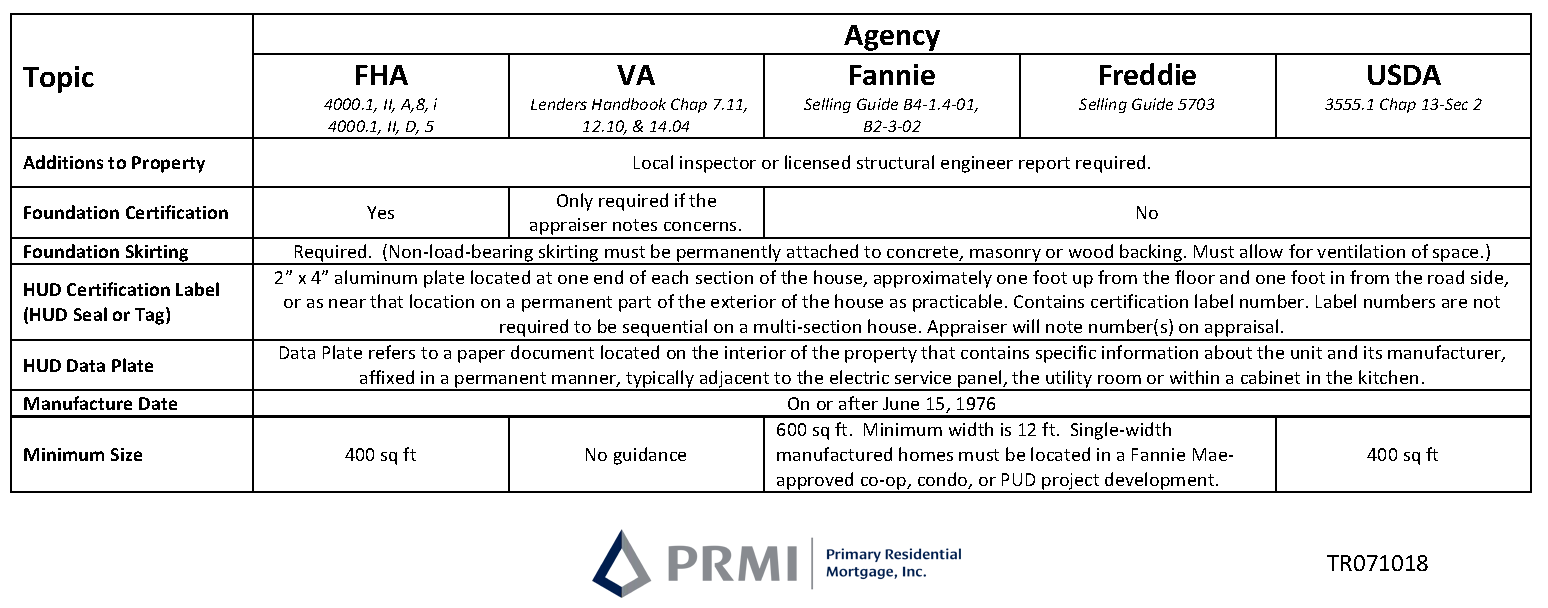
Not every manufactured home in Delaware can be financed with a traditional mortgage. The home has to meet a specific set of HUD and lender requirements — and these are the items the appraiser is going to verify the day they walk the property. Before you make an offer, confirm the home meets all of these standards:
- Single-wide or multi-wide — single, double, or triple-section homes all qualify; the loan applies to one unit only
- Built after June 15, 1976 — this is the date the federal HUD Code took effect; anything older is a “mobile home” and can’t be financed
- Permanent foundation per the HUD Permanent Foundations Guide for Manufactured Homes (PFGMH, HUD 7584) — wheels, axles, and hitch must be removed
- HUD Certification Label (red HUD Tag) on the exterior of each transportable section
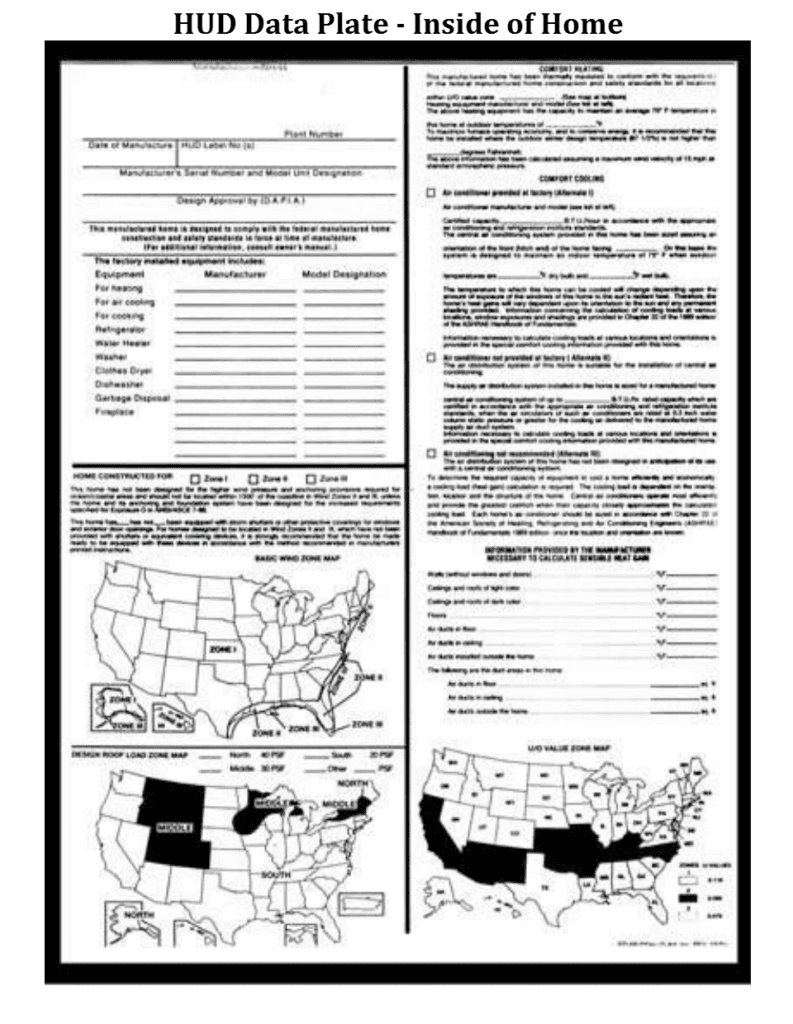
- HUD Data Plate mounted inside the home (typically near the electrical panel or in a kitchen cabinet)
- De-titled at the Delaware DMV — the vehicle title must be canceled and the home reclassified as real property before closing
- Permanently connected to utilities — public water/well and septic/sewer (no trucked-in water or cisterns allowed)
- Compliance with state, local, and federal building codes
What Are the HUD Tag and HUD Data Plate Requirements?
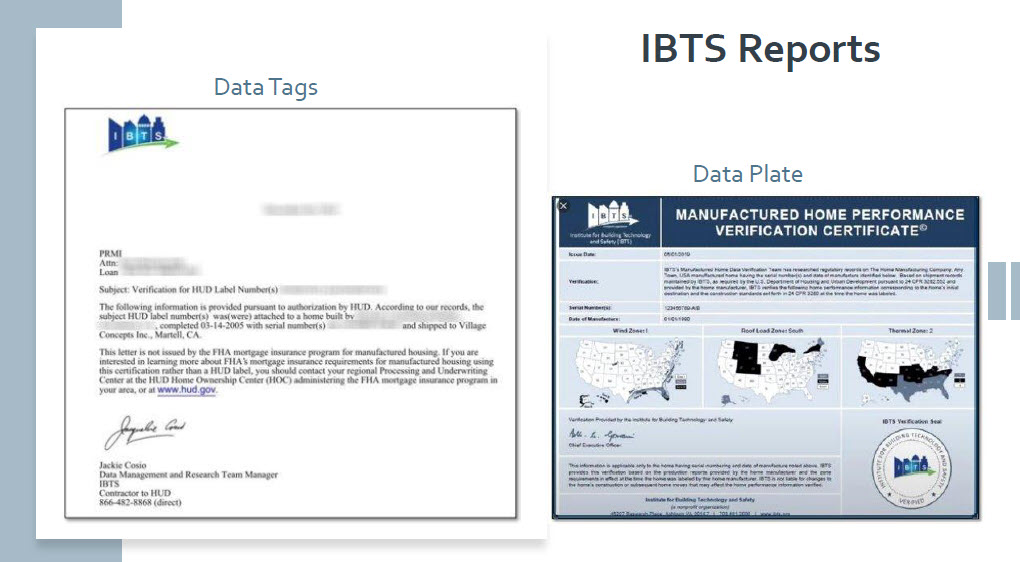
The HUD Tag and HUD Data Plate are the two pieces of physical evidence that prove the manufactured home was built to HUD code. The appraiser will photograph both and include them in the appraisal report. If either one is missing, painted over, or unreadable, the lender will require you to order an IBTS Verification Report at the buyer’s expense — which adds time and cost to the closing.
HUD Tag (Certification Label): A red metal plate affixed to the exterior of each transportable section of the home. Each tag carries a unique HUD Certification Number that proves compliance with the Federal Manufactured Home Construction and Safety Standards. A double-wide will have two tags, a triple-wide will have three.
HUD Data Plate (Compliance Certificate): A paper or foil label, 8.5″ x 11″ or 8.5″ x 14″, mounted inside the home — typically near the main electrical breaker box, inside a kitchen cabinet, or in a bedroom closet. The Data Plate lists the manufacturer’s name, the year built, the serial number and model, the wind and roof load zones, the HU Construction Zone, and the heating/cooling specifications. This is what tells the lender whether the home was built for the right region.
What If the HUD Tag or Data Plate Is Missing?
If the appraiser can’t locate or photograph the HUD Tag or Data Plate, your lender will be required to order an IBTS Report (from the Institute for Building Technology and Safety). The IBTS Report pulls the home’s certification data directly from HUD’s national records and serves as a replacement document. The cost runs $100–$150 and adds about 2 weeks to closing. The report is required when:
- The HUD Tag and/or Data Plate has been removed from the home
- The HUD Tag has been painted over or is illegible
- The HUD Tag or Data Plate has been covered up and the appraiser can’t get a clear photo
What Is De-Titling and Why Does It Matter in Delaware?
Because manufactured homes are built on a chassis with axles and a hitch, they are legally considered vehicles in Delaware until they go through a process called de-titling. The home starts its life with a vehicle title from the Delaware Division of Motor Vehicles, just like a car. To get a real-property mortgage on it (FHA Title II, VA, USDA, or Conventional), that vehicle title has to be surrendered to the DMV and the home reclassified as real property attached to the land — that’s de-titling. The title work is reviewed by the title company before closing to confirm:
- The vehicle title has been canceled and the home is now classified as real property
- The deed clearly shows the home as an improvement to the land, treated as real property under Delaware law
- An ALTA Endorsement 7, 7.1, or 7.2 (or an equivalent endorsement) is in place allowing the home to be insured as real property
If you’re buying a manufactured home where the previous owner never de-titled it, that work has to happen as part of your closing — and it adds time. If you’re buying a chattel loan in a mobile home park, the home stays titled as personal property at the DMV, and that’s exactly what the chattel lender wants. Either way, knowing which path you’re on at the front of the transaction prevents nasty surprises 30 days into underwriting. The official Delaware DMV mobile home titling guidance is published at dmv.de.gov.
Note: This is general information, not legal advice. Your title company and closing attorney will confirm the correct title path for your transaction.
What Is an Engineer’s Foundation Certification?
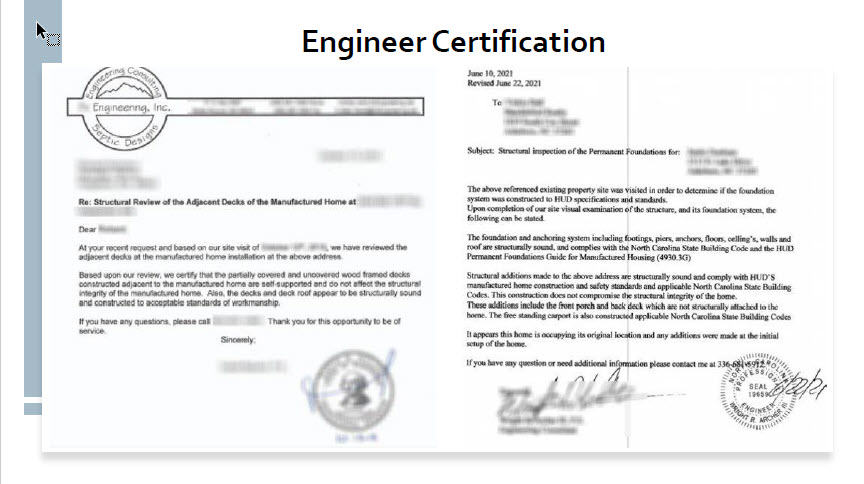
Every FHA, VA, USDA, and most Conventional manufactured home loans in Delaware require an Engineer’s Foundation Certification. This is a signed and stamped report from a licensed structural engineer certifying that the home’s foundation meets the structural stability standards in the HUD Permanent Foundation Guide for Manufactured Homes (PFGMH, HUD 7584). The engineer inspects the piers, anchoring system, skirting, and foundation footings, then issues the certification. The cost typically runs $500–$850 and the inspection takes 1–2 hours. If the foundation doesn’t meet the PFGMH standard, you’ll need foundation repairs before closing — which is why I always recommend ordering the engineer’s certification early in the process, not at the end.
What Isn’t Allowed With Delaware Manufactured Home Loans?
Even when the home meets HUD standards, there are scenarios where traditional financing isn’t an option. Knowing these restrictions before you put a contract on a property saves you weeks of wasted time:
- No investment properties with FHA, VA, USDA, or Conventional manufactured home loans (a portfolio loan is the only path)
- No leased land with traditional loans — you’ll need a Chattel Loan instead
- Renovation loans (FHA 203k or Conventional HomeStyle) are allowed only with FHA on manufactured homes
- Second homes are allowed only on Fannie Mae, Freddie Mac, or a portfolio loan — not on FHA, VA, or USDA
- Homes that have been moved from their original site are not eligible (except for VA loans, which do allow moved homes)
- No co-ops
- Wheels, axles, or hitch still attached — these must be removed before closing
- Trucked-in water or cistern water — must be public water or a permitted well
Can I Use Down Payment Assistance With a Delaware Manufactured Home Loan?
Yes — and this is one of the biggest advantages of working with a DSHA-approved lender. The Delaware State Housing Authority and several PRMI in-house programs allow down payment assistance on manufactured home purchases, with some restrictions. Depending on the loan program, property type, credit score, income, and DSHA eligibility, you may be able to reduce your out-of-pocket funds with down payment assistance. Here’s what’s actually available in 2026:
DSHA now organizes its homebuyer loans under the Delaware Mortgage Program (rebranded April 2026), with Welcome Home for first-time buyers and Open Door for broader homebuyer eligibility. Both first-mortgage tracks pair with the DPAs listed below.
DSHA Down Payment Assistance for Manufactured Homes
Through the DSHA Delaware Mortgage Program, you can pair a DSHA first mortgage (Welcome Home for first-time buyers or Open Door for first-time and repeat buyers) with one of the DSHA down payment assistance products. For manufactured homes, DSHA requires a 660 minimum credit score for all borrowers, and the home must be a double-wide or larger — single-wides are not eligible. The available DPAs are:
These manufactured home rules come from DSHA program guidance and should be confirmed before you write an offer because program rules can change.
- First State 3% DPA — 3% of the loan amount toward down payment and closing costs (pairs with both Welcome Home and Open Door)
- Keys4You 4% DPA — 4% zero-interest deferred second (pairs with both Welcome Home and Open Door); largest DPA available to repeat buyers on a manufactured home
- Take5 5% DPA — 5% of the loan amount as a zero-interest deferred second; Welcome Home only (first-time buyers)
The DSHA Diamond in the Rough program is the only DPA that cannot be used on a manufactured home, because Diamond pairs the DPA with an FHA 203(k) renovation loan and DSHA does not allow FHA 203(k) financing on manufactured homes. For a manufactured home with DSHA assistance, your three options are First State 3%, Keys4You 4%, and Take5 5% (Welcome Home only).
For 2026, the DSHA non-targeted Welcome Home income limits are $119,400 (1–2 person) / $137,310 (3+ person) in New Castle County and $108,800 (1–2 person) / $125,120 (3+ person) in Kent and Sussex Counties.
For Open Door (which launched in April 2026 as part of the DSHA Delaware Mortgage Program rebrand), the DSHA 2026 Open Door income and purchase price limits are $143,280 (1–2 person) / $179,100 (3+ person) in New Castle County and $130,560 (1–2 person) / $163,200 (3+ person) in Kent and Sussex Counties. Open Door purchase price limits are $617,241 in New Castle County and $544,232 in Kent and Sussex Counties.
Targeted-area limits are higher and waive the first-time buyer requirement.
PRMI In-House Down Payment Assistance Programs
If your credit score is below the DSHA 660 minimum or you don’t qualify for the state programs, we have two in-house options that work on manufactured homes:
- PRMI Empower DPA — 3.5% or 5% of the loan amount toward down payment and closing costs with a 600 minimum credit score; available in every state except New York
- PRMI Advantage DPA Grant — 3.5% grant (no repayment) toward down payment with a 620 minimum credit score
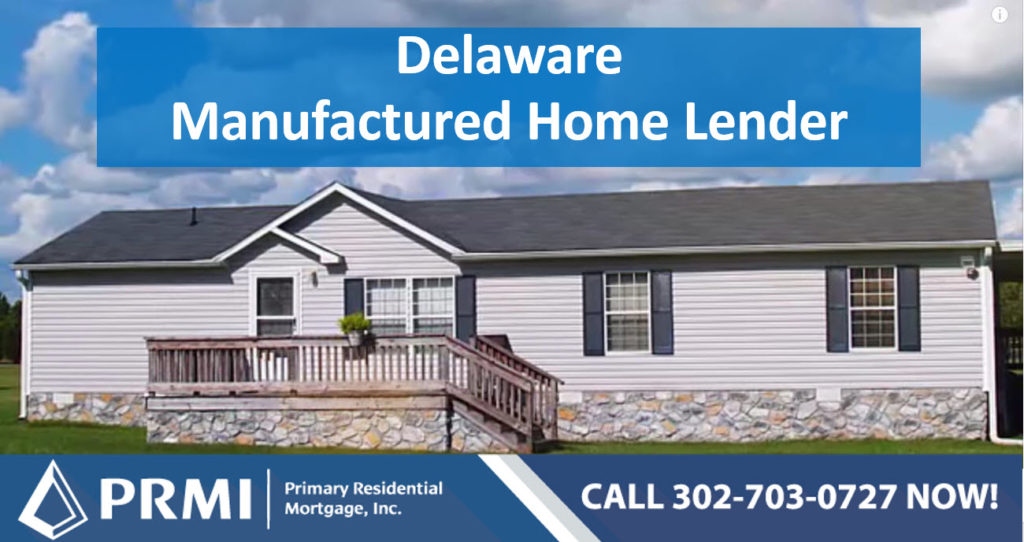
Delaware Manufactured Home Loans by County
Manufactured home financing can look different depending on which Delaware county you’re buying in. Here’s how the strategy shifts across the three counties:
New Castle County
New Castle County buyers — covering Newark, Middletown, Bear, New Castle, and the Wilmington outskirts — generally face higher land costs and the highest 2026 FHA Title II limit in Delaware at $630,200. USDA-eligible properties are limited mostly to southern New Castle County, so most buyers here use FHA Title II, VA, or Conventional financing. DSHA Welcome Home and Open Door income limits are higher in New Castle County than in Kent or Sussex, which gives more buyers a path to down payment assistance.
Kent County
Kent County buyers — Dover, Smyrna, Harrington, Camden, and Felton — often have the strongest mix of program options. The 2026 FHA Title II limit is $541,287, USDA-eligible areas cover most of the county outside the Dover city center, and VA financing is heavily used near Dover Air Force Base. Manufactured homes are common in Kent County, particularly on owned acreage outside the towns, which makes FHA Title II and USDA the most-used loan paths here.
Sussex County
Sussex County buyers — Georgetown, Millsboro, Seaford, Laurel, Milton, Lewes, and Long Neck — have the most diverse manufactured home market in Delaware. You’ll find homes on owned land, in leased-land communities, and in age-restricted retirement parks near the beaches. The 2026 FHA Title II limit is $541,287. USDA-eligible areas cover the majority of inland Sussex. If you’re buying in a leased-land community (very common around Long Neck and the inland bays), you’ll need a chattel loan or FHA Title I rather than a traditional mortgage.
What Documents Do I Need for a Delaware Manufactured Home Loan?
Manufactured home loans require a few extra documents beyond a standard mortgage. Having these ready up front can shave weeks off your closing timeline:
- Purchase contract (and any addenda)
- Manufactured home title or full title history
- HUD Certification Label numbers (the red HUD Tag on each section)
- HUD Data Plate photo (mounted inside the home)
- Engineer’s Foundation Certification (PFGMH compliance)
- Well/septic documentation, if applicable
- Land lease, if buying in a community or park
- Delaware DMV de-titling documentation, if converting to real property
- Appraisal and home inspection items
- Income, asset, and credit documents (pay stubs, W-2s, tax returns, bank statements, photo ID, Social Security number)
What Are the Most Common Reasons Manufactured Home Loans Get Delayed in Delaware?
Almost every manufactured home loan that runs into trouble runs into one of the same handful of issues. Knowing what these are before you make an offer makes them much easier to spot and solve:
- Missing or unreadable HUD Tag or HUD Data Plate (triggers a required IBTS Report)
- Home was moved from another site (only VA financing allows previously-moved homes)
- Home is still titled as personal property at the Delaware DMV
- Foundation does not meet HUD PFGMH standards
- Land lease terms do not meet FHA Title I or chattel lender rules (lease too short, park doesn’t meet FHA standards)
- Single-wide home doesn’t qualify for the desired DPA program (DSHA requires double-wide or larger)
- Property is being marketed as a “mobile home” but doesn’t meet HUD-code financing rules (built before June 15, 1976)
- Seller cannot provide a clean title history
- Trucked-in water or cistern water (not allowed on FHA, VA, USDA, or Conventional)
- Wheels, axles, or hitch still attached at time of appraisal
This can feel overwhelming at first, but most issues are easier to solve when we find them early. That’s why I always recommend a 15-minute pre-offer phone call before you sign a contract on a manufactured home — most of these can be flagged from the listing alone.
Real-World Example: Buying a Double-Wide on Owned Land in Delaware
Here’s how the numbers typically work for a Delaware buyer purchasing a $300,000 double-wide manufactured home on land they own:
- Purchase price: $300,000
- Loan program: FHA Title II (real property, owned land)
- Down payment: 3.5% = approximately $10,500
- Estimated closing costs and prepaids: roughly $9,000–$12,000 depending on the property
- Total estimated cash to close (before any DPA): $19,500–$22,500
If the buyer qualifies for DSHA Keys4You, the 4% DPA on a $289,500 loan would provide approximately $11,580 toward down payment and closing costs — which can cover most of the down payment requirement, depending on credit score, income, property type, and program rules. The actual figures depend on the home, the rates at lock, and the DPA program selected — call me at 302-703-0727 to run your specific scenario.
?????
“I have to say Sarah helped me through the whole process explaining every detail. Always available anytime with questions that I had. If you want a loan for a home or refi a home go to John Thomas. They are the Best!!! 10 stars all the way.”
— Stacy Hoopes, Mobile Home / Chattel Loan client · Google review
Why John Thomas Is Delaware’s Manufactured Home Loan Specialist
Primary Residential Mortgage is one of the leading Delaware manufactured home lenders, and the John Thomas Team has been writing these loans for over 20 years. Many loan officers do not handle manufactured homes regularly because the property requirements, appraisal, title work, and down payment assistance rules are different from a stick-built house. We help Delaware buyers compare FHA Title I, FHA Title II, VA, USDA, Conventional, and Chattel loan options in all three counties. We know which lots qualify for USDA, which mobile home parks have lease terms that meet FHA Title I, and which DSHA programs pair with a manufactured home purchase. If you’re looking at a manufactured home in Delaware and you want it financed correctly the first time, call me at 302-703-0727.
How Do I Get Started With a Delaware Manufactured Home Loan?
The fastest way to find out what you qualify for is to start with a soft credit pull and a 15-minute phone consultation. I’ll review your credit, income, county, and the home you’re looking at, then identify the best loan program and any DPA pairing that fits. No pressure, no obligation, no hard credit hit on the front end. Call 302-703-0727, schedule a 30-minute appointment online, or apply online to get started.
Talk to Delaware’s Manufactured Home Loan Specialist
20+ years writing manufactured home loans in New Castle, Kent, and Sussex Counties. FHA, VA, USDA, Conventional, and Chattel — all under one roof. DSHA approved.

About the Author — John R. Thomas
Branch Manager, Primary Residential Mortgage, Inc.
John R. Thomas has been originating Delaware manufactured home loans for over 20 years and is one of the few loan officers in the state who actively writes FHA Title I, FHA Title II, VA, USDA, Conventional, and Chattel financing for single-wide, double-wide, and multi-section HUD-code homes. He is a DSHA-approved lender for manufactured home purchases through both the Welcome Home and Open Door first-mortgage tracks, and he routinely pairs DSHA first mortgages with the First State 3% DPA and Keys4You 4% DPA on double-wide manufactured home transactions in New Castle, Kent, and Sussex Counties.
John is the author of Your Guide to Buying Your First Home in Delaware (ISBN 0557349826) and hosts a monthly homebuyer seminar at delawareHomeBuyerSeminar.com. He has personally helped over 3,000 Delaware buyers close on a home, with hundreds of those transactions involving manufactured housing. His YouTube channel publishes weekly videos walking buyers through every loan program and Delaware-specific scenario, including manufactured home financing edge cases like de-titling, IBTS reports, and engineer foundation certifications.
248 E Chestnut Hill Rd, Newark, DE 19713 | 302-703-0727
Schedule Appointment | YouTube Channel
FAQ — Delaware Manufactured Home Loans
What is a Delaware Manufactured Home Loan?
A Delaware Manufactured Home Loan is a mortgage or financing product specifically designed for factory-built homes that meet federal HUD Code construction standards (built after June 15, 1976). The home is built in a factory on a steel chassis, transported to your site in New Castle, Kent, or Sussex County, and installed on a permanent foundation. Depending on whether the home is classified as real property (titled to the land) or personal property (on leased land), you can finance it with FHA Title I, FHA Title II, VA, USDA, Conventional, or a Chattel Loan.
What is the difference between a manufactured home and a mobile home?
Both are built in a factory and transported to the property, but the legal distinction is the build date. Mobile homes were built before June 15, 1976, when no federal construction standard existed. Manufactured homes were built after June 15, 1976, under the federal HUD Code, which sets construction, safety, and energy-efficiency requirements. Because mobile homes predate HUD standards, almost no traditional lender will finance them — cash is usually the only option. Manufactured homes qualify for FHA, VA, USDA, Conventional, and Chattel financing in Delaware.
Can I use a regular mortgage to buy a manufactured home in Delaware?
Yes, when the home is classified as real property — meaning it is permanently affixed to land you own and the title has been recorded as real estate at the Delaware Recorder of Deeds. In that scenario, you can use a standard FHA Title II, VA, USDA, or Conventional 30-year mortgage. If the home is on leased land in a mobile home park or community, you’ll need a Chattel Loan instead, which treats the home as personal property similar to how a car loan works.
What credit score do I need for a Delaware manufactured home loan?
Credit score requirements depend on the loan type. FHA Title II goes down to 580 with 3.5% down, or 500 with 10% down at our shop because we service our own loans. FHA Title I requires 580. VA has no agency-set minimum credit score, though most lenders set their own around 580–620. USDA requires 600. Conventional Fannie Mae and Freddie Mac require 620, though 660+ is recommended for the best rates and lowest mortgage insurance. Chattel loans typically require 550 minimum. DSHA down payment assistance on manufactured homes requires a 660 minimum credit score.
How much down payment do I need for a manufactured home loan in Delaware?
FHA Title II requires 3.5% down with a 580+ credit score. FHA Title I requires 5% down. VA loans require 0% down for eligible veterans and active-duty service members. USDA requires 0% down for eligible rural properties under the income limit. Conventional loans typically require 5% down (3% on Fannie Mae HomeReady or Freddie Mac Home Possible for first-time buyers). Chattel loans typically require 5%–20% down depending on credit and lender. Down payment assistance through DSHA, PRMI Empower, or PRMI Advantage may cover part or most of these costs on eligible manufactured home transactions.
Do I need to own the land to get a Delaware manufactured home loan?
Not always. If you own the land where the manufactured home will be placed (or you’re buying both together), you can use a traditional mortgage — FHA Title II, VA, USDA, or Conventional. If you’re placing the home on leased land in a mobile home park or community, you’ll need a Chattel Loan, which finances only the home itself. FHA Title I is the one exception that allows financing on leased land if the lease has at least 3 years remaining beyond the loan maturity date and the park meets FHA property standards.
What are the FHA loan limits for manufactured homes in Delaware in 2026?
FHA splits manufactured home limits into two programs. FHA Title I limits were increased on March 29, 2024 — the first increase since 2008 — and are currently $105,532 for a single-section home-only loan, $193,719 for a multi-section home-only loan, $148,909 for a single-section home + lot loan, and $237,096 for a multi-section home + lot loan. FHA Title II uses the standard county FHA limits, which for 2026 are $630,200 in New Castle County and $541,287 in Kent and Sussex Counties. For most manufactured home purchases on owned land in Delaware, Title II is the right path because the loan limits are higher and the rates are typically better.
Can I use DSHA down payment assistance with a manufactured home loan?
Yes, but with restrictions. The Delaware State Housing Authority allows down payment assistance on manufactured home purchases through the DSHA Welcome Home (first-time buyer) and Open Door (first-time and repeat buyer) programs. The home must be a double-wide or larger — single-wides do not qualify under DSHA program rules. All borrowers must have a minimum 660 credit score. For manufactured homes, three DPAs are eligible: the First State 3% DPA, the Keys4You 4% DPA, and the Take5 5% DPA (Welcome Home only). The Diamond in the Rough program cannot be used on manufactured homes because it pairs the DPA with an FHA 203(k) renovation loan, and DSHA does not allow 203(k) financing on manufactured housing. DSHA financing on manufactured homes is FHA-only per DSHA program guidelines.
What is de-titling and is it required in Delaware?
De-titling is the process of canceling the manufactured home’s vehicle title at the Delaware Division of Motor Vehicles and reclassifying the home as real property attached to the land. Because manufactured homes are built on a chassis, Delaware initially titles them like a vehicle. To get a real-property mortgage (FHA Title II, VA, USDA, or Conventional), the home must be de-titled before closing. The title work confirms the vehicle title is canceled, the deed shows the home as real property, and an ALTA Endorsement 7, 7.1, or 7.2 is in place. If you’re using a chattel loan in a mobile home park, de-titling is not required because the home stays personal property.
What happens if the HUD Tag or HUD Data Plate is missing on the home I want to buy?
If either the red HUD Certification Label (HUD Tag) on the exterior or the HUD Data Plate inside the home is missing, painted over, or unreadable, your lender will be required to order an IBTS Report from the Institute for Building Technology and Safety. The IBTS Report pulls the home’s certification data directly from HUD’s national records and serves as a replacement document. The cost runs $100–$150 and adds about 2 weeks to closing. You cannot close an FHA, VA, USDA, or Conventional manufactured home loan without either the original HUD documentation or the IBTS Report on file.
Can I refinance a Delaware manufactured home loan?
Yes. If you have an existing FHA manufactured home loan, you can use the FHA Streamline Refinance to lower your rate without a new appraisal or income verification. If you have a Chattel Loan and you’ve since acquired the land the home sits on, you can refinance into an FHA Title II, VA, USDA, or Conventional real-property mortgage — which usually drops your rate by 2–4 percentage points. Cash-out refinances are available on Conventional and VA up to 80%–90% of the home’s appraised value, and FHA cash-out goes to 80%.
How do I get started with a Delaware manufactured home loan?
The fastest way to know what you qualify for is a 15-minute phone consultation with a soft credit pull (no hard credit hit). Call John Thomas at 302-703-0727, schedule a 30-minute appointment at schedule.johnthomasteam.com, or apply online. We’ll review your credit, income, county, the home you’re looking at, and any DPA pairing that fits. We can help review FHA Title I, FHA Title II, VA, USDA, Conventional, and Chattel manufactured home loan options, then match you to the right path based on the home, land, credit, income, and county.
Last Updated: April 2026
Reviewed by John R. Thomas, NMLS #38783, Branch Manager, Primary Residential Mortgage, Inc. Last updated April 26, 2026.
John Thomas, NMLS #38783 | Primary Residential Mortgage, Inc. | 248 E Chestnut Hill Rd, Newark, DE 19713 | 302-703-0727 | delawaremortgageloans.net
Copyright John R. Thomas, All Rights Reserved.
