Delaware USDA One-Time Close Construction Loans: Build a New Home With One Closing (2026)
USDA one-time close construction loan, in one sentence: a single USDA guaranteed mortgage that pays for the lot, the construction and the permanent 30-year fixed loan with one closing and no down payment, for eligible buyers building a primary residence in a USDA-eligible area.
Quick overview: Delaware USDA one-time close construction loans let eligible buyers finance the lot and the build of a new primary residence in a USDA-eligible area with one closing and no down payment. USDA guarantees the loan at closing, and up to 12 months of payments can be reserved from loan funds during construction. Current as of October 2026.
I’m John Thomas. Some of the most common calls I get from buyers in Kent and Sussex County start the same way: they found a lot, or they already own one, and they want to know if they can build without saving for a big down payment and paying for two closings. In a USDA-eligible area, the answer is often yes. If USDA financing is new to you, start with our guide to Delaware USDA rural housing loans for income limits and eligibility maps, then come back here for the construction rules. My goal is to walk you through how USDA’s single-close loan actually works – the payments, the rate, the builder rules – so nothing surprises you after you sign.
Talk through your USDA construction plans with John Thomas:
Table of Contents
What Is a USDA One-Time Close Construction Loan?
A USDA one-time close construction loan is a USDA guaranteed mortgage that combines the construction loan and the permanent 30-year fixed mortgage into one loan with one closing. Eligible buyers can finance the lot, the build and eligible costs with no down payment when the home is a primary residence in a USDA-eligible area.
USDA One-Time Close Requirements at a Glance
| Requirement | USDA single-close rule |
|---|---|
| Down payment | None for eligible buyers |
| Occupancy | Primary residence only |
| Location | Lot must be in a USDA-eligible area |
| Household income | Up to 115% of the area median, by county and household size |
| Credit score | No USDA minimum; set by the lender |
| Loan term | 30-year fixed |
| Closing | One closing, before construction starts |
| Construction rate | Fixed; adjustable rates not allowed |
| Builder | Eligible third-party builder; no owner-builders |
| Payment reserve | Up to 12 months of payments during construction |
| Contingency | Up to 10% of construction costs |
| Home types | Site-built, modular or new manufactured |
USDA program rules as of October 2026 (HB-1-3555, Chapter 12, Section 6). Lender requirements may add to these.
USDA calls it a combination construction-to-permanent loan, also known as a single-close loan (HB-1-3555, Chapter 12, Section 6, and 7 CFR 3555.105). Because there is only one closing, you pay one set of closing costs instead of two, and you qualify once instead of twice.
If the house you want already exists and only needs work, the better fit is a USDA renovation loan instead.
How Does USDA Single-Close Construction Work?
You close once, before construction starts, and USDA issues its loan guarantee right after closing – before the house is built, as of October 2026. At closing, funds pay for the land and closing costs. The rest is held in escrow and released to the builder in draws as construction is completed and inspected.
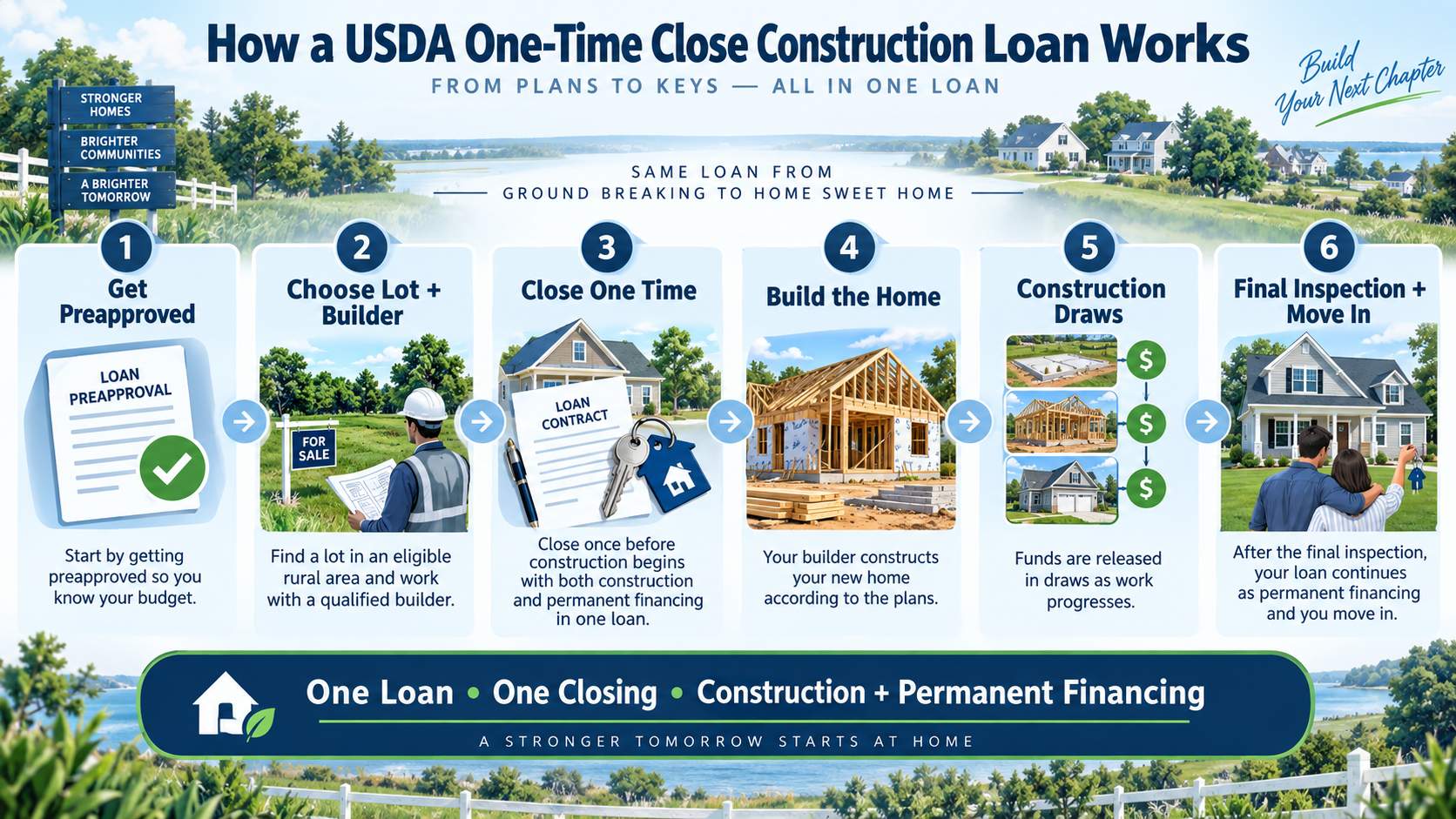
That timing matters more than it sounds. Because the guarantee is in place from day one, the lender is protected during construction, the builder does not have to fund the build out of their own line of credit, and the real estate agent is paid at closing rather than months later.
The lender, or a construction management company it hires, oversees the draws and keeps the documentation showing each phase was completed. When the home is finished, the lender collects the appraiser’s final inspection, the certificate of occupancy, a final title policy and the builder’s warranty to close out the construction phase.
Source: USDA Rural Development, Single-Close Construction lender training, January 2026, and the USDA lender training library.
Do You Make Mortgage Payments During Construction?
Usually not out of pocket. As of October 2026, USDA allows up to 12 months of loan payments to be reserved from the loan itself and paid during construction, so most buyers are not paying rent and a new mortgage at the same time. Whether the reserve covers full payments or interest only depends on the lender’s version.
| Feature | Securitized version | Interest-only version |
|---|---|---|
| Payments during construction | Full principal, interest, taxes and insurance (PITI) | Interest on the amount drawn so far |
| Who pays them | Paid from a reserve funded by the loan, up to 12 months | From a reserve (up to 12 months) or by the borrower |
| When the house is finished | No loan modification needed; payments continue | Loan is modified and re-amortized; the permanent rate may be lowered |
| Leftover reserves | Applied to reduce the principal balance | |
USDA program rules as of October 2026 (HB-1-3555, Chapter 12, Section 6). Which version a lender offers is the lender’s choice.
If the build runs longer than the reserve covers, payments for the remaining months come from you, so a realistic builder schedule matters. We review the timeline with you and your builder before closing.
How Does the Interest Rate Work on a USDA Construction Loan?
The permanent loan is a 30-year fixed rate, and the construction-period rate must also be fixed – adjustable rates during construction are not allowed, as of October 2026. The construction rate can be higher than the permanent rate, and on the interest-only version the permanent rate may be lowered when the loan is modified.
Rate locks on construction loans work differently from a standard purchase, because months can pass between closing and move-in. How long a rate can be locked, and whether any protection applies if rates move during the build, are set by the lender and can change. We explain the current terms in writing before you commit, and rates change daily, so call for a current quote rather than relying on any rate you read online.
Who Qualifies for a USDA One-Time Close Construction Loan in Delaware?
You can qualify if your household income is within USDA’s limit for the county, the lot is in a USDA-eligible area, and the home will be your primary residence. USDA itself sets no minimum credit score as of October 2026; lenders set their own, and construction loans are often held to a higher standard.
- Household income: at or below USDA’s limit for the county and household size – up to 115% of the area median. Current Delaware limits by county are on our USDA rural housing loans page.
- Location: the lot must be in a USDA-eligible area. Check the address on the official USDA eligibility site before you buy land.
- Occupancy: the finished home must be your primary residence.
- Citizenship: you must be a U.S. citizen, U.S. non-citizen national, or qualified alien.
- Credit: most lenders look for a 620 minimum credit score for USDA loans, and files at 640 and above generally move through USDA’s automated underwriting system. Construction loans can carry a higher lender minimum, so we confirm the current requirement for your file.
- No owner-builders: you cannot build the home yourself, and a contractor cannot use this program to build their own residence.
What Costs Can a USDA Construction Loan Cover?
The loan can cover the lot or the payoff on land you own, the builder’s contract, work outside it such as a well, septic system, driveway and landscaping, and soft costs like permits and surveys. As of October 2026 it can also include a contingency of up to 10% of construction costs and up to 12 months of payment reserves.
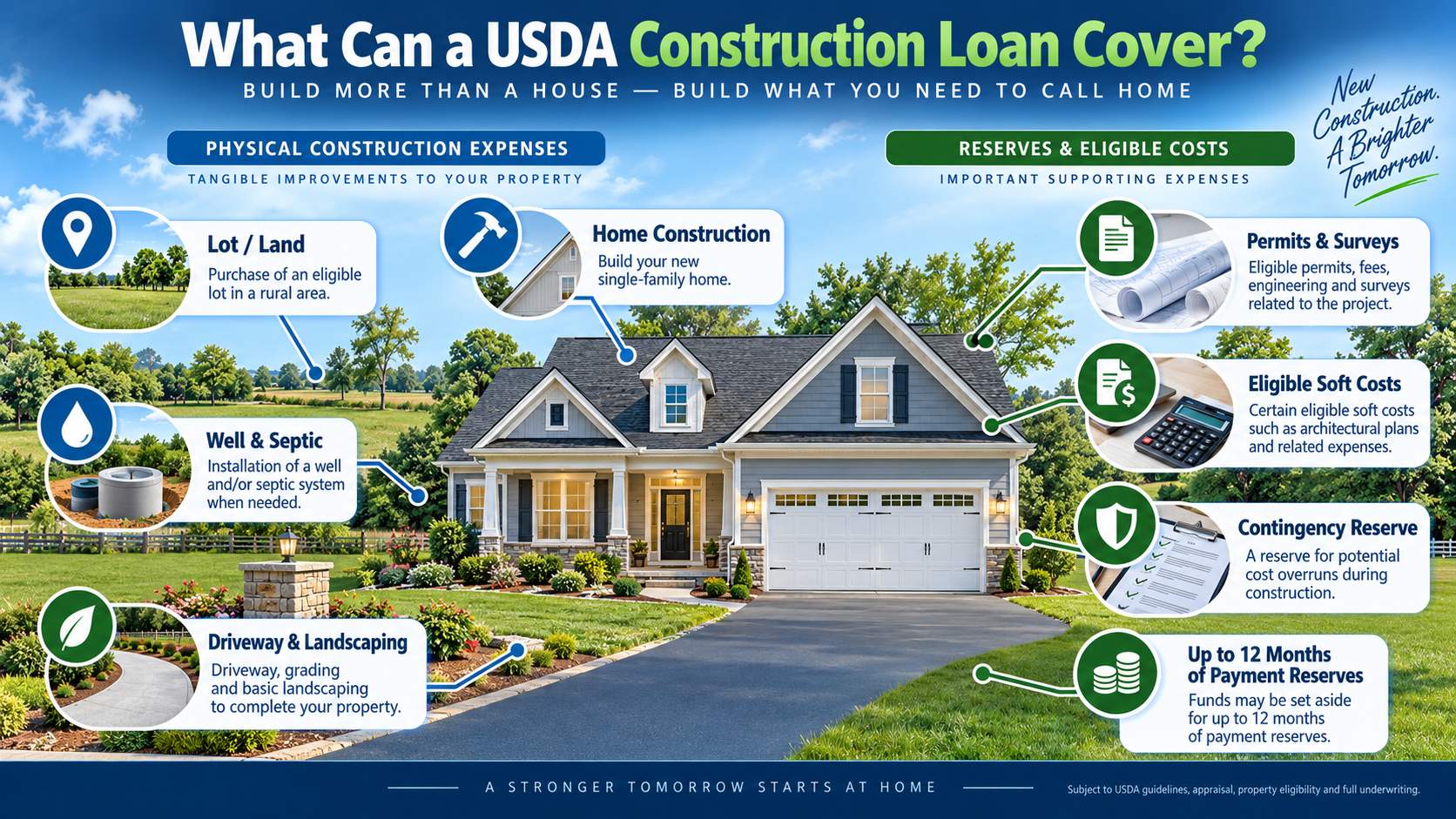
- Land: purchase of the lot, or payoff of the balance on a lot you already own
- Hard costs: everything in the construction contract and budget
- Costs outside the contract: well and septic installation, roads and driveways, landscaping
- Soft costs: inspection and survey fees, permits, lender administration fees
- Contingency reserve: optional, up to 10% of the cost of construction, for overruns or change orders
- Payment reserve: up to 12 months of payments during construction
The appraiser is given all of these costs, and the appraised value of the finished home – land, construction and reserves together – sets the ceiling for the loan.
What Are the Builder Requirements for a USDA Construction Loan?
As of October 2026, the builder needs at least two years of single-family building experience, a state-issued contractor license where state or local law requires one, and at least $500,000 of commercial general liability insurance. The lender verifies all three and the build must use a fixed-price construction contract.
A fixed-price contract can still include an approved contingency. If you already have a builder in mind, send us their details early – confirming a builder’s eligibility is one of the first things we do, and it is much easier before you sign a contract than after.
What Kind of Home Can You Build With a USDA Construction Loan?
You can build a site-built home, a modular home, which USDA treats the same as site-built, or a new manufactured home placed on a permanent foundation. As of October 2026, a manufactured home must be a new unit bought from a dealer, less than 12 months old at closing, and at least 400 square feet.
- Site-built single-family homes
- Modular homes (treated the same as site-built)
- New manufactured homes: never installed or occupied anywhere else, at least 400 square feet, on a permanent foundation, meeting federal manufactured-home standards for the area, and titled and taxed as real estate together with the land
Manufactured homes come with extra paperwork – an itemized dealer cost breakdown, a foundation plan, site plans and a contractor certification that the sections were properly joined. For the full rules, see our USDA manufactured home loans and Delaware manufactured home loans pages.
How Much Can You Borrow With a USDA Construction Loan?
As of October 2026, the loan can go up to the appraised value of the finished home, including the land, construction costs and reserves, with USDA’s upfront guarantee fee financed on top. There is no down payment and no set USDA loan limit; your household income limit and debt-to-income ratio set the practical ceiling.
A hypothetical example (not a real client)
Say a buyer finds a USDA-eligible lot in Sussex County for $60,000. The builder’s fixed-price contract is $250,000, the well, septic and driveway outside the contract add $25,000, and soft costs come to $8,000. A 10% contingency on construction adds about $28,300, and six months of payment reserves are included.
If the appraiser values the finished home – land, construction and reserves – at or above that total, the whole package can be financed with no down payment, and the upfront guarantee fee can usually be added on top. If the appraisal comes in lower, the buyer would need to trim the plans, negotiate the contract or bring the difference to closing.
Figures are illustrative only. Your loan amount depends on the appraisal, USDA income limits, your debt-to-income ratio and full underwriting.
What Are the Steps to Build With a USDA One-Time Close Loan?
Get preapproved, confirm the lot is USDA-eligible, choose an eligible builder, sign a fixed-price contract and get an appraisal based on the plans. You then close once, the builder draws funds as each phase is inspected, and after the final inspection and certificate of occupancy, you move in.
- Get preapproved. We review income, credit and USDA household income limits first.
- Confirm the lot. Check the address on the USDA eligibility site before you buy land.
- Choose an eligible builder. We verify experience, licensing and insurance.
- Sign a fixed-price contract. With plans, specifications and a detailed budget.
- Appraisal. The appraiser values the finished home from the plans and full cost breakdown.
- Close once. USDA issues its guarantee after closing; land and closing costs are paid.
- Build. Draws are released as each phase is completed and inspected; payments come from the reserve.
- Final inspection. Certificate of occupancy, final appraisal inspection and final title.
- Move in. Leftover reserves reduce your principal; on the interest-only version the loan is re-amortized.
What Happens If Construction Costs Change?
The contingency reserve covers overruns and approved change orders first. Change orders must be approved by the lender and cannot change the scope of the project or its appraised value, and any cost beyond the available loan funds is the borrower’s responsibility, as of October 2026.
There is a protection worth knowing about. If something happens to the buyer during construction – a job loss, for example – USDA’s rules keep the lender responsible for working with the builder to finish the home. And when construction wraps up, unused contingency money can go toward an eligible loan purpose or be applied to reduce your principal balance.
How Does USDA Compare to FHA, VA and Conventional One-Time Close Loans?
USDA is the only one of the four that pairs no down payment with no military-service requirement, but the lot must be in a USDA-eligible area and household income must be within the county limit. FHA works anywhere with a low down payment, VA is for eligible veterans, and conventional follows standard credit rules.
| One-time close loan | Down payment | Where you can build | Income limit | Often the better fit when… |
|---|---|---|---|---|
| USDA | None | USDA-eligible areas only | Yes, by county | The lot is eligible and household income is within the limit |
| FHA | 3.5% minimum for most buyers | Anywhere | No | The lot is outside USDA areas or income is over the limit |
| VA | None for eligible veterans | Anywhere | No | You are a VA-eligible veteran or service member |
| Conventional | Conventional rules | Anywhere | No | You have stronger credit or a larger budget |
Each has its own guide: the FHA one-time close construction loan, the VA one-time close construction loan and the conventional one-time close construction loan.
Building With a USDA Construction Loan in Delaware and Maryland
Most USDA-eligible land in Delaware is in Kent County, Sussex County and the rural or suburban edges of New Castle County. Communities in and around Dover, Milford, Harrington, Felton, Camden-Wyoming, Georgetown, Seaford, Laurel, Millsboro and Townsend often include eligible parcels, but eligibility is decided address by address. Buyers in Kent County can start with our Dover Delaware mortgage loans and Milford Delaware mortgage loans pages.
Two changes catch buyers off guard. Middletown lost USDA eligibility on June 4, 2018, and Smyrna lost it for closings on and after October 1, 2023, yet older listings still describe both as USDA towns. If you are looking at land in or near Middletown or Smyrna, check the exact address before you buy. We also lend in Maryland, where the same address-level check applies.
In my experience, two questions decide whether a USDA build can even start: is the lot in an eligible area, and does the builder meet USDA’s requirements? I ask both on the first call, before anyone spends money on plans or a land contract, because a no on either one changes which loan we should be talking about.
When Is a USDA Construction Loan Not a Good Fit?
It is usually not the right loan if the lot is outside a USDA-eligible area, your household income is over the county limit, you want to build the home yourself, the home will be a second home or rental, or your builder cannot meet USDA’s experience, licensing and insurance requirements. Each points to a different construction loan.
- The lot is not USDA-eligible. The FHA one-time close loan works anywhere with a low down payment.
- Your household income is over the USDA limit. FHA and conventional construction loans have no income cap.
- You want to act as your own builder. USDA does not allow owner-builders.
- It is a second home or investment property. USDA is for primary residences only.
- The house already exists and needs work. Look at a USDA renovation loan instead.
- Your builder is new or uninsured. USDA requires at least two years of experience and liability coverage.
USDA Construction Loan FAQ
Can I build a house with no down payment using a USDA loan?
Yes, for eligible buyers. A USDA one-time close construction loan can finance the lot, the construction, eligible costs outside the contract and reserves up to the appraised value of the finished home, with no down payment. You must meet USDA income limits, the lot must be in a USDA-eligible area, and the home must be your primary residence.
Can I use land I already own for a USDA construction loan?
Yes. The loan can pay off the balance owed on a lot you already own, or the land can be part of the financing when you buy it. The lot still has to be in a USDA-eligible area, and its value is included in the appraisal of the finished home.
Do I have to pay rent and a mortgage at the same time while the house is built?
Usually not. USDA allows up to 12 months of loan payments to be reserved from the loan and paid during construction, as of October 2026. If construction runs longer than the reserve covers, the remaining payments come from you, which is why a realistic builder schedule matters.
What credit score do I need for a USDA construction loan in Delaware?
USDA does not set a minimum credit score; lenders set their own. Most lenders look for at least 620 for USDA loans, and files at 640 and above generally move through USDA’s automated underwriting system. Construction loans can carry a higher lender minimum, so we confirm the current requirement against your full file.
Can I be my own general contractor on a USDA construction loan?
No. USDA does not allow owner-builders, and a contractor cannot use this program to build their own residence. The home must be built by an eligible builder with at least two years of single-family experience, any license your state or locality requires, and at least $500,000 of commercial general liability insurance.
Does the interest rate change during construction?
The construction-period rate must be fixed under USDA rules, and adjustable rates are not allowed, as of October 2026. The construction rate can be higher than the permanent rate, and on the interest-only version the permanent rate may be lowered when the loan is modified. Lock terms are set by the lender, so ask for them in writing.
Can I build a manufactured home with a USDA construction loan?
Yes, if it meets USDA’s rules for new manufactured homes. The unit must be new, bought from a dealer, never installed anywhere else, less than 12 months old at closing and at least 400 square feet, and it must sit on a permanent foundation and be titled and taxed as real estate with the land.
What happens if my builder goes over budget?
The contingency reserve, up to 10% of construction costs, covers overruns and approved change orders first. Change orders need lender approval and cannot change the scope or appraised value. Costs beyond the available loan funds are the borrower’s responsibility, so a firm fixed-price contract is your best protection.
My household income is slightly over the USDA limit. What are my options?
USDA’s income limit is strict, so even slightly over the county limit does not qualify. FHA and conventional one-time close construction loans have no household income cap, so they are the usual next step. Each has its own down payment and credit rules, which we can compare for your plans.
Can I build in Middletown or Smyrna with a USDA loan?
Usually not in town. Middletown lost USDA eligibility on June 4, 2018, and Smyrna lost it for closings on and after October 1, 2023, although some nearby rural addresses may still qualify. Check the exact lot address on the USDA eligibility site, or send it to us, before you buy land.

About John Thomas
Branch Manager & Division Vice President, John Thomas Team with AnnieMac Home Mortgage
I’m John Thomas, Branch Manager and Division Vice President with the John Thomas Team in Newark, Delaware. For more than 20 years I’ve helped Delaware and Maryland buyers finance homes, including new homes built from the ground up, and I’ve educated more than 3,000 buyers along the way.
On construction files, the conversation I have before anything is signed is about the timeline – matching the builder’s schedule to the payment reserve, so a buyer is not caught paying out of pocket in month thirteen. I hold a B.S. in Physics Education from the University of Delaware and an M.S. in Curriculum and Instruction from Delaware State University.
State licensing: Look up John R. Thomas, NMLS #38783, on NMLS Consumer Access.
Mortgage content reviewed by John R. Thomas, NMLS #38783. See more about John Thomas, Delaware Mortgage Loan Officer.
Years
Buyers Educated
Service Area
Certified Mortgage Planner
248 E Chestnut Hill Rd, Newark, DE 19713
Phone: 302-703-0727 | Email: team@johnthomasteam.com
John R. Thomas, NMLS #38783 | Schedule Appointment
See John Thomas Team on Google for reviews, directions, and local office information.
YouTube | Facebook | Instagram | TikTok | X / Twitter | LinkedIn
Ready to build in a USDA-eligible area?
Send us the lot address and your builder’s details. We will confirm USDA eligibility, check the builder requirements and map out the budget, reserves and timeline before you sign a contract.
Last Updated: October 2026 · John Thomas Team with AnnieMac Home Mortgage · Mortgage content reviewed by John R. Thomas, NMLS #38783. This page is educational and is not a commitment to lend; all loans are subject to borrower qualification, property eligibility and full underwriting review.
John R. Thomas, NMLS #38783 | John Thomas Team with AnnieMac Home Mortgage | AnnieMac Home Mortgage NMLS #338923 | 248 E Chestnut Hill Rd, Newark, DE 19713 | 302-703-0727 | delawaremortgageloans.net
AnnieMac Home Mortgage is an Equal Housing Lender. State licensing: Look up John R. Thomas, NMLS #38783, on NMLS Consumer Access.
(c) Copyright John R. Thomas, All Rights Reserved.
