Delaware Bridge Loan HELOC: Buy Your Next Home Before You Sell


Delaware bridge loan overview: A bridge loan HELOC lets you borrow against the home you live in now to buy your next home before it sells, with no home-sale contingency in your offer. It needs a 680 credit score and up to 80% loan-to-value on the current home, and lines run from $50,000 to $1,000,000. Current as of November 2026.
You found the next house, but your money is tied up in the one you live in. Sellers don’t want a sale contingency, and you don’t want to move twice. I’m John Thomas, NMLS #38783, and from our Newark office I help Delaware homeowners use the equity in their current home to buy first and sell second. This page covers how a bridge loan HELOC works, what it costs and when a regular Delaware HELOC or a different plan fits better.
Buying before you sell?
Send me your current home’s rough value, your mortgage balance and the price range you’re shopping. I’ll show you the bridge line and both payments before you make an offer.
Table of Contents
What Is a Bridge Loan HELOC and How Does It Work?
A bridge loan HELOC is a line of credit secured by the home you live in now. You draw on it for the down payment and costs on your next home, then pay it off when the current home sells. It is interest-only during a 10-year draw period, with no prepayment penalty, as of November 2026.
The point is timing. Without a bridge, many buyers have to sell first and rent, or write an offer that depends on their home selling, which sellers often reject. With the line in place, you can make a non-contingent offer and sell on your own schedule. It works like any home equity line, as the Consumer Financial Protection Bureau describes, except that it is built for a home you plan to sell soon.
What Are the Bridge Loan HELOC Guidelines?
You need a 680 credit score, a primary residence that is a one-unit home, and enough equity to stay at or under 80% loan-to-value. Lines run from $50,000 to $1,000,000 depending on credit and equity, and debt-to-income is generally capped at 43%, as of November 2026.
| Guideline | Bridge loan HELOC |
|---|---|
| Minimum credit score | 680 |
| Line amount | $50,000 to $1,000,000 (first lien); up to $750,000 in second position (720 or higher, under 50% combined loan-to-value) |
| Maximum loan-to-value | 80% of the current home’s value (combined, if your mortgage stays) |
| Occupancy | Primary residence only, one unit |
| Lien position | First lien (pays off your mortgage) or second lien (keeps it) |
| Structure | Variable rate tied to prime; 10-year interest-only draw, 20-year repayment |
| Listed for sale | Allowed, not required |
| Debt-to-income | Generally 38% housing / 43% total debt |
| Credit history | No prior bankruptcy, foreclosure or short sale; no 30-day mortgage lates in 24 months |
| Prepayment penalty | None |
Self-employed borrowers qualify with two years of tax returns, or one year when the loan-to-value is under 65%. Borrowers must be U.S. citizens or permanent residents. If you bought the home within the last 6 months, the value used is the lower of the purchase price or the appraisal.
How Much Can You Borrow With a Bridge Loan HELOC?
You can borrow up to 80% of your current home’s value, minus any mortgage that stays in place. The maximum line depends on your score and loan-to-value: $1,000,000 needs a 720 score and under 50% loan-to-value on a first lien, as of November 2026.

| Credit score | Lien | Over 65% LTV | 50% to 65% LTV | Under 50% LTV |
|---|---|---|---|---|
| 720 or higher | First lien | $500,000 | $750,000 | $1,000,000 |
| 680 to 719 | First lien | $500,000 | $750,000 | $750,000 |
| 720 or higher | Second lien | $350,000 | $500,000 | $750,000 |
| 680 to 719 | Second lien | $350,000 | $500,000 | $500,000 |
Example: a $500,000 Delaware home with a $150,000 mortgage that stays in place. At 80%, total loans can reach $400,000, so the bridge line could be up to $250,000, within the $350,000 second-lien cap at that loan-to-value. If the mortgage were paid off with a first-lien bridge instead, the line could reach $400,000. This is an illustration; the appraisal, your income and the declining-market rules can lower it.
First Lien or Second Lien: Which Bridge Loan Fits?
Choose a second-lien bridge if your current mortgage has a low rate or a small balance and you want to keep it until the sale. Choose a first-lien bridge if you need a larger line, because it pays off the existing mortgage and allows up to $1,000,000 with a 720 score and under 50% loan-to-value.
- Second lien: your current mortgage stays; the bridge line sits behind it, up to $750,000 with a 720 or higher score and under 50% combined loan-to-value ($500,000 at 680 to 719), within 80% combined loan-to-value. You carry both payments until the home sells.
- First lien: the bridge pays off your current mortgage and becomes the only loan on the home, up to $1,000,000 with a 720 or higher score and under 50% loan-to-value. Title insurance is required.
- Either way: the line is secured only by the home you are selling, and no lien goes on the home you buy.
How Does a Bridge Loan Help You Buy Before You Sell in Delaware?
You use the bridge line for the down payment and closing costs on the new home, buy it with a regular purchase mortgage, move in, then sell your old home and pay off the bridge from the proceeds. Your offer can go in without a home-sale contingency.
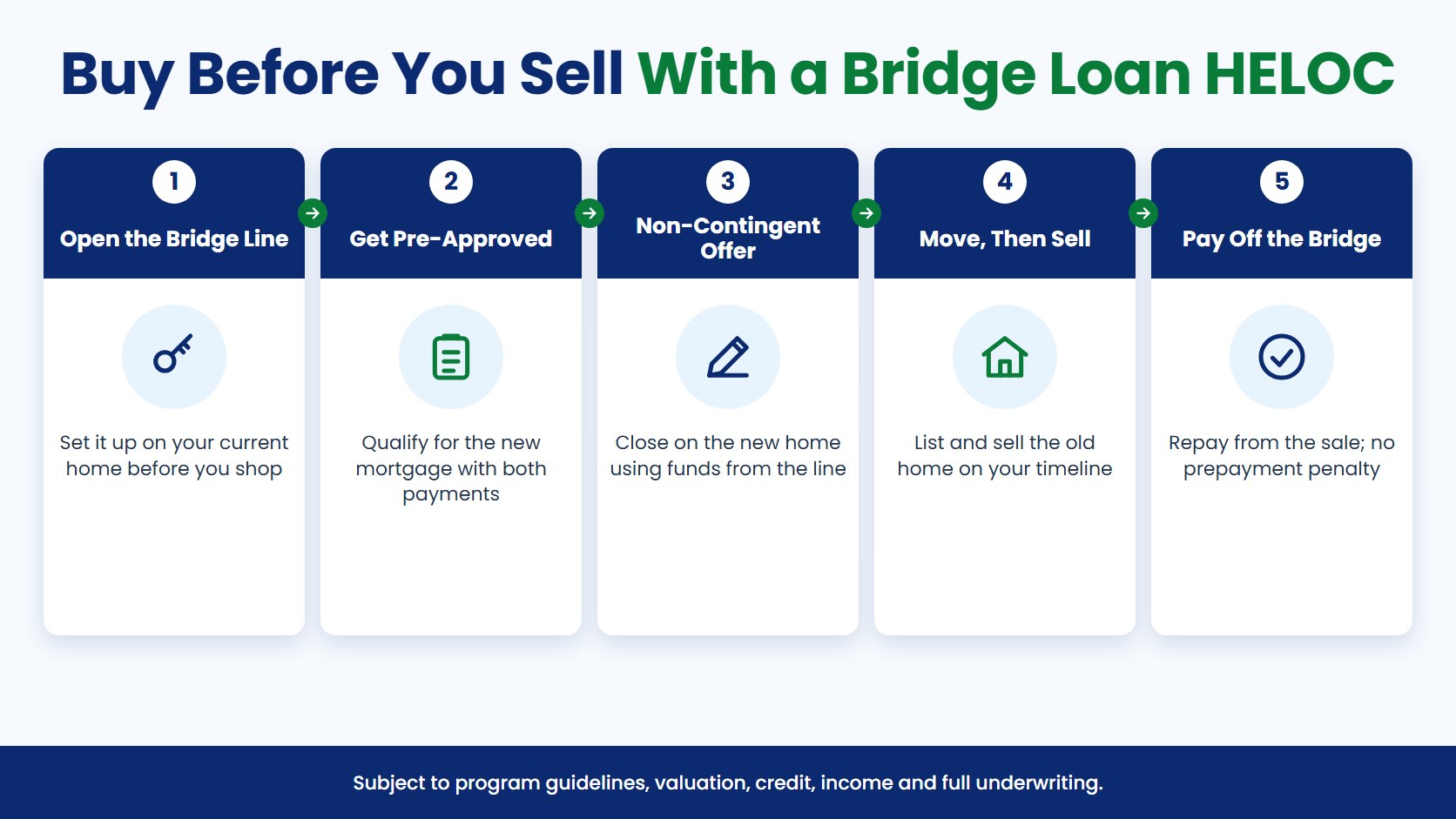
- Set up the bridge line on your current home before you shop, so the money is ready.
- Get pre-approved for the purchase mortgage on the new home; we qualify you with both payments, and it follows the normal loan limits (see the FHFA 2026 conforming loan limits).
- Make a non-contingent offer and close on the new home using funds from the line.
- Move, then list and sell the old home on your timeline (it can already be listed).
- Pay off the bridge from the sale; there is no prepayment penalty.
What I map out before a bridge offer
Most buyers I work with on a bridge loan focus on the down payment and forget the carrying cost. Before the offer goes in, I lay out three payments side by side: the current mortgage, the bridge line and the new mortgage, plus how many months that can run if the house takes longer to sell than planned. That number decides whether a bridge is the right tool.
Shopping across Delaware? Our Delaware mortgage service areas guide covers county loan limits and transfer tax by town, which matter when you budget both closings.
What Does a Bridge Loan HELOC Cost?
A bridge loan HELOC costs interest on what you draw plus an origination fee, title, the valuation and a monthly bridge servicing fee until the line is paid off and closed. There is no prepayment penalty, so selling quickly keeps the total cost down, as of November 2026.
- Rate: the prime rate (published in the Federal Reserve H.15 release) plus a margin, with a minimum rate floor. We don’t post rates here; call for a quote on your numbers.
- Valuation: automated valuation on lines under $400,000; full appraisal above that.
- Monthly servicing fee: charged each month until the bridge is paid off and closed.
- Right to cancel: on your primary residence you have 3 business days after signing (Regulation Z, 12 CFR 1026.23).
Which Properties Are Eligible for a Bridge Loan HELOC?
The home you borrow against must be a one-unit primary residence: a single-family home, a townhome, a PUD or a warrantable condo. Two- to four-unit homes, second homes and investment properties are not eligible, and the home can already be listed for sale.

How Do You Apply for a Bridge Loan HELOC?
Start with a call and a soft-pull pre-qualification. Then apply, send your income documents and mortgage statement, have the current home valued and close on the bridge line before you write your offer, so the funds are ready when you need them.
- Run the numbers. Call 302-703-0727 or book 30 minutes; we look at value, balance, credit and the price range.
- Apply and send documents. Pay stubs and W-2s or tax returns, your mortgage statement, insurance and ID.
- Valuation. Automated valuation under $400,000, full appraisal above.
- Close the bridge line. After the 3-day right to cancel, the line is open.
- Buy, move, sell, pay off. Use the funds for the new home and pay the bridge off from the sale.
When Is a Bridge Loan HELOC Not a Good Fit?
A bridge loan is usually not the right fit if your income can’t carry two housing payments for several months, if the home you are selling is a rental or second home, or if you have had a bankruptcy or foreclosure. Another plan often works better.
- You aren’t moving: a regular Delaware HELOC costs less and has no monthly bridge fee.
- You want to replace your mortgage anyway: compare a cash-out refinance on Delaware conventional loans.
- Your score is just under 680: it can pay to wait and raise it; see the five factors of credit scoring.
- Your debt-to-income is tight: read how lenders count it in debt-to-income ratio.
Bridge Loan HELOC FAQ
What credit score do I need for a bridge loan HELOC?
680 is the minimum. With 680 to 719 a first-lien line tops out at $750,000 (a second-lien line at $500,000), and a 720 or higher score opens the first-lien line up to $1,000,000 when the loan-to-value is under 50%. Any prior bankruptcy or foreclosure makes the program unavailable.
Can I keep my current mortgage and still get a bridge loan?
Yes. The bridge line can sit in second position behind your current first mortgage, up to $750,000 with a 720 or higher score and under 50% combined loan-to-value ($500,000 at 680 to 719), within 80% combined loan-to-value. Or it can be a first lien that pays off your current mortgage, which allows up to $1,000,000 with a 720 or higher score and under 50% loan-to-value.
Can my house be listed for sale when I apply?
Yes. The home you are borrowing against can already be listed on the MLS, and it does not have to be. It must be your primary residence and a one-unit home.
Does the bridge loan put a lien on the home I’m buying?
No. The bridge loan is secured only by your current home. The home you buy is financed with its own purchase mortgage, so the bridge does not touch it.
How long is the bridge loan term?
It is a line of credit with a 10-year draw period and a 20-year repayment period, with interest-only payments during the draw. In practice most homeowners pay it off when the current home sells, and there is no prepayment penalty.
Is there a monthly fee on a bridge loan HELOC?
Yes. There is a monthly bridge servicing fee until the line is paid off and closed, plus closing costs such as an origination fee, title insurance and the valuation. Paying it off quickly when your home sells keeps the total cost down.
Will I have to qualify with both mortgage payments?
Usually yes. Underwriting counts your current housing payment, the bridge line and the new mortgage, typically up to a 43% debt-to-income ratio. That is why a bridge loan works best with strong income or a home that is likely to sell quickly.
Can I use a bridge loan HELOC on a rental or a second home?
No. The home you borrow against must be your primary residence and a single unit. Second homes, investment properties and 2 to 4 unit homes are not eligible on this program.
Can I use bridge funds for my earnest money deposit?
Yes, once the line is open you can draw for the deposit and the cash to close. On a primary residence the line opens only after the 3-business-day right to cancel, so set it up before you make your offer.
What if my current home doesn’t sell?
The line stays open, so you are not forced to sell at a deadline, but you keep paying interest and the monthly servicing fee. Before you make an offer, we look at what both payments look like if the sale takes longer than you plan.

John R. Thomas is Branch Manager and Division Vice President with the John Thomas Team in Newark, Delaware, and has helped more than 3,000 Delaware and Maryland families finance a home over 20+ years, including move-up and downsizing buyers who bought before they sold. On a bridge loan he starts with the carrying cost: what all three payments look like if the old home takes longer to sell than planned.
He holds a BS in Physics Education from the University of Delaware and an MS in Curriculum and Instruction from Delaware State University, and is the author of Your Guide to Buying Your First Home in Delaware. State licensing: Look up John R. Thomas, NMLS #38783, on NMLS Consumer Access. Read more on his loan officer bio page.
Years 3,000+
Buyers Helped DE & MD
Service Area CMP
Certified Mortgage Planner
John Thomas Team with AnnieMac Home Mortgage
248 E Chestnut Hill Rd, Newark, DE 19713 | 302-703-0727 | team@johnthomasteam.com
Schedule Appointment (30 min)
See John Thomas Team on Google for reviews, directions, and local office information.
YouTube | Facebook | Instagram | TikTok | X / Twitter | LinkedIn

Make your offer without a sale contingency
One call shows you the bridge line, the monthly cost and both payments before you write an offer.
Last Updated: November 2026 · John Thomas Team with AnnieMac Home Mortgage · Mortgage content reviewed by John R. Thomas, NMLS #38783.
John R. Thomas, NMLS #38783 | John Thomas Team with AnnieMac Home Mortgage | AnnieMac Home Mortgage NMLS #338923 | 248 E Chestnut Hill Rd, Newark, DE 19713 | 302-703-0727 | delawaremortgageloans.net
AnnieMac Home Mortgage is an Equal Housing Lender. State licensing: Look up John R. Thomas, NMLS #38783, on NMLS Consumer Access.
(c) Copyright John R. Thomas, All Rights Reserved.
