Delaware USDA Rural Housing Loans: 100% Financing, Income Limits & How to Qualify in 2026
Delaware USDA Rural Housing Loans are 100% financing, zero-down-payment government-guaranteed mortgages for buyers purchasing a primary residence in a USDA-eligible area of Delaware who meet the program’s county income limits. There is no down payment and no loan limit; eligibility is set by household income (up to 115% of the area median) and the property’s location. Current as of June 2026 – income limits and eligible areas change, so confirm both before you write an offer.
I’m John Thomas, NMLS #38783, and I’ve been helping Delaware buyers use USDA Rural Housing financing from the John Thomas Team office at 248 E Chestnut Hill Rd in Newark for more than 20 years. The USDA loan is one of only two true zero-down options in Delaware – the other is the Delaware VA loan for eligible veterans. If you are not a veteran and you want to buy with no money down, a USDA loan is usually the path. The catch is two restrictions most buyers do not expect: the home has to sit in a USDA-eligible area, and your household income has to fall under the county limit. Both are easy to check up front, and that is where I start every USDA conversation.
See if Your Delaware Home Qualifies for 100% USDA Financing
A quick call confirms your income eligibility and whether the address is in a USDA-eligible area – before you fall in love with a house.
Table of Contents
USDA’s two filters – location and income – confuse a lot of buyers, so we make it simple. Before anything else, we run three quick checks:
- Address check. We confirm whether the exact Delaware property is in a USDA-eligible area.
- Income check. We compare your total household income to the limit for your county and household size.
- Payment check. We estimate your full payment – principal, interest, taxes, insurance, and the USDA annual fee – so you know the real number.
What Is a Delaware USDA Rural Housing Loan?
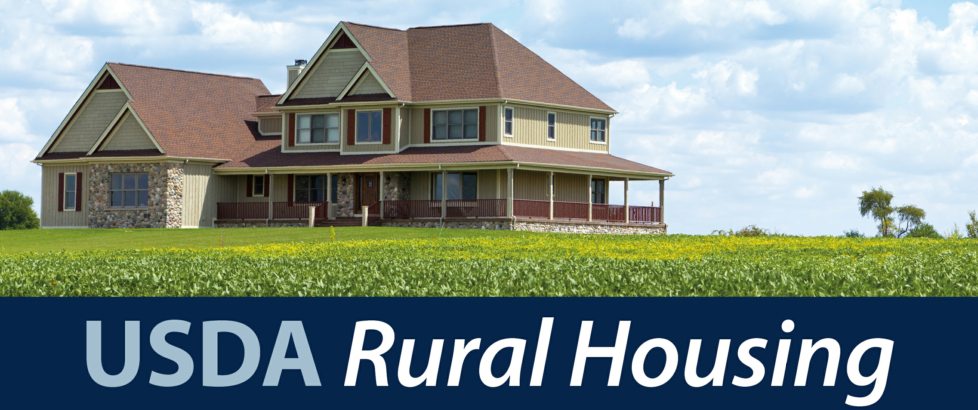
The USDA Rural Housing loan is a Section 502 Guaranteed mortgage made by an approved private lender like the John Thomas Team and backed by the U.S. Department of Agriculture’s Rural Development agency. Because the federal government guarantees the loan against default, lenders can offer 100% financing with no down payment for buyers who would otherwise have a hard time saving for one. A common misconception is that USDA loans are only for farmers – they are not. The program is designed to promote homeownership for low-to-moderate-income buyers in rural and many suburban areas, and in Delaware a surprising number of suburban communities qualify.
The USDA loan lets the lender finance up to the home’s appraised value, and because the program charges a 1% upfront guarantee fee that is usually rolled into the loan, the financed amount can reach roughly 101% of the value. If the home appraises for more than the purchase price, eligible closing costs may be financed into the loan as well. There are no loan limits on the Guaranteed program – your borrowing power is capped by your income and the appraised value, not a county dollar limit.
What Are the Benefits of a Delaware USDA Loan?
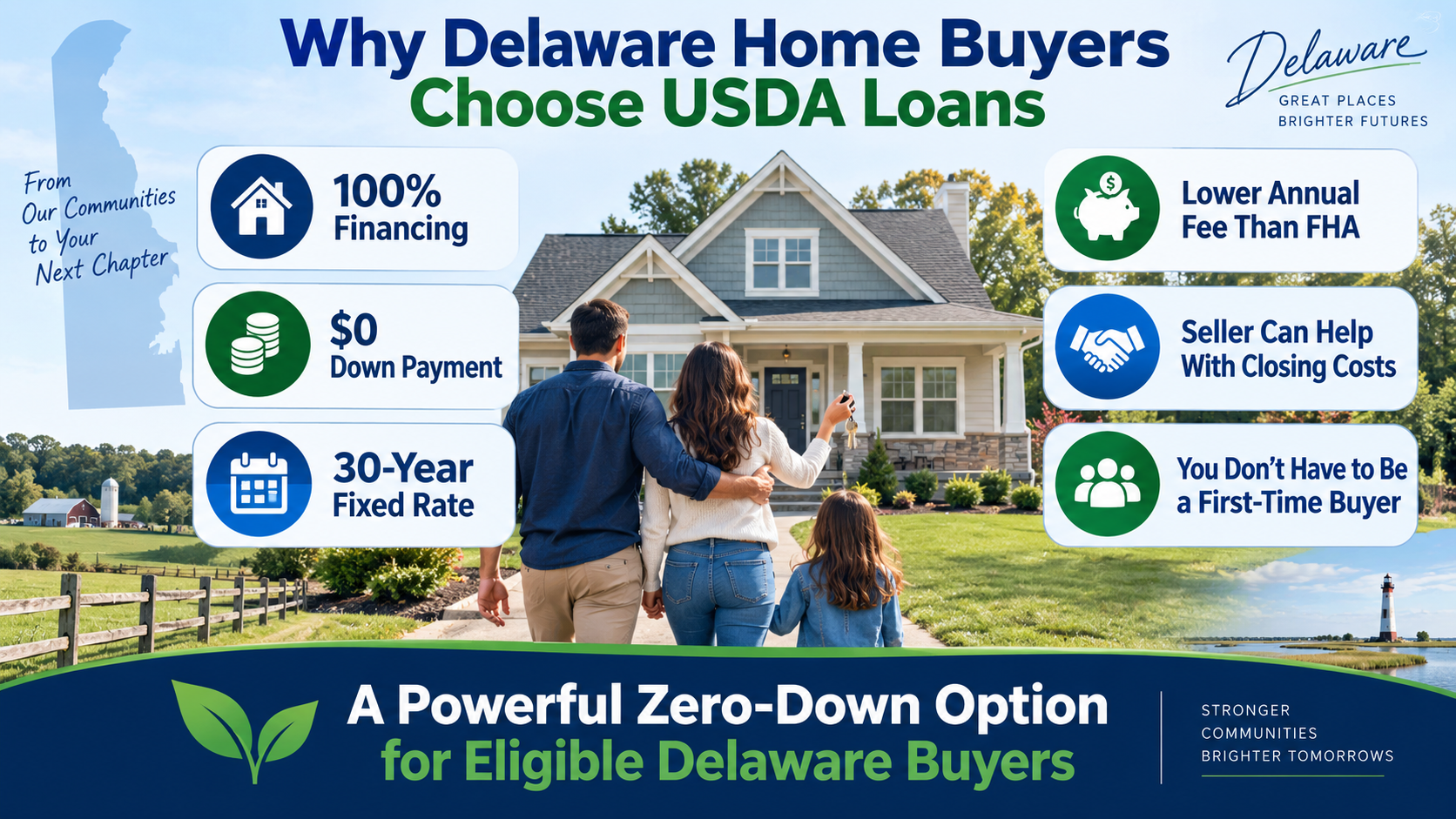
For buyers who meet the income and property-location rules, the Delaware USDA loan is one of the most affordable ways to buy a home. The most common advantages buyers value are:
- 100% financing with no down payment required (closing costs and fees may still apply)
- You do not have to be a first-time home buyer to use a USDA loan
- 30-year fixed-rate loan with competitive interest rates and no prepayment penalty
- No loan limit on the Guaranteed program – capped by income and appraised value, not a county dollar limit
- Lower monthly mortgage insurance (0.35% annual fee) than a comparable FHA loan
- Seller may contribute up to 6% of the purchase price toward your closing costs
- Gift funds are allowed for closing costs
- No cash reserves required for most approvals
- Closing costs may be financed into the loan if the home appraises higher than the purchase price
- Primary residences only – no rentals or investment properties
If you are weighing USDA against other low-down-payment options, it pairs naturally with the rest of the cluster – see Delaware FHA loans (3.5% down) and Delaware conventional loans (as little as 3% down) for comparison. Buyers who fall just outside the USDA income limit or eligible-area map can also look at Delaware down payment assistance programs, including the DSHA Welcome Home first mortgage.
What Are the USDA Loan Requirements in Delaware?
Below are the general guidelines most Delaware buyers need to meet for a USDA Guaranteed loan. These are program guidelines, not guarantees of approval – your full borrower profile determines your individual result, so use these as a starting point and confirm your scenario with us.
- Credit score: Most USDA approvals start at a 620 minimum credit score; buyers at 640 and above generally receive a more streamlined automated approval through USDA’s GUS system. Scores below that range may still be considered with additional documentation depending on the overall profile.
- Housing ratio: Your monthly housing payment (principal, interest, property taxes, and homeowners insurance) is generally guided toward about 29% of gross monthly income.
- Total debt ratio: Total monthly debt is generally guided toward about 41% of gross monthly income. Higher ratios may be approved with compensating factors such as reserves or a documented rent history equal to the new payment.
- Income limit: Household income generally must be at or below 115% of the area median income for the county, based on household size (see the income section below).
- Bankruptcy: Buyers who have been discharged from a Chapter 7 bankruptcy for three years or more may be eligible, depending on re-established credit.
- Property location: The home must be in a USDA-eligible area, which is generally open country or a community under the program’s population threshold.
- Occupancy: The home must be your primary residence; you must have enough income to afford the payment including taxes and insurance.
What Property Types and Borrowers Qualify for a Delaware USDA Loan?
USDA loans are for owner-occupied primary residences. Eligible property types in Delaware generally include single-family homes, townhomes and rowhomes, and warrantable condominiums in approved projects. Eligible new USDA manufactured home loans are also available under stricter program rules. Investment properties, second homes, and income-producing properties are not eligible.
USDA also offers programs beyond a standard purchase loan. A USDA renovation loan lets you buy and repair a home in a single loan, and a USDA one-time-close construction loan lets you build a new home with one closing – both keeping the zero-down advantage when you and the property qualify.
On the borrower side, USDA requires that you be a U.S. citizen, U.S. non-citizen national, or qualified alien, that you intend to occupy the home as your primary residence, and that you meet the program’s credit and income guidelines. Most lenders look for a 620 minimum credit score; at 640 and above, your file generally qualifies for USDA’s automated underwriting system (GUS), which produces a faster, more streamlined approval. Files below 640 can still be considered but usually require manual underwriting, where strong compensating factors – a clean recent rent or housing payment history, a low overall debt-to-income ratio, and cash reserves left after closing – help support the approval.
There are two USDA Section 502 programs, and they are not the same:
- USDA Guaranteed – made by an approved private lender like the John Thomas Team and backed by USDA. It is for low-to-moderate-income buyers (up to 115% of area median income) and is the program nearly every buyer on this page uses.
- USDA Direct – made directly by USDA for very-low- and low-income households, with its own lower income limits, area loan limits, and application process handled through Rural Development, not through a private lender.
Source: USDA Rural Development. This page covers the Guaranteed program.
How Do You Check if a Delaware Property Is USDA-Eligible?
USDA eligibility is determined property-by-property, not by zip code, and the boundaries shift over time. You can check any Delaware address on the USDA’s official eligibility tool at eligibility.sc.egov.usda.gov. Enter the street address and the map shows whether that exact parcel is in an eligible area. Because the line can run right through a neighborhood, always verify the specific address before you write an offer – never assume a home qualifies based on the town alone.
Delaware USDA Eligible Property Areas by County
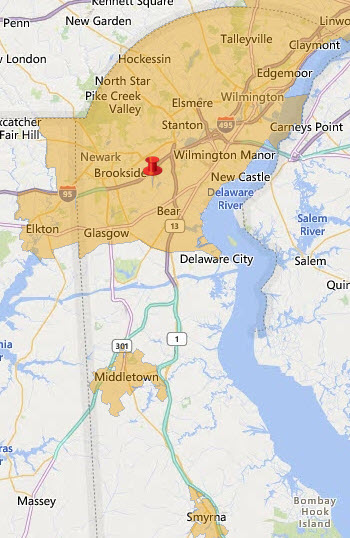
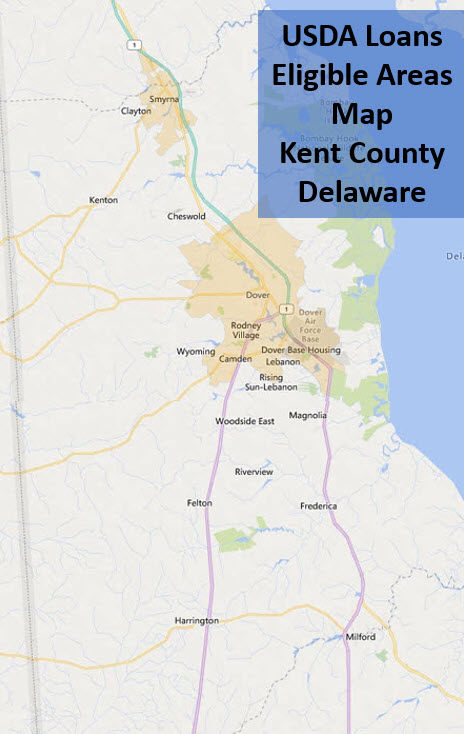
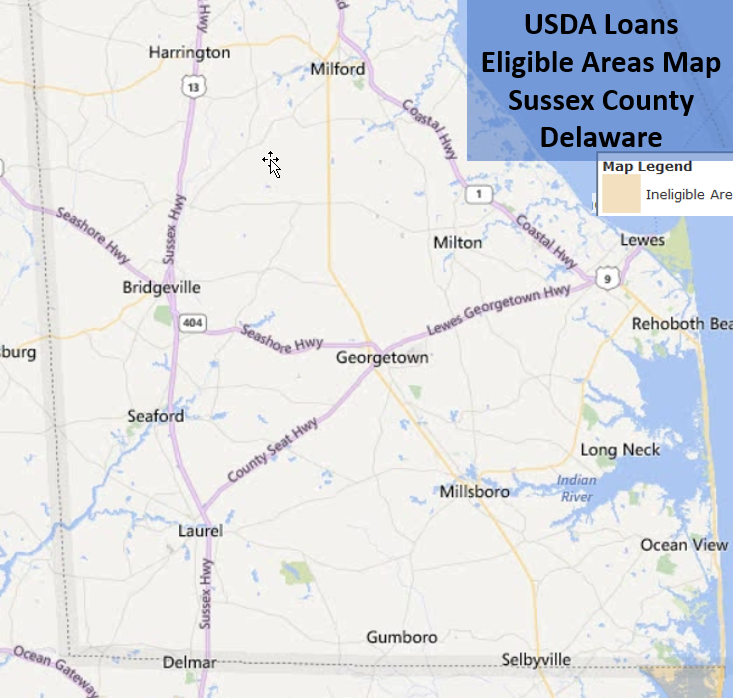
The maps below show the general USDA-eligible areas in each Delaware county. They are illustrative – shaded areas are not eligible – and eligibility maps are updated periodically, so always confirm the exact address on the USDA tool above before relying on them.
New Castle County USDA Eligible Areas
Kent County USDA Eligible Areas
Sussex County USDA Eligible Areas
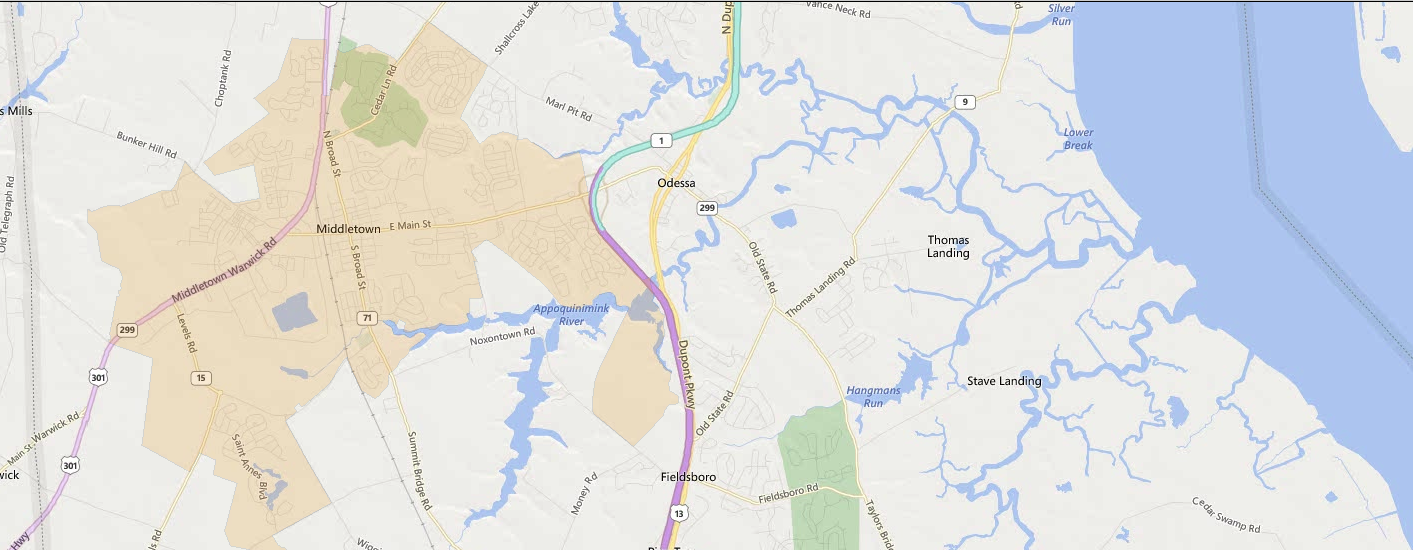
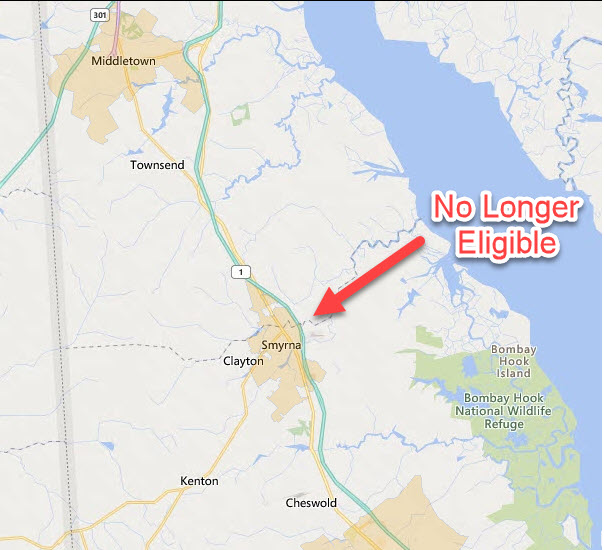
Two Delaware eligibility changes are worth knowing because they catch buyers off guard. Middletown, Delaware lost USDA eligibility on June 4, 2018, and Smyrna, Delaware lost eligibility for closings on and after October 1, 2023. Both were popular USDA towns for years, so older online guides and listings still describe them as eligible when they are not. If you are buying in or near Middletown or Smyrna, run the address through the USDA map first – some surrounding parcels outside the town boundary may still qualify.
Best Delaware Areas to Check First
Most Delaware USDA buyers start their search in Kent County, Sussex County, and the rural or suburban edges of New Castle County. Communities in and around Dover, Milford, Harrington, Felton, Camden-Wyoming, Georgetown, Seaford, Laurel, Millsboro, Townsend, and similar areas often include USDA-eligible parcels. Middletown and Smyrna need extra caution because many properties that used to qualify no longer do. None of this is a guarantee – USDA eligibility is decided parcel by parcel, so always confirm the exact address on the USDA tool before you write an offer.
Source: USDA Rural Development. The county maps above are illustrative; viewing the map is not a final eligibility determination until Rural Development reviews a complete application.
What Are the USDA Income Limits in Delaware?
Current as of June 2026. USDA Guaranteed income limits are set by county and by household size, capped at 115% of the area median income, and structured in two tiers – one limit for households of 1 to 4 people and a higher limit for households of 5 to 8 people. New Castle County is part of the higher-income Philadelphia-Camden-Wilmington metro, so its limits run above the rest of the state. Kent and Sussex Counties use the standard national limits. Here are the 2026 limits for each Delaware county:
| Delaware County | 1-4 person household | 5-8 person household |
|---|---|---|
| New Castle County | $137,300 | $181,250 |
| Kent County | $119,850 | $158,250 |
| Sussex County | $119,850 | $158,250 |
USDA counts total household income from every adult member of the household when testing eligibility – not just the people on the loan – which is different from how the DSHA programs count income. There are deductions that can lower your counted income (for dependents, childcare, and certain elderly or disabled household members), so if your household income is close to the limit, the calculation matters. A quick review with us is the fastest way to know where you stand.
What Are the USDA Guarantee Fee and Annual Fee?
Current as of June 2026, the USDA Guaranteed program charges two fees in place of a down payment, and both are lower than comparable FHA mortgage insurance:
- Upfront guarantee fee – 1% of the loan amount. This is technically due at closing, but USDA lets you finance it into the loan instead. On a $250,000 loan that is about $2,500, so your total financed loan would be roughly $252,500.
- Annual fee – 0.35% of the loan balance per year, collected as part of your monthly payment (about $73 per month on a $250,000 loan). This is meaningfully lower than FHA’s 0.55% annual mortgage insurance and applies for the life of the loan.
Fee percentages are set by USDA and can change; the figures above are current as of June 2026. The lower annual fee is one of the biggest reasons a USDA payment can beat an FHA payment for an eligible buyer, even though both are low-down-payment government programs.
Say a buyer is purchasing a $300,000 home in a USDA-eligible part of Kent County. With USDA, the down payment can be $0. The 1% upfront guarantee fee would be about $3,000, which can be financed into the loan instead of paid at closing. Closing costs and prepaid items still apply, but a seller contribution (up to 6%), gift funds, or an appraisal above the purchase price can help cover some of them. Final approval still depends on credit, income, debt, the property, and USDA guidelines. This is an illustrative example only, not a loan offer or commitment.
How Do Delaware USDA Loans Compare to FHA, VA, and Conventional?
| Feature | USDA | FHA | VA | Conventional |
|---|---|---|---|---|
| Minimum down payment | 0% | 3.5% | 0% | 3% |
| Who it is for | Low-to-moderate income, eligible rural/suburban area | Most buyers, esp. lower credit | Eligible veterans & service members | Buyers with stronger credit/down payment |
| Income limit? | Yes – 115% of area median | No | No | No |
| Property-location limit? | Yes – USDA-eligible area only | No | No | No |
| Upfront fee | 1% guarantee fee | 1.75% MIP | VA funding fee (varies; waived for many disabled vets) | None |
| Annual / monthly MI | 0.35% | 0.55% (most loans) | None | PMI varies; cancels at 20% equity |
For most Delaware buyers who qualify on both income and location, USDA wins on monthly cost because of the zero down payment and the lower annual fee. The two filters – income and eligible area – are what send buyers to FHA or conventional instead. If you want to see your real monthly payment side by side, our guide to understanding your mortgage payment breaks down how principal, interest, taxes, and insurance fit together.
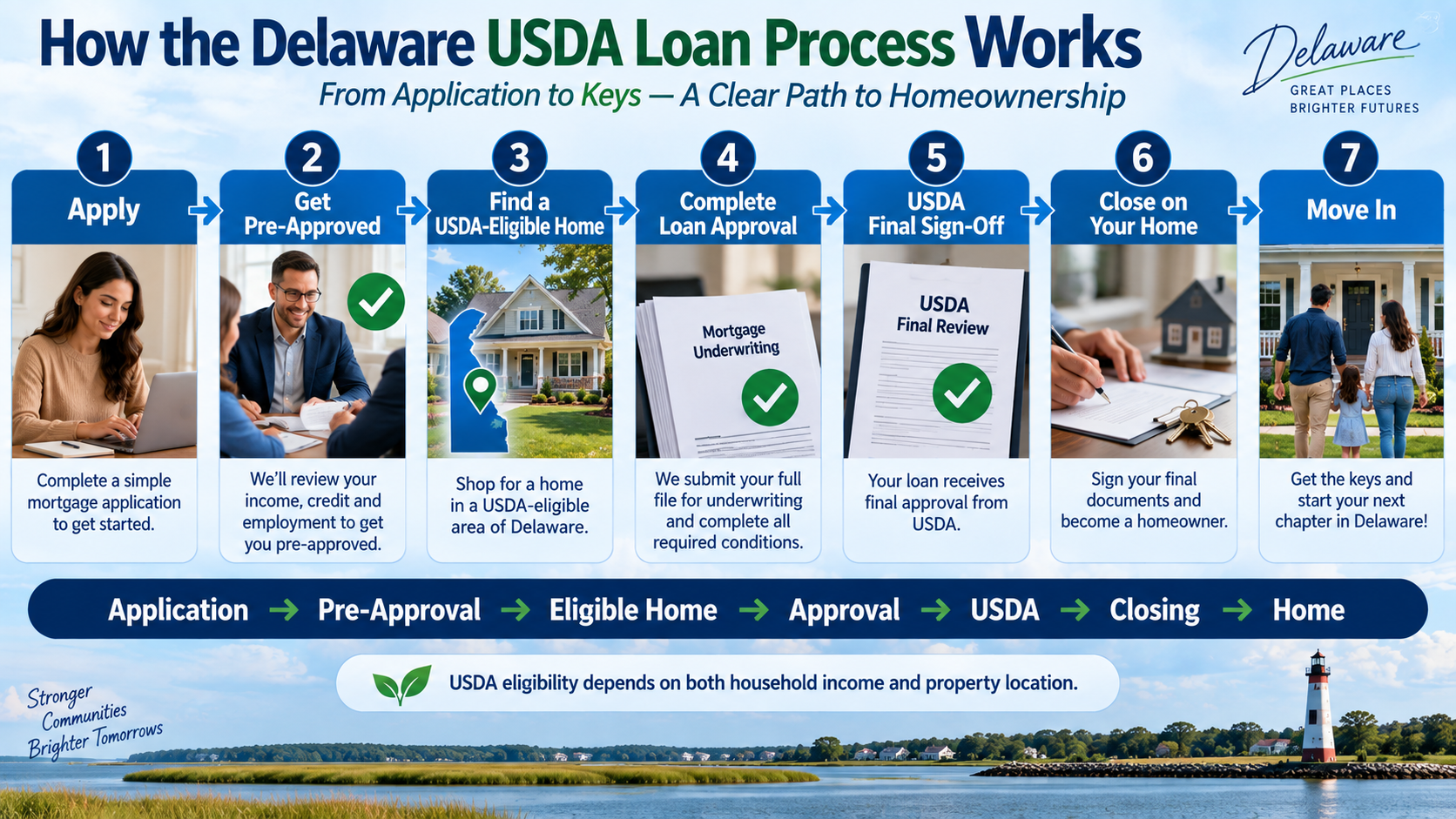
How Does the Delaware USDA Loan Process Work?
The process for a Delaware USDA Rural Housing loan is very similar to a Delaware FHA or conventional loan. Like FHA, a government agency sponsors the program, but the John Thomas Team handles 100% of the transaction – from your application through final approval – and then USDA puts a final stamp of approval on the file. Here is how it flows:
- Apply for your loan. We walk you through the process and give you everything you need to get started.
- Pre-approval. We review your income, credit, and employment. If you meet USDA guidelines, we issue your pre-approval letter.
- Find your Delaware home. Use your pre-approval to make an offer on a USDA-eligible home. Confirm the address is in a designated USDA area before you write the offer.
- Approval from the John Thomas Team. We add the property details to your file and complete final checks.
- Final sign-off by USDA. We submit the complete file to USDA for its final approval.
- Close the loan. You sign the final paperwork, and a few days later the home is yours.
- Move in. The process is done – enjoy your new home.
What Are the USDA Appraisal and Property Condition Requirements?
USDA requires an appraisal that confirms the home is safe, sound, and sanitary – the property has to be a decent place to live, not just a decent value. In practice, a USDA appraiser typically looks at things like a sound roof with reasonable remaining life, working heating and electrical and plumbing systems, safe access to the property, no obvious structural or foundation problems, no peeling paint on pre-1978 homes (a lead-paint concern), and proper separation distances and safe operation for any private well and septic system. Homes with an in-ground pool or income-producing outbuildings can draw extra scrutiny.
If the appraiser flags a health-and-safety issue, USDA generally requires it to be repaired before closing, with a re-inspection to confirm the work. This is similar to how an FHA appraisal works. If a home needs significant repairs to meet these standards, it may make more sense to look at a USDA renovation loan or a different program – we can help you decide before you spend money on an appraisal that is likely to come back with required repairs.
When a Delaware USDA Loan Is Not a Good Fit
USDA is an excellent program, but it is not the right tool for every Delaware buyer. It is generally not a good fit if:
- The home you want is in central Newark, Wilmington, Dover, Middletown, or Smyrna and is not in a USDA-eligible area – an FHA or conventional loan will fit instead.
- Your household income is above the county’s 115% area-median limit – you would likely use conventional or FHA, sometimes paired with down payment assistance.
- You are buying an investment property or second home – USDA is primary-residence only.
- You are an eligible veteran with no down payment concern – a VA loan usually beats USDA because it has no income limit, no eligible-area restriction, and no monthly mortgage insurance.
- You need a fast, tight-ratio approval and your debt ratios are stretched – USDA’s 29/41 guideline can be tighter than FHA’s.
Delaware USDA Rural Housing Loans – FAQ
What credit score do I need for a USDA loan in Delaware?
Most USDA Guaranteed approvals in Delaware start at a 620 minimum credit score. Buyers at 640 and above usually get a more streamlined automated approval through USDA’s GUS system. Scores below that range may still be considered with extra documentation depending on your overall profile – rent history, reserves, and how recent any credit issues are all factor in. Current as of June 2026.
Can I get a USDA loan in Delaware after a Chapter 7 bankruptcy?
Yes, in many cases. USDA generally requires that you have been discharged from a Chapter 7 bankruptcy for three years or more, with re-established credit since the discharge. Whether you qualify depends on your full credit picture after the bankruptcy, so the three-year mark is a starting point, not an automatic approval. We can review your specific timeline with you.
How do I know if a Delaware property is USDA-eligible?
USDA eligibility is checked address-by-address on the USDA’s official map at eligibility.sc.egov.usda.gov. Enter the exact street address and the map shows whether that parcel is in an eligible area. Eligibility is not based on zip code or town, and the boundary can run through a single neighborhood, so always verify the specific address before writing an offer. Current as of June 2026.
Are Middletown and Smyrna still eligible for USDA loans in Delaware?
No. Middletown, Delaware lost USDA eligibility on June 4, 2018, and Smyrna, Delaware lost eligibility for closings on and after October 1, 2023. Many older guides and listings still call these towns eligible, which is no longer accurate. Some parcels just outside the town boundaries may still qualify, so check the exact address on the USDA map before assuming either way.
What are the USDA income limits in Delaware?
For 2026, USDA Guaranteed income limits in New Castle County are $137,300 for a 1-4 person household and $181,250 for a 5-8 person household, because it is part of the higher-income Philadelphia-Camden-Wilmington metro. Kent and Sussex Counties use the standard limits of $119,850 (1-4 person) and $158,250 (5-8 person). USDA caps household income at 115% of area median income and counts all adult household income, though some deductions apply. Confirm your county’s current limit at eligibility.sc.egov.usda.gov. Current as of June 2026.
Do I have to be a first-time home buyer to use a USDA loan?
No. You do not have to be a first-time buyer to use a USDA Rural Housing loan. The main requirements are that the home is your primary residence in a USDA-eligible area and that your household income is within the county limit. Repeat buyers who meet those rules can use the program.
Is there really no down payment, and what about closing costs?
USDA Guaranteed loans require no down payment – they finance up to 100% of the appraised value. There is a 1% upfront guarantee fee, but USDA lets you finance it into the loan, so you can borrow up to about 101% of the value. Closing costs and prepaid items still apply, but the seller may contribute up to 6% of the purchase price toward them, gift funds are allowed, and if the home appraises higher than the purchase price, eligible closing costs may be financed in.
How much are the USDA fees compared to FHA?
USDA charges a 1% upfront guarantee fee (financeable) plus a 0.35% annual fee collected monthly. Compared to FHA’s 1.75% upfront mortgage insurance and 0.55% annual on most loans, USDA’s ongoing cost is lower, which is a major reason a USDA monthly payment can beat an FHA payment for an eligible buyer. Fee percentages are set by USDA and can change. Current as of June 2026.
Can I use a USDA loan for a manufactured home in Delaware?
USDA does allow financing on eligible new manufactured homes that meet program and property standards, but the rules are stricter than for a stick-built home and not every manufactured home qualifies. If you are considering a manufactured home, call us at 302-703-0727 so we can confirm whether your specific home and site meet USDA’s requirements before you go under contract.
How long does a Delaware USDA loan take to close?
Many Delaware USDA purchases close in roughly 30 to 45 days from a complete application, similar to FHA, but the exact timeline depends on the appraisal, your documentation, USDA turn times, and final underwriting. USDA adds a final agency sign-off step after the lender’s approval, which can add a few days versus a conventional loan. A complete, well-documented file and a cooperative appraisal are the biggest factors in closing on the faster end of that range.
Does USDA allow seller-paid closing costs in Delaware?
Yes. On a USDA loan the seller may contribute up to 6% of the purchase price toward your closing costs and prepaid items. Combined with USDA’s zero down payment, gift funds, and the option to finance the 1% guarantee fee, a well-structured offer can get many Delaware buyers to the closing table with very little out of pocket. The right amount of seller help depends on your contract and the appraised value.
Is a USDA loan or DSHA down payment assistance better in Delaware?
They solve different problems, and sometimes you use both. USDA gives you zero down payment but limits you to eligible rural and suburban areas and to households under the county income limit. DSHA down payment assistance works anywhere in Delaware and can pair with FHA, VA, conventional, or USDA loans to cover closing costs. If your address and income both fit USDA, it is often the lowest-cost path; if they do not, DSHA assistance with another loan type is usually the answer. We compare both for you before you decide.
Can I use a USDA loan if I already own a home?
Possibly. You do not have to be a first-time buyer, but USDA is for a primary residence, so you generally cannot keep a USDA loan on a home you no longer live in, and owning other adequate housing can affect eligibility. Buyers who are selling their current home and moving into a USDA-eligible primary residence often qualify. We review your specific situation – timing, the home you are leaving, and your income – to confirm.
Can a USDA loan be assumed by the next buyer?
Generally yes, but not the way FHA and VA loans usually are. A buyer can assume a USDA loan only by qualifying with the current lender and taking a new rate and term at today’s market rate, so there is usually no rate advantage in assuming one. The lender then transfers responsibility for the loan from the seller to the new buyer. If you are the seller, make sure you receive a release of liability before closing, so a later missed payment cannot affect your credit. If a low existing rate is the reason you are interested in an assumption, call 302-703-0727 and we can talk through FHA and VA assumptions, which can keep the original rate when the buyer qualifies.
About the Author – John R. Thomas

John R. Thomas is Branch Manager and Division Vice President with the John Thomas Team in Newark, Delaware, and has helped Delaware families finance homes for more than 20 years. He has guided thousands of buyers through zero-down USDA Rural Housing loans, walking each one through the two filters that decide eligibility – household income and the property’s USDA-eligible location – before they ever write an offer.
John is the author of a Delaware first-time home buyer guide and a frequent host of Delaware home buyer seminars. State licensing: Look up John R. Thomas, NMLS #38783, on NMLS Consumer Access. Read more on his loan officer bio page.
Years 3,000+
Buyers Helped 1,000+
Govt Loans DE & MD
Service Area CMP
Certified Mortgage Planner
John Thomas Team with AnnieMac Home Mortgage
248 E Chestnut Hill Rd, Newark, DE 19713 | 302-703-0727 | team@johnthomasteam.com
Schedule Appointment (30 min)
See John Thomas Team on Google for reviews, directions, and local office information.
YouTube | Facebook | Instagram | TikTok | X / Twitter | LinkedIn

Let’s confirm your income eligibility and check your address on the USDA map. If USDA fits, we’ll get you pre-approved; if it doesn’t, we’ll line up the program that does.
Last Updated: June 2026 · John Thomas Team with AnnieMac Home Mortgage · Mortgage content reviewed by John R. Thomas, NMLS #38783.
