Delaware DSCR Loans: Investor Cash Flow Mortgages for Rental Property

DELAWARE DSCR LOAN – QUICK ANSWER
A Delaware DSCR loan is a Non-QM investor mortgage that qualifies you on the subject property’s rental income – not your W-2s or tax returns. Most Delaware investors qualify with a 600+ credit score, 15-25% down, and a property that produces rent at or above the proposed PITIA payment. Loans up to $5 million, LLC vesting allowed, no cap on financed properties, and short-term rental income (Airbnb/VRBO) accepted with AirDNA documentation. Available statewide across Wilmington, Newark, Dover, and the Delaware beaches by John Thomas, NMLS #38783.
Current as of June 2026. Rates and program guidelines change daily – call 302-703-0727 for current pricing on your scenario.
Delaware Investor Glossary – Quick Definitions
- DSCR (Debt Service Coverage Ratio)
- Gross monthly rent divided by monthly PITIA. The single number that determines whether a property qualifies for a DSCR loan.
- PITIA
- Principal, Interest, Taxes, Insurance, and Association dues – the full monthly mortgage payment used in the DSCR calculation.
- No-Ratio DSCR
- A DSCR program variant that does not require the property’s rental income to cover PITIA at any specific ratio. Higher rates and lower LTV, but the property doesn’t have to pencil.
- 1007 Rent Schedule
- The Fannie Mae appraisal addendum where the appraiser estimates fair market rent for the subject property. Used as the rental income figure when the property is vacant or has below-market in-place rent.
- AirDNA Report
- Third-party short-term rental data report estimating projected Airbnb/VRBO income on a property the investor doesn’t yet own. Standard documentation path for STR DSCR loans.
- BRRRR
- Buy, Rehab, Rent, Refinance, Repeat – the investor strategy of acquiring with hard money, stabilizing, then refinancing into a long-term DSCR loan.
- LLPA (Loan Level Price Adjustment)
- The pricing surcharges Fannie/Freddie apply to investment property conventional loans. DSCR loans don’t have agency LLPAs, which is why DSCR often beats conventional on investor pricing.
- Foreign Qualification
- The filing required when an LLC formed in one state (commonly Delaware) is doing business in another state (where the property sits). Usually a 1-3 week turnaround through the destination state’s Secretary of State.
- Personal Guarantee
- When a DSCR loan closes in an LLC, members holding 20%+ interest sign personally guaranteeing the loan. The LLC owns the property, but the guarantor remains personally liable.
Delaware DSCR Loan Requirements at a Glance
| Minimum credit score | 600 (better pricing at 680+, best at 720+) |
| Minimum down payment | 15% (1-4 unit, 680+ score) up to 40% (1-4 unit, 600 score) |
| Target DSCR ratio | 1.00+ standard; below 1.00 with reserves; No-Ratio DSCR also available |
| Maximum LTV | 85% on 1-4 unit purchase; 75% on 5-10 unit and mixed-use |
| Reserves required | Typically 6 months PITIA (12 months for STR or sub-1.00 DSCR) |
| LLC vesting | Yes – with personal guarantee from members holding 20%+ interest |
| Short-term rentals (Airbnb/VRBO) | Eligible – qualifies on AirDNA report or 12-month operating history. See DSCR loans for short-term rentals. |
| Income documentation | None – no tax returns, W-2s, or pay stubs |
| Loan amount range | $75,000 minimum to $5,000,000 maximum |
| Property limit | No cap on number of financed DSCR properties |
Are you a real estate investor who wants to maximize your earning potential without the hassle of documenting personal income to qualify for an investor mortgage? The DSCR Investor Cash Flow Loan Program qualifies you on the cash flow of the property you’re buying or refinancing – no tax returns, no pay stubs, no employment verification. As a Non-QM lender with deep Delaware investor experience, my team has helped hundreds of investors close on Wilmington row homes, Newark student rentals, Rehoboth and Bethany Beach short-term rentals, and Dover military-corridor multi-units using this program. Call 302-703-0727 to talk through your scenario, or read on for the full investor playbook.
Ready to Finance Your Next Delaware Investment Property?
Get a free DSCR loan analysis on your target property – no income docs, no commitment.
Delaware DSCR Calculator: Will This Property Qualify?
Run the numbers on your target Delaware property in 30 seconds. Enter the rent, mortgage payment components, and your purchase plan – the calculator returns the DSCR ratio, your loan-to-value, and a plain-English qualification verdict you can take into your next conversation with me.
- Property taxes: Wilmington/Newark ~$300-$450/mo on a $300K basis | Dover/Middletown ~$200-$300/mo | Sussex County beach areas ~$150-$280/mo (lower millage, but assessed values run higher on coastal property)
- Investor-rate hazard insurance: ~$80-$150/mo for a standard 1-4 unit; STRs and beach properties price higher
- HOA dues: Wilmington high-rise condos $250-$500/mo | suburban townhouses $100-$250/mo | single-family 0
Verify exact figures with your title company and insurance agent before closing.
Long-term lease, 1007 market rent, or AirDNA estimate
Monthly P&I on the proposed loan
Enter 0 if no HOA
Table of Contents
What Is a DSCR Loan?
A DSCR loan, or Debt Service Coverage Ratio loan, is a mortgage designed for real estate investors. Instead of qualifying based on tax returns or employment income, the lender evaluates whether the property’s rental income can cover the proposed mortgage payment. That makes DSCR loans especially useful for:
- Investors with multiple properties already on their tax return
- Self-employed borrowers whose tax returns understate true earnings
- Investors who write off significant business or rental expenses
- Portfolio builders scaling beyond the conventional 10-financed-property cap
- Investors closing in the name of an LLC or other business entity
- ITIN borrowers using a tax identification number instead of an SSN
DSCR loans are Non-QM (Non-Qualified Mortgage) loans because they don’t follow traditional agency income documentation rules. The Investor Cash Flow Mortgage Loan or DSCR Loan allows a real estate investor to use the cash flow on the subject property to qualify for the new mortgage. The program covers loans for non-owner occupied 1-4 unit properties, 5-10 unit residential properties, and even 2-10 unit mixed-use properties. There’s no limit to the number of financed properties, which is why DSCR is the workhorse program for serious Delaware portfolio builders.
How Is the DSCR Calculated?
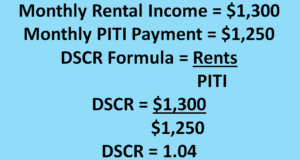
The debt service coverage ratio (DSCR) of the subject property is the ratio used to qualify the loan:
- DSCR is defined as gross rents divided by qualifying PITIA (principal, interest, taxes, insurance, association dues). 100% of the rents can be used in the calculation.
- A DSCR greater than 1.00 means the property is cash-flowing – gross rent exceeds the full mortgage payment.
- A DSCR equal to 1.00 is break-even.
- A DSCR below 1.00 means negative cash flow. Some programs allow this with 12 months of reserves to cover the shortfall, and a No Ratio DSCR option also exists for properties that don’t pencil to 1.00.
The formula is simple:
Gross Monthly Rent / Monthly PITIA = DSCR Ratio
PITIA includes principal, interest, taxes, insurance, and HOA dues if applicable.
DSCR Example
Monthly Rent: $2,500
Monthly PITIA: $2,000
$2,500 / $2,000 = 1.25 DSCR
A 1.25 ratio means the property generates 25% more income than the mortgage payment. That’s a strong DSCR by Delaware standards and qualifies for the most aggressive pricing tiers on most lender rate sheets.
What Is a Good DSCR Ratio?
A “good” DSCR is really defined by the investor and the investment goal. There are essentially three scenarios:
- 1.00 = Break-even
- Above 1.00 = Positive cash flow
- Below 1.00 = Negative cash flow
I have DSCR loan programs that fit each of these scenarios:
- 1.00 DSCR is the standard minimum for a basic DSCR loan
- Below 1.00 is allowed with additional reserves on most programs
- No Ratio DSCR – no rental income calculation required at all (priced higher, but the property doesn’t have to pencil)
Who Qualifies for a DSCR Loan?
Qualifying for a DSCR loan is much more streamlined than a traditional conventional investment loan. Below are the general qualification guidelines – call for the exact pricing and overlays that apply to your specific scenario, since rate sheets and reserve requirements can shift week to week:
- Minimum 600 credit score to apply (better pricing at 680+, best at 720+)
- Loan amounts $75,000 minimum up to $5,000,000
- Up to 85% LTV on purchase of 1-4 unit properties
- Up to 75% LTV on 2-8 unit mixed-use properties
- Up to 75% LTV on 5-10 unit residential properties
- No personal income provided – no tax returns, pay stubs, or W-2s
- No DTI restrictions – qualification is on the property’s DSCR ratio
- No employment required
- Can close in the name of an LLC or business entity
- 40-year terms with interest-only payment options available
- Seller-paid closing costs allowed up to 6%
- Available for purchase, cash-out refinance, or rate/term refinance
- 100% gift funds permitted toward down payment
- First-time investors are eligible – you don’t need a track record
- Vacant properties are eligible (qualify on market rent appraisal)
- Short-term rentals allowed – AirDNA reports accepted
Delaware DSCR Strategy by Market: Where the Numbers Pencil
Delaware is uniquely investor-friendly because four very different sub-markets each support a different DSCR play. The right strategy depends on the city – here’s how I think about each one with my Delaware investor clients:
Wilmington – Financial Services Corridor (LLC + Long-Term Rental)
Delaware’s corporation-friendly legal structure has made Wilmington home to major operations for Bank of America, Chase, Capital One, Barclays, and Citigroup. That concentration of professional renters in Trolley Square, Forty Acres, and Brandywine supports strong DSCR ratios on row homes and condos priced from the high $100Ks into the $400Ks. The right play here is usually a long-term-rental DSCR loan vested in a Delaware LLC – both for asset protection and because the LLC’s “real estate purpose” formation language is straightforward to draft when the entity itself is Delaware-domiciled.
Newark – University of Delaware Corridor (Multi-Unit, Student-Adjacent)
The University of Delaware enrollment plus the surrounding Christiana medical and biotech employment generate steady demand for 2-4 unit student-and-young-professional rentals. Newark duplexes and triplexes regularly DSCR above 1.20 when bought at the right basis. The right play is a 2-4 unit DSCR loan, usually 75-80% LTV, with PITIA carefully modeled because Newark properties cluster on the higher end of New Castle County’s effective property tax rates.
Dover & Middletown – Stable Cash Flow Markets
Dover’s reliable BAH-anchored tenant demand from Dover Air Force Base plus a state-government employment base produces stable rental cash flow and lower vacancy than most Mid-Atlantic markets. Middletown sits in the Route 1 commuter corridor with strong rental demand from professionals working in either Wilmington or Baltimore. Both markets favor long-term-rental DSCR plays with solid 1.10-1.25 ratios on single-family and small multi-unit purchases.
Rehoboth, Lewes, Bethany, Dewey, Fenwick – Short-Term Rental DSCR
The Mid-Atlantic’s premier short-term rental market. Sussex County’s regulatory environment combined with Delaware’s no-state-sales-tax draw for DC, Baltimore, and Philly visitors supports strong AirDNA peak-season numbers. STR DSCR ratios on Rehoboth and Bethany properties often pencil higher than long-term-rental ratios in the same zip code. The right play is an STR-eligible DSCR with the AirDNA report ordered before contract – and verify each town’s STR licensing rules separately, because incorporated beach towns (Rehoboth, Bethany, Dewey, Fenwick, Lewes) each have their own framework that can affect how aggressively the appraiser projects income.
BRRRR Strategy in Delaware – Hard Money to DSCR Refinance
BRRRR – Buy, Rehab, Rent, Refinance, Repeat – is the most common multi-loan strategy I work with Delaware investors on, and DSCR is the long-term-financing leg that completes the cycle. The play: acquire and rehab with hard money or a fix-and-flip bridge loan, stabilize the tenant and document rent, then refinance into a 30-year fixed (or 40-year interest-only) DSCR loan that pulls cash out at the new appraised value. Done well, the cash-out at the DSCR refinance step recovers most or all of the original capital, freeing it up to acquire the next property.
The strongest Delaware BRRRR markets right now are Newark (older single-family and 2-4 unit student-adjacent properties bought below market, rehabbed, refinanced into long-term DSCR), Wilmington row-home neighborhoods (Trolley Square, Forty Acres, Brandywine – strong post-rehab rent comps), and Dover (older single-family inventory with reliable tenant demand). The DSCR ratio on the refinance is calculated on the stabilized rent – not the pre-rehab rent – which is why getting the rehab done correctly and the lease in place before applying matters. Order the appraisal with a 1007 rent schedule so the appraiser validates the new market rent.
For investors expanding from PA, NJ, NY, or DC, Delaware also offers a meaningful structural advantage: no state-level sales tax, low property taxes by Mid-Atlantic standards, and Delaware’s well-established LLC framework – all of which favor the LLC-vested DSCR loan structure most serious investors prefer. Any DSCR program details, rates, and LTV tiers referenced on this page are current as of May 2026 and subject to change – call for live pricing on your scenario.
How a Delaware Investor Should Compare DSCR Lenders
If you’ve spent any time researching DSCR loans, you’ve already seen the marketing pitches: “industry-leading rates,” “no minimum DSCR,” “close in days.” Most of those claims are real for someone – the question is whether they’re real for your Delaware deal. Below is the framework I’d use to evaluate any DSCR lender, including my own team. Use it on the next two or three lenders you’re considering.
| Comparison Dimension | Typical National DSCR Specialist | John Thomas Team (Newark, DE) |
|---|---|---|
| Local Delaware office | Remote / national; rarely a Delaware presence | Yes – staffed branch at 248 E Chestnut Hill Rd, Newark, DE |
| Loan officer NMLS lookup | Often only a corporate NMLS; no individual loan officer publicly attached | Individual NMLS #38783 – verifiable on the NMLS Consumer Access registry |
| Years in Delaware investor lending | Variable – many DSCR specialists are post-2020 entrants | 20+ years, 3,000+ Delaware buyers, 1,000+ investor & Non-QM closings |
| Loan range | Often $100K-$3M (some specialists go higher case-by-case) | $75K-$5M in-house |
| Maximum LTV (1-4 unit purchase) | Typically 75-80% | Up to 85% with strong credit |
| Minimum credit score | Often 620-660; some specialists at 680 | 600 floor (better pricing at 680+ and 720+) |
| No-Ratio DSCR option | Some specialists offer; many do not | Yes – see No Ratio DSCR program for properties that don’t pencil to 1.00 |
| Delaware-specific market knowledge | Generic state pages; rarely detailed sub-market analysis | Wilmington / Newark / Dover / Sussex beach STR strategy worked through with each investor client |
| DSHA & FHA / VA cross-sell capability | DSCR-only specialists usually can’t help when the file isn’t a DSCR fit | Full FHA / VA / USDA / DSHA / Conventional / Non-QM toolkit – if DSCR isn’t the right tool, I tell you and we route differently |
| In-person Delaware consultation | Phone / video only | Phone, video, or in-person at the Newark office |
The trade-off is real and worth being honest about. National DSCR specialists have built impressive technology stacks and can sometimes price a clean-profile deal more aggressively than a relationship-driven local lender – that’s how they win their lane. Where they typically lose is when something about the file is not standard: a non-warrantable Wilmington high-rise condo, a 5-unit mixed-use in Newark, an LLC-vested deal where the operating agreement needs amending, a Delaware-domiciled LLC closing on a Maryland property that needs Foreign Qualification, a borrower who’s just under the standard credit minimum, or a Sussex beach STR where the appraiser needs to be coached on how to project AirDNA income on a property still under construction. Those are the deals that fall out of national-specialist pipelines and land on my desk.
The other dimension worth weighing: a national DSCR specialist can only offer you one tool. If your scenario isn’t a clean DSCR fit – too low a DSCR, manufactured property type, a credit event in the recent past, a primary-residence acquisition that should never have been pitched as DSCR in the first place – they’ll either decline the file or stretch the program in a way that costs you on rate. As a full-service Delaware lender, I’m equally fluent in the full Non-QM stack (Bank Statement, 1099, P&L, Asset Qualifier, ITIN), the agency programs (FHA, VA, USDA, conventional), and Delaware-specific products (DSHA Welcome Home, Open Door). So if DSCR isn’t the right tool for your specific deal, you don’t have to start over with a different lender – we just route to the program that actually fits.
My suggestion: make a short list of three lenders, run the same scenario past each one, and compare the answers across the dimensions above – not just the rate. The rate is real, but the rate plus a wrong-program closing or a 14-day delay because the lender doesn’t understand a Delaware LLC structure is more expensive than the rate gap. Call 302-703-0727 if you want to put John Thomas Team on that short list – happy to be one of the comparisons even if you ultimately go elsewhere.
DSCR vs Conventional vs Bank Statement: Which Investor Loan Is Right?
Most Delaware investors don’t realize they’re choosing between three real options. Here’s how DSCR stacks up against the two closest alternatives:
| Feature | DSCR Loan | Conventional Investor | Bank Statement Loan |
|---|---|---|---|
| Income docs | None – property rent only | Tax returns, W-2s, pay stubs | 12-24 months bank statements |
| DTI calculation | No DTI | Strict DTI applies | DTI calculated from deposits |
| Property limit | No cap | 10 financed maximum | No agency cap (Non-QM) |
| LLC vesting | Yes | No – personal name only | Usually personal name |
| Min. credit score | 600 (better at 680+) | Typically 680+ | 660+ |
| Max LTV (purchase, 1-4 unit) | Up to 85% | Up to 85% (with MI >80%) | Up to 80% |
| Mortgage insurance | None above 80% LTV | Required above 80% | Varies |
| LLPA pricing hits | No agency LLPAs | Stacked LLPAs on investment | No agency LLPAs |
| Best fit | Portfolio scaling, STR, LLC, write-offs | First investment property, clean W-2 income | Self-employed primary or single investment |
Bottom line: DSCR is the right tool when you’re past your first or second property, when your tax returns don’t reflect your real earning power, when you want to vest in an LLC, or when you’re chasing short-term rental cash flow. Conventional may actually be cheaper on your first investment property if your W-2 income is clean. The right answer is scenario-specific – let’s talk through which one wins for your deal.
What Property Types Are Eligible for a DSCR Loan?
The DSCR Investor Cash Flow loan can finance a wide variety of property types:
- Single-family rental homes
- Townhouses
- 2-4 unit residential properties
- Multi-units up to 25 units
- Mixed-use properties (2-10 units)
- PUDs (Planned Unit Developments)
- Warrantable condos
- Non-warrantable condos (Wilmington high-rises included)
- Condotels
DSCR Loans for Short-Term Rentals (Airbnb / VRBO) in Delaware
The Delaware beach STR market is one of the strongest seasonal rental markets in the Mid-Atlantic. DSCR programs underwrite short-term rental income using one of three documentation paths:
- 12-month rental history – your existing operating statement (best result if you already own the unit)
- AirDNA report – the standard third-party data source for projected STR income on a property you don’t yet own
- Market rent analysis – appraiser’s 1007 rent schedule for a long-term-rent fallback when STR data is thin
For Delaware, the markets where I see the strongest STR DSCR results are Rehoboth Beach, Dewey Beach, Bethany Beach, Fenwick Island, and Lewes – peak-season nightly rates and shoulder-season weekend demand combine to support DSCR ratios that often beat what the same property would do as a long-term rental. Verify each town’s STR licensing rules before you contract – some incorporated beach towns have stricter frameworks than others, and that affects how aggressively the appraiser can project income. For the full short-term rental playbook – AirDNA documentation, income methods, beach-town due diligence, and the least-restrictive guidelines I can source across lenders – see the dedicated DSCR loans for short-term rentals page. If the STR numbers do not pencil to a 1.00 ratio, the No Ratio DSCR program closes the deal without a rental-income calculation at all.
Can ITIN Borrowers Qualify for a Delaware DSCR Loan?
Yes. I offer DSCR loans for borrowers using an Individual Taxpayer Identification Number (ITIN) instead of a Social Security Number. The structure works because DSCR underwriting focuses on the property’s cash flow rather than the borrower’s personal income – so the same documentation logic that benefits self-employed U.S. investors also opens the door to ITIN investors building Delaware portfolios. Pricing and reserve requirements run higher than the standard DSCR program, and LTV typically caps lower (often 70-75% on purchase), but it’s a real path to property ownership for borrowers without an SSN. See the full ITIN Loan Program page or call to discuss how it overlays with DSCR.
Three Real Delaware DSCR Scenarios
The fastest way to understand whether a DSCR loan fits is to walk through scenarios. Here are three I’ve closed variations of recently:
SCENARIO 1 – WILMINGTON ROW HOME, LLC PURCHASE
Property: Trolley Square 3-bed/2-bath row home, $325,000 purchase price.
Borrower: Self-employed consultant, 715 credit, vesting in a Delaware LLC.
Numbers: 25% down ($81,250), $243,750 loan, monthly PITIA roughly $2,000. Market rent for the area $2,500. DSCR = 1.25.
Result: Cleared underwriting on rental income only. No tax returns. Closed in the LLC name with a personal guarantee.
SCENARIO 2 – REHOBOTH BEACH STR REFINANCE
Property: Rehoboth 2-bed condo, currently operating as a short-term rental.
Borrower: Owns six rental properties already – past the conventional 10-property cap is approaching, so cash-out refi was the goal.
Numbers: AirDNA report supported $48,000/year in projected STR revenue. Trailing 12-month operating statement confirmed it. PITIA at the new loan amount supported a 1.30 DSCR.
Result: Cash-out refinance funded the down payment on the next acquisition. No personal income docs.
SCENARIO 3 – NEWARK STUDENT DUPLEX, FIRST-TIME INVESTOR
Property: Newark 2-unit, $345,000 purchase price near University of Delaware.
Borrower: First investment property, W-2 employee but already maxed on the conventional DTI calculation due to a separate primary residence.
Numbers: 20% down, combined market rent on both units $3,200, PITIA $2,650. DSCR = 1.21.
Result: First-time investors are eligible on DSCR. Closed without his W-2 mattering.
How Do You Close a DSCR Loan in the Name of an LLC?
Closing in the name of an LLC is one of the biggest advantages of the DSCR program over conventional financing. Conventional Fannie Mae and Freddie Mac loans must close in your personal name; DSCR allows entity vesting. To close in an LLC, you must meet the following guidelines:
- The LLC must be formed only for the purchase or management of real estate
- For multi-member LLCs with varying membership interests, a fully executed Board Resolution authorizing the borrower to enter the loan contract is required
- Borrowers must personally guarantee the loan

What Documents Does the LLC Need to Provide?
- Operating Agreement, including authorization to borrow and designation of signers
- Certificate of Formation / Articles of Organization
- Certificate of Good Standing or equivalent
- Certificate of Foreign Qualification (or other authorization to operate in the state where the property sits, if the entity is formed in a different state – common for Delaware-formed LLCs operating in MD or PA)
- Name and principal residence/home address of every member with greater than 20% interest who will be signing the personal guaranty
Should You Take a Pre-Payment Penalty on a DSCR Loan?
DSCR loans are not required to have a pre-payment penalty, but accepting one usually buys a meaningfully better interest rate. The standard pre-payment penalty options are:
- No pre-payment penalty
- 1-year pre-payment penalty
- 2-year pre-payment penalty
- 3-year pre-payment penalty
- 4-year pre-payment penalty
- 5-year pre-payment penalty
The right answer depends on your investment plan and the rate environment. If rates are low compared to the last 3-5 years, taking a longer pre-payment penalty in exchange for the lowest possible rate makes sense – you’re locking in cheap money you don’t expect to refinance away. If rates are near a 3-5 year high, no penalty or a 1-2 year penalty makes more sense, because you want the optionality to refinance when rates drop. Critical rule: if you do take a pre-payment penalty, make sure the term lines up with your hold horizon – paying off a loan inside the penalty window is expensive enough to wipe out months of cash flow.
What Are the Credit Score Requirements for a DSCR Loan?
Your credit score determines your maximum LTV, which determines your required down payment. The minimum to apply is 600, but pricing and LTV improve in tiers as your score rises. Most programs use the following structure:
| Maximum LTV | Minimum Credit Score | Down Payment |
|---|---|---|
| 85% LTV | 680 | 15% |
| 80% LTV | 660 | 20% |
| 75% LTV | 640 | 25% |
| 70% LTV | 620 | 30% |
| 60% LTV | 600 | 40% |
Lender overlays may apply on top of these tiers depending on the loan amount, occupancy type (long-term vs short-term rental), and DSCR ratio strength. The above is the general framework; your specific scenario may price differently.
What Are the Common Mistakes Delaware Investors Make on DSCR Loans?
After closing hundreds of DSCR loans for Delaware investors, the same expensive mistakes keep showing up. Avoid these:
- Forming the LLC the wrong way. If your LLC is for “general business purposes” instead of real estate specifically, the underwriter will require an amended Operating Agreement before closing. Form the LLC for real estate from day one.
- Underestimating reserves. Most DSCR programs require 6 months of PITIA in reserves at closing, sometimes 12 months for negative DSCR or STR scenarios. Don’t drain your liquidity into the down payment and forget the reserve requirement.
- Taking a 5-year pre-payment penalty on a property you plan to flip in 18 months. The penalty math will eat your spread. Match the PPP term to your hold horizon.
- Assuming the appraiser’s market rent will match your projection. If you’re buying based on aggressive rent assumptions, get the 1007 rent schedule before you remove your appraisal contingency. Many Wilmington and Newark deals fall apart when the appraiser comes in 10-15% below the seller’s pro forma.
- Submitting a Delaware LLC for a Maryland property without Foreign Qualification. If your LLC is Delaware-formed but the property is in MD, the entity needs to be qualified to do business in MD before closing – or the title insurance gets complicated.
- Not shopping the rate spread between PPP options. The rate gap between “no PPP” and “5-year PPP” can be 75-125 bps. That’s a meaningful number on a 30-year loan – worth a real conversation, not a default.
What’s the Step-by-Step Process for a Delaware DSCR Loan?
- Initial call (15 minutes). We talk through your target property, your credit profile, your LLC structure if applicable, and your goals. I quote a rate range and a DSCR estimate based on the property’s likely market rent.
- Pre-qualification. I pull credit, run the property through pricing engines, and confirm the loan amount and pricing tier you’ll qualify for. No tax returns or W-2s required.
- Property under contract. Once you have a signed agreement, I order the appraisal with rent schedule (1007 form) so we have appraiser-validated market rent for the DSCR calculation.
- LLC and entity docs. If you’re vesting in an LLC, we collect the Operating Agreement, Certificate of Formation, Certificate of Good Standing, and personal guarantee paperwork.
- Underwriting. The file goes to underwriting against the DSCR ratio, your credit, and your reserves – not your DTI. Conditions are usually lighter than conventional.
- Clear to close. 21-30 days from contract is typical for a clean DSCR deal in Delaware. Repeat investor clients with all entity docs ready and a clean appraisal often close in 14-18 days on a fast-track basis. STR transactions, non-warrantable condos, or 5+ unit deals may run longer.
- Closing. Settle at title in Newark or wherever the property sits. Wire your down payment from the LLC’s operating account if vesting in the LLC.
How Do You Apply for a Delaware DSCR Loan?
If you’re ready to talk through your specific scenario or want to start an application, you can apply online here, schedule a 30-minute appointment, or call me directly at 302-703-0727. I’m a licensed mortgage loan officer in 17 states with operational service in Delaware and Maryland, and have been closing investor loans in Delaware since the program first launched.
Recently Helped Delaware DSCR Investors
Anonymized snapshots of recent Delaware investor closings – same kind of scenario, different details. Names and exact addresses omitted for privacy:
WILMINGTON | TROLLEY SQUARE
Self-employed consultant, $325K row home walking distance to the Bank of America corporate corridor. 25% down in LLC, market rent supported a 1.25 DSCR. Closed in the entity name.
REHOBOTH BEACH | STR REFINANCE
2-bed condo two blocks from the boardwalk. AirDNA supported $48K projected revenue, 1.30 DSCR on the new loan. Cash-out funded the next acquisition.
NEWARK | DUPLEX, FIRST INVESTMENT
$345K 2-unit walking distance to UD’s Main Street campus. W-2 borrower already DTI-maxed on conventional. Closed on DSCR alone, 1.21 ratio.
DOVER | BRRRR EXIT
Single-family rental in the Dover AFB BAH commute zone. Refi’d a hard money loan into a 30-year DSCR. Stabilized rents covered the new PITIA at 1.18.
BETHANY BEACH | NO-RATIO STR
Vacation home four blocks from the bandstand, converted to STR mid-purchase. AirDNA didn’t pencil – closed on No Ratio DSCR program at 70% LTV.
MIDDLETOWN | PORTFOLIO #11
Investor past the conventional 10-property cap, single-family rental in the Route 1 commuter corridor. 80% LTV DSCR purchase, 1.22 ratio.
Who Is a Delaware DSCR Loan NOT a Good Fit For?
I’d rather pre-qualify you out of a bad-fit loan than waste your time. A DSCR loan is probably not the right tool if any of these describe your scenario:
- You plan to live in the property. DSCR is strictly for non-owner-occupied investment property. If you’re going to occupy any unit as your primary residence, you need an FHA, VA, USDA, conventional, or DSHA loan instead. Owner-occupancy on a DSCR loan is occupancy fraud.
- This is your first investment property and your W-2 income is clean. Conventional investor financing with a 20-25% down payment usually beats DSCR pricing on a clean W-2 file. DSCR earns its keep when you’re past the conventional 10-property cap, when your tax returns understate true earnings, when you want LLC vesting, or when you’re chasing STR cash flow.
- You’re shopping rate above all else. DSCR rates run higher than conventional for the same credit profile – usually 75-150 bps. The trade-off is no income docs, no DTI, no property cap. If rate is your only metric, DSCR is the wrong tool.
- The property is a manufactured home or rural acreage outside DSCR program guidelines. Most DSCR programs don’t finance manufactured housing. Rural USDA-eligible properties usually fit better in a Non-QM Bank Statement or Asset Qualifier program.
- You don’t have 6 months of PITIA in reserves. Reserve requirements are non-negotiable on DSCR. If your liquidity is going entirely into the down payment with nothing left, the underwriter will require a different program or a smaller loan.
- Your credit score is below 600. The minimum to apply on standard DSCR programs is 600. Below that, the right path is usually credit repair before applying – or in some cases, the Fresh Start Program.
FAQ – Delaware DSCR Loans
What credit score is required for a Delaware DSCR loan?
DSCR programs typically begin at a 600 minimum credit score, but pricing and maximum LTV improve in tiers as the score rises. Investors with a 680+ score can usually access up to 85% LTV; 720+ scores see the most aggressive pricing on the rate sheet. Below 620 the down payment requirement climbs to 30% or more, and lender overlays may apply. Specific tiers can shift week to week – call for current rate sheet on your scenario.
How much down payment is required for a DSCR loan?
DSCR loans require as little as 15% down for borrowers with strong credit (680+) on 1-4 unit purchases. Lower credit scores require larger down payments – 20% at 660, 25% at 640, and so on. Mixed-use and 5-10 unit residential properties typically cap at 75% LTV, meaning 25% minimum down. Gift funds are permitted for 100% of the down payment, which is unusual for an investor loan.
Can I close a Delaware DSCR loan in the name of an LLC?
Yes. LLC vesting is one of the biggest advantages of DSCR over conventional financing. The LLC must be formed for the purchase or management of real estate, and any member with greater than 20% interest signs a personal guarantee. The lender will need the Operating Agreement, Certificate of Formation, and Certificate of Good Standing. If the LLC was formed in a state other than where the property is located, a Certificate of Foreign Qualification is also required.
Can I buy through a Delaware LLC if the property is in another state?
Yes – this is a very common structure because Delaware LLCs offer well-established asset protection and case law. The Delaware-domiciled LLC will need to file for Foreign Qualification in the property’s home state before closing, which is typically a straightforward filing. Plan for the qualification timeline (usually 1-3 weeks) when setting your closing date. I work with these structures regularly and can coordinate the timing with your title company.
Can I get a Delaware DSCR loan after a Chapter 7 bankruptcy?
In most cases yes – DSCR programs typically require a 2-year seasoning period from the discharge date of a Chapter 7 bankruptcy, though some programs allow as little as 12 months with re-established credit and stronger reserves. The Chapter 13 seasoning requirement is usually shorter from the dismissal or completion date. Pricing will be higher and LTV may be capped lower while the BK is fresh on the credit report.
Can I refinance a hard money loan into a Delaware DSCR loan?
Yes – this is one of the cleanest exits from a hard money or fix-and-flip bridge loan. Once the property is stabilized and the rehab is complete, a DSCR refinance into a 30-year fixed (or 40-year with interest-only) lets you take out the hard money lender, lock in long-term financing, and often pull cash out at the same time if the new appraised value supports it. The DSCR ratio is calculated on the stabilized rent, not the pre-rehab rent.
Can I use a DSCR loan for a BRRRR strategy in Delaware?
Yes – DSCR is the standard refinance leg of a Delaware BRRRR (Buy, Rehab, Rent, Refinance, Repeat) strategy. Acquire and rehab with a hard money or fix-and-flip loan, stabilize the rent, then refinance into a long-term DSCR loan. The new appraisal usually supports a cash-out that recovers most or all of the original capital, freeing it up for the next deal. Newark, Wilmington, and Dover are the strongest BRRRR markets in Delaware right now.
Can I use a DSCR loan for a 1031 exchange in Delaware?
Yes. DSCR loans work as the financing leg of a 1031 like-kind exchange – the loan amount and timing fit cleanly into the 45-day identification and 180-day closing windows. The key is starting the DSCR pre-approval as soon as you identify replacement properties so the appraisal and underwriting timeline doesn’t push you against the 1031 deadline. Coordinate with your qualified intermediary and let me know early so we can lock pricing and order the appraisal in parallel.
Can I use a DSCR loan for a manufactured home in Delaware?
Most DSCR programs do not finance manufactured housing – DSCR underwriting is generally limited to standard residential and mixed-use construction. If you’re looking at a manufactured home as an investment, alternative Non-QM products may fit better. I can review the property type and route you to the right program on a quick call.
Are short-term rentals (Airbnb / VRBO) eligible for Delaware DSCR financing?
Yes. DSCR programs accept short-term rental income using a 12-month operating history (if you already own the property), an AirDNA report (for properties you don’t yet own), or an appraiser’s market rent schedule as a long-term-rent fallback. Delaware beach markets – Rehoboth, Dewey, Bethany, Fenwick, and Lewes – typically pencil better as STRs than as long-term rentals. Verify each town’s STR licensing rules before contracting. See our DSCR loans for short-term rentals page for the full STR financing guide.
Can I use mid-term rental (30+ day) income on a DSCR loan?
Yes. Mid-term rental income – usually 30-day-plus furnished rentals to traveling professionals, medical staff at ChristianaCare, or military families near Dover AFB – is eligible on most DSCR programs. The documentation path is usually the appraiser’s 1007 long-term market rent figure rather than mid-term-rate AirDNA-style projections, which makes mid-term DSCR underwriting more conservative but also more predictable.
What reserves are required for a Delaware DSCR loan?
Most DSCR programs require 6 months of PITIA (principal, interest, taxes, insurance, association dues) in reserves at closing, sometimes 12 months for negative DSCR scenarios, short-term rentals, or larger loan amounts. Reserves can be held in checking, savings, money market, or qualifying retirement accounts (typically 60-70% of retirement balance counts). Don’t drain liquidity into the down payment without confirming reserve coverage first.
What happens if the property’s DSCR is below 1.00?
You have two paths. The first is a standard DSCR loan with 12 months of additional reserves to cover the negative cash flow. The second is the No Ratio DSCR program, which doesn’t require any rental income calculation at all – pricing runs higher, but it’s a clean solution for properties that don’t pencil. Both paths are alive and well in 2026.
Do DSCR loans require tax returns?
No. DSCR loans qualify based on the rental income of the subject property – not your personal tax returns, W-2s, or pay stubs. That’s the entire point of the program. The lender will pull your credit and verify your reserves, but personal income documentation is not part of the underwriting process.
Is there a limit to how many properties I can finance with DSCR loans?
DSCR programs themselves do not impose a limit on the number of financed properties – that’s why DSCR is the workhorse program for portfolio scaling. Individual lenders may cap their own concentration at 20 or 25 loans to one borrower, but you can move to another lender for the next acquisition. There is no agency 10-property cap the way there is on conventional financing.
Do DSCR loans include prepayment penalties?
Pre-payment penalties are not required, but accepting one buys a meaningfully better interest rate. Standard options range from no penalty up to a 5-year penalty. The right choice depends on your hold horizon and the rate environment – long PPP makes sense in a low-rate environment when you don’t expect to refinance; short or no PPP makes sense when rates are high and you want optionality.
About John Thomas – Delaware’s Investor Lending Specialist

John R. Thomas
Branch Manager & Mortgage Loan Officer | Primary Residential Mortgage, Inc.
NMLS #38783 DSCR & Non-QM Specialist DSHA Approved Lender Published Author
John R. Thomas is the Branch Manager of Primary Residential Mortgage, Inc.’s Newark, Delaware office and one of the longest-tenured DSCR and Non-QM lenders in the state. Over 20+ years in mortgage lending he has helped 3,000+ Delaware families and investors close, including 1,000+ investor and Non-QM transactions across DSCR, Bank Statement, 1099, P&L, Asset Qualifier, ITIN, and Foreign National programs. John is a Bachelor of Science in Physics Education graduate of the University of Delaware and holds a Master of Science in Curriculum and Instruction from Delaware State University – a teaching background that shapes how he walks investors through the DSCR math, LLC vesting, and pre-payment-penalty trade-offs that determine whether a deal actually pencils.
John is the author of Your Guide to Buying Your First Home in Delaware (ISBN 0557349826), runs the Delaware Mortgage YouTube channel, and hosts free Delaware Home Buyer Seminars. License is verifiable on the NMLS Consumer Access registry (NMLS #38783).
Licensing: Licensed in 17 states (AL, DC, DE, FL, GA, IN, KS, MD, MN, MO, NC, NJ, OH, PA, SC, TN, VA), with operational service for John Thomas Team mortgage clients in Delaware and Maryland. NMLS #38783.
CONTACT JOHN THOMAS TEAM
Primary Residential Mortgage, Inc.
248 E Chestnut Hill Rd, Newark, DE 19713
Phone: 302-703-0727 | Email: JohnThomasTeam@primeres.com
Schedule Appointment (30 min) | See John Thomas Team on Google | YouTube Channel | Verify NMLS License
SERVING DELAWARE INVESTORS FROM OUR NEWARK MORTGAGE OFFICE
248 E Chestnut Hill Rd, Newark, DE 19713 | Just off I-95 in Newark, 5 minutes from the New Castle County Courthouse | See John Thomas Team on Google
Ready to Run the DSCR Numbers on Your Next Deal?
Whether you’re scaling past the conventional 10-property cap, refinancing a Rehoboth STR, or closing your first investment property in an LLC – let’s talk through which DSCR structure fits your scenario. No tax returns required. No commitment to apply.
Last Updated: June 2026
Mortgage content reviewed by John R. Thomas, NMLS #38783.
John Thomas, NMLS #38783 | Primary Residential Mortgage, Inc. | 248 E Chestnut Hill Rd, Newark, DE 19713 | 302-703-0727 | delawaremortgageloans.net
Copyright John R. Thomas, All Rights Reserved.
