Delaware Condo Loans: FHA, VA, Conventional & USDA Condo Rules for 2026

Delaware condo loans are conventional, FHA, VA or USDA mortgages for a condominium unit. Besides the buyer, the condo project itself must meet the loan program’s rules, or be approved by the agency, before the loan can close. FHA needs 3.5% down; conventional can allow 3% for qualifying first-time buyers. Current as of October 2026.
You found a condo you like, the price works, and then someone tells you the building has to be “approved” before you can get a loan. That catches a lot of Delaware buyers off guard. My goal on this page is to show you what lenders check on a condo, how each loan program handles it, and how to find out whether a project will work before you write an offer. I’m John Thomas, NMLS #38783, and if this is your first purchase, our Delaware first-time home buyers guide walks through the rest of the process.
Find Out if the Condo You Like Will Work With Your Loan
Send us the address or the name of the condo association. We’ll check the project against FHA, VA, Fannie Mae and Freddie Mac rules and tell you which loan fits before you make an offer.
Table of Contents
What Is a Condo Loan?
A condo loan is a regular mortgage used to buy a unit in a condominium, where you own your unit and share ownership of the common areas with the other owners. The loan can be conventional, FHA, VA or USDA, but the condo project must also pass that program’s review.
Here’s the part most people miss. “Condo” is the type of ownership, not the style of the home. A condo can be an apartment in a building, a townhome, or even a single-family home, as long as it is part of a condominium association. When you buy one, you own the inside of your unit. The roof, the exterior walls, the grounds and the shared amenities are owned in common through the association, which every owner belongs to. You take care of your unit; the association takes care of everything you share.
That shared ownership is why a condo loan has an extra layer. With a house, the lender looks at you and the home. With a condo, the lender also looks at the association: its budget, its reserves, its insurance, how many owners are behind on their dues, and whether the project has problems that could affect every unit. If the project doesn’t pass, a perfectly qualified buyer can still be told no.
Which Loans Can You Use to Buy a Condo in Delaware?
As of October 2026, four loan types finance condos in Delaware: conventional (Fannie Mae or Freddie Mac), FHA, VA and USDA. Each has its own project rules. FHA and VA keep approved-condo lists, USDA accepts a project that FHA, VA, Fannie Mae or Freddie Mac approves, and conventional loans use a lender project review.
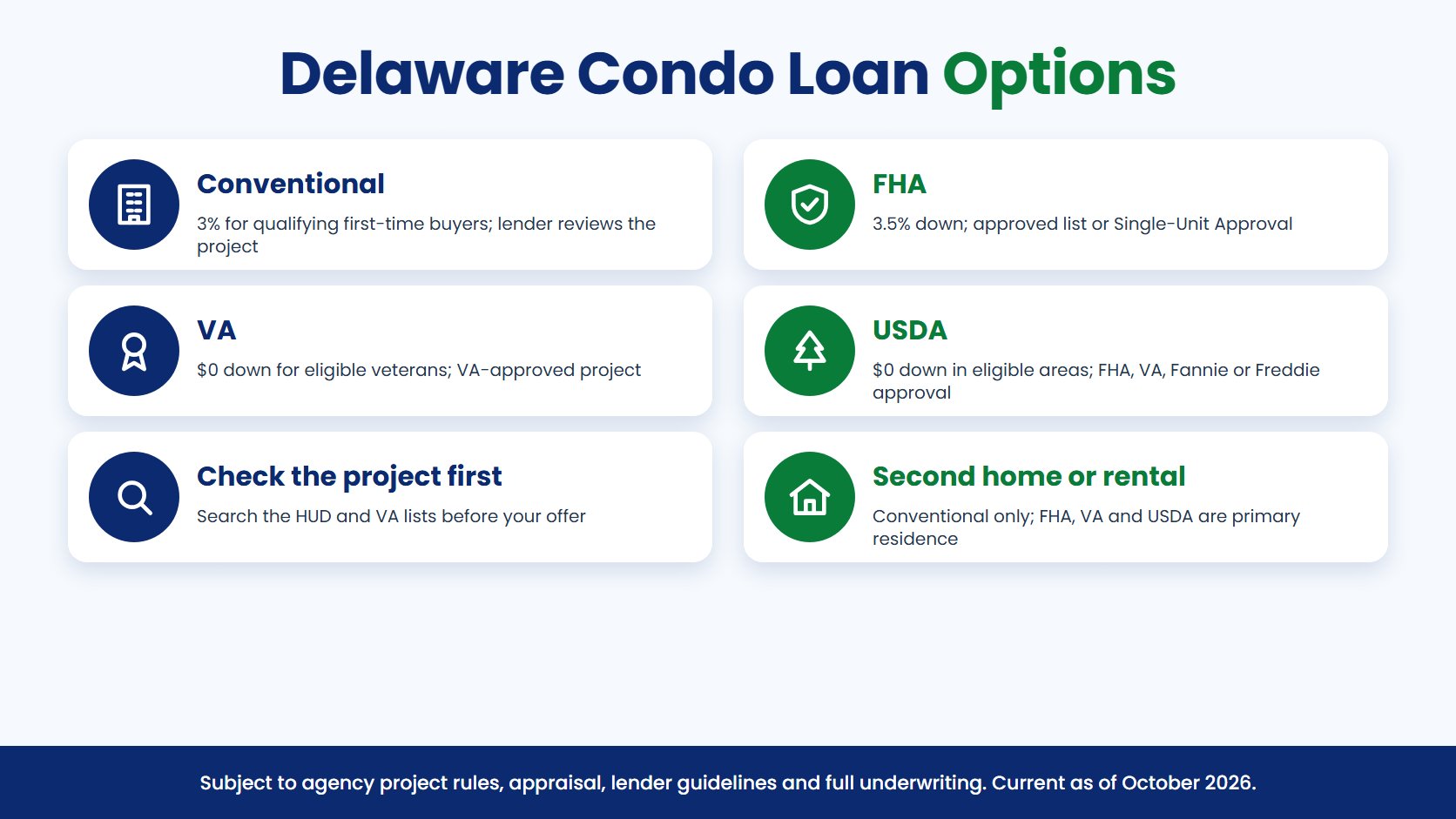
| Loan type | Minimum down payment | How the condo project qualifies | Occupancy |
|---|---|---|---|
| Conventional (Fannie Mae / Freddie Mac) | 3% for qualifying buyers on a 1-unit fixed-rate purchase; 5% otherwise | Lender project review (Full Review), or a waiver for small or detached projects | Primary home, second home or investment |
| FHA | 3.5% with a 580+ credit score | On HUD’s FHA-approved list, or a Single-Unit Approval for that one unit | Primary residence |
| VA | $0 for eligible veterans with full entitlement | On VA’s approved condo list | Primary residence |
| USDA Guaranteed | $0 in an eligible area, within income limits | Approved or accepted by FHA, VA, Fannie Mae or Freddie Mac | Primary residence |
Each program has its own page with the borrower rules: Delaware conventional loans, Delaware FHA loans, Delaware VA loans and USDA rural home loans. Loan size matters too. For 2026, the conforming loan limit set by FHFA is $832,750 in all three Delaware counties. HUD’s FHA limit lookup shows $630,200 for a one-unit home in New Castle County and $541,287 in Kent and Sussex. Our pages on Delaware FHA loan limits and Delaware conforming loan limits have the details.
How Do You Check Whether a Condo Is Approved?
Anyone can search the FHA and VA approved-condo lists online. Fannie Mae and Freddie Mac have no public approved list; a lender checks the project through Fannie Mae’s Condo Project Manager or its own review. An approval can also expire, so the date on the listing matters as much as the name.
- FHA: search HUD’s FHA-approved condominium list by state, county or project name. Look at the status and the expiration date. FHA project approval runs three years, and a project that lets it lapse drops off the approved list until it is renewed.
- VA: search the VA condo report on the LGY Hub. Choose Delaware and filter to approved projects. VA keeps its own list, so an FHA approval does not by itself make a project VA-approved.
- Conventional: your lender reviews the project. Fannie Mae’s public Condo Status Finder is built for associations and their managers, and Fannie Mae says a “no findings” result there does not mean a project was reviewed or approved.
- USDA: if the project is approved or accepted by FHA, VA, Fannie Mae or Freddie Mac, USDA can accept it too.
One warning about the third-party condo-list websites you’ll find in a search. Several of them still show Delaware projects whose FHA approval expired years ago. Go to the HUD and VA lists themselves, or send us the address and we’ll check.
In my experience, the condo files that run into trouble usually aren’t about the buyer. They’re about the project: an FHA approval that had lapsed, a budget that is short on reserves, a special assessment nobody mentioned, or a master insurance policy with a deductible the lender can’t accept. That’s why I ask for the association name and the condo documents before you write an offer, not after the appraisal. A ten-minute project check up front is a lot cheaper than a lost deposit or a missed closing date.
What Are the FHA Condo Rules?
As of October 2026, an FHA loan can finance a condo in a project on HUD’s approved list, or a single unit through FHA Single-Unit Approval when the project isn’t on the list. Either way, at least 50% of the units must be owner-occupied for an existing project, and the buyer needs 3.5% down with a 580 or higher score.
The FHA condo rules changed in October 2019, and a lot of what you’ll read online is older than that. The current rules are in HUD Handbook 4000.1, and HUD’s condominium program page explains the two paths.
Short on the 3.5% down payment? On an FHA-eligible condo, Dream Maker down payment assistance can provide 3.5% or 5% of the price as a second mortgage, with no income limit, as of October 2026 and subject to underwriting.
Path 1, an FHA-approved project. The whole project is on HUD’s list. For an existing project, at least 50% of the units must be owner-occupied; HUD can approve an existing project between 35% and 50% when it reviews the project itself and no more than 10% of units are behind on dues. Commercial space can’t be more than 35% of the floor area, and HUD can stop issuing new FHA case numbers once more than half the units carry FHA loans.
Path 2, Single-Unit Approval. This is the 2019 change that brought back what used to be called a “spot loan.” If the project isn’t on HUD’s list, FHA can still approve your one unit when:
- the project has at least 5 units and at least 50% of them are owner-occupied;
- FHA loans stay within the cap: no more than 10% of the units in a project of 20 or more units, or no more than two FHA loans in a project under 20 units;
- the unit’s certificate of occupancy is at least a year old, or the unit has already been lived in;
- the loan gets an “Accept” from FHA’s automated underwriting, or is held to 90% of the value if it is underwritten manually;
- the project has none of FHA’s ineligible characteristics.
Some articles still say the Single-Unit Approval cutoff is 10 units. The current Handbook uses 20 units, so a 15-unit building is held to two FHA loans, not 10%. The down payment is the same on either path: 3.5% with a credit score of 580 or higher, or 10% with a score from 500 to 579. FHA also charges mortgage insurance: an upfront premium of 1.75% of the loan amount, usually added to the loan, plus an annual premium paid monthly, which is 0.55% a year on a 30-year loan with the minimum 3.5% down, as set in HUD Mortgagee Letter 2023-05. And if the unit needs work, an FHA 203(k) rehab loan can cover repairs to the inside of a condo unit, but not the parts the association is responsible for.
What Are the VA and USDA Condo Rules?
As of October 2026, a VA loan requires the condo project to be on VA’s own approved list, which is separate from FHA’s. A USDA Guaranteed loan accepts a project that FHA, VA, Fannie Mae or Freddie Mac has approved or accepted. Both programs finance a primary residence only, with no down payment for eligible buyers.
VA. Federal regulations require VA to approve a condominium project’s legal documents before it guarantees a loan on a unit (38 CFR 36.4360). In practice that means the project has to show up as approved on the VA condo report. If it doesn’t, the project’s association or a lender can ask VA to review it, which takes time, so check the list before you’re under contract. Our VA loan eligibility requirements page covers the borrower side.
USDA. USDA’s handbook, HB-1-3555 Chapter 12, accepts a condo in a project that is approved or accepted by HUD, VA, Fannie Mae or Freddie Mac, or that can be approved under one of their standards. The lender certifies which one applies. The home also has to be in a USDA-eligible area, and your household income has to be within the county limit. You can check an address on USDA’s property eligibility map.
What Do Fannie Mae and Freddie Mac Require for a Condo?
As of October 2026, a conventional condo loan needs a lender project review unless the project qualifies for a waiver, such as a detached condo or a project of 10 or fewer units. The review checks that no more than 15% of owners are 60 days behind on dues and that at least 10% of the budget goes to reserves.
Fannie Mae and Freddie Mac both changed their condo rules for loan applications dated on or after August 3, 2026. Fannie Mae retired its “Limited Review,” Freddie Mac retired its “Streamlined Review,” and Fannie Mae dropped its old cap on how many units investors can own in an established project. You can read the changes in Fannie Mae Lender Letter LL-2026-03 and Freddie Mac’s Guide Section 5701.5. Here is what the review looks at now:
- Dues delinquency: no more than 15% of the units can be 60 or more days behind on their association dues or on a special assessment (Fannie Mae B4-2.2-01).
- Reserves: at least 10% of the association’s budget set aside for repairs and replacements, or a current reserve study the budget follows. Fannie Mae raises this to 15% for applications dated on or after January 4, 2027.
- Completed project: for an established project, the units, common areas and amenities are finished.
- Waivers: Fannie Mae waives the project review for detached condo units, 2-4 unit projects, and projects of 5 to 10 units that are not part of a larger master association (B4-2.1-02). Insurance rules still apply.
Conventional is also the only one of the four programs that finances a condo as a second home or a rental, which matters at the beach. Two cost points are worth knowing. A first-time buyer can put 3% down on a one-unit condo with a fixed rate, according to the Fannie Mae Eligibility Matrix. And as of October 2026, Fannie Mae’s pricing matrix adds a 0.75% condo price adjustment when you borrow more than 75% of the value (0.125% from 60% to 75%), which shows up in your rate or costs. Detached condos are exempt from that adjustment. With less than 20% down you’ll also pay private mortgage insurance until you reach 20% equity.
How Do Condo Fees Affect Your Mortgage Approval?
Your monthly condo or HOA fee counts as part of your housing payment when a lender figures your debt-to-income ratio, the same as principal, interest, taxes and insurance. A $300 monthly fee reduces the loan amount you qualify for roughly as much as $300 of extra mortgage payment would.
Fannie Mae’s housing expense rule lists owners’ association dues and special assessments in the monthly payment it uses to qualify you, which lenders call PITIA (principal, interest, taxes, insurance and association dues). Our page on understanding your debt-to-income ratio shows how that ratio works.
So what does the fee actually pay for? Every association is different, and the bylaws decide how much you pay and whether it’s due monthly or yearly. Some condos even charge two fees, a condo fee and an HOA fee for a larger community the condo sits in. In most Delaware condos the fee covers:
- Exterior maintenance, including the roof, siding, sidewalks, landscaping and snow removal. When the roofs or siding need replacing, the association handles it, paid for out of the fees and the reserves.
- The master insurance policy on the building’s exterior and structure.
- The common areas and amenities, such as a pool, clubhouse or recreation room, playground, walking paths or fitness center.
Let’s say a buyer is looking at a $250,000 condo with a $325 monthly condo fee, using FHA with 3.5% down. The lender adds the $325 to the principal, interest, mortgage insurance, taxes and homeowners policy to get the full monthly housing payment. If the same buyer compared a townhome at the same price with no association fee, the condo’s payment would run about $325 a month higher, and the buyer would need that much more room in their debt-to-income ratio to qualify. Cash to close is separate: the down payment plus closing costs, which in Delaware include the state and local realty transfer tax (first-time buyers may qualify for a state transfer tax exemption). Illustrative example only, not a loan offer or commitment. Taxes, insurance and fees vary by property.
What Insurance Do You Need for a Condo?
Most condo buyers need two policies: the association’s master policy, paid through the condo fee, and their own walls-in policy, called an HO-6. As of October 2026, Fannie Mae requires the owner’s policy when the master policy leaves any part of the unit’s interior uncovered or has a per-unit deductible.
The master policy covers the building’s exterior and structure. Your HO-6 policy covers what’s inside your walls: your personal belongings, and often the interior finishes such as flooring, cabinets and fixtures, depending on how the master policy is written. Under Fannie Mae’s unit insurance rule, your coverage has to be at least enough to restore the interior the master policy doesn’t cover, or the master policy’s per-unit deductible, whichever is greater. Ask the association for the master policy’s coverage page early, because it decides how much HO-6 coverage you need and what it costs. Our guide to understanding homeowners insurance covers the basics.
What Happens if the Condo Is Not Approved?
A condo that isn’t approved can often still be financed. FHA may approve a single unit, another program may accept the project, or a lender can complete a conventional project review. A project with an ineligible feature, such as hotel-style rentals or unfunded critical repairs, is “non-warrantable” and usually needs a portfolio or non-QM loan instead.
“Not on the list” and “not eligible” are two different things. “Not on the list” usually just means nobody has asked for an approval yet, and there’s often another path. “Not eligible” means the project has a feature that Fannie Mae and Freddie Mac won’t finance at all. Fannie Mae’s ineligible projects list includes:
- Condotels and hotel-style projects with a rental desk, mandatory rental pooling or hotel services. Fannie Mae also takes a closer look when 75% or more of the units are second homes or rentals, or units are under 400 square feet. At the Delaware beaches this matters: a building that is mainly nightly or weekly rentals, rented through a front desk or management company, can be ineligible even if it is called a condo.
- One owner with too many units: more than two units in a project of 20 or fewer units, or more than 20% of the units in a project of 21 or more.
- Too much commercial space: more than 35% of the project, or more than 10% of the association’s income from businesses such as a restaurant.
- Safety and repair problems: critical repairs of more than $10,000 per unit due within a year that aren’t funded, failed safety inspections, or an evacuation order.
- Litigation against the association or developer over safety, structural soundness or habitability.
A non-warrantable condo or condotel can’t get a Fannie Mae, Freddie Mac, FHA, VA or USDA loan, but that doesn’t make it unfinanceable. We finance non-warrantable condos and condotels through non-QM loan programs, which usually ask for a larger down payment and carry a higher rate than an agency loan. Approval still depends on the project, the property and your full file, so call us before you walk away from a condo you love.
What Is a Delaware Condo Resale Certificate?
A resale certificate is the package of association documents a Delaware condo seller must give the buyer by the time the purchase contract is signed. If you didn’t get it before signing, Delaware law lets you cancel the contract within 5 calendar days after you first receive it, before settlement.
The rule is in the Delaware Uniform Common Interest Ownership Act, Title 25, Section 81-409 of the Delaware Code. The association has 10 days to provide the certificate once the owner asks for it. It includes the declaration, bylaws and rules, the current fee and any special assessments, delinquencies, the reserves and any reserve study, the budget and recent financial statements, pending lawsuits, an insurance summary, and the last six months of board meeting minutes.
Those are the same things a lender’s project review checks. Read the certificate with your financing in mind: a special assessment raises your monthly cost, a thin reserve fund or a lawsuit can affect loan eligibility, and the insurance summary decides your HO-6 coverage. Send us a copy as soon as you have it. For questions about the contract itself, talk with your Delaware settlement attorney; this page is not legal advice.
How Does the Condo Loan Process Work?
A Delaware condo purchase moves through six steps: check the project, get pre-approved with the condo fee included, review the resale certificate and condo documents, complete the lender’s project review and appraisal, confirm the master and HO-6 insurance, then close. Checking the project first prevents most late surprises.
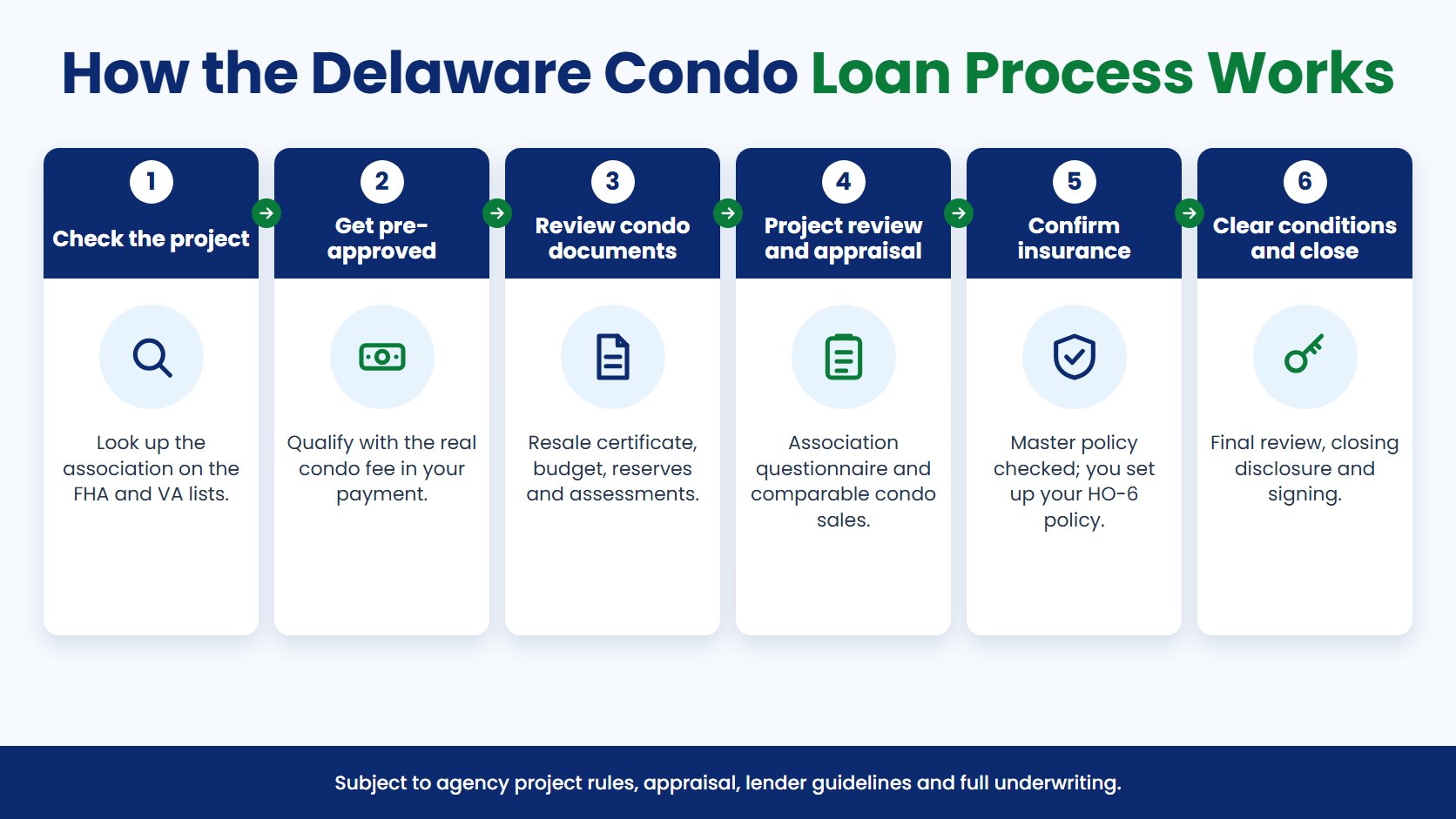
The John Thomas Team handles your file from application through underwriting. Our underwriting is local and typically takes 24 to 48 hours on a complete file. Here is the order we work in:
- Check the project. We look up the association on the FHA and VA lists and tell you which loan programs can work for that building.
- Get pre-approved. We qualify you with the actual condo fee in the payment, not an estimate.
- Review the condo documents. The resale certificate, budget, reserves, insurance and any special assessments.
- Project review and appraisal. The association or its manager completes the lender’s condo questionnaire, and the appraiser compares the unit with similar condo sales.
- Insurance. We confirm the master policy meets the program’s rules and you set up your HO-6 policy.
- Clear conditions and close. Final review, closing disclosure and signing.
When a Condo May Not Be the Right Fit for Your Loan
A condo can be a great way to own in Delaware for less than a single-family home, but be honest with yourself about these situations before you make an offer:
- You’re counting on FHA, VA or USDA, and the project isn’t approved and can’t qualify for a Single-Unit Approval. A conventional loan may still work, usually with a larger down payment.
- You want a beach condo that operates like a hotel, with a rental desk or required rental program. That’s a condotel. Agency loans won’t finance it, so you’d be looking at a non-QM condotel loan with more money down.
- The association has a large special assessment coming, very low reserves or a lawsuit over the building’s condition. Those can stop the loan or raise your monthly cost.
- The condo fee would push your debt-to-income ratio past what your loan program allows. A townhome or single-family home at the same price may qualify more easily.
- You want to renovate the outside or the structure. A 203(k) or HomeStyle renovation loan can only cover the inside of a condo unit; the exterior belongs to the association.
Delaware Condo Loans – FAQ
Can I get an FHA loan on a condo that isn’t on the FHA-approved list?
Often, yes. FHA Single-Unit Approval lets FHA insure one unit in a project that isn’t on HUD’s approved list, as long as the project has at least 5 units, at least half are owner-occupied, FHA loans stay within the cap (10% of units in a project of 20 or more, or two loans in a smaller project) and the loan gets an automated Accept. The project also can’t have any of FHA’s ineligible characteristics. Send us the address and we’ll check it before you make an offer.
What credit score do I need to buy a condo in Delaware?
It depends on the loan. FHA allows 3.5% down with a credit score of 580 or higher, and 10% down from 500 to 579. Fannie Mae no longer sets a fixed minimum score for loans approved through its automated system. Every lender adds its own minimums for each program, so ask us for ours. In my experience the condo project stops more condo loans than the buyer’s score does, so we check both at the start.
Can I buy a beach condo in Sussex County as a second home or rental?
Yes, with a conventional loan. FHA, VA and USDA finance a primary residence only, so a second home or rental condo needs conventional financing, which usually means a larger down payment than a primary residence. The project still has to pass review. A building that runs like a hotel, with a rental desk or a required rental program, is a condotel and is not eligible for a Fannie Mae or Freddie Mac loan. We finance condotels through non-QM programs, usually with a larger down payment.
Does the condo fee count against me when I qualify?
Yes. Lenders add your monthly condo or HOA fee to your principal, interest, taxes and insurance to get your full housing payment, and that payment goes into your debt-to-income ratio. A higher fee lowers the loan amount you qualify for. If a special assessment is being billed to owners, the lender counts that payment too. We build your pre-approval with the real fee from the association, not an estimate.
What is an HO-6 policy and do I need one?
An HO-6 is the walls-in insurance policy a condo owner buys to cover the inside of the unit and personal belongings. The association’s master policy covers the building’s exterior and structure. Fannie Mae requires the owner’s own policy when the master policy leaves any part of the unit’s interior uncovered or carries a per-unit deductible, and most buyers end up needing one. The master policy’s coverage decides how much HO-6 coverage you need.
What happens if the condo association has a special assessment?
The lender reviews what the assessment is for, how much it is, how much is left to pay and when it ends. A special assessment for routine work usually isn’t a problem, though your share counts in your monthly payment. One tied to an unfunded critical repair, such as structural or safety work, can make the project ineligible for Fannie Mae and Freddie Mac. Ask the seller who pays any assessment that is already billed, and read the resale certificate closely.
Can I use a VA loan on a condo that’s FHA-approved?
Not on the strength of the FHA approval alone. VA must approve the condo project itself, and it keeps its own list on the LGY Hub condo report. A project can be FHA-approved and not VA-approved, or the other way around. If the project isn’t on VA’s list, the association or a lender can ask VA to review it, which takes time. Check the VA list before you’re under contract, or send us the project name and we’ll check.
Can I cancel a Delaware condo purchase after I read the condo documents?
Sometimes. Under Delaware Code Title 25, Section 81-409, the seller must give you a resale certificate by the time you sign the contract. If you didn’t receive it before signing, you can cancel within 5 calendar days after you first receive it, before settlement. Contracts can add their own contingencies as well. Talk with your Delaware settlement attorney about your contract; this answer is general information, not legal advice.
Can I use an FHA 203(k) or renovation loan to fix up a condo?
Yes, for the inside of the unit. HUD allows a 203(k) loan to rehabilitate the interior of an eligible condo unit, but not the parts of the building the association is responsible for, such as the roof, exterior walls or common areas. The project still has to meet FHA’s condo rules. A conventional HomeStyle renovation loan works the same way for the unit’s interior.
Are condos harder to finance than a single-family house?
The borrower side is about the same: credit, income, debts and savings follow the same program rules as a house. What’s different is that the lender also reviews the condo project itself, including the association’s budget, reserves, insurance, dues delinquencies and any lawsuits or critical repairs. A strong buyer can still be turned down because of the project, so condo financing has one more hurdle than a house. Checking the project before you make an offer removes most of that risk.
About the Author – John R. Thomas

John R. Thomas is Branch Manager and Division Vice President with the John Thomas Team in Newark, Delaware, and has helped Delaware families finance homes for more than 20 years. He has been teaching buyers how condo financing works since he first put this page and its companion video online, and on every condo purchase he checks the project before the borrower: the FHA and VA lists, the association’s budget and reserves, and the master insurance policy.
John holds a BS in Physics Education from the University of Delaware and an MS in Curriculum and Instruction from Delaware State University. He is the author of Your Guide to Buying Your First Home in Delaware and a frequent host of Delaware home buyer seminars. State licensing: Look up John R. Thomas, NMLS #38783, on NMLS Consumer Access. Read more on his loan officer bio page.
Years 3,000+
Buyers Helped 1,000+
Govt Loans DE & MD
Service Area CMP
Certified Mortgage Planner
John Thomas Team with AnnieMac Home Mortgage
248 E Chestnut Hill Rd, Newark, DE 19713 | 302-703-0727 | team@johnthomasteam.com
Schedule Appointment (30 min)
See John Thomas Team on Google for reviews, directions, and local office information.
YouTube | Facebook | Instagram | TikTok | X / Twitter | LinkedIn

Send us the condo’s address or association name. We’ll check the project against FHA, VA, Fannie Mae and Freddie Mac rules, build your payment with the real condo fee, and tell you which loan fits before you make an offer.
Last Updated: October 2026 · John Thomas Team with AnnieMac Home Mortgage · Mortgage content reviewed by John R. Thomas, NMLS #38783.
John R. Thomas, NMLS #38783 | John Thomas Team with AnnieMac Home Mortgage | AnnieMac Home Mortgage NMLS #338923 | 248 E Chestnut Hill Rd, Newark, DE 19713 | 302-703-0727 | delawaremortgageloans.net
AnnieMac Home Mortgage is an Equal Housing Lender. State licensing: Look up John R. Thomas, NMLS #38783, on NMLS Consumer Access.
(c) Copyright John R. Thomas, All Rights Reserved.
