Understanding Seller Paid Closing Costs in Delaware
What are seller paid closing costs? They are a credit a Delaware seller agrees to apply toward the buyer’s closing costs at settlement — also called seller concessions or seller’s assistance. Limits depend on loan type: up to 6% with FHA and USDA, up to 9% on some conventional loans, and customary costs plus up to 4% with VA. Current as of June 2026.
I’m John Thomas, NMLS #38783, and one of the most common questions I get from Delaware buyers is how to keep cash in their pocket at the closing table. From our Newark office, I help buyers across Delaware and Maryland understand how seller credits affect their cash to close. Seller paid closing costs are often the answer — but only when they are negotiated correctly and written into the sales agreement. If you are early in the process, it helps to look at your full down payment and closing cost picture first, so we can structure your offer around the help you actually qualify for instead of guessing.
Find Out How Much Seller Help You Need
Get pre-approved and we’ll run the exact numbers on your offer before you sign.
John Thomas, NMLS #38783, will help you size the credit before your offer is written.
Table of Contents
What Are Seller Paid Closing Costs?
Seller paid closing costs are negotiated between the home buyer and the home seller during the initial offer process and are written into the sales agreement. They are also called seller’s assistance or seller concessions. The key thing to understand is simple: if the seller paid closing costs are not written into the contract, they do not exist and will not be credited to you at settlement. There is no way to add them after the fact without renegotiating the entire deal.
One more point worth being clear about: a seller credit is a term of the purchase contract negotiated between buyer and seller. It is not a gift, a rebate, or money from your lender — it is the seller agreeing to apply part of the sale proceeds toward your costs at closing.
In this short video, John Thomas walks through how seller paid closing costs are negotiated into the contract, how the credit reduces your cash to close at settlement, and how the maximum you can ask for changes with your loan type.
What Seller Assistance Can (and Cannot) Cover
First, the baseline: closing costs are the lender, title, government, and prepaid charges a buyer pays to finalize a purchase — typically about 2% to 5% of the price for Delaware buyers. Seller paid closing costs are a credit toward those charges, applied at settlement. They are not cash back, and they cannot go toward your down payment.
Seller assistance can typically be applied to allowable closing costs, prepaid items, and certain loan costs, including:
- Loan origination and underwriting fees
- The appraisal fee
- Title search and lender’s title insurance
- Settlement or attorney fees
- Recording fees and other government charges
- Prepaid property taxes and homeowners insurance (escrows)
- Per-diem (daily) interest
- Discount points to lower your interest rate
- On government loans, the upfront FHA mortgage insurance premium or VA funding fee (program-dependent)
Seller assistance generally cannot be used for the down payment, the buyer’s minimum required investment (such as the 3.5% on FHA), cash back at closing, and — on conventional loans — required reserves. The cap and the eligible uses follow the buyer’s loan program: FHA’s interested-party contribution limit is 6% of the sales price (per HUD Handbook 4000.1), VA limits seller concessions to 4% of the value while customary closing-cost credits are not capped, USDA allows up to 6%, and conventional interested-party contributions follow Fannie Mae and Freddie Mac limits that scale with the down payment. These are program rules and may be subject to investor overlays, so confirm the exact treatment for your loan with your loan officer.
How Seller Assistance Affects Your Offer Price
It is very important to understand that when you ask the seller to pay money toward your closing costs, the seller is effectively taking that money off the purchase price to hand back to you at closing. For example, if you offer the seller $200,000 for their home and ask for $10,000 in seller paid closing costs, your real net offer to the seller is $190,000. Most sellers and their agents look at the net number, so a strong-looking price with a large assistance request can be weaker than it appears. This is why your agent and your loan officer should structure the offer together.
Why Sellers Agree: Seller Paid Costs vs. a Price Reduction
A common question is why a seller would pay your closing costs instead of just lowering the price. To the seller, a credit and a price cut are not the same thing. A price reduction lowers the contract price (and the comparable value other buyers and appraisers see in the neighborhood), while a closing-cost credit keeps the contract price intact and simply reduces the seller’s net proceeds by the same dollars. Agreeing to a credit can also help keep a deal together and move the sale along, which is why many sellers prefer it.
For the buyer, the choice usually comes down to cash. If you are short on funds to close, a $9,000 credit is often far more useful than a $9,000 price cut, because the credit directly reduces what you bring to the table rather than trimming a few dollars off the monthly payment. The tradeoff: a credit only helps up to the amount of your real closing costs, so a buyer with plenty of cash may be better off asking for the price reduction instead. Run both ways with your loan officer before you decide.
Who Negotiates Seller Paid Closing Costs?
Seller paid closing costs are negotiated by your buyer’s agent with the seller’s agent when the offer is submitted. It is critical that you, your agent, and your lender are all working from the same numbers. Here is a common mistake: say your lender pre-approves you for a $200,000 purchase with $10,000 in seller paid closing costs, but the offer goes in for $200,000 with “3% seller assist.” Three percent of $200,000 is only $6,000 — so you just asked for $4,000 less than you needed, and you will have to bring the difference to closing yourself.
That is why you should always have your lender run the numbers on your offer and on any counteroffers before you accept the contract. Catching it up front prevents the “sticker shock” of learning, after the contract is signed, that you did not lock in the assistance you needed — because at that point it is very hard to get the seller to agree to new terms.
How Seller Paid Closing Costs Get Into Your Deal
Step by step, here is how seller assistance goes from idea to credit on your Closing Disclosure:
- Get pre-approved so your loan officer can estimate your real closing costs and the maximum credit your loan type allows.
- Decide the dollar amount of assistance you need — ask in dollars, not just a percentage, so the figure is exact.
- Have your buyer’s agent write the seller credit into the purchase contract; if it is not in the contract, it does not exist.
- Re-run the numbers on any counteroffer before you accept it.
- At closing, the credit appears on the Closing Disclosure as a credit to you and a matching debit to the seller.
How Much Seller Paid Closing Costs Can I Get by Loan Type?
The amount of seller assistance you can negotiate depends on the type of mortgage you are using to finance the purchase. Each loan program sets its own cap, and on conventional loans the cap also depends on your down payment. These are program maximums — the actual amount you negotiate is still up to you, your agent, and the seller, and you can only use as much as there are real closing costs to apply it to.
| Loan Type | Maximum Seller Paid Closing Costs |
|---|---|
| FHA and FHA 203(k) | Up to 6% of the purchase price |
| VA | All customary closing costs, plus up to 4% of the value for items such as discount points and paying off buyer debt |
| USDA | Up to 6% of the purchase price |
| Conventional — less than 10% down | Up to 3% of the purchase price |
| Conventional — 10% to 25% down | Up to 6% of the purchase price |
| Conventional — 25% or more down | Up to 9% of the purchase price |
| Conventional — investment property (any down payment) | Up to 2% of the purchase price |
You can dig into each program on its own page: Delaware FHA loans, FHA 203(k) rehab loans, Delaware VA loans, USDA rural home loans, and Delaware conventional loans.
What this means for you: the highest allowed seller credit is not always the right number to ask for. The right number is the amount that covers your real closing costs and prepaid items without creating unused credit that the seller simply keeps.
Delaware buyer example — $300,000 purchase (statutory math, not a rate quote): 3% seller assistance is $9,000 and 6% is $18,000. You can only apply as much as you have real closing costs and prepaid items to cover, and the maximum percentage depends on your loan type (see the table above). Your loan officer can give you the exact dollar figure to write into your offer.
How and When Do You Get the Money?
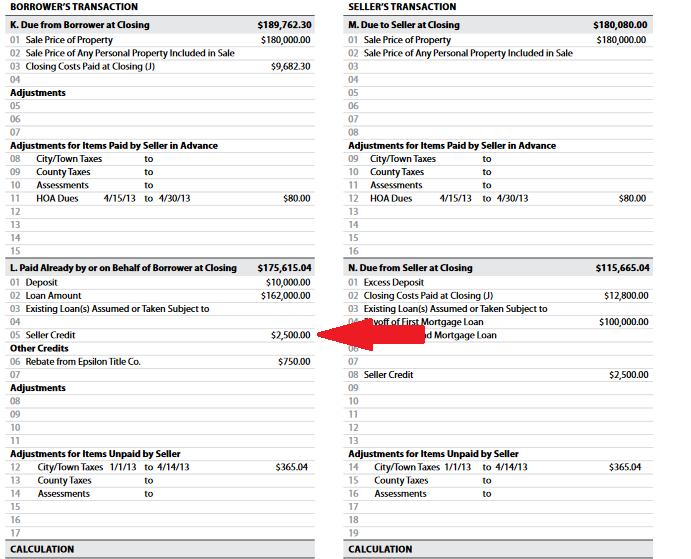
The seller assistance negotiated in your sales contract is never handed to you directly. It can only appear as a credit at closing on the Closing Disclosure (CD). Typically it shows up as a line-item credit on the buyer’s side of Page 3 of the CD and a matching line-item debit from the seller’s side of Page 3. In some cases, the same result is achieved by moving specific buyer fees over to the seller’s side of Page 2 of the Closing Disclosure instead of doing one lump-sum credit on Page 3. Either way, the dollars reduce what you owe at the table. You can review the official CFPB explanation of the Closing Disclosure for reference.
Here is how that credit looks on an actual Closing Disclosure:
Does the Seller Pay Closing Costs Out of Pocket?
No. The seller does not write you a check and does not pay your closing costs out of their own pocket. Any closing cost assistance you negotiate is a credit at closing on the Closing Disclosure — a line-item debit from the seller to the buyer. In practice, it simply reduces the seller’s net proceeds from the sale. The seller is not bringing money to the table for you; they are accepting a little less from their own sale price. That framing is also why sellers care about the net number, not just the headline price.
What If There Are Not Enough Costs to Use the Assistance?
If you negotiate more seller paid closing costs than there are actual costs to apply them to, the seller keeps the difference — you cannot pocket the extra as cash. For example, if you negotiate $10,000 in seller assistance but your real closing costs come to $8,500, the leftover $1,500 stays with the seller and goes to their bottom line on the Closing Disclosure.
One way to put leftover assistance to work is to add a seller-paid home warranty. If you add a two-year home warranty at, say, $500 per year ($1,000 total), then in the example above only $500 would revert to the seller and you walk away with two years of warranty coverage instead. Whether that move makes sense depends on your contract and the property, so talk it through with your agent.
Common Mistakes With Seller Paid Closing Costs
- Asking for a percentage when you needed a dollar amount — 3% of $200,000 is only $6,000, which can fall short of your actual costs.
- Not having your lender re-run the numbers before you sign the contract or a counteroffer.
- Asking for more assistance than you have real closing costs to use, so the seller keeps the unused portion.
- Using the higher-price-plus-credit strategy without first confirming the home will appraise for the higher price.
- Forgetting the Delaware transfer tax when sizing the request — on a builder contract the buyer may owe the full 4%.
Can I Finance My Closing Costs Into My Mortgage Loan?
A frequent misunderstanding is that you can simply “roll” your closing costs into the loan. On a purchase, the loan programs generally will not let you do that, because the amount you can borrow is based on the purchase price. For example, an FHA loan lets you borrow 96.5% of the purchase price, so on a $100,000 purchase you can borrow $96,500 and put down $3,500 as your minimum required investment. If your closing costs are $6,500, you would need your $3,500 down payment plus the $6,500 in costs — $10,000 total. If you negotiated the maximum 6% FHA seller assistance ($6,000), you would only need about $4,000.
There is one indirect way to fold closing costs into the financing: increase the sales price by the amount of the costs and have the seller agree to pay that amount back as seller paid closing costs. On the FHA example above, you would raise the purchase price to $106,000 and have the seller credit $6,000 toward closing — in effect “rolling” the costs into the loan. The important catch is that the home must appraise for $106,000 for this to work. If the appraisal comes in lower, the strategy falls apart, so it should only be used when the value clearly supports it.
Seller Assistance and the Delaware Transfer Tax
Delaware-specific note on transfer tax. Delaware’s combined state and county transfer tax is generally 4% of the purchase price, and on standard Delaware Association of Realtors (DAR) contracts it is usually split 2% buyer / 2% seller. Seller paid closing costs can help cover the buyer’s 2% share, which is often the single largest line on a Delaware buyer’s Closing Disclosure.
Watch the builder contracts. On many new-construction builder agreements, the buyer may be required to pay the full 4% transfer tax. That changes how much seller assistance you will need, so always confirm who pays the transfer tax in your specific contract before you set your assistance request. First-time Delaware buyers may also qualify for a reduction in the state portion of the transfer tax — ask whether you qualify, because it affects your cash to close.
| Delaware Cost Item | Why It Matters |
|---|---|
| Transfer tax (about 4%) | Often the single largest closing cost on a Delaware purchase |
| Standard DAR resale contract | Transfer tax usually split 2% buyer / 2% seller |
| New-construction builder contract | Buyer may be required to pay the full 4% |
| First-time buyer reduction | May reduce the buyer’s share of the state portion — ask if you qualify |
Buyers across Newark, Wilmington, Middletown, Dover, Bear, New Castle, Smyrna, and Sussex County all use seller assistance to bring down cash to close. Because Delaware transfer taxes and prepaid costs can be a large share of settlement charges, getting the seller-credit number right matters more here than in many states.
Closing costs are only one piece of the cash-to-close puzzle. If you want to see how the down payment, closing costs, and monthly payment fit together, start with our Delaware first-time home buyer guide and our breakdown of your monthly mortgage payment. You may also be able to pair seller assistance with a DSHA Welcome Home down payment assistance program, depending on your loan structure.
Seller paid closing costs: the short version
- A seller credit is negotiated into the purchase contract — if it is not written in, it does not exist.
- The maximum depends on your loan type: up to 6% on FHA and USDA, up to 9% on some conventional loans, and customary costs plus up to 4% on VA.
- It can cover allowable closing costs, prepaid items, and certain loan costs — never the down payment or cash back.
- You can only use as much as you have real costs to apply it to; the seller keeps any unused portion.
- In Delaware, a credit can help with the buyer’s share of the 4% transfer tax — but watch builder contracts, where the buyer may owe the full amount.
FAQ — Seller Paid Closing Costs in Delaware
How much can the seller pay toward my closing costs?
It depends on your loan type. FHA, FHA 203(k), and USDA loans allow up to 6% of the purchase price. VA loans allow all customary closing costs plus up to 4% of value for items like discount points and paying off buyer debt. Conventional loans allow 3% with less than 10% down, 6% with 10 to 25% down, 9% with 25% or more down, and 2% on investment properties. These are program maximums and may be subject to overlays, so confirm your number with your loan officer.
Does asking for seller paid closing costs lower my offer?
Effectively, yes. When you ask the seller to credit money toward your closing costs, that amount comes off what the seller nets from the sale. A $200,000 offer with a $10,000 assistance request is really a $190,000 net offer. Most sellers evaluate the net figure, so your agent and loan officer should structure the price and assistance together so your offer still reads as competitive.
Can I roll my closing costs into my mortgage loan in Delaware?
On a purchase, loan programs generally will not let you simply roll closing costs into the loan, because the loan amount is based on the purchase price. The one indirect method is to raise the sales price by the cost amount and have the seller credit it back as seller paid closing costs. This only works if the home appraises for the higher price, so it should be used only when the value clearly supports it.
What happens if my closing costs are less than the assistance I negotiated?
If you negotiate more seller assistance than you have actual closing costs, the seller keeps the unused portion — you cannot take it as cash. For example, $10,000 negotiated against $8,500 in real costs leaves $1,500 with the seller. A common workaround is adding a seller-paid home warranty so some of the leftover credit benefits you instead of reverting entirely to the seller.
Does the seller write me a check for my closing costs?
No. The seller never hands the buyer a check and does not pay out of pocket. Seller assistance appears only as a credit at closing on the Closing Disclosure — a line-item debit from the seller to the buyer on Page 3, or by moving certain buyer fees to the seller’s side on Page 2. It reduces the seller’s net proceeds rather than being a separate payment.
Can I use seller paid closing costs with a DSHA down payment assistance program?
In many cases buyers can pair seller assistance with a Delaware State Housing Authority program such as Welcome Home, since the two address different costs — down payment versus closing costs. Whether they stack, and by how much, depends on your specific loan structure and program rules, so confirm your scenario with your loan officer before writing the offer.
Does the seller paying my closing costs affect my interest rate?
Not by itself. Seller assistance covers closing costs and prepaid items. However, if you choose to use part of that credit to buy discount points, that can lower your rate. The credit and your rate are separate decisions, and your loan officer can show you whether applying assistance toward points makes sense for how long you plan to keep the loan.
Can seller paid closing costs cover the Delaware transfer tax?
Often, yes. On standard Delaware Association of Realtors contracts the 4% transfer tax is usually split 2% buyer / 2% seller, and seller assistance can help cover the buyer’s 2% share. Be careful with new-construction builder contracts, where the buyer may owe the full 4% — that changes how much assistance you should request. Always confirm who pays the transfer tax in your specific contract.
What happens if the appraisal comes in lower than the contract price?
A low appraisal does not erase the seller credit, but your loan amount is based on the lower of price or appraised value, so you may need to renegotiate the price, bring extra cash, or use an appraisal contingency. If you used the higher-price-plus-seller-credit strategy to fold in costs, a low appraisal can unwind it — which is why that approach should only be used when the value clearly supports it. Your loan officer and agent can map out the options for your specific contract.
Should I ask for a price reduction or seller paid closing costs?
It depends on your cash situation. If you are short on funds to close, a seller credit is usually more useful because it directly reduces what you bring to the table, up to the amount of your real closing costs. If you have plenty of cash and want a lower loan balance and payment, a price reduction may be better. Buyers in similar situations often benefit more from the credit early on, but the right answer is specific to your numbers, so run both with your loan officer before deciding.
Can seller assistance cover my buyer’s agent commission?
This is an evolving area following recent changes to how buyer-agent compensation is handled, and the treatment varies by loan program and investor. In some cases a negotiated seller concession may be applied toward buyer-agent fees within program limits; in others it may not. Because the rules are still settling and differ by loan type, confirm the current treatment for your specific program with your loan officer before counting on it in your offer.

About the Author — John R. Thomas, Branch Manager & Mortgage Loan Officer. John has spent more than 20 years helping Delaware buyers structure offers that keep cash in their pockets at closing. Seller paid closing costs are one of his most-used tools, and he has run the numbers on thousands of Delaware purchase contracts to make sure buyers ask for the right amount before they sign — not after.
John is the author of Your Guide to Buying Your First Home in Delaware and a frequent host of free Delaware home buyer seminars. He works with buyers across Delaware and Maryland from the Primary Residential Mortgage office in Newark, and his team is known for explaining the parts of a closing that most lenders gloss over.
John Thomas Team — Primary Residential Mortgage, Inc.
248 E Chestnut Hill Rd, Newark, DE 19713 | 302-703-0727
Schedule Appointment (30 minutes) | Watch on YouTube
Rated 4.8 stars across 285 Google reviews. See John Thomas Team on Google for reviews, directions, and local office information.
Licensed in 17 states (AL, DC, DE, FL, GA, IN, KS, MD, MN, MO, NC, NJ, OH, PA, SC, TN, VA). NMLS #38783. This list reflects licensing credentials; the operational service area for this site is Delaware and Maryland.
When to call John about seller assistance:
- Before you write an offer
- Before you accept a counteroffer
- If your assistance is written as a percentage instead of a dollar amount
- If the appraisal might come in tight
- If you are combining seller help with DSHA or another down payment assistance program
Get Your Seller Assistance Numbers Right Before You Sign
A quick pre-approval review tells you exactly how much seller paid closing costs to write into your Delaware offer — so you are not surprised at the table. Let’s run your numbers.
Last Updated: June 2026. Mortgage content reviewed by John R. Thomas, NMLS #38783.
John Thomas, NMLS #38783 | Primary Residential Mortgage, Inc. | 248 E Chestnut Hill Rd, Newark, DE 19713 | 302-703-0727 | delawaremortgageloans.net
Copyright John R. Thomas, All Rights Reserved.
