The Financial Benefits of Owning a Home in Delaware


Current as of June 2026. Owning a home in Delaware can help you build equity through loan paydown, hold your principal-and-interest payment steady with a fixed-rate mortgage, and qualify for tax deductions if you itemize. These benefits depend on your budget, timeline, and the market – and renting can still be the better short-term choice.
I am John Thomas, a Delaware mortgage loan officer (NMLS #38783) with the John Thomas Team at Primary Residential Mortgage in Newark. Over more than 20 years I have helped more than 3,000 Delaware families buy their first home, and one question comes up at almost every kitchen-table conversation and every first-time home buyer seminar I teach: “Is owning really better than renting, or does it just feel that way?” This page walks through the actual financial reasons people choose to own, written for Delaware first-time home buyers – including where owning helps, and where it honestly does not.
Wondering whether buying makes sense for your numbers?
Talk it through with a local Delaware loan officer – no pressure, no obligation.
Table of Contents
What Are the Financial Benefits of Owning a Home in Delaware?
The financial benefits of owning a home include building equity through loan paydown, stabilizing your housing costs with a fixed-rate mortgage, qualifying for tax advantages if you itemize, and building long-term wealth as you pay down the loan and any appreciation accrues. Here is how each one works, with the Delaware programs that make starting easier.
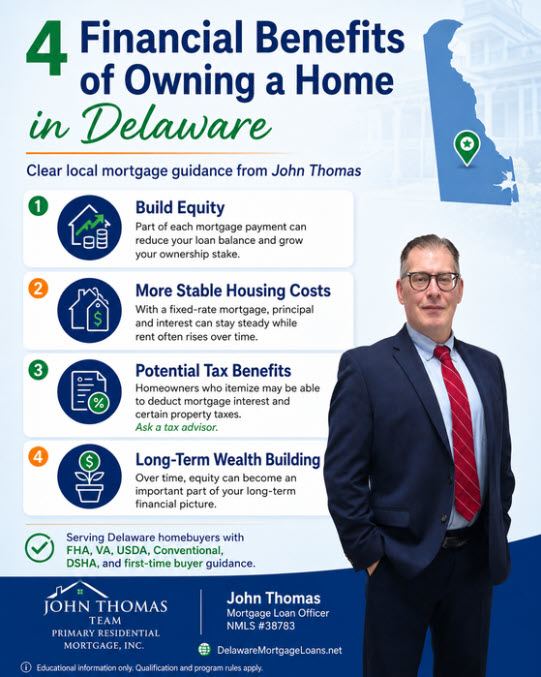
When people ask me why owning beats renting, they usually expect a single magic answer. There is not one – there are several smaller advantages that add up over time. For most Delaware buyers, the financial case for owning rests on four things: you build equity instead of paying someone else’s mortgage, a fixed-rate loan keeps your principal-and-interest payment stable while rents climb, you may qualify for tax deductions that renters cannot use, and over many years home equity often becomes a meaningful part of a family’s net worth. Each of those depends on your situation, so think of them as advantages that are available to owners, not guarantees that apply to everyone.
Quick Answer for Delaware Buyers
Owning a home in Delaware can be a strong financial move when you plan to stay put for several years, you can comfortably afford the monthly payment plus upkeep, and you have a path to a down payment (often with help from Delaware down payment assistance programs). The biggest benefit for most buyers is forced savings through equity: a fixed mortgage payment slowly converts into ownership, while rent pays for housing but does not build any ownership interest in the property. It is not the right move for everyone, and that is okay – the goal is to make the choice with clear numbers, not pressure.
Financial benefits of owning a home in Delaware, at a glance:
| Benefit | How it works | What can change it |
|---|---|---|
| Equity (forced savings) | Scheduled principal payments reduce your loan balance, building your ownership stake | The home’s value can rise or fall over time |
| Stable principal and interest | A fixed-rate loan locks the principal-and-interest portion of your payment | Property taxes and insurance can still increase |
| Tax treatment | Owners who itemize may be able to deduct mortgage interest and certain property taxes | Depends on current tax law and whether you itemize – see a tax advisor |
| Long-term housing cost | A mortgage can eventually be paid off, unlike rent | Maintenance, repairs, insurance, and taxes continue after payoff |
| Long-term family wealth | Equity can be kept, borrowed against later, or passed on | Market value, selling costs, and how long you own all affect the result |
Building Equity: A Forced Savings Account You Live In
The single benefit I come back to most often is equity. Every month, part of your mortgage payment goes toward interest and part goes toward paying down what you borrowed. The portion that pays down the balance is yours – it is, in effect, a savings account you live inside. With renting, the entire payment is an expense; with a mortgage, a slice of it builds your stake in the property. Early in the loan that slice is small because more of the payment is interest, but it grows every year as the balance falls.
Equity can also grow a second way: if your home’s value rises over time. Delaware home values have generally trended upward over the long run, but values can also stay flat or fall in any given period, so I never promise appreciation. The dependable part is the loan paydown – it follows your amortization schedule as long as you make your payments as agreed, regardless of what the market does. Many buyers tell me the “forced” nature of it is what makes it work: the payment is due whether or not they feel like saving that month, so the equity builds even when a voluntary savings plan might not. If you want to see how the pieces of a payment break down, our guide to understanding your mortgage payment (PITI) walks through principal, interest, taxes, and insurance.
How Does Owning Protect You From Rising Rent in Delaware?
One of the quieter advantages of owning is cost stability. With a fixed-rate mortgage, your principal-and-interest payment is locked for the life of the loan. Property taxes and homeowners insurance can change over time, so your total monthly payment is not perfectly frozen – but the principal-and-interest portion does not change on a fixed-rate loan. Renters do not get that protection. Lease renewals in many Delaware markets have brought higher rent more years than not, and a tenant has little control over the next increase.
It is worth being clear-eyed here: in the first few years, owning is not always cheaper month to month than renting once you add taxes, insurance, and maintenance. The stability advantage tends to show up over a longer horizon, as rents rise and your fixed payment does not. That is why timeline matters so much in the rent-versus-buy decision, which is the next section.
Being balanced also means naming the costs that can shrink the benefit. As an owner you take on expenses a renter does not pay directly, and they belong in any honest comparison:
- Maintenance and repairs – routine upkeep plus the occasional larger repair (roof, HVAC, appliances) that a landlord would otherwise handle.
- Property taxes and homeowners insurance – these can rise over time and are the parts of your payment that are not fixed.
- HOA or condo fees – where they apply, and they can change.
- Closing costs to buy and selling costs to sell – which is a big reason short ownership periods often favor renting.
- Less liquid cash – your down payment is tied up in the home and is not as easy to reach as money in a savings account.
One quieter upside cuts the other way: because the principal-and-interest portion is fixed, owning can act as a partial hedge against rising housing costs over the long run, while a renter’s payment is exposed to each year’s increase. None of this makes owning automatically better or worse – it makes the honest comparison a personal one.
Is It Cheaper to Rent or Buy a Home in Delaware?
This is the question I get most, and the honest answer is: it depends on how long you plan to stay and what your numbers look like. Renting often looks cheaper on a single month’s comparison, because a tenant does not pay property taxes, homeowners insurance, or repairs directly. But those costs do not vanish; landlords may reflect property expenses, market conditions, and expected returns in the rent they charge. Over a longer stay, the math frequently shifts toward owning, mostly because of the equity you build and the rent increases you avoid. Over a short stay, renting often wins, because the upfront costs of buying have not had time to pay off.
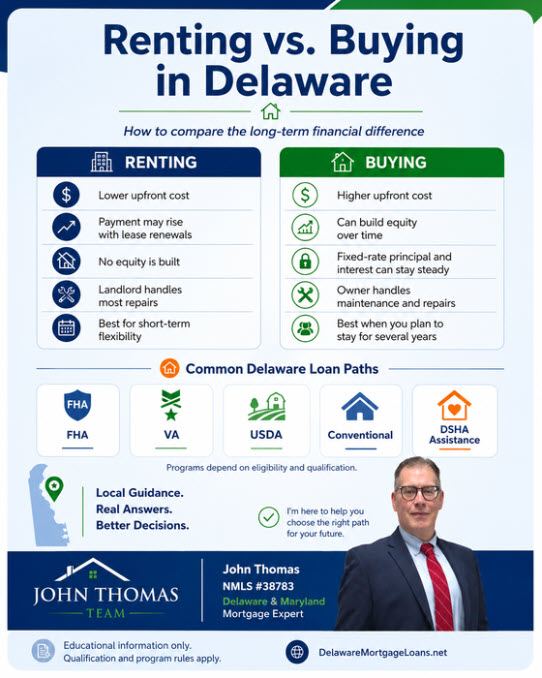
| Factor | Renting in Delaware | Owning in Delaware |
|---|---|---|
| Monthly payment trend | May increase when the lease renews | Fixed principal and interest with a fixed-rate loan |
| Equity / forced savings | None – payment is an expense | Loan paydown builds equity each month |
| Upfront cost | Lower (deposit plus first/last month) | Higher (down payment plus closing costs) |
| Maintenance and repairs | Landlord’s responsibility (paid via rent) | Owner’s responsibility (budget for it) |
| Tax deductions | Not available to renters | May be available if you itemize (see a tax advisor) |
| Best fit when | You may move within a couple of years or want flexibility | You plan to stay several years and want stable costs |
If you are weighing the cost of staying a renter against buying sooner, our breakdown of the cost of waiting to purchase a home works through how rent paid and equity missed can add up while you wait. The right move is the one that fits your plans, not a slogan in either direction.
What Should Delaware Buyers Consider by County?
The rent-versus-buy math also looks a little different depending on where in Delaware you buy. Your expected ownership period and the specific property usually matter more than any statewide average, but the three counties tend to differ in ways worth weighing:
- New Castle County (including Wilmington): older housing stock in the city and inner suburbs can mean more upfront maintenance and renovation budgeting, alongside the state’s largest job centers.
- Kent County: generally lower price points and more rural or commuter properties, where land, well and septic, and overall condition can factor into the comparison.
- Sussex County: the coastal markets bring their own price points, HOA fees, and insurance considerations (including flood coverage in some areas), plus seasonal-market dynamics.
None of this changes the core benefits of owning – it just means the honest comparison is local. Property condition and how long you plan to stay carry more weight than a county-wide headline number.
Do Delaware Homeowners Get Tax Benefits?
Homeowners who itemize their federal deductions may be able to deduct the mortgage interest they pay, and many homeowners can also deduct certain property taxes within current limits. Renters cannot use either deduction. That said, whether these deductions actually help you depends on your full tax picture – including whether you itemize at all, since many filers take the standard deduction instead. Tax rules also change over time. I am a mortgage loan officer, not a tax professional, so I always tell buyers to confirm the specifics with a CPA or tax advisor before counting on any tax savings. I can explain how the mortgage works; your tax advisor should tell you what it means on your return.
How Owning a Home Builds Long-Term Family Wealth
Put the pieces together and you can see why a home is often a family’s largest asset by the time the mortgage is paid off. The loan balance falls a little more each year, the home may appreciate over the long run, and the payment stays anchored while rents climb. None of that requires you to do anything extra – it happens simply by owning and making your payments on time. I have watched Delaware families who bought modest first homes in their twenties or thirties build real equity over a couple of decades, and that equity often becomes the down payment on a next home, a cushion for emergencies, or part of what they pass on. I want to be careful not to oversell it: housing is not a guaranteed investment, and a home is first a place to live. But the wealth-building side effect of ownership is real, and it is one of the strongest long-term reasons people choose to buy.
How Much Do You Really Need to Buy a Home in Delaware?
A big reason people keep renting is the belief that you need 20 percent down. For most Delaware buyers, that is simply not true. There are loan programs built specifically to lower the cash you need at the start, and there is assistance designed to help with the down payment itself. Here are the most common paths I help buyers use:
- Conventional loans can allow down payments as low as 3 percent for buyers who qualify, which is far below the old 20 percent rule of thumb.
- FHA loans are popular with first-time and credit-rebuilding buyers and allow a lower down payment with more flexible credit guidelines, subject to qualification.
- VA loans offer eligible veterans and service members a path to buy with no down payment, subject to VA eligibility and qualification.
- USDA rural home loans can offer 100 percent financing in eligible Delaware areas for buyers who meet income and location requirements.
- Down payment assistance programs through DSHA, including the Welcome Home first mortgage, can help eligible buyers cover the down payment when they meet income, purchase price, and homebuyer education requirements.
The right program depends on your credit, income, and how much you want to bring to closing. Two things that drive what you qualify for are your debt-to-income ratio and your credit profile – and if your score is a work in progress, our explainer on the five factors of credit scoring shows where to focus first. The point is that the cash hurdle to start building equity is often much lower than buyers assume.
A Delaware Example (Hypothetical)
Take a buyer purchasing a $300,000 home in Delaware with an FHA loan. FHA’s minimum down payment is 3.5 percent – about $10,500 before closing costs – far less than a 20 percent down payment of $60,000. Depending on income, credit, debt, property eligibility, and program rules, an eligible buyer may be able to pair the first mortgage with Delaware down payment assistance to lower the cash needed at closing even further. From the first payment forward, the portion that reduces the principal builds the buyer’s equity.
What this means for you: you may not need 20 percent down to begin building equity. This is a hypothetical for illustration only – not a quote, rate, or approval. Your actual cash to close depends on your loan program, assistance, seller credits, closing costs, and a full underwriting review.
When Does Renting Still Make More Sense?
I would not be doing my job if I only listed the upsides. Owning is the wrong move for some buyers right now, and naming those cases is part of giving honest advice. Renting may make more sense if any of these describe you:
- You expect to move within the next year or two. Short stays often do not give the upfront costs of buying enough time to pay off, so renting can be the cheaper and more flexible choice.
- Your income or job situation is unsettled right now. A stable, predictable picture usually makes for a smoother purchase and a more comfortable payment.
- You have little or no savings and no access to down payment assistance yet. In that case the better first step is often a plan to build reserves and credit, not a purchase this month.
- The comfortable monthly payment for the homes you want is more than your budget can absorb once you add taxes, insurance, and maintenance. Stretching too far is how a benefit turns into a burden.
If one of those fits, that does not mean owning is off the table forever – it usually means “not yet.” Part of what I do is help renters build a realistic timeline so they are ready when the moment is right, rather than rushing in before it is.
Common Mistakes That Can Reduce the Benefits of Owning
The financial benefits of owning are real, but a few common missteps can shrink or erase them. These are the ones I see most often:
- Buying before your income is stable. A predictable job and income usually make for a more comfortable payment and a smoother approval.
- Comparing rent only to the mortgage payment. The honest comparison includes taxes, insurance, maintenance, and any HOA fees – not just principal and interest.
- Using every last dollar for the down payment. Leaving yourself no reserves for repairs or emergencies can turn a small problem into a large one.
- Ignoring ongoing upkeep. Maintenance and the occasional larger repair are part of ownership; budgeting for them protects the benefit.
- Buying when you expect to move soon. Short ownership periods often do not give the upfront costs enough time to pay off.
- Assuming appreciation is guaranteed. Values can rise, stay flat, or fall; the dependable benefit is loan paydown, not market gains.
How to Start Your Path to Homeownership in Delaware
If the financial benefits of owning sound like a fit for where you are, the first step is simple and costs nothing: a conversation about your numbers. There is no obligation and no pressure to buy before you are ready. You can also start with our Delaware home buyer information hub or attend a free first-time home buyer seminar to learn the process before you commit to anything. Here is how I walk Delaware buyers through it, step by step:
- Review your timeline. How long do you realistically expect to stay? That drives whether buying is likely to pay off.
- Set a comfortable total housing budget. Include principal, interest, taxes, insurance, and any HOA – not just the mortgage payment.
- Check your credit and debt-to-income ratio. See our guides to the five factors of credit scoring and your debt-to-income ratio.
- Review your savings and reserves. Look at what you have for a down payment and what to keep as a cushion.
- Compare your loan options. We map conventional, FHA, VA, USDA, and DSHA programs to your situation.
- Estimate your cash to close. Factor in down payment assistance and any seller credits that may apply.
- Get fully reviewed before you shop. A complete pre-approval makes your offer stronger and your numbers real.
When you are ready, use the Call, Schedule, or Apply options at the bottom of this page – whichever feels like the right next step.
FAQ – Financial Benefits of Owning a Home in Delaware
Is it cheaper to rent or buy a home in Delaware?
It depends mostly on how long you plan to stay. Renting often looks cheaper on a single month because tenants do not directly pay property taxes, insurance, or repairs – though those costs are built into the rent. Over a longer stay, owning frequently comes out ahead because you build equity and avoid years of rent increases, while a fixed-rate payment stays stable. Over a short stay, renting often wins because the upfront costs of buying have not had time to pay off. The right answer comes from running your actual numbers and timeline.
How much down payment do I need to start building equity in Delaware?
Far less than the old 20 percent rule of thumb for most buyers. Conventional loans can allow as little as 3 percent down for those who qualify, FHA loans allow a lower down payment with more flexible credit, VA loans can offer no down payment for eligible veterans, and USDA loans can offer 100 percent financing in eligible rural areas. Delaware down payment assistance programs can also help cover the down payment for buyers who meet income, purchase price, and education requirements. The exact figure depends on the program and your qualification.
Can I deduct mortgage interest on my taxes as a Delaware homeowner?
Homeowners who itemize their federal deductions may be able to deduct mortgage interest, and many can also deduct certain property taxes within current limits – deductions renters cannot use. Whether it helps you depends on your full tax picture, including whether you itemize at all rather than taking the standard deduction. Tax rules change over time, so confirm the specifics with a CPA or tax advisor. As a mortgage loan officer I can explain how the loan works, but your tax professional should tell you what it means on your return.
Does owning a home really build wealth faster than renting?
For many long-term owners it does, but it is not guaranteed. Three forces work together: your loan balance falls a little each month (forced savings), the home may appreciate over the long run, and your fixed payment stays anchored while rents tend to rise. Principal reduction follows the amortization schedule when you make payments as agreed; appreciation does not, since values can stay flat or fall in any period. A home is first a place to live and second a long-term asset – treat the wealth-building as a likely side effect of ownership over many years, not a short-term investment strategy.
What credit score do I need to buy a home in Delaware?
It varies by loan program. FHA loans tend to allow more flexible credit, conventional and DSHA programs have their own minimums, and your overall profile – income, reserves, and debt-to-income ratio – matters alongside the score itself. Rather than fixating on a single number, the better step is a conversation that reviews your full picture and points you to the program that fits. If your score needs work, focusing on the main credit-scoring factors first is usually the fastest path to qualifying.
When does renting still make more sense than buying?
Renting can be the smarter choice if you expect to move within a year or two, if your income or job situation is unsettled, if you have little savings and no access to down payment assistance yet, or if a comfortable payment for the homes you want is more than your budget can absorb once taxes, insurance, and maintenance are added. In those cases owning is usually ‘not yet’ rather than ‘never’ – the right move is often a plan to build savings and credit so you are ready when the timing fits.
How does a fixed-rate mortgage protect me from rising rent?
With a fixed-rate loan, your principal-and-interest payment is locked for the life of the loan. Property taxes and homeowners insurance can still change, so your total payment is not perfectly frozen, but the largest part does not move. Renters get no such protection – lease renewals in many Delaware markets have brought higher rent more years than not. Over time, that gap between a stable owner payment and a rising rent is one of the clearest financial advantages of owning.
I have almost no savings. Can I still buy a home in Delaware?
Possibly, depending on your situation. Down payment assistance programs through DSHA can help eligible buyers cover the down payment, and lower-down-payment loans reduce the cash needed at the start. If you are not quite ready, the better first step is usually a plan to build a small cushion of reserves and strengthen your credit, so the purchase is comfortable rather than a stretch. The only way to know which path fits is to review your numbers together – that review is free and carries no obligation.
What are the real upfront costs of buying versus renting?
Renting usually has lower upfront costs – typically a security deposit plus first and sometimes last month’s rent. Buying involves a down payment plus closing costs, which is why short stays often favor renting. The trade-off is that the upfront cost of buying converts into equity over time, while a rental deposit does not. Down payment assistance and seller-paid closing cost strategies can reduce the cash a buyer needs at the table, which is one reason many buyers can start sooner than they expect.
What ongoing costs can reduce the financial benefits of owning a home?
Owning carries expenses a renter does not pay directly, and they belong in any honest comparison: maintenance and repairs, property taxes and homeowners insurance (the parts of your payment that are not fixed), HOA or condo fees where they apply, and closing costs to buy plus selling costs to sell. Your down payment is also tied up in the home and is less liquid than cash savings. None of these erase the benefits of owning, but they are why the rent-versus-buy answer is personal and why your expected ownership period matters so much.

John R. Thomas
Mortgage Loan Officer | Primary Residential Mortgage, Inc.
John R. Thomas has helped more than 3,000 Delaware families buy their first home over a career spanning more than 20 years. A former teacher, John brings an educator’s approach to the mortgage process – he wrote “Your Guide to Buying Your First Home in Delaware” and teaches free first-time home buyer seminars so buyers understand the financial picture before they commit, not after.
John holds a B.S. in Physics Education from the University of Delaware and an M.S. in Curriculum and Instruction from Delaware State University. He is licensed as a mortgage loan officer in 17 states (AL, DC, DE, FL, GA, IN, KS, MD, MN, MO, NC, NJ, OH, PA, SC, TN, VA). NMLS #38783. The John Thomas Team’s primary service area for home purchases is Delaware and Maryland.
John Thomas Team – Primary Residential Mortgage, Inc.
248 E Chestnut Hill Rd, Newark, DE 19713 | 302-703-0727 | JohnThomasTeam@primeres.com
See John Thomas Team on Google for reviews, directions, and local office information.
Sources & Further Reading
This page is general education, not financial, tax, or legal advice. For authoritative, current detail, these public resources are worth reading (direct links to be added after verification; titles listed so you can search them now):
- Consumer Financial Protection Bureau (CFPB) – guidance on deciding whether buying is the right move, including when an expected move, unstable income, or transaction costs make renting the better choice.
- U.S. Department of Housing and Urban Development (HUD) – Delaware homeownership resources and HUD-approved housing counseling.
- IRS Publication 530 – tax information for homeowners (confirm your situation with a tax advisor).
- Federal Housing Finance Agency (FHFA) – Delaware house-price index data (past appreciation does not guarantee future results).
- Delaware State Housing Authority (DSHA) – current Delaware Mortgage Program and down payment assistance details.
Ready to run your own numbers?
Review your income, credit, savings, and timeline with a local Delaware mortgage professional – no pressure, no obligation. Approval depends on a full underwriting review.
Last Updated: June 2026. Mortgage content reviewed by John R. Thomas, NMLS #38783.
John Thomas, NMLS #38783 | Primary Residential Mortgage, Inc. (NMLS #3094) | Newark Branch NMLS #106170 | 248 E Chestnut Hill Rd, Newark, DE 19713 | 302-703-0727 | delawaremortgageloans.net
Copyright (c) 2026 John R. Thomas, All Rights Reserved. Equal Housing Lender.
