Delaware Foreign National Mortgage Loans: Buy a Rental or Second Home Without U.S. Credit
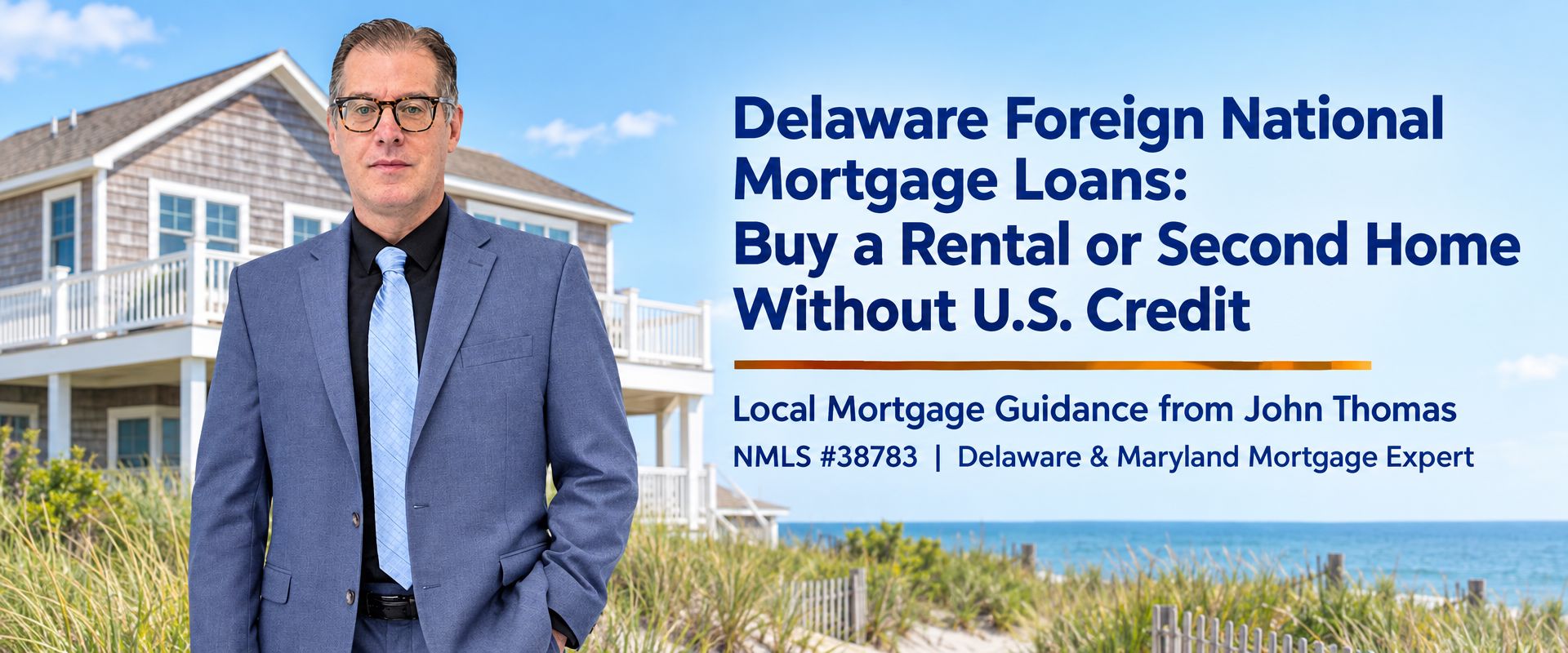

Delaware foreign national mortgage overview: A foreign national mortgage lets someone who lives outside the United States finance a Delaware rental property or second home with a passport and no Social Security number or U.S. credit score. Loans run from $75,000 to $3,000,000, up to 75% of the price on loans to $1,500,000, qualified on rent, foreign income or assets. Current as of November 2026.
You live abroad, you have the down payment, and you want a beach rental in Sussex County, a townhome near the University of Delaware for a student in the family, or a long-term rental in New Castle County. Then a U.S. bank asks for a Social Security number and two years of U.S. tax returns you will never have. I’m John Thomas, NMLS #38783, and for more than 20 years I’ve helped buyers finance Delaware property from our Newark office on Chestnut Hill Road. On this page I lay out what foreign national programs lend today, how you qualify without U.S. credit, how the money moves and how you close from overseas. If you are investing, our Delaware real estate investing guide covers the strategy side.
What could you buy in Delaware?
Tell me the price range, whether it is a rental or a second home, and how you would like to qualify. I’ll show you the loan size, the down payment and the documents your file needs, by phone or video call from wherever you are.
Table of Contents
What Is a Foreign National Mortgage?
It is a non-QM home loan for a buyer who lives and works outside the United States. You qualify with a passport, the property’s rent, foreign income or your assets instead of a Social Security number, U.S. credit and U.S. tax returns. It finances investment property or a second home, never a primary residence.
Fannie Mae and Freddie Mac loans are built around U.S. credit reports and U.S. income documents, which a buyer living overseas usually does not have. Foreign national loans are held or sold privately, so each lender sets its own rules. We compare several of these programs and use the one whose rules fit your file, which is why the figures on this page are the most flexible terms available as of November 2026. Our Delaware non-QM loans page explains the wider family of loans outside agency rules.
- No Social Security number or ITIN required. A valid passport and visa (or a visa-waiver country) is the starting point.
- No U.S. credit score required. Several programs lend the same percentage with no score as with a 680 score.
- Rental property or second home. Never a home you live in as your main residence.
- Loan size: $75,000 to $3,000,000.
- Terms: 30-year fixed, plus 15- and 40-year fixed, interest-only and an adjustable-rate option on some programs.
Who Qualifies as a Foreign National Borrower?
You qualify as a foreign national if your primary residence is outside the United States, you are not a U.S. citizen or permanent resident, and you can show a valid passport plus a visa or visa-waiver status. Diplomats with immunity and citizens of comprehensively sanctioned countries are not eligible.
| Requirement | Guideline |
|---|---|
| Where you live | Primary residence outside the U.S., in the country that issued your passport |
| Identification | Valid, unexpired passport |
| Visa | Valid U.S. visa, or an I-797 with valid dates plus I-94; no visa needed for Visa Waiver Program countries or Canada |
| Social Security number / ITIN | Not required |
| U.S. credit | Not required; a U.S. score is used if you have one |
| Not eligible | U.S. residents, diplomats with immunity, citizens of comprehensively sanctioned countries |
| Experience | First-time investors allowed; no landlord experience required on several programs |
The Visa Waiver Program list from the U.S. State Department shows which countries can visit without a visa. Sanctioned-country rules follow the U.S. Treasury’s OFAC sanctions programs; today programs exclude citizens of countries such as Cuba, Iran, North Korea, Russia and Syria. If a co-borrower is a U.S. citizen, the foreign national’s documents still apply on most programs.
How Much Can a Foreign National Borrow in Delaware?
The most flexible programs lend up to 75% of the price on loans up to $1,500,000 with no U.S. credit score, on a rental or a second home, as of November 2026. That means 25% down. Larger loans need more down, and cash-out refinances top out at 70%.
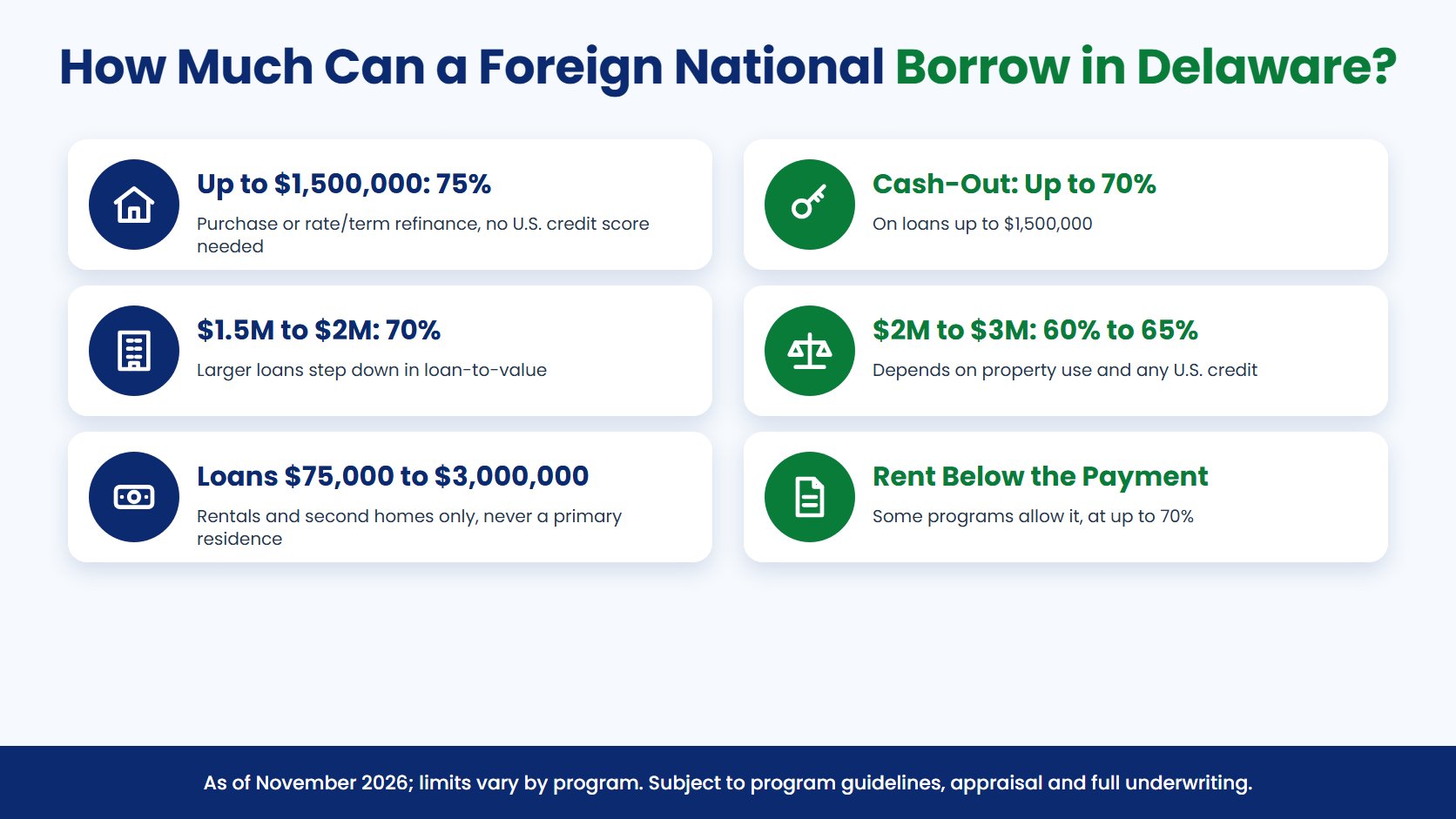
Loan-to-value (LTV) is the loan divided by the price or appraised value, whichever is lower. These are the highest limits available across the programs we use, for a single-family home:
| Loan amount | Purchase or rate/term refinance | Cash-out refinance | Down payment on a purchase |
|---|---|---|---|
| Up to $1,500,000 | 75% | 70% | 25% |
| $1,500,001 to $2,000,000 | 70% | 65% | 30% |
| $2,000,001 to $2,500,000 | 65% | 60% | 35% |
| $2,500,001 to $3,000,000 | 65% second home, 60% rental (with a U.S. score of 700 to 720) | 60% or less | 35% to 40% |
With no U.S. score, the top tier is 60% on a second home and 55% on a rental. Condos, 2- to 4-unit buildings, condotels and rural homes usually cap at 70% on a purchase. Cash-out on these loans also has a dollar limit on the cash you take home, often $300,000 to $1,000,000 depending on the loan-to-value.
Here is the math on a $400,000 Delaware rental bought with no U.S. credit:
| Item | Amount |
|---|---|
| Purchase price | $400,000 |
| Maximum loan at 75% | $300,000 |
| Down payment (25%) | $100,000 |
| Plus closing costs, transfer tax share and any reserves | Varies; see the cost section below |
How Do You Qualify Without U.S. Credit or U.S. Income?
You choose one of three paths: the property’s rent covers the payment (DSCR), your foreign income is documented by an employer or CPA letter, or your assets are converted into a monthly income figure. None of them needs a U.S. credit report or U.S. tax returns, as of November 2026.
| Path | What you provide | Best for |
|---|---|---|
| Rental income (DSCR) | The lease or the appraiser’s market rent; rent divided by the payment | Rental property; no income documents |
| Foreign income (full doc) | Employer letter with salary and year-to-date pay, or a CPA letter with 2 years of income; translated into English | Second homes and rentals |
| Assets | Bank and investment statements; assets divided over 60 or 84 months | Buyers with savings but irregular income |
The rental-income path is the most common. The debt service coverage ratio (DSCR) is the monthly rent divided by the full payment of principal, interest, taxes, insurance and any HOA dues. A ratio of 1.00 or higher means the rent covers the payment and opens the highest limits. Some programs accept a ratio below 1.00 at up to 70%, and one accepts a ratio under 0.75, a no-ratio loan, at up to 60%. Our Delaware DSCR loans and no-ratio DSCR loan pages explain the math for U.S. investors, and it works the same way here.
See whether the rent covers the payment, using the November 2026 program rules on this page. Your numbers stay in your browser: nothing is sent to us or saved. This check does not quote rates or calculate a payment; use the full monthly payment from your loan quote, or call us for one.
If you do have U.S. credit, a score of 680 or higher can help on larger loans. If you don’t, many programs simply use a no-score column. Some want two or three references instead: a letter from your bank, a credit card statement history or an international credit report. The asset path works like our asset qualifier loan program, with foreign accounts allowed when statements are translated.
Documents to have ready, by path:
- Every file: valid passport, plus your U.S. visa, or proof of Visa Waiver Program or Canadian status; the signed purchase contract; one or two recent bank statements for the down payment, translated into English and converted to U.S. dollars.
- Rental income (DSCR): the current lease if a tenant is in place; otherwise the appraiser’s market rent is used.
- Foreign income: an employer letter on letterhead with your position, start date, salary and year-to-date pay, or a CPA or accountant letter covering 2 years of income, translated into English.
- Assets: recent bank and investment account statements, translated into English.
- Buying in an LLC: articles of organization, operating agreement and EIN, on programs that allow it.
Can You Buy a Rental Property or a Second Home?
Yes, both. A rental can qualify on its own rent, and a first-time investor is welcome. A second home for your own use is financed on the foreign-income or asset path, one unit only, with up to 75% loan-to-value on loans up to $1,500,000. A primary residence is never allowed.
| Rental (investment) | Second home | |
|---|---|---|
| How you qualify | Rent (DSCR), foreign income or assets | Foreign income or assets |
| Units | 1 to 4 | 1 |
| Can you or family stay there? | No | Yes, part of the year |
| Top loan-to-value | 75% to $1,500,000 | 75% to $1,500,000 |
| LLC ownership | Allowed on several programs | No, titled to you |
| Prepayment penalty | Usually, up to 5 years | None on the programs we use |
| Short-term rental | Allowed on some programs | Not the purpose |
Planning a beach rental in Rehoboth, Lewes or Bethany? Short-term rental income can qualify on some programs, usually at 80% of projected or actual rents, and the town has to allow short-term rentals. See DSCR loans for short-term rentals for how lenders count that income. A rental financed this way can’t be occupied by you, your family or anyone connected to you.
What I ask first on a foreign national call
Is it a rental or a home you will use? That one answer decides the income path, the documents and whether an LLC can hold title. Next I ask where the down payment sits today, because moving money across borders takes longer than people expect, and the funds need to reach the U.S. before closing.
How Do You Move Your Down Payment and Close From Abroad?
Wire your down payment and closing costs directly to the Delaware closing agent, or move them to a U.S. bank account at least 10 days before closing. Reserves can usually stay abroad. You sign at a U.S. embassy or consulate, or with a local notary and an Apostille where accepted.

- Show where the money is: one or two recent statements, translated into English and converted to U.S. dollars.
- Move it in time: transfer to a U.S. account in your name at least 10 days before closing, or wire it straight to the closing agent from the bank shown on your statements. Funds at a foreign bank with FDIC-insured U.S. branches may not need to move early.
- Gifts: allowed on several programs, usually after you put in 10% of your own money; one program needs no minimum contribution from you.
- Reserves: none on some rental loans up to $1,500,000; otherwise 6 to 12 months of payments, which can usually stay in your home-country account.
- Payments: plan on automatic payments from a U.S. bank account, and on an escrow account for property taxes and insurance.
- Signing: remote online notarization works only while you are in the U.S. Abroad, sign before a U.S. embassy or consular notary, or a local notary with an Apostille in Hague Apostille Convention countries. A power of attorney is generally not accepted.
Which Delaware Properties Are Eligible?
Single-family homes, townhomes, PUDs and warrantable condos are eligible, plus 2- to 4-unit buildings for rentals. Some programs also take non-warrantable condos, condotels and rural homes up to 5 acres, usually at 70% or less. Manufactured homes and co-ops are not eligible.
| Property | Eligible? | Typical limit |
|---|---|---|
| Single-family, townhome, PUD | Yes | Full limits |
| Warrantable condo | Yes | Up to 70% to 75% |
| Non-warrantable condo | Some programs | About 5% lower |
| 2 to 4 units | Rentals only | Up to 70% |
| Condotel | Some programs | Up to 70%; loan often $1,500,000 or less |
| Rural (up to 5 acres) | Some programs | Up to 70% |
| Manufactured home, co-op | No | – |
Buying a condo? Our Delaware condo loans guide explains warrantable and non-warrantable projects. Not sure which town fits your plan? See the areas we serve in Delaware and Maryland.
What Does It Cost, Including Delaware Transfer Tax and FIRPTA?
Expect a higher rate than a U.S. resident loan, normal closing costs, and Delaware’s realty transfer tax of usually 4% of the price, customarily split equally, so about 2% from the buyer. When you sell later, the buyer generally withholds 15% under FIRPTA.
- Rate: fixed or adjustable and priced on loan-to-value, loan size, path, property and U.S. credit if any. We don’t post rates here because they move with the market; call for a quote on your numbers.
- Delaware realty transfer tax: 2.5% to the state plus 1.5% to the county or town where it levies the full local share, apportioned equally between buyer and seller (Delaware Code Title 30, Section 5402). Where no local tax applies, the state rate is 3%.
- Closing costs: appraisal (a second appraisal above $2,000,000), title, settlement, recording and prepaid taxes and insurance for the escrow account.
- Prepayment penalty: usually on rental loans, for up to 5 years; Delaware allows them.
- When you sell: under FIRPTA, the buyer generally withholds 15% of the price from a foreign seller and sends it to the IRS; you reconcile it on your U.S. tax return.
- Rental income: U.S. tax filing rules apply to rent you collect; see IRS Publication 519, U.S. Tax Guide for Aliens and Publication 527, Residential Rental Property. Talk to a cross-border tax advisor before you buy.
Our guide to your mortgage payment breaks down principal, interest, taxes and insurance, the same payment used in the DSCR math.
Foreign National, ITIN or Non-Permanent Resident: Which Loan Fits?
Use a foreign national loan if your home is outside the U.S. If you live and work in the U.S. with an ITIN, an ITIN loan lets you buy a home to live in. If you hold a U.S. work visa and live here, non-permanent resident programs usually work better than either.
| You are | Best fit | Can you live in it? |
|---|---|---|
| Living abroad, no SSN or U.S. credit | Foreign national loan | Second home only |
| Living and working in the U.S. with an ITIN | ITIN home loan | Yes |
| Living in the U.S. on a work visa with an SSN | Non-permanent resident financing (conventional, FHA or non-QM) | Yes |
| Self-employed U.S. resident | Bank statement loan | Yes |
How Do You Get a Foreign National Loan, Step by Step?
Start with a call or video meeting, choose rental or second home and the income path, gather your passport, statements and translations, get under contract, move the funds, then sign abroad or in Delaware. Timing depends most on the appraisal and how long the wire takes.
- Run the numbers. Call 302-703-0727 or book 30 minutes. We look at price, use, path and where your money sits.
- Gather documents. Passport, visa or visa-waiver status, statements, income letters, translations.
- Set up a U.S. bank account. Needed for automatic payments on most programs.
- Make an offer. Your agent writes the contract; we issue the pre-approval letter.
- Appraisal and underwriting. The appraiser also sets market rent on a rental.
- Move the funds and sign. Wire to the closing agent or a U.S. account 10 days ahead, then sign at a consulate, with an Apostille notary, or in person in Delaware.
When Is a Foreign National Loan Not a Good Fit?
A foreign national loan is the wrong choice if you plan to live in the home full time, if you already live and work in the U.S., if you need more than 75% financing, or if your down payment can’t reach the U.S. before closing. Each has a better path.
- You live in Delaware with an ITIN: see the Delaware ITIN home loan program.
- You want to move here and live in it: a primary residence is not allowed; once you have U.S. residency status, other programs open up.
- You need more than 75% financing: no foreign national program goes higher today.
- The rent won’t cover the payment: a bigger down payment, the asset path or a no-ratio loan may still work.
- A manufactured home or co-op: not eligible on these programs.
Before you wire anything
Wire fraud targets real estate closings. Confirm the closing agent’s wiring instructions by phone, using a number you found yourself, before you send money, and never act on changed instructions that arrive by email.
Foreign National Mortgage FAQ
Do I need a Social Security number or a U.S. credit score?
No. Foreign national programs are built for buyers with no Social Security number, no ITIN and no U.S. credit history. Several programs lend at the same loan-to-value with no U.S. score as with a 680 score. If you do have U.S. credit, some programs will use it, and a strong score can help on larger loans.
How much do I need for a down payment?
Plan on at least 25% of the price. The best programs lend up to 75% of the price on loans up to $1,500,000, so 25% down plus closing costs and any reserves. Loans above $1,500,000 need more: 30% down to $2,000,000 and 35% to 40% above that, depending on the program.
Can I buy a vacation home in Delaware that I use myself?
Yes. Some programs finance a one-unit second home for a foreign national, up to 75% of the price on loans up to $1,500,000, with income documented from your home country. The rental-income (DSCR) version is for investment property only, so you and your family cannot stay in a rental financed that way.
Can I buy the property in an LLC?
Yes, on investment property. Several programs let a U.S. LLC or corporation take title, with each owner signing a personal guarantee. Some require every member to be an individual and the LLC to be formed in the United States. Second homes are titled to you personally. Ask your attorney or tax advisor which structure fits.
Do I have to fly to Delaware to close?
Not always. You can sign the closing documents abroad in front of a U.S. embassy or consular notary, and some programs accept a local notary with an Apostille in Hague Convention countries. A power of attorney is generally not accepted on foreign national loans, so plan to sign yourself.
Can my money stay in my home-country bank?
Partly. Reserves can usually stay in a foreign account if you show statements translated into English. The down payment and closing costs must reach the U.S.: either moved to a U.S. account at least 10 days before closing or wired directly to the closing agent. Monthly payments are drafted from a U.S. account.
Is there a prepayment penalty?
Usually on investment property. Rental loans for foreign nationals generally carry a prepayment penalty for up to 5 years, often a schedule such as 5%, 4%, 3%, 2%, 1%, and Delaware allows them. Second-home loans do not carry one on the programs we use. We show you the penalty terms in writing before you apply.
Can I qualify if I had a bankruptcy or foreclosure?
Yes, after a waiting period. The most flexible programs require 3 years since a bankruptcy, foreclosure, short sale or deed-in-lieu; others require 4 years. U.S. mortgage history counts only if it is documented, and your home-country housing history usually does not have to be shown at all.
I live in Delaware on a work visa. Is this the right loan?
Probably not. Foreign national programs are for people whose primary residence is outside the U.S. If you live and work here on a visa or with an ITIN, you can usually buy a home to live in. See the ITIN and non-permanent resident comparison above, or call us to match the right program.

John R. Thomas is Branch Manager and Division Vice President with the John Thomas Team in Newark, Delaware, and has helped more than 3,000 Delaware and Maryland families finance a home over 20+ years, including investors who qualify on rental income and buyers who live overseas. On a foreign national file, he starts with how the property will be used and where the down payment sits today, because those two answers decide the income path and the closing timeline.
He holds a BS in Physics Education from the University of Delaware and an MS in Curriculum and Instruction from Delaware State University, and is the author of Your Guide to Buying Your First Home in Delaware. State licensing: Look up John R. Thomas, NMLS #38783, on NMLS Consumer Access. Read more on his loan officer bio page.
Years 3,000+
Buyers Helped DE & MD
Service Area CMP
Certified Mortgage Planner
John Thomas Team with AnnieMac Home Mortgage
248 E Chestnut Hill Rd, Newark, DE 19713 | 302-703-0727 | team@johnthomasteam.com
Schedule Appointment (30 min)
See John Thomas Team on Google for reviews, directions, and local office information.
YouTube | Facebook | Instagram | TikTok | X / Twitter | LinkedIn

Own Delaware property from anywhere
No Social Security number, no U.S. credit: one call or video meeting shows you the loan size, the down payment and the documents before you apply.
Last Updated: November 2026 · John Thomas Team with AnnieMac Home Mortgage · Mortgage content reviewed by John R. Thomas, NMLS #38783.
John R. Thomas, NMLS #38783 | John Thomas Team with AnnieMac Home Mortgage | AnnieMac Home Mortgage NMLS #338923 | 248 E Chestnut Hill Rd, Newark, DE 19713 | 302-703-0727 | delawaremortgageloans.net
AnnieMac Home Mortgage is an Equal Housing Lender. State licensing: Look up John R. Thomas, NMLS #38783, on NMLS Consumer Access.
(c) Copyright John R. Thomas, All Rights Reserved.
