Delaware P&L Mortgage Loan: Qualify With a Profit & Loss Statement, Not Tax Returns

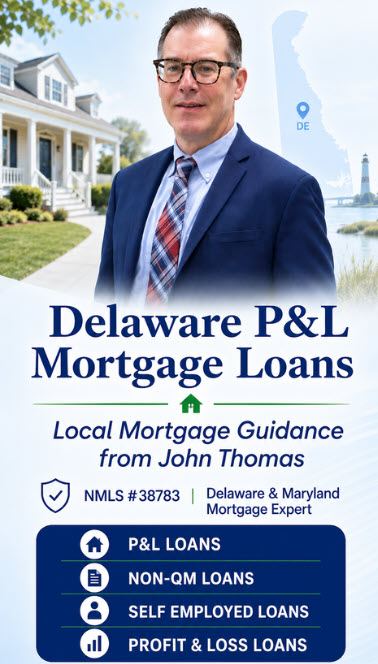
Quick answer: Profit & Loss loans are Non-QM mortgages for self-employed borrowers who may be able to qualify with a recent P&L prepared by an eligible tax professional instead of tax returns. Depending on the program, underwriting may also review business bank statements, credit, reserves, ownership, property type, and debt-to-income ratio.
Current as of July 2026. Delaware P&L mortgage guidelines vary by investor. Eligible self-employed borrowers may be able to use a 12- or 24-month P&L, sometimes with limited bank statements, for a primary home, second home, or investment property. Credit, down payment, reserves, ownership, and documentation requirements depend on the selected program and are confirmed at application.
If you own a business in Delaware, you already know the frustration. You write off everything you legally can to keep your tax bill down, and then a traditional lender looks at the net income on your Schedule C and tells you that you do not earn enough to buy a home. I have sat across from plumbers in Newark, restaurant owners in Wilmington, and independent contractors all over New Castle, Kent, and Sussex counties who are clearly successful but simply do not fit a W-2 file. A P&L mortgage loan is built for exactly that borrower. Instead of tax returns, we use a Profit & Loss statement from your CPA or licensed tax preparer, and the net profit becomes your qualifying income. This is one of several Delaware self-employed mortgage options I help business owners compare. Call me directly at 302-703-0727 or apply online to see which options you may qualify for.
Table of Contents
What Is a P&L Mortgage Loan for Self-Employed Delaware Borrowers?
A P&L mortgage loan, also called a Profit & Loss loan, is a type of Non-QM (non-qualified) mortgage designed for self-employed borrowers who do not fit the strict income-verification rules of conventional financing. Instead of relying on your tax returns and W-2s, the lender uses a Profit & Loss statement prepared by a licensed tax professional to measure your income. The net profit from a 12-month or 24-month P&L, divided by the months it covers, becomes the starting income figure used in the underwriting analysis.
This matters because many successful business owners deduct so much on their taxes that their reported net income looks far lower than what the business actually produces. A P&L loan may let that borrower be evaluated using a fuller, more current picture of the business. It removes the need for exhaustive tax returns, 4506-C transcript requests, and, on many files, extensive bank statements. It is worth being clear about one thing up front: on a P&L loan the statement is used to calculate your income, which is different from a conventional loan where a year-to-date P&L is sometimes requested only to validate a trend on top of your tax returns.
What Are the Guidelines for a Delaware P&L Mortgage Loan?
Guidelines vary by investor, occupancy, and credit profile, and Non-QM programs change often. The ranges below reflect the most flexible positions available across current wholesale P&L guidelines as of mid-2026, so you can see what is possible. They are not a rate quote or a commitment to lend, and your exact terms are confirmed at application.
| Feature | What May Be Available (confirmed at application) |
|---|---|
| Minimum credit score | As low as 600 on broader Non-QM tiers; most P&L pricing starts around 640 to 680 |
| Maximum loan amount | Up to $4,000,000 (lower caps apply on some programs) |
| Minimum loan amount | As low as $50,000; most programs start around $100,000 to $150,000 |
| Maximum LTV, purchase | Up to 90% on select programs (typically with about 2 months of bank statements supporting the P&L); commonly 80% to 85% |
| Maximum LTV, refinance | Up to 80% rate-and-term and cash-out |
| Maximum DTI | Up to about 55% with residual-income support |
| Self-employment history | As little as 1 year on some programs; 2 years is common (same line of work often required) |
| Business ownership | Generally 25% or more (some programs require 50%) |
| Occupancy | Primary residence, second home, and investment property |
| Income documentation | 12- or 24-month P&L from a CPA, Enrolled Agent, tax attorney, or licensed tax preparer |
| Bank statements | Often not required on strong files (typically 700+ FICO and 70% LTV or lower); otherwise 2 to 3 months of business bank statements support the P&L |
| Reserves | Commonly around 6 months for P&L income; sometimes reduced or waived on low-LTV refinances |
How we sourced these ranges: they represent the least-restrictive positions across current Non-QM P&L guidelines from multiple wholesale investors (effective dates late 2025 through mid-2026). These are best-case figures drawn from different programs; the lowest credit score, highest LTV, and largest loan amount will not all appear together on a single program. Because programs change and vary by investor, occupancy, and credit profile, treat every number here as directional and confirm your file at application. Nothing on this page is a rate quote, an approval, or a commitment to lend.
How Much Down Payment and Cash Do You Need?
Guidelines are usually written in loan-to-value (LTV), but what you really want to know is the cash. Your down payment is 100% minus the LTV. On the strongest P&L profiles, purchase LTV can reach 90%, which is 10% down; more commonly you should plan for 15% to 20% down. Here is how that translates on a $500,000 Delaware home:
- 90% LTV (best profiles) is about $50,000 down
- 85% LTV is about $75,000 down
- 80% LTV is about $100,000 down
Down payment is not the same as total cash to close. Your actual cash needed also depends on lender costs, title and settlement charges, prepaid property taxes and homeowners insurance, any required reserves, seller or lender credits, and the specific program. Many P&L programs also expect a few months of reserves for alternative-income files. Before you write an offer, I will give you a written estimate of the full cash to close for the program that fits you, so there are no surprises at the closing table.
What Are the 6 Things Underwriters Look For on a P&L?
Because a P&L loan qualifies you on a statement rather than filed tax returns, the underwriter’s job is to make sure the statement is believable. In my experience, the files that move fastest are the ones that get ahead of these questions before underwriting ever asks them. Underwriters generally look for:
- Revenue that is stable or explainable. Big swings are fine if there is a reason; unexplained spikes invite questions.
- Reasonable expenses for your industry. Several programs floor the expense ratio (often around 15% of gross revenue) when a statement shows unusually low expenses.
- A believable net income that fits the size and type of business.
- Consistency between the P&L and your bank activity. When bank statements are part of the file, deposits are expected to reasonably support the revenue on the P&L.
- A recent statement. Most programs want the P&L dated within 60 to 90 days of closing.
- Documented ownership and business existence, such as a licensed preparer’s letter, an operating agreement, or a state filing.
Common P&L Loan Mistakes to Avoid
Most P&L files that stall do so for a handful of avoidable reasons. Here are the ones I see most often and how to get ahead of them.
| Mistake | Why it causes problems | Better approach |
|---|---|---|
| P&L revenue does not match supporting deposits | Creates an income-verification issue | Reconcile the records before applying |
| Statement is too old | May not reflect current business performance | Confirm the required statement period first |
| Self-prepared P&L | Not accepted by many programs | Use an eligible independent tax professional |
| Unrealistically low expenses | May trigger additional review or an expense floor | Use complete, accurate books |
| Ordering a P&L before checking preparer requirements | The preparer may not qualify for the selected program | Confirm the program path first |
| Assuming P&L-only means no other documentation | Credit, assets, property, and reserves are still reviewed | Prepare the complete file |
What this means for you: the goal is to catch these issues before underwriting, not during it. We walk through the documentation path first so you know exactly what to ask your CPA or tax professional for.
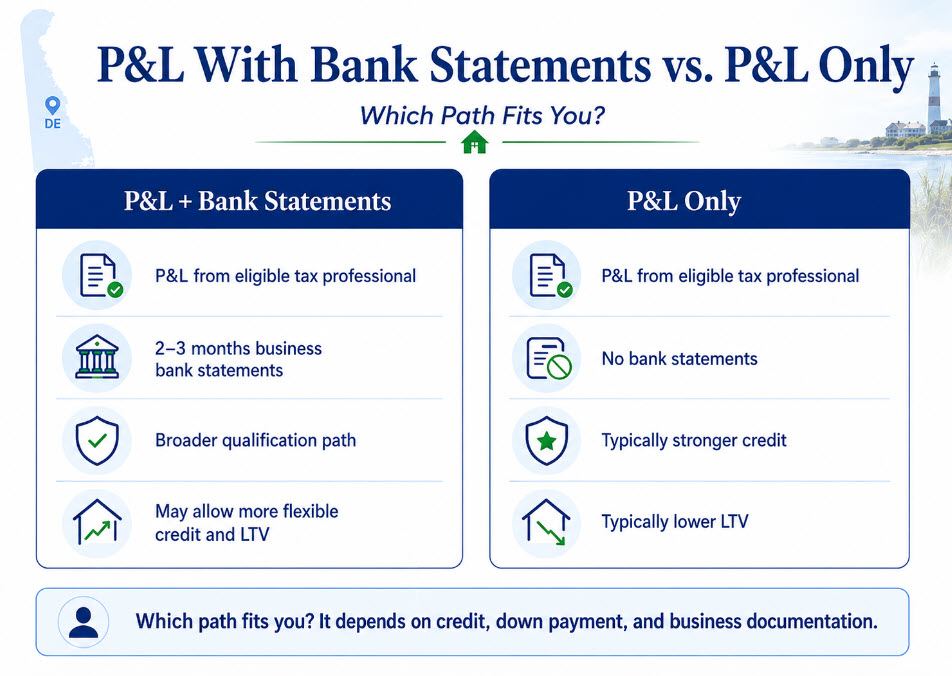
P&L With Bank Statements vs. P&L Only: Which Path Fits You?
Most P&L programs offer two documentation paths, and choosing the right one usually comes down to your credit score and how much you are putting down.
- P&L with a couple of months of bank statements. This is the broader path. Your tax preparer provides the P&L, and 2 to 3 months of business bank statements are used to corroborate that deposits reasonably support the revenue on the statement. It tends to allow more flexible credit and the highest loan-to-value, including the 90% purchase tier on select programs.
- P&L only, no bank statements. On stronger files, many programs let you qualify on the P&L alone with no bank statements at all. That path typically expects higher credit and a more conservative loan-to-value (on several programs, roughly a 700-plus score and 70% LTV or lower). It is the fastest, cleanest documentation route when you qualify for it.
In my experience, the P&L files that clear underwriting the cleanest are the ones where the tax preparer’s numbers line up with what is actually hitting the business bank account. When credit is strong and the loan-to-value is conservative, we can often document the file with the P&L alone; when a file needs a little more support, adding those business bank statements to back up the deposits generally does it. I walk through that choice up front, because the borrowers who get surprised at underwriting are almost always the ones who were never told that a self-prepared statement, or a preparer who only holds a PTIN, can stall the file on some investors’ guidelines.
What Property Types and Occupancies Are Eligible?
P&L financing is available for a wide range of property types and for all three occupancy types. The most commonly eligible properties include:
- Single-family residences (SFR) and planned unit developments (PUDs)
- Townhomes
- 1 to 4 unit properties
- Warrantable and non-warrantable condominiums
Additional property types such as rural properties and manufactured or modular homes are available on select programs, so ask if that describes your purchase. On occupancy, P&L loans can generally be used for a primary residence, a second home, or an investment property, though the exact loan-to-value and credit expectations tighten as you move from primary to investment.
What Is a Profit & Loss Statement and How Is Income Calculated?
A Profit & Loss statement (also called an income statement) summarizes all of a business’s income and expenses over a set period on one ledger. It starts with gross revenue, subtracts the cost of goods sold and operating expenses, and arrives at the business’s net income. That net income is the figure a P&L loan uses. Below is a simplified example of what a Profit & Loss statement looks like for a business.
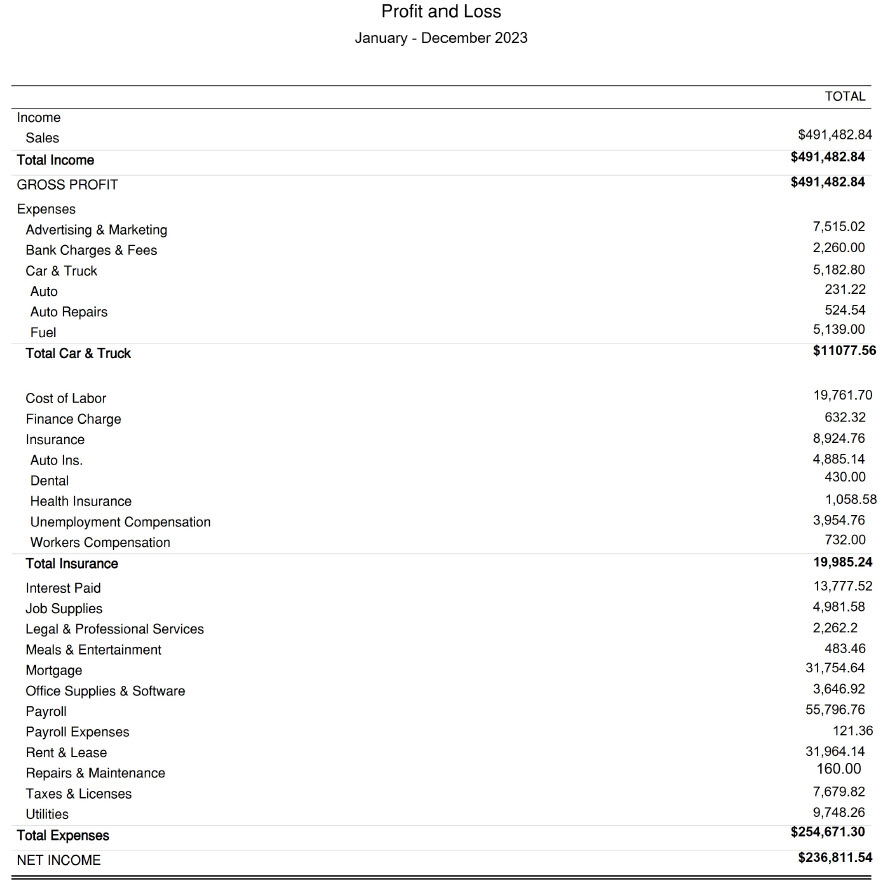
Here is how the income calculation generally works. The qualifying income is the net income from the P&L divided by the number of months the statement covers, then adjusted for your ownership percentage of the business. Several non-cash items on the P&L can usually be added back to increase your qualifying income, including depreciation, depletion, and amortization or casualty losses. Some programs also apply a minimum expense ratio (commonly around 15% of gross revenue) when a statement shows unusually low expenses, and several programs will use the lower of the P&L result or the income you disclosed on your signed application.
A quick example. Say a Delaware contractor owns 100% of a business and shows $180,000 of net income on a 12-month P&L. That starts from a $15,000 monthly average before any program-specific adjustments. If a selected program allowed 10% down on a $500,000 purchase, the down payment would be about $50,000 before closing costs. This is an illustration, not a quote or an approval: final eligibility always depends on the full underwriting review. The most reliable way to know your number is to have me review a draft P&L before you are under contract.
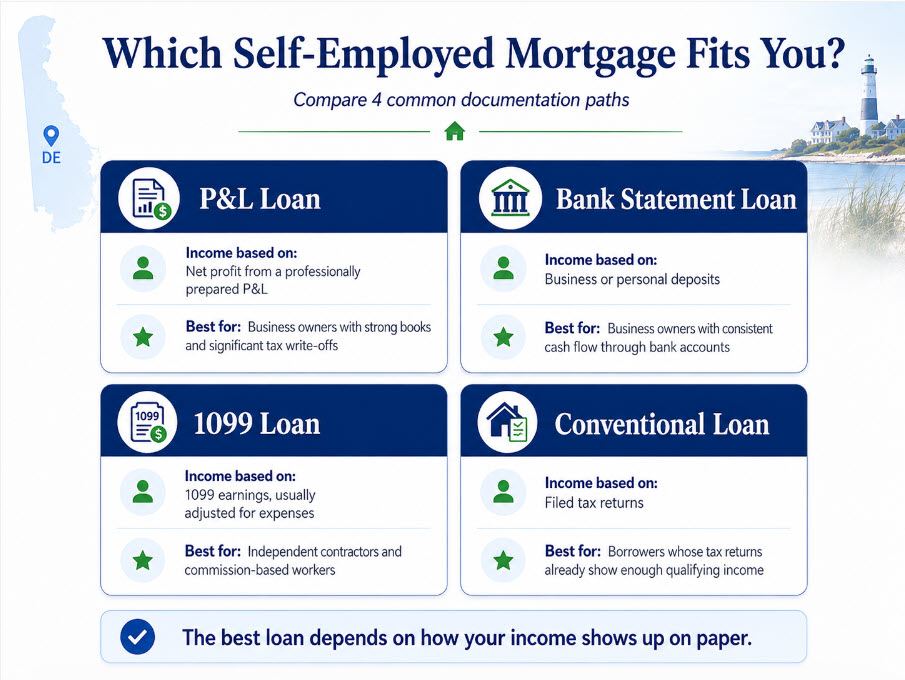
P&L Loan vs. Bank Statement vs. 1099 vs. Conventional
The P&L loan is one of four common ways a self-employed Delaware borrower can qualify. The right one depends on how your income shows up on paper. Here is a side-by-side comparison.
| Program | How income is measured | Best for | Typical documents |
|---|---|---|---|
| P&L mortgage loan | Net profit from a CPA or tax-preparer P&L | Business owners with heavy write-offs and organized books | 12- to 24-month P&L, sometimes 2 to 3 months of bank statements |
| Bank statement loan | Deposits into personal or business accounts | Owners whose revenue shows up as steady deposits | 12 to 24 months of bank statements |
| 1099 loan | Total 1099 income, minus an expense factor | Independent contractors paid on 1099s | 1 to 2 years of 1099s |
| Conventional loan | Net income from filed tax returns | Borrowers who already show enough income on their taxes | 1 to 2 years of tax returns, W-2s, paystubs |
It also helps to weigh the trade-offs of the P&L route directly:
| Potential advantages | Potential trade-offs |
|---|---|
| May avoid tax-return income analysis | Pricing may be higher than full-doc financing |
| Can reflect current business profitability | Documentation rules vary by investor |
| P&L-only paths may require fewer bank statements | Stronger credit or more equity may be needed |
| Available across multiple occupancy types | Not every preparer qualifies for every program |
Who Prepares the P&L, and Who Can Qualify?
The P&L cannot be something you type up yourself. It must be prepared and signed by an appropriately licensed tax professional. Across programs, that generally means a Certified Public Accountant (CPA), an IRS Enrolled Agent (EA), a tax attorney, or a CTEC-registered preparer. A preparer holding only a PTIN (Preparer Tax Identification Number) is accepted on some programs but is not an eligible preparer on several others, so confirm this before you commission the statement. Many programs also expect the preparer to have completed or filed your most recent tax return, and some require documentation that the preparer’s license is active.
To qualify, you will generally need to be self-employed with a documented ownership stake in the business (commonly 25% or more, and 50% or more on some programs), a business that has been in existence for the required period, and a P&L that is recent (often dated within 60 to 90 days of closing). Depending on the program, you may also provide a short narrative describing your business and documentation that supports the business’s existence. Just like conventional financing, recent credit events such as a bankruptcy or foreclosure usually carry a seasoning period before you are eligible.
P&L Loan Document Checklist
The exact list depends on your program and profile, but most P&L files draw from the same set of documents:
- A recent 12- or 24-month Profit & Loss statement from an eligible tax professional
- Proof of business ownership and existence (such as an operating agreement, preparer letter, or state filing)
- Business bank statements when the selected program requires them
- Asset and reserve statements
- Credit and identification documentation
- Property and occupancy documents once you are under contract
What this means for you: you may not need every item on every P&L loan. The goal is to confirm the documentation path first, so you do not order or collect documents the selected program does not require.
When a Delaware P&L Mortgage Loan Is NOT a Good Fit
A P&L loan is a powerful tool, but it is not the right answer for every self-employed buyer. It may not be your best option when:
- Your tax returns already show enough income to qualify. A conventional, FHA, or VA loan is usually cheaper, so it is worth checking full-doc first.
- Your business is under a year old with no prior history in the same line of work. Most programs want 1 to 2 years.
- Your tax preparer holds only a PTIN and your chosen program does not accept PTIN-only preparers. You may need a CPA, EA, or CTEC preparer instead.
- You want the absolute lowest rate and can document income the traditional way. Non-QM pricing typically runs above conventional because the investor is taking on more risk.
- Your business deposits do not support the revenue on the P&L and you are below the credit or LTV thresholds for the P&L-only path. The file may not validate.
- You are counting on Delaware down payment assistance. DSHA programs are agency-backed and are generally not compatible with a Non-QM P&L loan.
How the P&L Mortgage Process Works
Here is the path we follow so nothing gets ordered out of sequence:
- Review your situation. We compare P&L, bank-statement, 1099, and traditional financing so we start with the right tool.
- Confirm the documentation path. We determine whether the likely program uses P&L only or P&L plus supporting bank statements.
- Confirm the preparer requirements. We check the eligible-preparer rules before you order the statement, so a PTIN-only issue never surprises you.
- Review the P&L before you are under contract. We look for income, ownership, recency, expense, and deposit issues while there is still time to fix them.
- Complete the full loan review. Credit, assets, debts, property, occupancy, reserves, and program guidelines are all reviewed before final approval.
P&L Mortgage Loans for Delaware and Maryland Self-Employed Buyers
From our Newark office, I help self-employed buyers compare P&L mortgage options throughout Delaware and for borrowers in Maryland. That includes business owners in Dover, Middletown, and communities across New Castle, Kent, and Sussex counties, along with self-employed buyers on Maryland’s Eastern Shore and in Cecil County, and buyers looking at mortgage help for Newark buyers or mortgage options for self-employed buyers in Wilmington. The borrowers I work with most on this program are contractors and trades, restaurant and retail owners, real estate agents, consultants, freelancers, and other gig-economy earners whose tax returns understate what they really make.
Local guidance matters here because the right answer is rarely a P&L loan in isolation. It is knowing when a P&L loan beats a bank-statement loan, when a conventional or government loan would actually be cheaper, and when a Delaware down payment assistance program changes the math entirely. That comparison is exactly the conversation I have with self-employed buyers every week.
What Other Loan Options Do Self-Employed Delaware Borrowers Have?
The P&L loan is one of several ways to finance a home when your income is self-employed. Depending on how your business is structured, one of these may fit better:
- Conventional loans (Fannie Mae and Freddie Mac) when your tax returns support the income
- Bank statement loans that qualify you on personal or business deposits
- 1099 income loans for independent contractors
- No income, no employment loans for qualified borrowers who cannot document income the usual way
- DSCR loans for investors qualifying on a property’s rental cash flow
Not sure which one fits? Start with the Delaware self-employed mortgage overview, or just call me and we will figure it out together.
How Do You Apply for a Delaware P&L Mortgage Loan?
Getting started is simple. Call the John Thomas Team at 302-703-0727, schedule a consultation, or apply online, and we will review your situation, tell you which documentation path fits, and let you know what to ask your CPA or tax preparer for. First-time buyers can also review our Delaware first-time home buyer resources. There is no cost to review which options you may qualify for.
Delaware P&L Mortgage Loan FAQs
Do I need tax returns for a Delaware P&L mortgage loan?
Generally, no. A P&L mortgage loan is designed to qualify eligible borrowers using a Profit & Loss statement instead of tax returns, though documentation requirements vary by program. Your qualifying income comes from a P&L prepared by a CPA or licensed tax preparer, using the net profit over a 12- or 24-month period, which avoids tax returns, 4506-C transcript requests, and, on many files, extensive bank statements.
How many years of self-employment do I need?
It depends on the program. Some programs allow as little as 1 year of self-employment, while 2 years is common, and many require you to have been in the same line of work for at least 2 years. The business usually needs to have been in existence for the required period as well. We confirm which program fits your history before you apply.
Who can prepare my P&L statement?
The P&L must be prepared and signed by an appropriately licensed tax professional, generally a CPA, IRS Enrolled Agent (EA), tax attorney, or CTEC-registered preparer. A preparer holding only a PTIN is accepted on some programs but not on others, so confirm before you commission the statement. You cannot prepare the P&L yourself.
Do I also need bank statements?
Not always. On stronger files, many programs let you qualify on the P&L alone with no bank statements, typically when your credit is around 700 or higher and your loan-to-value is roughly 70% or lower. On other files, 2 to 3 months of business bank statements are used to confirm that deposits reasonably support the revenue shown on the P&L.
What credit score do I need for a P&L loan?
Requirements vary. Scores as low as 600 may be considered on broader Non-QM tiers, while most P&L pricing starts around 640 to 680, and the P&L-only path (no bank statements) often expects 700 or higher. A higher score generally improves your terms and your options. We confirm the exact floor for your program at application.
Can I use a P&L loan for an investment property?
Often, yes. Many P&L programs may be available for a primary residence, a second home, or an investment property, though the loan-to-value and credit expectations tend to tighten as you move from primary to investment. If you are financing rental property, a DSCR loan that qualifies on the property’s cash flow may also be worth comparing.
How is my income calculated from the P&L?
Generally, the net income on the P&L is divided by the number of months it covers and adjusted for your ownership percentage. Non-cash items such as depreciation, depletion, and amortization or casualty losses can usually be added back to increase qualifying income. Some programs apply a minimum expense ratio when expenses look unusually low, and several use the lower of the P&L result or the income on your signed application.
What if my business deposits do not support the revenue on my P&L?
When a program uses bank statements alongside the P&L, deposits are expected to reasonably support the revenue on the statement, and some programs allow additional months of statements until the tolerance is met. If your deposits fall short and you are below the credit or LTV thresholds for the P&L-only path, the file may not validate. We check this early so we can pick the right path or reconcile the records before you apply.
Can I get a P&L loan after a bankruptcy or foreclosure?
Often, yes, once enough time has passed. Non-QM P&L programs usually apply a seasoning period after a bankruptcy, foreclosure, short sale, or deed-in-lieu, and the required wait varies by program. If a recent credit event is a factor, we can review the timeline and point you to the program with the shortest applicable seasoning.
Is a P&L loan more expensive than a conventional loan?
Rates on P&L and other Non-QM loans typically run above conventional pricing because the investor is taking on more risk without traditional tax-return documentation. The trade-off is qualifying on income your tax returns understate. If your returns already show enough income, a conventional loan is usually cheaper, which is why we always compare both. Call for current pricing.

About John R. Thomas, NMLS #38783
John R. Thomas is a Branch Manager and Mortgage Loan Officer with Primary Residential Mortgage, Inc. in Newark, Delaware, with more than 20 years of experience helping over 3,000 Delaware families finance homes. He holds a BS in Physics Education from the University of Delaware and an MS in Curriculum and Instruction from Delaware State University, which is why he is known for teaching borrowers the “why” behind their loan, not just the “what.”
He specializes in self-employed and Non-QM financing across Delaware and Maryland. In two decades of originating loans across Delaware, the pattern John sees most with self-employed buyers is that their tax returns understate what they really earn, which is exactly the gap a P&L loan is designed to close, and he reviews a draft P&L with clients before they are under contract so there are no surprises at underwriting.
Licensed in 17 states: AL, DC, DE, FL, GA, IN, KS, MD, MN, MO, NC, NJ, OH, PA, SC, TN, VA (credential only, not a service-area claim). Primary service area: Delaware and Maryland.
Years Lending 3,000+
Buyers Helped Newark, DE
Local Office DE & MD
Self-Employed Specialist 4.8 / 5
285 Reviews
John Thomas Team – Primary Residential Mortgage, Inc.
248 E Chestnut Hill Rd, Newark, DE 19713
Phone: 302-703-0727 | Email: team@johnthomasteam.com
NMLS #38783 | Branch NMLS #106170 | Corporate NMLS #3094
See John Thomas Team on Google
YouTube | Facebook | Instagram | TikTok | Twitter | Pinterest | LinkedIn
Last Updated: July 4, 2026. Mortgage content reviewed by John R. Thomas, NMLS #38783. John Thomas Team, Primary Residential Mortgage, Inc., 248 E Chestnut Hill Rd, Newark, DE 19713. Phone 302-703-0727. NMLS #38783. Equal Housing Lender. (c) 2026 John R. Thomas. All rights reserved.
