Delaware Home Buyer Information: Resources for First-Time and Repeat Buyers

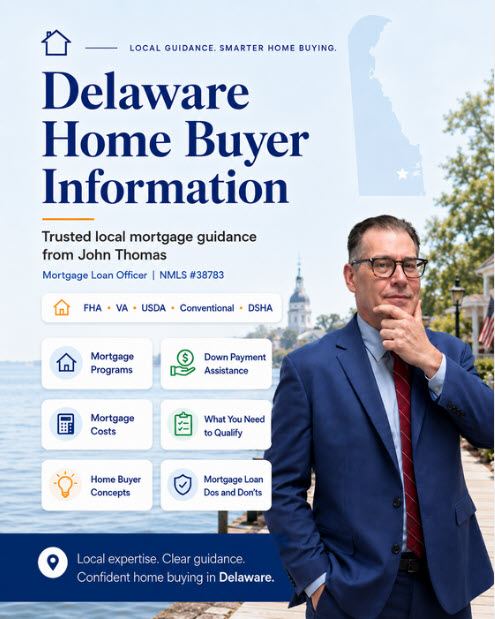
Delaware Home Buyer Information at a Glance. Delaware buyers in 2026 have access to FHA, VA, USDA, Conventional, and four DSHA down payment assistance programs (Keys4You 4%, First State 3%, Take5 5%, Diamond in the Rough 5% + 203k). Closing costs in Delaware typically run 2 to 5 percent of the purchase price, plus a 4% Delaware transfer tax that is split 2% buyer / 2% seller on a standard DAR contract (builder contracts often shift the full 4% to the buyer). First-time buyers purchasing a home priced $400,000 or less may also receive a Delaware Buyer Transfer Tax Credit of up to $2,000. Current as of May 2026.
I am John Thomas, NMLS #38783, a mortgage loan officer at Primary Residential Mortgage in Newark, Delaware. For 20+ years I have helped over 3,000 buyers across Delaware and Maryland buy their first home, their move-up home, and everything in between. This page is the index to the resources you need to become an educated Delaware home buyer — whether this is your first home or your tenth. If you have a question that is not answered here, call 302-703-0727 and ask me directly. There is no charge for the conversation, and I will not put you on a high-pressure sales call.
If you would like a structured introduction to the full buying process, the Delaware First Time Home Buyers Guide walks the journey step by step. This page is the resource library that supports that journey.
What does “Delaware home buyer information” mean?
Delaware home buyer information is the mortgage, down payment assistance, closing cost, credit, inspection, title, attorney, and local program details a buyer needs to know before purchasing a home in Delaware. This page is the resource library for every one of those topics, written for first-time and repeat buyers in Delaware and Maryland by a Newark, DE mortgage loan officer.
20+ Years Lending in Delaware | 3,000+ Buyers Helped | DSHA Approved Lender | Newark, DE Office | 285 Google Reviews / 4.8 Stars
Based in Newark, DE, serving buyers throughout New Castle County, Kent County, Sussex County, and nearby Maryland communities — including Wilmington, Newark, Bear, Middletown, Hockessin, Pike Creek, Dover, Smyrna, Milford, Lewes, Rehoboth Beach, Georgetown, and Seaford.
Start Your Delaware Home Buyer Conversation
The first conversation is educational, not a sales call. Pick whichever option fits how you like to communicate.
Table of Contents
The Delaware Home Buying Journey: Step-by-Step Overview
Buying a home in Delaware is a process, not an event. Most Delaware buyers I work with complete the process in 45 to 60 days from accepted offer to closing, but the work that determines whether you close on time — and at the price you expected — happens in the weeks before you ever look at a property. Here is the journey at a glance:
- Get pre-approved before you shop. Pre-approval tells you exactly which Delaware mortgage programs you qualify for, your maximum purchase price, and the cash you will need at closing. Most Realtors will not tour homes with you without a pre-approval letter.
- Decide which loan program fits your situation. Most Delaware first-time buyers use FHA, VA, USDA, Conventional, or a DSHA-paired program. The right answer depends on your credit, your income, your cash available, and whether you are a veteran or buying in a rural area.
- Shop with a buyer’s agent under a signed Buyer Agency Agreement. As of September 16, 2024, buyers must sign a written Buyer Agency Agreement before touring homes — this is the NAR settlement rule, not a personal preference, and it protects both you and your agent.
- Get the home under contract, then run inspection / appraisal / title in parallel. Your lender, your buyer’s agent, your home inspector, your appraiser, your title attorney, and your insurance agent all have work to do in the 30 to 45 days between contract and closing. Most delays come from one of these steps not running on schedule.
- Close and move in. Delaware law requires an attorney at closing (unlike most other states). Closing is typically held at the title attorney’s office or by remote / hybrid signing.
The full step-by-step walkthrough is in the Delaware First Time Home Buyers Guide — come back to this resource library whenever you hit a topic you need to dig into.
Mortgage Programs Available to Delaware Home Buyers
Delaware buyers have access to every major mortgage program available nationwide, plus several state-specific DSHA programs that pair with the major programs to add down payment assistance. The table below summarizes the main options. Each row links to a dedicated program page with full eligibility criteria, scenario examples, and how the program works specifically in Delaware.
| Program | Down Payment Minimum | Credit Floor | Best Fit For |
|---|---|---|---|
| FHA Loan | 3.5% | 580 typical (some lenders 620+) | Buyers with lower credit or limited cash; flexible underwriting |
| VA Loan | 0% | No fixed floor (lender overlays vary) | Eligible veterans, active-duty service members, surviving spouses |
| USDA Rural Loan | 0% | 620+ typical | Buyers in USDA-eligible rural areas of Kent and Sussex County (income limits apply) |
| Conventional Loan | 3% (HomeReady / Home Possible) | 620+ typical | Buyers with strong credit and lower DTI; flexibility with PMI removal |
| DSHA Welcome Home | Pairs with FHA/VA/USDA/Conventional first mortgage; adds DPA | 620+ | First-time buyers within DSHA income and price limits |
| DSHA Open Door | Pairs with FHA/VA/USDA/Conventional; adds DPA | 620+ | First-time AND repeat buyers within DSHA income and price limits |
The right program for you is usually not the one you see advertised first — it is the one that minimizes your cash to close while keeping your monthly payment in your comfort zone. That is what the pre-approval conversation is for.
Down Payment Assistance for Delaware Buyers
The Delaware State Housing Authority (DSHA) rebranded its homeownership platform in April 2026, replacing the long-running “Kiss Your Landlord Goodbye!” branding with the Delaware Mortgage Program at destatehousing.com. The rebrand introduced two first-mortgage tracks (Welcome Home for first-time buyers; Open Door for first-time AND repeat buyers) and four down payment assistance programs that pair with those first mortgages.
- Keys4You — 4% down payment assistance; pairs with Welcome Home AND Open Door. The only 4%-tier DPA available to repeat buyers in Delaware — a meaningful advantage for buyers who owned a home in the past but no longer do.
- First State — 3% down payment assistance; pairs with Welcome Home AND Open Door. The most accessible DPA tier, suitable when full 4% or 5% is not needed.
- Take5 — 5% down payment assistance; pairs with Welcome Home ONLY. The largest standard DPA, but limited to first-time buyers using the Welcome Home first mortgage.
- Diamond in the Rough — 5% DPA plus FHA 203k Limited renovation financing; Welcome Home only. The right tool when the home needs cosmetic or non-structural repairs financed into the loan.
The Delaware Down Payment Assistance Programs hub compares all four DPA options side by side with current income and purchase price limits.
One important DSHA detail many lenders get wrong: as of April 15, 2025, DSHA Welcome Home counts only the income of borrowers whose names appear on the Note and Mortgage — NOT every adult in the household. DSHA Open Door counts only the qualifying income on the loan application (Form 1003). Household size still determines which income tier applies, but who counts toward the income limit changed in 2025. If you have been told you do not qualify based on the older “all adult household members” rule, call me and we will check the current calculation. Current as of May 2026.
Delaware Mortgage Credit Certificate (MCC) — Legacy Reference
The Delaware Mortgage Credit Certificate (MCC) program ended on August 15, 2025. Buyers who closed with an MCC before that date continue to claim a federal tax credit for a portion of the mortgage interest paid each year for the life of the loan — this benefit follows the loan, not the program, so MCC holders did not lose anything when the program closed. New Delaware buyers in 2026 cannot apply for an MCC; the current first-time buyer incentives are the four DSHA DPA programs above plus the Delaware Buyer Transfer Tax Credit. If you closed with an MCC and want to confirm how your federal tax credit works on your existing loan, see What is a Mortgage Credit Certificate. Current as of May 2026.
City of Wilmington First Start Down Payment Assistance Program
Buyers purchasing a home inside the City of Wilmington, Delaware have access to one additional layer of down payment help that buyers elsewhere in the state do not. The City of Wilmington First Start Home Ownership Down Payment and Settlement Assistance Program provides up to $15,000 or 6% of the purchase price (whichever is less) toward down payment and settlement costs for eligible Wilmington home buyers. First Start can stack with DSHA Welcome Home or Open Door and the four DSHA DPA programs above — meaning a Wilmington first-time buyer using DSHA Welcome Home + Keys4You (4% DSHA DPA) + First Start (up to $15,000 city DPA) + the Delaware Buyer Transfer Tax Credit can dramatically reduce cash to close on a Wilmington purchase. For complete eligibility, income limits, and how the program stacks with DSHA, see Wilmington Delaware First Start Down Payment Program. Current as of May 2026.
Delaware Home Buyer Assistance Program Comparison
The table below summarizes every active down payment and closing cost assistance program available to Delaware home buyers in 2026, plus the Delaware Buyer Transfer Tax Credit. Programs in the table can frequently stack — a Wilmington first-time buyer, for example, may combine DSHA Welcome Home + Keys4You + First Start + Transfer Tax Credit in a single closing.
| Program | Assistance Amount | Available To | Where It Works |
|---|---|---|---|
| DSHA Keys4You | 4% of first mortgage | First-time AND repeat buyers (pairs with Welcome Home or Open Door) | Statewide DE |
| DSHA First State | 3% of first mortgage | First-time AND repeat buyers (pairs with Welcome Home or Open Door) | Statewide DE |
| DSHA Take5 | 5% of first mortgage | First-time buyers only (Welcome Home only) | Statewide DE |
| DSHA Diamond in the Rough | 5% DPA + FHA 203k Limited renovation financing (up to $75,000 in repairs) | First-time buyers only (Welcome Home only) | Statewide DE |
| City of Wilmington First Start | Up to $15,000 or 6% of purchase price (lesser amount) | First-time buyers purchasing in Wilmington city limits; stacks with DSHA | City of Wilmington only |
| Delaware Buyer Transfer Tax Credit | 0.5% reduction in buyer’s transfer tax share; capped at $2,000 | First-time buyers on homes priced $400,000 or less | Statewide DE |
Why some online Delaware buyer guides are outdated.
Many of the major national mortgage education websites still publish older program details that no longer reflect Delaware’s 2026 reality. Common stale references on competitor sites include: the older DSHA branding “Kiss Your Landlord Goodbye!” (retired April 2026), the program name “Home Again” (renamed to Open Door April 2026), the Delaware Mortgage Credit Certificate (MCC ended August 15, 2025), older Diamond in the Rough renovation caps (HUD raised the FHA 203k Limited cap to $75,000 per HUD ML 2024-13, effective November 2024), and the pre-April-2025 DSHA income calculation rule that counted “all adult household members” (DSHA now counts only borrowers on the Note/Mortgage for Welcome Home and only qualifying 1003 income for Open Door). If you are reading this page on a competitor site that mentions any of those legacy items as current, the rest of that page is probably also out of date. Authoritative current sources: DSHA at destatehousing.com, HUD at hud.gov, the CFPB Owning a Home resource library, and Delaware Division of Revenue at revenue.delaware.gov.
Example Cash-to-Close Scenarios (Delaware First-Time Buyers)
The table below shows how DPA stacking can affect cash to close for three common Delaware first-time buyer scenarios. These are illustrative examples only — not loan estimates and not guarantees. Your actual cash to close depends on the purchase contract terms, your credit profile, the property’s appraised value, your loan program, current mortgage rates (which change daily), seller concessions, and other underwriting factors. Use the table to understand how the building blocks fit together, then call 302-703-0727 for a personalized estimate tied to your specific scenario.
| Buyer Scenario | Program Stack | What the Stack Covers | Estimated Cash Need (example only) |
|---|---|---|---|
| $300,000 purchase, first-time buyer in Wilmington, DE | FHA + DSHA Welcome Home + DSHA Take5 (5% DPA) + seller credit | 3.5% FHA down payment ($10,500) offset by 5% DSHA Take5 ($15,000); seller credit covers part of closing costs and prepaids | Low thousands; depends on seller credit negotiated and final closing costs |
| $325,000 purchase, eligible veteran buyer in New Castle County | VA loan + seller credit (up to 4% VA cap) | 0% down on VA; seller credit covers most or all of buyer’s closing costs and prepaids | Possible $0 out of pocket to closing, depending on seller credit |
| $275,000 purchase, first-time buyer in Kent County (rural USDA-eligible area) | USDA + DSHA Open Door + DSHA Keys4You (4% DPA) + seller credit | 0% down on USDA; DSHA Keys4You can roll into closing costs and prepaids; seller credit covers remaining buyer costs | Possible $0 to low thousands out of pocket, depending on seller credit |
Understanding Mortgage Costs Beyond the Down Payment
The down payment is only one piece of what you pay at closing. The other costs catch most buyers by surprise the first time. Here is the resource library for each of the major cost categories — click through for the full breakdown on each topic.
Delaware Closing Costs and Seller Paid Closing Costs
Closing costs in Delaware typically run 2 to 5 percent of the purchase price, covering lender fees, title insurance, attorney fees, recording fees, prepaid escrows, and the buyer’s share of the Delaware transfer tax. A well-written purchase contract can shift some or all of those costs to the seller through what is called a “seller credit” or “seller paid closing costs.” See the full breakdown at Understanding Seller Paid Closing Costs.
| Closing Cost Category | Typical Range (Delaware) | Who Charges It | Negotiable? |
|---|---|---|---|
| Lender Fees (origination, processing, underwriting) | $1,000 to $3,500 | Mortgage lender | Compare lenders; rate-shopping window protects credit |
| Appraisal Fee | $525 to $750 typical; higher on USDA / 203k | Appraiser via AMC | No — ordered through neutral AMC |
| Lender’s Title Insurance | ~0.5% of loan amount (one-time) | Title company / attorney | Required by lender; shop the title attorney |
| Owner’s Title Insurance (optional but recommended) | ~0.5% of purchase price (one-time) | Title company / attorney | Optional but strongly recommended |
| Delaware Real Estate Attorney Fees | $800 to $1,500 | Closing attorney | Shop the attorney |
| Recording Fees + Government Charges | $200 to $400 | County / state | No — statutory |
| Prepaid Escrows (taxes + insurance) | 2 to 6 months of taxes + insurance | Lender holds in escrow | No — prepaid by buyer at closing |
| First Year Homeowners Insurance | $800 to $1,800 typical | Insurance carrier | Shop the carrier; bundling with auto often saves |
| Delaware Transfer Tax (Buyer’s 2% share, before first-time credit) | 2% of purchase price | State + county | Standard DAR contract splits 2% buyer / 2% seller; builder contracts may shift |
| Delaware Buyer Transfer Tax Credit (first-time buyer only) | -0.5% reduction; -$2,000 cap on homes <=$400K | Delaware Division of Revenue | Applied by your attorney at closing if eligible |
Delaware Transfer Tax (and the First-Time Buyer Credit)
Delaware charges a 4% real estate transfer tax. On a standard Delaware Association of Realtors (DAR) contract, the 4% is split 2% buyer / 2% seller. Builder contracts often shift the full 4% to the buyer — read your contract carefully before signing. Delaware first-time buyers purchasing a home priced $400,000 or less may receive a Delaware Buyer Transfer Tax Credit reducing the buyer’s share by one-half of one percent (0.5%), capped at $2,000. For the full mechanics of the exemption, eligibility rules, the $400,000 purchase price cap, and the refund process for first-time buyers who already closed and paid the higher rate, see Delaware First-Time Home Buyer State Transfer Tax Exemption. For a broader overview of Delaware’s real estate tax structure (transfer tax in context with property tax, no mortgage tax, no recordation tax), see Delaware Real Estate Taxes. Source: Delaware Division of Revenue (the credit is administered at closing by your Delaware real estate attorney). Current as of May 2026.
Private Mortgage Insurance (PMI) and FHA Mortgage Insurance
If your down payment is less than 20% on a Conventional loan, your lender will require Private Mortgage Insurance (PMI) until your loan-to-value ratio drops to 78 to 80 percent. FHA loans use a different mortgage insurance structure (an upfront premium plus monthly MIP), and on most FHA loans the monthly MIP stays for the life of the loan. VA and USDA loans have their own funding fee / guarantee fee structures. See the full breakdown at What is Mortgage Insurance or PMI.
Home Appraisal
Your lender will order an independent appraisal of the home — the appraiser confirms the home is worth the price you agreed to pay (which is what the lender is securing the loan against). Since the 2009 Home Valuation Code of Conduct rule, your lender cannot pick the appraiser directly — the order goes through an appraisal management company (AMC). See the full breakdown at Understanding the Home Appraisal.
Homeowners Insurance
Your lender will require a homeowners insurance policy in place at closing, with the first year typically paid upfront. The best place to start is whoever currently insures your auto — bundling usually drops both premiums. See the full breakdown at Understanding Homeowners Insurance.
Owner’s Title Insurance
Two title insurance policies typically come up at closing — the lender’s policy (required, protects the lender) and the owner’s policy (optional but strongly recommended, protects you). Owner’s title insurance is a one-time premium paid at closing that protects your ownership claim against title defects discovered after closing. See the full breakdown at Why You Need Owner’s Title Insurance.
Understanding Your Monthly Mortgage Payment (PITI)
Your monthly mortgage payment has four components — Principal, Interest, Taxes, and Insurance — the four together are called PITI. Most Delaware lenders escrow the property taxes and homeowners insurance, meaning your monthly payment covers all four pieces. See the full breakdown at Understanding Your Mortgage Payment.
What You Need to Qualify for a Delaware Mortgage
Mortgage lenders look at three things to decide whether you qualify for a loan: your income, your assets, and your credit. The resources below explain each of the qualification components — click through for the full breakdown on each topic.
Credit Score and the Five Factors of Credit Scoring
Most Delaware first-time buyer programs require a credit score of 620 or higher. Some FHA lenders accept 580. Your credit score is determined by five factors: payment history, amounts owed, length of credit history, new credit, and credit mix. See the full breakdown at 5 Factors that Impact Your Credit Score.
Debt-to-Income Ratio (DTI)
Lenders calculate two debt-to-income ratios: your housing ratio (the proposed mortgage payment divided by your gross monthly income) and your total ratio (housing payment plus all other minimum debt payments divided by your gross monthly income). The guidelines vary by loan program — most Delaware first-time buyer scenarios cap the total ratio between 45% and 50% depending on the program and compensating factors. See the full breakdown at Understanding Your Debt to Income Ratio.
Gift Funds and Gift of Equity
Most mortgage programs allow your down payment and closing costs to come from a gift — from a parent, grandparent, sibling, fiance, or in some cases a friend or employer. The donor signs a gift letter confirming the funds are a true gift (not a loan), and the funds must be documented on bank statements. See the full breakdown at Gift Funds and Gift of Equity for Home Buyers.
Cost of Waiting to Purchase a Home
Waiting for “the right time” to buy is often more expensive than the down payment hurdle you are trying to avoid. Home prices, interest rates, and rent all move — not always in your favor. See the full breakdown at Cost of Waiting to Purchase a Home.
Key Home Buyer Concepts (Inspection, Warranty, Buy vs Rent, LTV, Survey, Short Sale)
The six topics below come up in almost every Delaware home purchase, but they are short enough to cover here without you needing to click through to a separate page. Each section is a complete answer you can cite or save for reference.
Why You Need a Home Inspection
A home inspection is a non-invasive visual examination of the home’s condition performed by a licensed home inspector, typically scheduled within the first 7 to 10 days after your purchase contract is accepted. Delaware inspections usually run $400 to $600 for a single-family home and take 2 to 4 hours on site. The inspector evaluates the roof, exterior, structure, electrical, plumbing, HVAC, insulation, interior, and appliances — and gives you a written report with photos. The inspection is for YOU, not the lender. Your purchase contract typically gives you the right to negotiate repairs, request a credit, or walk away based on what the inspection finds. Skipping the inspection to make your offer more competitive is a real risk — one major hidden defect can cost more than the entire inspection fee for the next ten homes you might buy.
What is a Home Warranty?
A home warranty is a one-year service contract that covers the repair or replacement of major home systems and appliances when they break due to normal wear and tear — separate from homeowners insurance, which covers sudden disasters like fire, theft, or storm damage. Home warranties typically cost $400 to $700 per year in Delaware and cover items like the HVAC, water heater, kitchen appliances, washer/dryer, and electrical/plumbing systems. Many Delaware purchase contracts negotiate a one-year home warranty as a seller-paid item. A home warranty does NOT cover pre-existing conditions, code violations, or items disclosed in the inspection report — read the policy carefully so you know what is and is not covered.
Buy vs Rent Comparison
The buy-vs-rent question is not just about the monthly payment — it is about the long-term math of paying down a mortgage that builds your equity versus paying rent that builds your landlord’s equity. When you rent, 100% of your housing payment is an expense. When you own, a portion of every payment goes toward principal — building wealth in the home — and another portion may be tax-deductible (mortgage interest deduction, property tax deduction within the SALT cap). The trade-off is that homeownership comes with maintenance, repairs, property taxes, and homeowners insurance that renters do not pay directly. For most Delaware first-time buyers, the breakeven point against renting is somewhere between 24 and 48 months of ownership. If you plan to stay in the home longer than that, the math typically favors buying — if you plan to move sooner, renting may be the better short-term choice. Your specific situation depends on your local rent, your local home prices, your tax situation, and how long you plan to stay — so this is a conversation, not a calculator output.
Understanding Loan-to-Value (LTV)
Loan-to-Value (LTV) is the percentage of the home’s value that you are financing with a mortgage. If you buy a $300,000 home with $30,000 down and finance the remaining $270,000, your LTV is 90% ($270,000 divided by $300,000). LTV matters because it drives mortgage insurance requirements and program eligibility: Conventional loans at 80% or below LTV avoid Private Mortgage Insurance entirely; FHA loans go up to 96.5% LTV; VA loans up to 100% LTV; USDA up to 100% LTV. When you refinance later, your LTV at refinance time determines whether you can remove PMI, take cash out, or access programs like FHA Streamline. Watch the related Combined LTV (CLTV) when stacking a second mortgage or DPA program on top of your first mortgage — DSHA Keys4You, First State, Take5, and Diamond in the Rough all add a second-lien DPA amount to the CLTV calculation.
What is a Survey?
A survey is a professional measurement of the property boundaries that confirms exactly where your lot starts and ends, where the home sits within those boundaries, and where any easements (utility right-of-ways, shared driveways, drainage rights) cross the property. Delaware closings typically include a “mortgage location plat” — a basic survey that the title company orders to confirm the home is on its lot and to flag obvious boundary or easement issues. A full boundary survey is more detailed (and more expensive) and is usually only required when there is a known boundary dispute, a planned addition or fence project, or a title issue that needs surveyor-level resolution. Most Delaware buyers do not need a full boundary survey — but if your purchase involves vacant land, a planned addition, or a property with unclear boundaries, ask your title attorney before closing.
What is a Short Sale?
A short sale is a home sale where the seller owes more on the mortgage than the home is worth, so the sale price is “short” of paying off the existing loan. The seller’s lender must approve the sale (because the lender is agreeing to accept less than they are owed). Short sales appeal to buyers looking for a discount, but they come with a real cost: the lender approval process can take four to eight months, the home is typically sold as-is, and there is no guarantee the lender will accept your offer even if the seller does. If you find a short sale you love and you have the patience to wait, it can be a good deal — but if you need to be in your new home in 60 days, look elsewhere. As a Delaware buyer, you also have to confirm your loan program allows short sale purchases — some DPA programs have timing rules that may not align with short sale realities.
Mortgage Loan Dos and Don’ts
Once you are pre-approved, the most expensive mistakes happen in the weeks between pre-approval and closing — new credit cards opened, large deposits that cannot be sourced, job changes, large unexplained withdrawals. Any of these can sink an approved loan two weeks before closing. The full list of what to do and what to avoid during your loan process is at Mortgage Loan Dos and Don’ts — read it the day you get pre-approved, not the week before closing.
Quick Answer for Delaware Buyers
If you are a Delaware buyer just starting to think about buying a home — whether your first or your tenth — here is the shortest version of what to do next. Call 302-703-0727 for a 15-minute pre-approval consultation. There is no charge, no credit hard-pull (we use a soft credit pull during the conversation), no sales pressure, and no obligation. We will review your credit, income, and cash position; identify which Delaware mortgage programs you may qualify for (subject to full underwriting review); and tell you what you would need to do to be ready to make an offer if you wanted to start tomorrow. If you are not ready, we will tell you that — and we will put you in our Get Mortgage Ready program to walk you to ready. The conversation is the start, not the commitment. Current as of May 2026.
When This Hub Isn’t Your Starting Point
This page is the general resource library for Delaware home buyers. Some buyers have a specific situation that means a more focused starting point would save them time. The table below lists the best starting point by buyer type.
| If You Are… | Start Here | Why |
|---|---|---|
| A veteran, active-duty service member, or eligible surviving spouse | Delaware VA Loan | VA financing is almost always better than FHA or Conventional for an eligible buyer (0% down, no monthly MI) |
| A buyer focused on rural Kent or Sussex County properties | Delaware USDA Loans | USDA offers 100% financing in eligible areas with no monthly mortgage insurance |
| A buyer purchasing inside the City of Wilmington, DE | Wilmington First Start DPA | City-specific DPA up to $15,000 stacks with DSHA programs |
| A buyer looking at a manufactured or mobile home | Delaware Manufactured Home Loans | Financing rules differ meaningfully from a stick-built home |
| A self-employed buyer with 1099, K-1, or bank statement income | Self Employed Bank Statement Loan or 1099 Mortgage Loan Program | Non-QM products may work where traditional underwriting does not |
| An investor buying a rental property | DSCR Loans | Investment financing is a separate underwriting track from owner-occupied |
| A homeowner age 62 or older looking to tap home equity for retirement | Delaware Reverse Mortgage | HECM and proprietary reverse products work differently from a traditional mortgage |
If you are not sure which entry point fits, start with the phone call. Five minutes of conversation will route you to the right starting page.
FAQ — Delaware Home Buyer Information
What is the minimum credit score I need to buy a home in Delaware in 2026?
Most Delaware first-time buyer programs require a credit score of 620 or higher (DSHA Welcome Home, DSHA Open Door, USDA, and most Conventional first-time buyer products). FHA loans go down to 580 with most lenders and a small number of FHA lenders go down to 500 with 10% down. VA loans have no fixed credit floor, though most lenders overlay 580 or 620 in practice. Your specific path depends on the full picture: credit score, income, debt-to-income ratio, and the loan program you are using. Current as of May 2026.
How much money do I actually need to buy a home in Delaware?
Many Delaware first-time buyers close on a home with $3,000 to $8,000 of their own funds when DSHA down payment assistance and seller-paid closing costs are stacked correctly. The absolute minimum depends on which program you use: VA can go to $0 out-of-pocket; USDA can go to $0 out-of-pocket; FHA + DSHA Take5 (5% DPA) plus seller credit can bring total cash to closing into the low thousands; Conventional without DPA typically needs 3 to 5 percent down plus 2 to 5 percent for closing costs. Current as of May 2026.
Can I qualify for a Delaware mortgage if I have a Chapter 7 bankruptcy?
Yes, depending on how recent the bankruptcy was. FHA, VA, and USDA loans generally require a 2-year wait from the Chapter 7 discharge date. Conventional loans typically require a 4-year wait from discharge. DSHA programs follow the underlying first mortgage rules (so a DSHA Welcome Home paired with FHA follows the 2-year FHA rule). Some lenders have additional overlays on top of these baseline guidelines. If your Chapter 7 was discharged more than 2 years ago and you have re-established positive credit since, you almost certainly have a path forward.
Do I need to take a homebuyer education class to buy a home in Delaware?
It depends on the program. DSHA-paired loans (Welcome Home or Open Door with any of the four DPA programs) require completion of a HUD-approved homebuyer education course before closing — typically 8 hours, available in-person and online. FHA, VA, USDA, and Conventional loans without DSHA assistance do NOT require homebuyer education, though many buyers find it useful regardless. The Get Mortgage Ready program we run includes guidance on which counseling agency to use and how to complete the requirement efficiently.
Can my parents give me the down payment as a gift?
Yes. All major Delaware mortgage programs (FHA, VA, USDA, Conventional, DSHA) accept gift funds from a parent, grandparent, sibling, fiance, or in some cases a friend or employer. The donor signs a gift letter confirming the funds are a true gift (not a loan), the funds must be documented through bank statements (source on the donor’s side, deposit on the buyer’s side), and large unsourced deposits before the gift will create underwriting problems. On Conventional loans for a primary residence with at least 5% down, you can gift the entire down payment — on smaller down payment Conventional loans, some of the down payment must come from the borrower’s own funds, but FHA and VA allow 100% gift funds in all cases.
What’s the difference between pre-qualification and pre-approval?
Pre-qualification is a quick estimate based on what you self-report — credit, income, debt — and gives you a rough idea of what you might qualify for. Pre-approval is the real version: we pull your credit, verify your income with paystubs and tax returns, verify your assets with bank statements, run automated underwriting, and issue a pre-approval letter that a Delaware Realtor will actually rely on. Most Delaware Realtors will not tour homes with you on a pre-qualification alone. Get pre-approved before you shop, not after you find a home.
What is the Delaware Buyer Transfer Tax Credit?
Delaware first-time buyers purchasing a home priced $400,000 or less may receive a state transfer tax credit that reduces the buyer’s portion of the 4% Delaware transfer tax by one-half of one percent (0.5%), capped at $2,000 total. The credit was created by the Delaware General Assembly to offset a 2017 transfer tax increase and applies to qualified first-time buyers only. Your title attorney handles the application at closing. The credit is separate from DSHA down payment assistance and stacks with DSHA programs. For full mechanics, the $400,000 purchase price cap, and the refund process if you already closed and paid the higher rate, see the dedicated page: Delaware First-Time Home Buyer State Transfer Tax Exemption. Current as of May 2026.
Is the MCC (Mortgage Credit Certificate) still available in Delaware?
No. The Delaware Mortgage Credit Certificate (MCC) program ended on August 15, 2025. Buyers who closed with an MCC before that date still benefit from the federal tax credit for the life of the loan, but new buyers cannot apply for an MCC. DSHA Welcome Home and Open Door (with paired DPA programs Keys4You, First State, Take5, or Diamond in the Rough) are the current Delaware first-time buyer programs. The MCC reference page on this site is kept live for buyers who closed under MCC and want to confirm how the credit works on their existing loan.
Do I need a real estate attorney for a Delaware home purchase?
Yes — Delaware is one of a small number of U.S. states that requires an attorney to handle the closing on a residential real estate purchase. You will pick a real estate attorney (or use a title company that has attorneys on staff) early in the contract period — ideally a full-time real estate attorney rather than a generalist. The attorney handles the title search, prepares the deed, conducts the closing, and disburses the funds. Your buyer’s agent and your lender can recommend several attorneys, but per RESPA rules we cannot require you to use a specific one.
How do I get started buying a home in Delaware?
Three options, pick whichever fits how you like to communicate. Call 302-703-0727 for a 15-minute educational consultation with a soft credit pull (no FICO impact). Schedule a 30-minute appointment online at schedule.johnthomasteam.com. Or start the application at myloan.primeres.com if you prefer to begin online. All three lead to the same place — a real conversation about which programs you may qualify for (subject to full underwriting review), what you would need to be ready, and how DSHA down payment assistance might fit your situation.
Can I use DSHA down payment assistance with the City of Wilmington First Start program?
Yes. Wilmington First Start is a city-level DPA that stacks on top of DSHA Welcome Home or DSHA Open Door first mortgages, and it can pair with the DSHA DPA programs (Keys4You, First State, Take5, or Diamond in the Rough) when guidelines align. A common Wilmington first-time buyer scenario stacks: DSHA Welcome Home first mortgage + Keys4You 4% DSHA DPA + Wilmington First Start (up to $15,000 or 6% of purchase price, whichever is less) + Delaware Buyer Transfer Tax Credit (up to $2,000 if the home is priced $400,000 or less). The exact stacking rules depend on current program guidelines and the property’s location inside Wilmington city limits. Call 302-703-0727 to review whether stacking applies to your specific purchase. Current as of May 2026.
Can I buy a home in Delaware if I work in Maryland, Pennsylvania, or New Jersey?
Yes. Many Delaware buyers commute to jobs in Maryland, Pennsylvania, New Jersey, and even further — this does not affect your ability to buy a primary residence in Delaware. What matters for the loan is that the home is your primary residence (where you live most of the year), not where your paycheck comes from. Out-of-state income is documented the same way as Delaware income: paystubs, W-2s or 1099s, and the most recent two years of tax returns if self-employed. Borrowers who recently moved jobs across state lines should expect underwriting to verify the employment continuity, but a cross-state commute is not by itself a qualifying issue.
Can I use seller-paid closing costs with DSHA down payment assistance?
Yes, in most scenarios. A seller credit (sometimes called “seller concessions” or “seller-paid closing costs”) can stack with DSHA DPA programs to further reduce a buyer’s cash to close, up to the maximum seller concession allowed by the first mortgage program: FHA allows up to 6% seller concessions; VA allows up to 4%; Conventional allows 3% to 9% depending on loan-to-value; USDA allows up to 6%. The seller concession cannot exceed the buyer’s actual closing costs and prepaids — you cannot use it to receive cash back at closing. Combined with DSHA DPA, a properly written purchase contract can bring many Delaware first-time buyers to near-zero cash to close. Current as of May 2026.
About John Thomas, NMLS #38783

NMLS #38783 | Branch Manager & Mortgage Loan Officer | DSHA Approved Lender | Author
John R. Thomas is a mortgage loan officer at Primary Residential Mortgage, Inc. in Newark, Delaware. For over 20 years, John has helped more than 3,000 buyers across Delaware and Maryland buy their first home, their move-up home, and everything in between. John is the author of Your Guide to Buying Your First Home in Delaware (ISBN 0557349826) and has run the Delaware First Time Home Buyer Seminar series since 2005 — 586 seminars run, 21,092 buyers educated, and counting.
John holds a B.S. in Physics Education from the University of Delaware and an M.S. in Curriculum & Instruction from Delaware State University. Before mortgage lending, John taught physics and physical science at Delcastle High School in Newark, Delaware for over a decade — which means many of his current Delaware mortgage clients are former students or their parents. Licensed in 17 states (AL, DC, DE, FL, GA, IN, KS, MD, MN, MO, NC, NJ, OH, PA, SC, TN, VA). NMLS #38783.
20+ Years | 3,000+ Buyers Helped | 586 Seminars Run | 285 Google Reviews / 4.8 Stars | DE & MD
John Thomas Team — Primary Residential Mortgage, Inc.
248 E Chestnut Hill Rd, Newark, DE 19713
302-703-0727 | team@johnthomasteam.com
Schedule Appointment | YouTube | See John Thomas Team on Google for reviews, directions, and local office information.
What Happens After You Call, Schedule, or Apply
The first contact is educational, not transactional. Here is exactly what happens after you reach out, so there are no surprises:
- 15 to 30 minute educational consultation. We review your credit (soft pull, no FICO impact on the first call), income, debt, and cash position. No sales pressure, no obligation, no hard credit pull, no application required at this stage.
- Program review. We identify which Delaware mortgage programs you may qualify for, subject to full underwriting review — FHA, VA, USDA, Conventional, DSHA Welcome Home, DSHA Open Door, and which DPA programs stack with your situation.
- “Ready” vs “Get Ready” decision. If you are ready to make an offer, we move toward formal pre-approval. If you are not ready yet, we put you in our Get Mortgage Ready program — a structured walk to ready with no charge and no pressure.
- Formal pre-approval (when you are ready). We pull your credit, verify income with paystubs and tax returns, verify assets with bank statements, run automated underwriting, and issue the pre-approval letter your Realtor will rely on.
- Shop with your buyer’s agent, then get the home under contract. We re-engage at the offer stage, then run inspection, appraisal, title, and underwriting in parallel toward your closing date.
Subject to full underwriting review. The educational conversation is not a commitment to lend and does not guarantee loan approval.
Prefer to learn first? John runs the Delaware First Time Home Buyer Seminar series — 586 seminars run, 21,092 buyers educated since 2005. The next session covers the full Delaware buying process from credit and DSHA programs through closing. See dates and register at Delaware Home Buyer Seminars. Free, no obligation, no sales pitch.
Get Started With Your Delaware Home Purchase
Whether you are buying your first home or your tenth, the conversation starts the same way. Call, schedule, or apply — we will review which Delaware mortgage programs you may qualify for and what your next step looks like, subject to full underwriting review. No sales pressure, no obligation, no hard credit pull on the first call.
Last Updated: May 2026 | Mortgage content reviewed by John R. Thomas, NMLS #38783.
John Thomas, NMLS #38783 | Primary Residential Mortgage, Inc. | 248 E Chestnut Hill Rd, Newark, DE 19713 | 302-703-0727 | delawaremortgageloans.net
Copyright (c) 2026 John R. Thomas, All Rights Reserved.
