

Delaware First-Time Home Buyer Transfer Tax Exemption
Written by John Thomas, Delaware mortgage lender (NMLS #38783),
specializing in first-time homebuyers, VA loans, and down payment assistance.
Last reviewed April 2026.
Quick Answer: Delaware first-time home buyers receive a 0.5% reduction on the state transfer tax, saving up to $2,000 on homes priced at or below $400,000. Some first-time buyers may also qualify for a local county-level exemption (0.75%) if the property is in unincorporated county land — not inside a city or municipality that collects its own transfer tax. Combined, a qualifying first-time buyer in Delaware may pay as little as 0.75% total instead of the standard 2.0% buyer share.
When you purchase a home in Delaware, one of the closing costs you will encounter is the real estate transfer tax. As a first-time home buyer, Delaware law provides meaningful savings at the closing table — savings that can reduce your cash-to-close by thousands of dollars. This guide explains exactly how the Delaware first-time home buyer transfer tax exemption works, how much you can save based on where you are buying, and what to do at settlement to claim the exemption automatically.
This page is designed as a quick reference for Delaware home buyers and real estate agents. The county tables below cover every municipality in all three counties so you can identify exactly what transfer tax applies to any Delaware address. If you have questions about how the exemption affects your specific purchase, call 302-703-0727 or schedule a free consultation with John Thomas.
Table of Contents
Do You Qualify for the Delaware First-Time Buyer Transfer Tax Exemption?
To qualify for the Delaware first-time home buyer transfer tax exemption:
- You must not have owned residential real estate in the past
- The home must be your primary residence
- You must move into the home within 90 days of closing
- All buyers listed on the deed must qualify
Here’s what that means for you:
If you’ve rented or lived with family and are buying your first home, you will likely qualify. If one borrower has owned a home before, the exemption may not apply — but we can walk through your situation step-by-step.
Delaware First-Time Home Buyer Transfer Tax Explained by John Thomas
John Thomas walks through Delaware transfer tax rules, the first-time buyer exemption, county exemption rules by location, and how the 2018 law change affects buyers today. Subscribe to the Delaware Mortgage YouTube channel for more home buyer education.
How Delaware Real Estate Transfer Tax Works
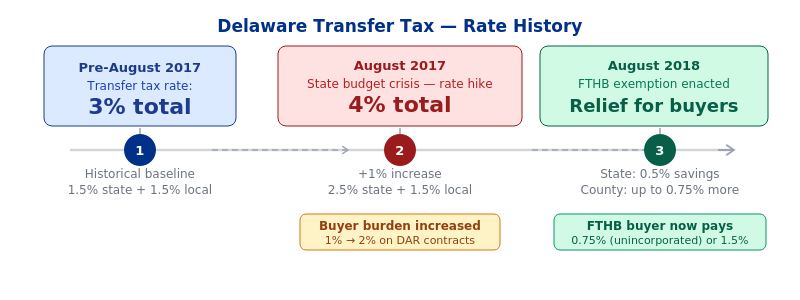
Delaware’s real estate transfer tax is charged as a percentage of the home’s sale price and is due at closing. The standard total rate is 4% of the purchase price — a state portion and a local (county or municipality) portion combined. Under the standard Delaware Association of Realtors (DAR) sales contract, this is split equally: buyer pays 2%, seller pays 2%.
Here’s what that means for you:
On a $300,000 home, the standard buyer transfer tax is $6,000. This is one of the largest closing costs in Delaware — which is why the first-time buyer exemption can make a meaningful difference.
| Party | State Portion | Local Portion | Total Paid |
|---|---|---|---|
| Buyer | 1.25% | 0.75% | 2.00% |
| Seller | 1.25% | 0.75% | 2.00% |
| Total | 2.50% | 1.50% | 4.00% |
Why the State Rate Is Sometimes 3% Instead of 2.5%
Under Delaware Code Title 30 §5402(a), the default state transfer tax rate is 3% — not 2.5%. The state rate only drops to 2.5% when the local municipality or county has enacted the full 1.5% local transfer tax authorized under Delaware law. When a local government collects its own 1.5%, the state reduces its share from 3% to 2.5%, keeping the combined total at 4%.
In practical terms this means:
- Most of Delaware (county + municipality collecting 1.5% local): State = 2.5%, Local = 1.5%, Total = 4%
- Areas with a 1% local rate (Hartly, Kenton, Woodside in Kent County; Farmington): State stays at 3% because the local rate does not meet the 1.5% threshold, Local = 1%, Total = 4%
- Areas with no local transfer tax at all (Arden, Ardentown, Ardencroft in New Castle County): State = 3%, Local = 0%, Total = 3% — the only places in Delaware where total transfer tax is 3%, not 4%
Arden, Ardentown & Ardencroft — The Exception: These three villages in northern New Castle County have a single-tax system and collect no local transfer tax. Because no local tax is enacted, the state collects its default 3% rate and there is no county portion. The total transfer tax is 3% split 1.5% buyer / 1.5% seller — not the standard 4%. A first-time buyer there still qualifies for the 0.5% state FTHB reduction and pays 1.0% state tax. No county exemption applies because there is no county portion.
Here’s what that means for you:
The total transfer tax is usually still 4%, but how it’s split between the state and local government can change depending on the property location. The first-time buyer state exemption still applies either way.
Resale vs. New Construction — Who Pays the Transfer Tax
The standard DAR sales contract splits transfer tax equally — buyer pays 2%, seller pays 2%. This is the norm for virtually all resale transactions in Delaware.
New construction is different. Home builders in Delaware write their own purchase contracts and many require the buyer to pay the entire 4% transfer tax. This is not negotiating error — it is written into the builder’s contract as a standard term. Before signing any new construction contract, ask your loan officer to calculate your cash-to-close with the buyer paying the full 4%. On a $400,000 new construction home the difference is $8,000 vs. $16,000 — a significant impact on how much cash you need at closing.
New Construction Warning: Many Delaware builder contracts require the buyer to pay 100% of the transfer tax (4% of the purchase price). Read the contract before you fall in love with the home. Your loan officer should factor this into your closing cost estimate from day one. Here’s what that means for you: If you’re buying new construction, your cash needed at closing could be significantly higher — even with the first-time buyer exemption. We’ll calculate this before you sign anything so there are no surprises.
The 2018 Law Change: Why This Exemption Exists
To understand the first-time buyer exemption, it helps to know why it was created. Delaware’s transfer tax history has two distinct eras separated by a 2017 budget decision that changed the math for every home buyer in the state.
Before August 1, 2017
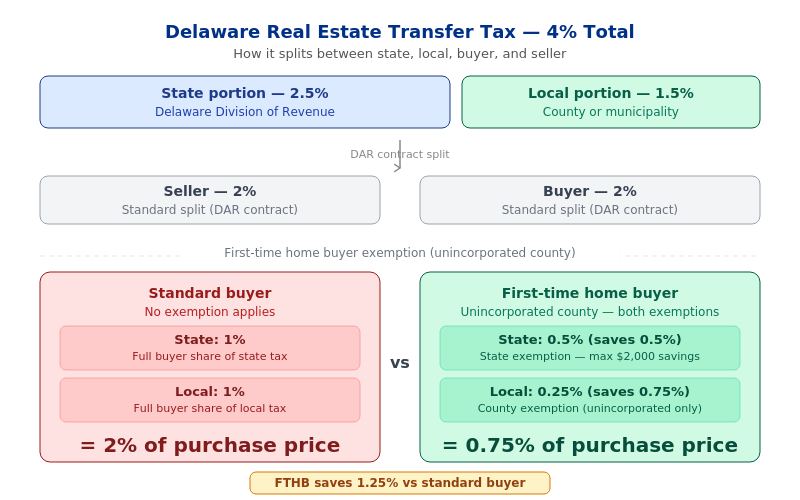
For many years, Delaware’s total transfer tax was 3% of the purchase price — 1.5% state and 1.5% local, split evenly so buyer and seller each paid 1.5%. The tax was straightforward and consistent across the state.
August 1, 2017 — The Rate Increase
Facing a significant state budget shortfall, Delaware’s General Assembly raised the state portion of the transfer tax from 1.5% to 2.5% — effective August 1, 2017. This increased the total transfer tax from 3% to 4% for properties in areas with a full local transfer tax. The additional 1% went entirely to the state’s general operating fund.
For buyers, the standard buyer share jumped from 1.5% to 2.0% overnight — a $1,500 increase on a $300,000 purchase. The increase applied to all contracts executed on or after August 1, 2017. Buyers who had signed a contract before August 1 but closed after that date were still subject to the old 3% rate.
August 30, 2018 — The Delaware First-Time Home Buyer Transfer Tax Exemption
Recognizing that the rate increase disproportionately impacted first-time home buyers, the Delaware legislature enacted the first-time buyer exemption on August 30, 2018. The exemption was made retroactive to August 1, 2017 — meaning every first-time buyer who had paid the increased rate since the hike took effect was entitled to a refund.
The exemption reduced the buyer’s state transfer tax share from 1.25% to 0.75% on the first $400,000 of the purchase price — returning 0.5% of the purchase price, up to a maximum of $2,000, to qualifying first-time buyers. The exemption is now permanently codified in Delaware Code Title 30, Chapter 54, §5402(c).
Delaware Transfer Tax Timeline
- Pre-August 2017: Total = 3% (1.5% state / 1.5% local). Buyer pays 1.5%.
- August 1, 2017: State raises its portion to 2.5%. Total = 4%. Buyer share rises to 2.0%.
- August 30, 2018: FTHB exemption enacted — buyer’s state share reduced from 1.25% to 0.75% on first $400,000. Made retroactive to August 1, 2017.
- Today: Exemption is permanent. First-time buyers claim it at closing using RTT-SCH Schedule 1.
If You Bought Between August 2017 and August 2018
If you purchased your first home in Delaware between August 1, 2017 and August 30, 2018 and paid the full increased state transfer tax without claiming the exemption, you may still be entitled to a refund of up to $2,000. Complete Form RTT-FHB and submit it to the Delaware Division of Revenue. Processing typically takes 4–6 weeks. Get the form at revenue.delaware.gov.
The Delaware First-Time Home Buyer Transfer Tax Exemption — Current Rules
State Exemption at a Glance
- Standard buyer’s state share: 1.25%
- First-time buyer’s state share: 0.75% (on first $400,000)
- Savings: 0.5% × purchase price, capped at $2,000
- On amounts above $400,000: buyer pays full 1.25% state rate
- Seller’s state share: unchanged at 1.25%
- Must intend to occupy as principal residence within 90 days of closing
- Applies statewide — regardless of county or municipality location
State Exemption Savings by Purchase Price
| Purchase Price | Standard Buyer State Tax | FTHB Buyer State Tax | State Savings |
|---|---|---|---|
| $200,000 | $2,500 | $1,500 | $1,000 |
| $300,000 | $3,750 | $2,250 | $1,500 |
| $400,000 | $5,000 | $3,000 | $2,000 |
| $500,000 | $6,250 | $4,250* | $2,000 |
| $600,000 | $7,500 | $5,500* | $2,000 |
*For purchases above $400,000: buyer pays 0.75% on the first $400,000 ($3,000) + 1.25% on the amount above $400,000. The $2,000 savings cap applies regardless of purchase price.
How to Estimate Your Transfer Tax in 3 Steps
Before diving into the county tables, here’s a simple way to estimate your transfer tax:
Step 1: Confirm you qualify as a first-time home buyer
Step 2: Check if the property is in unincorporated county land or a city/town
Step 3: Determine if it’s resale or new construction
Here’s what that means for you:
Most buyers in unincorporated areas receive both the state and county exemption. Buyers inside cities and towns usually only receive the state exemption.
Common Transfer Tax Scenarios for First-Time Buyers
| Scenario | Buyer Transfer Tax |
|---|---|
| Unincorporated county | ~0.75% |
| Inside most municipalities | ~1.50% |
| New construction (buyer pays all) | Up to 4.0%+ |
Example:
$350,000 home in unincorporated Sussex County
? Buyer transfer tax ? $2,625 instead of $7,000
Delaware County Transfer Tax Exemption by Municipality
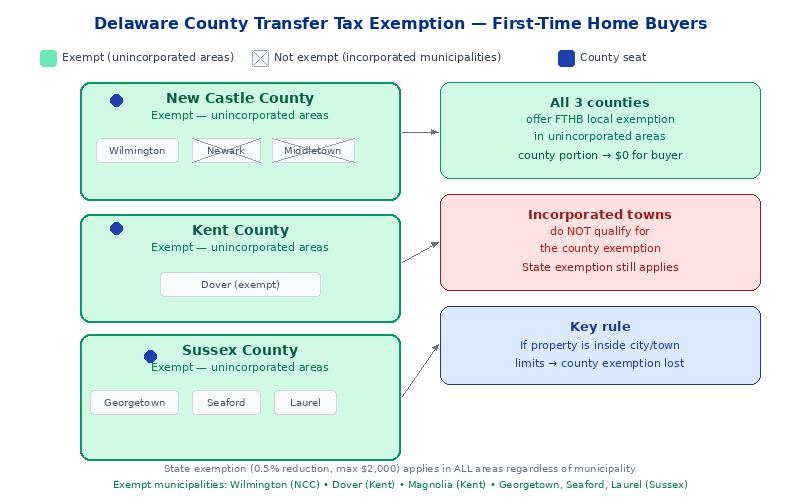
In addition to the state exemption, all three Delaware counties exempt first-time home buyers from the county’s 0.75% share of the transfer tax when the property is in unincorporated county land. When the property is inside a municipality, that municipality collects the local tax and its own rules apply — and those rules vary significantly from town to town.
The three tables below are a complete reference for every municipality in Delaware. The state exemption (0.5%, max $2,000) always applies regardless of location. The FTHB column in each table shows whether the buyer also saves the additional local portion at that specific location.
Official sources: New Castle County Recorder of Deeds | Kent County Recorder of Deeds Transfer Tax Rate Schedule | Delaware Division of Revenue
For Real Estate Agents: The state exemption (0.5%, max $2,000) applies to all qualifying first-time buyers statewide. The FTHB column below shows whether the buyer also saves the local 0.75% portion. For a first-time buyer in a fully exempt location on a purchase up to $400,000: use 0.75% of purchase price as the buyer’s total transfer tax line item on the closing cost estimate. For a first-time buyer inside a municipality with no exemption: use 1.50% of purchase price (0.75% state + 0.75% local).
Want help estimating your exact transfer tax before making an offer?
We can review the property, confirm eligibility, and map out your total cash to close so you can move forward with confidence.
New Castle County — First-Time Buyer Transfer Tax by Municipality
The New Castle County Recorder of Deeds collects transfer tax for the state and county, and also collects directly for: City of Newark, Town of Middletown, Delaware City, Town of New Castle, Town of Smyrna, and Town of Clayton. Other municipalities collect their own local portion separately. Source: NCC Recorder of Deeds Transfer Tax Information Sheet.
| Location | Local Rate | State Rate | Total | FTHB Local Exempt? |
|---|---|---|---|---|
| New Castle County (unincorporated) | 1.5% | 2.5% | 4.0% | Yes — Exempt |
| Town of Arden | None | 3.0%† | 3.0% | No local tax |
| Town of Ardencroft | None | 3.0%† | 3.0% | No local tax |
| Town of Ardentown | None | 3.0%† | 3.0% | No local tax |
| Town of Bellefonte | 1.5% | 2.5% | 4.0% | Confirm with town‡ |
| Town of Clayton | 1.5% | 2.5% | 4.0% | Not Exempt |
| Delaware City | 1.5% | 2.5% | 4.0% | Not Exempt |
| Town of Elsmere | 1.5% | 2.5% | 4.0% | Not Exempt§ |
| Town of Middletown | 1.5% | 2.5% | 4.0% | Not Exempt |
| Town of New Castle | 1.5% | 2.5% | 4.0% | Not Exempt |
| City of Newark | 1.5% | 2.5% | 4.0% | Not Exempt** |
| Town of Newport | 1.5% | 2.5% | 4.0% | Not Exempt |
| Town of Odessa | 1.5% | 2.5% | 4.0% | Not Exempt |
| Town of Smyrna | 1.5% | 2.5% | 4.0% | Not Exempt |
| Town of Townsend | 1.5% | 2.5% | 4.0% | Not Exempt |
| City of Wilmington | 1.5% | 2.5% | 4.0% | Yes — Exempt†† |
†Arden, Ardentown, Ardencroft: No local transfer tax. Under Delaware Code §5402(a), the state rate defaults to 3% when no local tax is enacted. Total transfer tax is 3% (not 4%) split 1.5%/1.5%. A first-time buyer still qualifies for the 0.5% state FTHB reduction and pays 1.0% state tax. No local portion to exempt.
‡Bellefonte: Collects its own local transfer tax separately via town stamp. Contact Town of Bellefonte at 302-632-0206 to confirm FTHB exemption status.
§Elsmere offered a FTHB exemption but it was repealed by the Mayor and Town Council on February 9, 2012.
**Newark exemption does not apply in standard transactions. A limited exception may exist for properties that have held a valid rental license for the past two years — contact City of Newark at 302-366-7088 to confirm.
††Wilmington’s exemption applies to any buyer who has not held a legal interest in residential real estate within Wilmington city limits, OR a displaced spouse due to divorce or legal separation. This is a broader standard than the state definition. Contact City of Wilmington Realty Transfer Tax office at 302-571-4320.
Kent County — First-Time Buyer Transfer Tax by Municipality
Source: Kent County Recorder of Deeds — Transfer Tax Rate Schedule (May 2025, KCROD-10.0)
| Location | Local Rate | State Rate | Total | FTHB Local Exempt? |
|---|---|---|---|---|
| Kent County (unincorporated) | 1.5% | 2.5% | 4.0% | Yes — Exempt |
| Bowers Beach | 1.5% | 2.5% | 4.0% | Not Exempt |
| Town of Camden | 1.5% | 2.5% | 4.0% | Not Exempt |
| Town of Cheswold | 1.5% | 2.5% | 4.0% | Not Exempt |
| Town of Clayton | 1.5% | 2.5% | 4.0% | Not Exempt |
| City of Dover | 1.5% | 2.5% | 4.0% | Yes — Exempt |
| Town of Farmington | 1.0%† | 3.0% | 4.0% | Not Exempt |
| Town of Felton | 1.5% | 2.5% | 4.0% | Yes — Buyer Only‡ |
| Town of Frederica | 1.5% | 2.5% | 4.0% | Not Exempt |
| City of Harrington | 1.5% | 2.5% | 4.0% | Not Exempt |
| Town of Hartly | 1.0%† | 3.0% | 4.0% | Not Exempt |
| Town of Houston | 1.5% | 2.5% | 4.0% | Not Exempt |
| Town of Kenton | 1.0%† | 3.0% | 4.0% | Not Exempt |
| Town of Leipsic | 1.5% | 2.5% | 4.0% | Not Exempt |
| Town of Little Creek | 1.5% | 2.5% | 4.0% | Not Exempt |
| Town of Magnolia | 1.5% | 2.5% | 4.0% | Yes — Exempt |
| City of Milford (Kent portion) | 1.5% | 2.5% | 4.0% | Yes — Exempt§ |
| Town of Smyrna | 1.5% | 2.5% | 4.0% | Not Exempt |
| Town of Viola | 1.5% | 2.5% | 4.0% | Not Exempt |
| Town of Woodside | 1.0%† | 3.0% | 4.0% | Not Exempt |
| Town of Wyoming | 1.5% | 2.5% | 4.0% | Not Exempt |
†1% local rate: Because the local rate does not meet the 1.5% threshold, the state rate stays at its default 3% rather than reducing to 2.5%. Total is still 4%. The first-time buyer state exemption (0.5%) still applies.
‡Felton FTHB exemption applies to buyer only — seller is not exempt. Contact Town of Felton at 302-284-9365.
§Milford exemption applies when buyer and seller both qualify for the county exemption. Milford straddles Kent and Sussex counties — confirm which parcel is in which jurisdiction with your settlement attorney.
Sussex County — First-Time Buyer Transfer Tax by Municipality
Sussex County’s FTHB exemption (Sussex County Code Chapter 103, Article IV, Section 103-19D) applies to the buyer’s 0.75% county share in unincorporated areas. Most Sussex County municipalities do not offer a local exemption — but Georgetown, Seaford, and Laurel are notable exceptions that extend the exemption to both buyer and seller.
| Location | Local Rate | State Rate | Total | FTHB Local Exempt? |
|---|---|---|---|---|
| Sussex County (unincorporated) | 1.5% | 2.5% | 4.0% | Yes — Buyer Exempt |
| Town of Bethany Beach | 1.5% | 2.5% | 4.0% | Not Exempt |
| Town of Bethel | 1.5% | 2.5% | 4.0% | Not Exempt |
| Town of Blades | 1.5% | 2.5% | 4.0% | Not Exempt |
| Town of Bridgeville | 1.5% | 2.5% | 4.0% | Not Exempt |
| Town of Dagsboro | 1.5% | 2.5% | 4.0% | Not Exempt |
| Town of Delmar | 1.5% | 2.5% | 4.0% | Partial* |
| Town of Dewey Beach | 1.5% | 2.5% | 4.0% | Not Exempt |
| Town of Ellendale | 1.5% | 2.5% | 4.0% | Not Exempt |
| Town of Fenwick Island | 1.5% | 2.5% | 4.0% | Not Exempt |
| Town of Frankford | 1.5% | 2.5% | 4.0% | Not Exempt |
| Town of Georgetown | 1.5% | 2.5% | 4.0% | Yes — Exempt |
| Town of Greenwood | 1.5% | 2.5% | 4.0% | Not Exempt |
| Henlopen Acres | 1.5% | 2.5% | 4.0% | Not Exempt |
| Town of Laurel | 1.5% | 2.5% | 4.0% | Yes — Buyer & Seller |
| City of Lewes | 1.5% | 2.5% | 4.0% | Not Exempt |
| City of Milford (Sussex portion) | 1.5% | 2.5% | 4.0% | Confirm with attorney |
| Town of Millsboro | 1.5% | 2.5% | 4.0% | Not Exempt |
| Town of Millville | 1.5% | 2.5% | 4.0% | Not Exempt |
| Town of Milton | 1.5% | 2.5% | 4.0% | Not Exempt |
| Town of Ocean View | 1.5% | 2.5% | 4.0% | Not Exempt |
| City of Rehoboth Beach | 1.5% | 2.5% | 4.0% | Not Exempt |
| City of Seaford | 1.5% | 2.5% | 4.0% | Yes — Buyer & Seller |
| Town of Selbyville | 1.5% | 2.5% | 4.0% | Not Exempt |
| Town of South Bethany | 1.5% | 2.5% | 4.0% | Not Exempt |
| Slaughter Beach | 1.5% | 2.5% | 4.0% | Not Exempt |
*Delmar partial exemption: first-time home buyers pay 1% to the Town of Delmar instead of the standard 1.5% local rate — a savings of 0.5% on the local portion. Contact Town of Delmar at 302-846-2664 to confirm.
Laurel and Seaford extend the FTHB exemption to both buyer and seller on the local portion. Georgetown exemption applies to buyer. Always confirm current status with your settlement attorney — municipal ordinances can change.
Source: Delaware Settlement Services FTHB reference table; Sussex County Code Chapter 103, Article IV, Section 103-19D.
How Much Do First-Time Buyers Save? Comparison by Scenario
The table below shows total buyer transfer tax under four common scenarios on a $300,000 purchase, assuming the standard DAR contract split:
| Scenario — $300,000 Purchase | Buyer Pays | vs. Standard |
|---|---|---|
| Standard buyer (not FTHB) — resale, DAR contract | $6,000 (2.00%) | Baseline |
| Standard buyer (not FTHB) — new construction, buyer pays full 4% | $12,000 (4.00%) | +$6,000 more |
| FTHB — inside municipality, no local exemption (state only) | $4,500 (1.50%) | Save $1,500 |
| FTHB — unincorporated county or exempt municipality (state + local) | $2,250 (0.75%) | Save $3,750 |
| FTHB — Arden/Ardentown/Ardencroft (3% total, no local portion) | $3,000 (1.00%)* | Save $1,500 |
*Arden villages: Total transfer tax is 3% not 4%. Standard buyer split is 1.5%/1.5%. FTHB buyer pays 1.0% (1.5% minus 0.5% state exemption). Savings = $1,500 on a $300,000 purchase.
Who Qualifies as a First-Time Home Buyer for the DE Transfer Tax Exemption?
Delaware’s definition of “first-time home buyer” for transfer tax purposes is strict. Under Delaware Code Title 30 §5402(2), the definition requires:
You qualify if you:
- Have never held any direct legal interest in residential real estate anywhere — not just Delaware, this is nationwide, AND
- Intend to occupy the property as your principal residence within 90 days of closing, OR within 90 days of a certificate of occupancy for new construction
You do NOT qualify if you:
- Have ever owned any residential property anywhere, including a rental or investment property
- Are purchasing as an investment — must be owner-occupied
- Are a co-buyer with someone who has previously owned residential real estate — if any person on the deed has owned before, the entire transaction loses the exemption
Note on Wilmington: The City of Wilmington applies a broader standard — the exemption is available to anyone who has not held a legal interest in residential real estate within Wilmington city limits, or a displaced spouse from divorce or legal separation. This means a buyer who previously owned outside of Wilmington may still qualify for Wilmington’s local exemption even if they do not qualify for the state exemption. Always confirm with the City of Wilmington at 302-571-4320.
How to Claim the Exemption at Closing
At Closing (Standard Process)
Your settlement attorney will complete Form RTT-TAX (Realty Transfer Tax Return) along with RTT-SCH Schedule 1 (First-Time Home Buyer’s Credit) and submit it to the Delaware Division of Revenue on your behalf. You will not pay the exempted portion at the closing table — it simply will not appear as a charge on your settlement statement.
Tell your loan officer and settlement attorney that you are a first-time home buyer before your closing date so the exemption is flagged in advance and all required documentation is prepared.
After Closing (Retroactive Refund)
If you closed after August 1, 2017 and paid the full state transfer tax rate without claiming the first-time buyer exemption, you may still be eligible for a refund:
- Complete Form RTT-FHB (Claim for Refund)
- Submit directly to the Delaware Division of Revenue
- Allow 4–6 weeks for processing
- Maximum refund: $2,000
Get current forms at the Delaware Division of Revenue official page.
Real-World Example: What a Delaware First-Time Buyer Saves
Maria is purchasing a resale home in unincorporated New Castle County for $350,000 using the standard DAR contract. She has never owned real estate anywhere.
Maria saves $4,375 at closing. Had she been purchasing new construction with a builder contract requiring her to pay the full 4%, her transfer tax bill would have started at $14,000 before any exemptions applied — making it even more important to understand the contract terms before signing.
Learn More: Your Guide to Buying Your First Home in Delaware
John Thomas is the author of Your Guide to Buying Your First Home in Delaware (ISBN: 0557349826), a comprehensive resource covering every aspect of the Delaware home buying process — including transfer taxes, closing costs, loan programs, and what to expect at settlement.
As a Branch Manager and Certified Mortgage Planner with Primary Residential Mortgage (NMLS #38783), John Thomas has closed hundreds of Delaware first-time home buyer transactions across all three counties. He was writing about the 2017 rate increase and the 2018 exemption as they happened, understands the difference between DAR contracts and builder contracts, and works closely with settlement attorneys to ensure every eligible buyer claims every exemption they are entitled to at closing.
Delaware First-Time Buyer Programs That Work Alongside the Transfer Tax Exemption
The transfer tax exemption reduces your closing costs. These programs reduce what you need for a down payment:
- Delaware First-Time Home Buyer Programs Overview — complete guide to all available programs
- Delaware Down Payment Assistance Programs — DSHA grants and second mortgages
- DSHA Homes for Grads Program — for recent college graduates buying in Delaware
- Delaware Mortgage Credit Certificate (MCC) — federal tax credit that reduces your annual tax bill
- Good Neighbor Next Door Program — 50% off list price for teachers, firefighters, law enforcement, and EMTs
Frequently Asked Questions
What is the Delaware first-time home buyer transfer tax exemption?
The Delaware first-time home buyer transfer tax exemption reduces the buyer’s state transfer tax by 0.5% of the purchase price, saving up to $2,000 on homes priced at or below $400,000.
Here’s what that means for you:
On a $300,000 home, you could save about $1,500 at closing. This reduces your total cash needed to buy the home.
Who qualifies as a first-time home buyer in Delaware?
To qualify, you must not have owned residential real estate before, must intend to live in the home as your primary residence, and must move in within 90 days of closing. All buyers listed on the deed must meet this definition.
Here’s what that means for you:
If you’ve been renting or living with family, you will likely qualify. If one borrower has owned a home before, the exemption may not apply.
How much can first-time buyers save on transfer tax in Delaware?
First-time buyers can save up to $2,000 on the state portion of transfer tax. Additional savings may apply if the property qualifies for a county-level exemption.
Here’s what that means for you:
In some areas, your total transfer tax could drop from 2.0% to as low as 0.75% of the purchase price.
Do all first-time buyers get the county transfer tax exemption?
No. The county exemption typically applies only to properties located in unincorporated county areas. Homes inside cities or towns usually do not qualify for the local exemption.
Here’s what that means for you:
Where you buy matters. Two homes at the same price can have very different closing costs depending on location.
How much transfer tax do first-time buyers pay in Delaware?
Most first-time buyers pay between 0.75% and 1.50% of the purchase price, depending on the property location and whether a local exemption applies.
Here’s what that means for you:
On a $350,000 home, your transfer tax could range from about $2,625 to $5,250 depending on where the home is located.
Does the exemption apply to new construction homes?
Yes, the state exemption still applies. However, many builders require the buyer to pay the full 4% transfer tax, which increases total closing costs.
Here’s what that means for you:
Even with the exemption, your out-of-pocket costs can be much higher on new construction compared to resale homes.
Do all buyers on the loan need to be first-time buyers?
Yes. All buyers listed on the deed must qualify as first-time home buyers to receive the exemption.
Here’s what that means for you:
If one borrower has owned a home before, the exemption may not apply—but there may still be other ways to reduce your closing costs.
Can you combine the transfer tax exemption with other first-time buyer programs?
Yes. The transfer tax exemption can be combined with down payment assistance, FHA loans, VA loans, and other first-time home buyer programs.
Here’s what that means for you:
You may be able to reduce both your upfront costs and your down payment at the same time.
If I previously owned an investment property but never lived in it, do I qualify?
No. Delaware’s definition requires that you have never held any direct legal interest in residential real estate anywhere — regardless of whether it was your primary residence. If you have previously owned any residential property of any kind you do not qualify for the Delaware first-time home buyer transfer tax exemption.
Can my spouse and I both qualify if only one of us is a first-time buyer?
No. If any buyer taking title to the property has previously owned residential real estate, none of the buyers on the transaction qualify for the Delaware first-time home buyer transfer tax exemption. All individuals on the deed must individually meet the first-time buyer definition.
Does Delaware have a transfer tax on refinances?
No. Delaware does not impose a transfer tax on mortgage refinances. Transfer tax only applies when property changes ownership through a purchase transaction. Delaware also has no mortgage tax. The only government fee on a refinance is the county recording fee for the new mortgage.
How do I find out if my property is in unincorporated county land or inside a municipality?
Your settlement attorney will determine this during closing preparation and flag which transfer tax rules apply. The three county tables on this page cover every municipality in Delaware. If your property address falls within a listed municipality, that municipality’s rules apply. If it is not within any listed municipality, unincorporated county rules apply and the full county first-time home buyer transfer tax exemption is available.
When did Delaware add the first-time home buyer transfer tax exemption?
The Delaware first-time home buyer transfer tax exemption was enacted on August 30, 2018 and made retroactive to August 1, 2017. It was created in direct response to Delaware raising the state transfer tax rate from 1.5% to 2.5% on August 1, 2017, which increased the total transfer tax from 3% to 4%.
How much is the transfer tax in Delaware?
The standard Delaware transfer tax is 4% of the purchase price. Under the standard Delaware Association of Realtors (DAR) sales contract this is split equally — buyer pays 2% and seller pays 2%. Home builders write their own contracts and many require the buyer to pay the entire 4%, so always review a new construction contract carefully before signing.
Who pays the transfer tax in Delaware — buyer or seller?
Under the standard Delaware Association of Realtors (DAR) sales contract, transfer tax is split equally — buyer pays 2% and seller pays 2%. However, home builders write their own purchase contracts and many require the buyer to pay the entire 4% transfer tax. Always review a builder contract carefully and ask your loan officer to factor the full transfer tax into your closing cost estimate before signing.
Why is the state transfer tax rate sometimes 3% instead of 2.5%?
Under Delaware Code §5402(a), the default state transfer tax rate is 3%. It only drops to 2.5% when the local municipality or county has enacted the full 1.5% local transfer tax. In areas with no local transfer tax — like Arden, Ardentown, and Ardencroft in New Castle County — the state collects its full 3% default rate and the total transfer tax is 3%, not 4%.
How do you claim the Delaware transfer tax exemption?
No special action is required if you claim the Delaware first-time home buyer transfer tax exemption at closing. The exemption is claimed at closing by completing the required Delaware transfer tax forms, typically handled by your settlement attorney or title company. The attorney will complete RTT-SCH Schedule 1 and submit it to the Delaware Division of Revenue on your behalf.
Here’s what that means for you:
You don’t need to apply separately in most cases—the exemption is usually applied automatically during settlement.
Can I get the county transfer tax exemption if I’m buying in Wilmington?
Yes. Wilmington offers a first-time home buyer transfer tax exemption. Wilmington’s standard is slightly broader than the state definition — it applies to any buyer who has not held a legal interest in residential real estate within Wilmington city limits, or a displaced spouse due to divorce or legal separation. Contact the City of Wilmington at 302-571-4320 to confirm eligibility for your specific transaction.
Does the Delaware first-time home buyer transfer tax exemption apply to homes over $400,000?
Yes, but only partially on the state portion. The Delaware first-time home buyer transfer tax exemption applies on the first $400,000 of the purchase price, saving the buyer a maximum of $2,000 on the state portion. On the amount above $400,000, the buyer pays the standard state rate of 1.25%. The county exemption, where applicable, applies to the full county portion regardless of purchase price.
What happens if I bought a home before but not recently?
If you have owned residential real estate at any time in the past, you typically do not qualify as a first-time home buyer under Delaware’s definition.
Here’s what that means for you:
Even if it was years ago, prior ownership can affect eligibility—but we can review your situation to confirm your options.
What Delaware Buyers Usually Ask About Transfer Tax
Most Delaware buyers are surprised by how much transfer tax affects their closing costs.
In areas like Middletown, Newark, and Dover, the rules can vary depending on whether the property is inside town limits or just outside in county land.
Beach areas in Sussex County often fall inside municipalities, which means the county exemption may not apply — even though the state exemption still does.
This can feel confusing at first, but we’ll walk through it step-by-step so you know exactly what to expect before you make an offer.
Talk to a Delaware First-Time Home Buyer Expert
Understanding Delaware’s transfer tax rules — including the difference between a DAR contract and a builder contract, how the county tables apply to your specific address, and how the 2018 exemption affects your cash-to-close — is something John Thomas walks through with every first-time buyer he works with. The John Thomas Team closes loans across all three Delaware counties and knows how the exemption applies at every location.
Not sure how this applies to your situation? That’s completely normal — we’ll walk through everything step-by-step.
Ready to Buy Your First Home in Delaware?
Get pre-approved and find out exactly how much you’ll save at closing.
John Thomas | NMLS #38783 | 302-703-0727
John Thomas Team | Primary Residential Mortgage
NMLS #38783 | Licensed by the Delaware State Bank Commissioner
248 E Chestnut Hill Rd, Newark, DE 19713
Phone: 302-703-0727
Website: delawaremortgageloans.net
YouTube: youtube.com/@johnthomasteam
Page last updated: April 2026. Transfer tax rules are established by Delaware state law and county/municipal ordinance and are subject to change. Always confirm current rates and exemption status with your settlement attorney at closing. Official sources: Delaware Division of Revenue — First-Time Home Buyer Tax Credit | Delaware Code Title 30, Chapter 54, §5402 | New Castle County Recorder of Deeds | Kent County Recorder of Deeds
