Delaware Jumbo Mortgage Loans: 2026 Limits, Down Payment and How to Qualify

Quick answer (Current as of July 2026): Delaware jumbo mortgage loans are home loans larger than the 2026 conforming limit of $832,750 for a one-unit property. Delaware has no high-cost counties, so that same limit applies in New Castle, Kent and Sussex. Jumbo loans sit outside Fannie Mae and Freddie Mac guidelines, so credit, reserve and down payment expectations generally run tighter.
Delaware jumbo mortgage loans come into play when the amount you need to borrow rises above the conforming loan limit. If you are buying or refinancing a higher-priced home in Delaware, you may run into the term “jumbo loan.” I am John Thomas, a Branch Manager and Mortgage Loan Officer here in Newark (NMLS #38783), and I have helped Delaware buyers finance homes across every price point for more than 20 years. The good news for 2026 is that the conforming loan limit rose again, to $832,750 for a one-unit home, which means a lot of Delaware purchases that would have needed a jumbo loan a few years ago now fit inside a standard conventional (conforming) loan. This guide explains what actually counts as a jumbo mortgage in Delaware today, how much you may need to put down, and how qualifying differs from a conforming loan.
Talk through your options before you make an offer – no application required for the first call.
Table of Contents
What is a jumbo mortgage in Delaware?
A jumbo mortgage is a home loan that is larger than the conforming loan limit set each year by the Federal Housing Finance Agency (FHFA). Loans at or below that limit can be sold to Fannie Mae and Freddie Mac as conventional conforming loans. Loans above it cannot, so they are called “non-conforming” or “jumbo” and are funded through investors with their own guidelines. For 2026, the one-unit conforming limit is $832,750. In Delaware, any one-unit loan amount above $832,750 is generally a jumbo loan.
One point that trips buyers up: the limit applies to the loan amount, not the purchase price. If you buy a $1,000,000 Delaware home and put 20 percent ($200,000) down, your loan is $800,000 – which is under $832,750, so it is a conforming loan, not a jumbo. You only cross into jumbo territory – the world of Delaware jumbo mortgage loans – when the amount you actually borrow exceeds the limit.
| Home price | Down payment | Loan amount | Jumbo in 2026? |
|---|---|---|---|
| $900,000 | 20% ($180,000) | $720,000 | No – conforming |
| $1,000,000 | 10% ($100,000) | $900,000 | Yes – jumbo |
| $1,150,000 | 20% ($230,000) | $920,000 | Yes – jumbo |
What are the 2026 Delaware jumbo loan limits?
Some parts of the country have “high-cost” counties with higher conforming limits (up to a national ceiling of $1,249,125 for 2026). Delaware does not have any high-cost counties – all three counties use the baseline limit set by the Federal Housing Finance Agency (FHFA). That makes the Delaware jumbo threshold simple:
| Property size | 2026 Delaware conforming limit | Jumbo starts above |
|---|---|---|
| One-unit (most homes) | $832,750 | $832,750 |
| Two-unit | $1,066,250 | $1,066,250 |
| Three-unit | $1,288,800 | $1,288,800 |
| Four-unit | $1,601,750 | $1,601,750 |
A quick Delaware example: say you are buying a $1,150,000 home in Hockessin and putting 20 percent ($230,000) down. Your loan amount is $920,000 – above the 2026 one-unit limit of $832,750 – so that is a jumbo loan, and you would compare jumbo options. Put more down and land at or below $832,750, and the same purchase becomes a conforming loan. The number that matters is what you borrow, not the sticker price.
Because the threshold is the same statewide, a $1.1 million home in Rehoboth Beach and a $1.1 million home in Hockessin cross into jumbo territory at the same loan amount. What changes from buyer to buyer is not the limit – it is the down payment, reserves and documentation the investor expects on a loan that size.
How much do you need to put down on a jumbo loan?
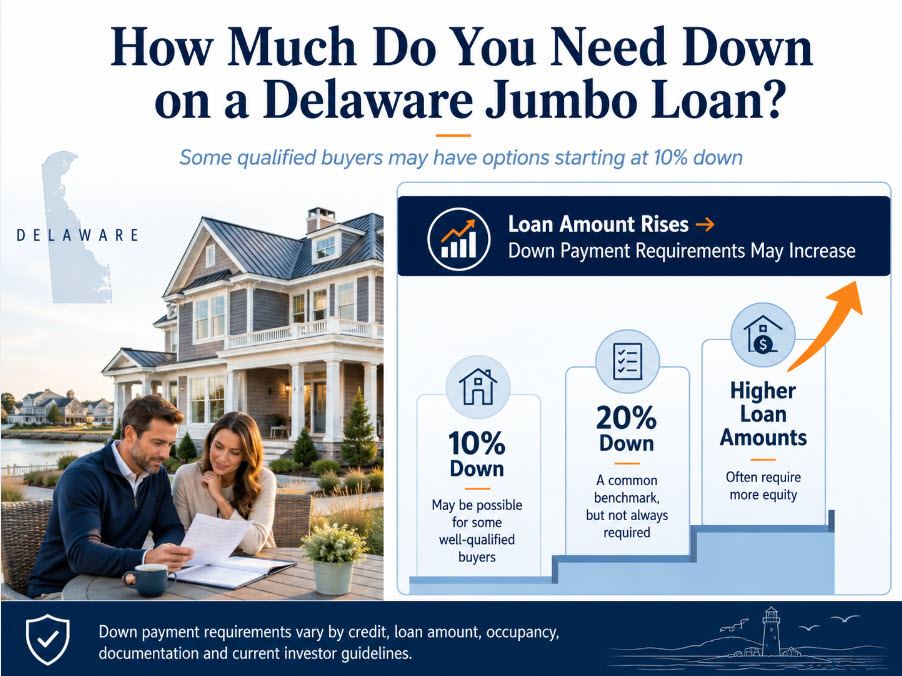
Down payment expectations on jumbo loans are more varied than on conforming loans, and they generally rise as the loan amount rises. Many people assume “jumbo means 20 percent down,” but that is not always the case: some jumbo programs may allow as little as 10 percent down (up to 90 percent financing) for well-qualified buyers. As the loan amount climbs into the multi-million-dollar range, the required down payment typically increases and the maximum financing steps down. The exact figure depends on your credit, documentation, occupancy and the current investor guidelines, so treat these as ranges to confirm for your scenario rather than fixed rules.
Loan size is rarely the ceiling in Delaware. Many jumbo programs run to roughly $3 to $4 million, and for the highest-value homes some portfolio and super-jumbo programs may reach up to $30 million with the right investor. Whatever your price point, the practical move is the same: bring me your price range, your down payment and how you document income, and I will tell you which jumbo structures may fit – and whether a conforming loan is actually the better path.
How do you qualify for a Delaware jumbo mortgage?
Here is the honest version of “what does it take to qualify?” The guidelines for Delaware jumbo mortgage loans are set by individual investors, not Fannie Mae or Freddie Mac, so the numbers below are the most flexible figures I see across the jumbo programs I work with. No single program offers every one of these at once – a 620 score and 90 percent financing and 55 percent DTI would not live on the same loan – so read this as the outer edge of what may be possible, then let me match your file to the program that fits.
| Guideline | What may be possible (varies by program) |
|---|---|
| Minimum credit score | As low as 620 on some programs; a few portfolio programs consider no-score borrowers |
| Maximum loan amount | Up to about $4 million on most non-QM jumbo programs; up to $30 million on some portfolio / super-jumbo programs |
| Minimum down payment | As little as 10% down (up to 90% financing) for well-qualified buyers; more as the loan amount rises |
| Maximum DTI | Up to 55% on some programs, usually at lower loan-to-value |
| Documentation | Full doc, or alt-doc: bank statement, 1099-only, P&L, asset qualifier / asset depletion, DSCR, no-income |
| Occupancy | Primary residence, second home, or investment property |
| Reserves | From about 3 months of payments, rising with loan size; some asset-based programs require none |
| Credit-event seasoning | Some programs consider buyers about 1 year after a bankruptcy, foreclosure or short sale (or sooner, case by case) |
| Seller concessions | Up to 6% toward closing costs |
| Interest-only | Available on some programs |
What this means for you: you do not have to hit every “best-case” number in this table. The goal is to match your credit, income, assets, down payment and property type to the jumbo program that may fit your situation – which is exactly the conversation I have with buyers before they make an offer.
Because jumbo loans are not backed by Fannie Mae or Freddie Mac, the investor carries more risk, and qualifying generally runs tighter than a conforming loan. In broad strokes, jumbo buyers should expect to document income and assets fully (or through one of the alternative-documentation paths below), show a solid credit profile, keep their debt-to-income ratio in range, and hold post-closing reserves. Reserve requirements in particular tend to scale with loan size – the larger the loan, the more months of payments an investor typically wants to see in the bank after closing. Specific floors move by program and over time, so treat the table above as ranges to confirm, not fixed rules.
In my own experience, the surprise on these files is usually reserves rather than the rate – a buyer who is comfortable with the down payment has not always planned for the extra months of payments an investor wants held back on a jumbo, which can run from a few months to a year or more depending on loan size. I plan for that early. None of this guarantees approval, but knowing the pattern up front is what keeps a jumbo purchase on schedule. (There is more on appraisal timing and what else I watch for in the local section below.)
Self-employed buyers deserve a special note: strong assets and good credit may help support a jumbo file even when tax returns understate income. If that describes you, it is worth comparing a full-documentation jumbo against one of the alternative-documentation options below before you decide.
Can you get a jumbo loan without full tax returns?
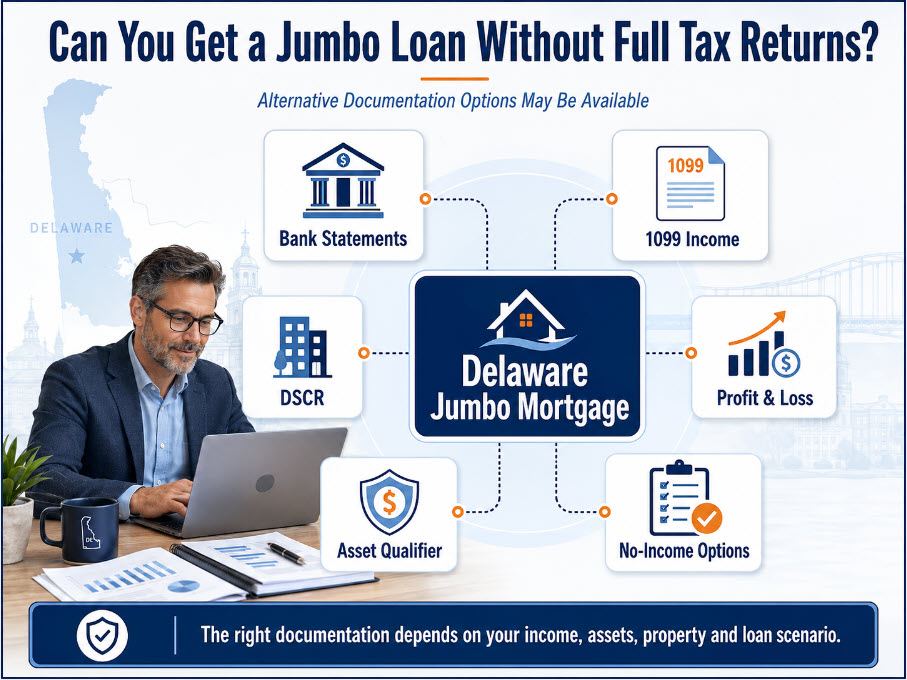
Often, yes. This is where jumbo lending has changed the most. Because jumbo loans are funded through investor guidelines rather than Fannie Mae and Freddie Mac, non-QM jumbo programs may allow a wide range of documentation – not just W-2s and tax returns. Depending on the program and your profile, a Delaware jumbo may be documented with:
- Full documentation – traditional W-2s, pay stubs and tax returns.
- Bank statements – typically 12 or 24 months of personal or business deposits in place of tax returns.
- 1099-only – for independent contractors who are paid on a 1099.
- Profit-and-loss (P&L) – a CPA- or licensed-preparer P&L statement for the business.
- Asset qualifier / asset depletion – qualifying on liquid assets rather than monthly income.
- DSCR – for an investment property, qualifying on the property’s rental cash flow.
- No-income / no-ratio – for buyers whose profile supports the loan without a calculated income figure.
- ITIN – for borrowers using an Individual Taxpayer Identification Number.
Not every program offers every option, and terms vary by loan size, occupancy and current investor guidelines – so this is a menu to match to your situation, not a promise that any one path is available to everyone. The point is that being self-employed, paid on 1099s, or asset-rich but low on taxable income does not automatically shut you out of a higher-priced Delaware home. Tell me how your income and assets look on paper and I will point you to the documentation path that fits.
Jumbo vs. conforming: how are they different?
| Feature | Conforming loan | Jumbo (non-conforming) loan |
|---|---|---|
| 2026 one-unit loan amount | Up to $832,750 in Delaware | Above $832,750 in Delaware |
| Backed by Fannie Mae / Freddie Mac | Yes | No – funded through investor guidelines |
| Typical down payment | As low as 3 percent for some buyers | As little as 10 percent down on some programs; more as loan size rises |
| Credit and reserves | Standard conventional guidelines | Generally tighter; some programs start near 620, reserves scale with loan size |
| Documentation | Standard | Full doc, or alt-doc (bank statement, 1099, P&L, asset, DSCR, no-income) by program |
| Rate behavior | Standard conventional pricing | Historically higher, but often close to conforming today because standards are stricter |
For a long stretch, jumbo rates ran noticeably higher than conforming and FHA rates. In today’s market that gap is often smaller, in part because jumbo lending standards are stricter, with larger down payments and stronger reserves. Rates change daily, so I never publish a number here – call for a current quote on your loan amount.
What affects your Delaware jumbo mortgage rate?
I do not publish rates on this page – they move daily and depend on your file – but it helps to know what actually drives a Delaware jumbo mortgage rate so you can put yourself in the best position. The biggest factors are:
- Credit profile – stronger scores generally earn better pricing.
- Loan amount and loan-to-value – a larger down payment often helps, and pricing can shift at higher loan sizes.
- Reserves – more months of reserves can strengthen the file.
- Occupancy – a primary residence usually prices better than a second home or investment property.
- Documentation type – full-doc and alternative-documentation files may price differently.
- Property type – a single-family home versus a condo or multi-unit can affect terms.
Delaware jumbo loans come as both fixed-rate loans (commonly 30-year) and adjustable-rate mortgages (ARMs) such as 5/6, 7/6 and 10/6, and some programs offer an interest-only option. An ARM can start lower than a comparable fixed rate but adjusts later, so the right structure depends on how long you plan to keep the loan. Tell me your plans and I will price out the options – call 302-703-0727 for a current quote on your scenario.
Delaware jumbo refinance and cash-out
Jumbo financing is not just for buying. You may be able to refinance an existing Delaware jumbo loan to change your rate or term, and a cash-out refinance may let you tap equity in a higher-value home – though cash-out generally comes with lower maximum financing and its own reserve expectations, and terms vary by current investor guidelines. The same documentation flexibility applies: a jumbo refinance can often be done with full documentation or one of the alternative-documentation paths above. One more difference from low-down conforming loans: jumbo loans typically do not carry standard monthly private mortgage insurance (PMI) – investors price that risk in other ways – which is part of why the down payment and reserve bar sits higher.
What properties and closing costs to expect
Property eligibility. Jumbo programs are generally available on single-family homes, townhomes and PUDs, many condominiums (warrantable, and some non-warrantable with tighter terms), and two- to four-unit properties. Manufactured and log homes are typically not eligible on the alternative-documentation jumbo programs, and unique or rural properties can carry their own conditions – so it is worth confirming your property type early.
Closing costs. A jumbo loan has the same broad closing-cost categories as any Delaware mortgage – lender fees, title, appraisal, taxes and prepaid items – but the dollar amounts can run higher because the loan is larger and the appraisal can be more involved (loans above about $2 million commonly need two appraisals). I do not publish a flat percentage, because it varies with loan size, property and county. I will put together a full estimate for your specific purchase so there are no surprises at the table.
Where jumbo financing comes up in Delaware – and what I watch for
Jumbo purchases are not evenly spread across the state. In my experience, demand for Delaware jumbo mortgage loans clusters in a few markets, and the pattern is worth knowing before you shop:
- Coastal Sussex County – Rehoboth Beach, Lewes and Bethany Beach – is where I see the most jumbo activity, often for second homes and higher-value beach properties.
- New Castle County – Hockessin, Greenville and North Wilmington – is the other frequent source, usually for move-up and executive purchases.
- Kent County uses the same $832,750 threshold; fewer purchases cross it, but the rules are identical when they do.
On the higher-value files I actually originate, two things surprise buyers more than the rate. The first is reserves: a buyer who is comfortable with the down payment sometimes has not planned for the extra months of payments an investor wants held back on a jumbo, so we plan for that early. The second shows up most on larger or more unique coastal Sussex homes – they can take longer to appraise, and above roughly $2 million some jumbo programs call for a second appraisal. I also flag the Delaware realty transfer tax on a jumbo-priced home: on a standard Delaware realty transfer tax contract the 4 percent is typically split 2 percent buyer and 2 percent seller, but builder contracts sometimes shift the full 4 percent to the buyer – real money at this price point, so I confirm it before an offer goes in. None of this guarantees approval, but knowing the pattern up front is what keeps a jumbo purchase on schedule.
Common Delaware jumbo loan mistakes
The good news is that most jumbo missteps are avoidable with a little planning. The ones I see most often:
- Assuming the purchase price decides jumbo status. It is the loan amount that matters – a bigger down payment can keep you conforming.
- Using every dollar of cash for the down payment and forgetting the post-closing reserves a jumbo investor expects.
- Waiting too long to plan for the appraisal on a unique or coastal property that may take longer to value, or need a second appraisal.
- Assuming self-employment is disqualifying. Alternative-documentation jumbo paths exist for exactly this situation.
- Assuming 20 percent down is always required. Some programs may allow as little as 10 percent for well-qualified buyers.
- Not comparing staying conforming when the loan is only slightly over the limit, where a small change can simplify the whole file.
When a jumbo loan is not the best fit
A jumbo loan is a tool, not a goal. In a fair number of Delaware conversations, a buyer who thinks they need a jumbo actually does not. A few situations where another path usually fits better:
- Your loan amount lands under $832,750. With a typical down payment, many Delaware purchases stay conforming – a conventional loan is usually simpler and may price better.
- You are a first-time buyer stretching to the top of your budget. Down payment help and first-time programs live on the conforming side – start with the Delaware first-time home buyer resources and down payment assistance options.
- You are eligible for VA and buying above the limit. A veteran with full entitlement may not need a jumbo at all – see Delaware VA loans.
- You are financing an investment property purely on rents. A DSCR investor loan may qualify on the property’s cash flow instead of your personal income.
- You are a senior tapping equity rather than buying up. A reverse mortgage may fit better than a new jumbo.
Other Delaware loan options to consider
Jumbo is one lane of a much bigger menu, and Delaware jumbo mortgage loans are not always the best fit. Depending on your price point, down payment and income picture, one of these may be a stronger fit – and I am happy to compare them side by side with you:
- Delaware conventional loans – the conforming path up to $832,750.
- Delaware FHA loans – lower down payment and flexible credit for eligible buyers.
- Delaware VA loans – for eligible veterans and active-duty service members.
- Bank statement loans and asset qualifier loans – for self-employed and asset-strong buyers.
- Delaware manufactured home loans – for factory-built homes.
- Buying in a specific market? See Newark Delaware mortgage loans and Wilmington Delaware mortgage loans.
How to apply for a Delaware jumbo mortgage
The simplest first step is a conversation – no application required. Here is how the process usually goes:
- Review your price range and expected loan amount to see whether you are actually above the $832,750 conforming limit.
- Compare conforming, jumbo, and alternative-documentation options so you are on the right track from the start.
- Verify credit, income, assets, and reserves against the program that fits your profile.
- Plan for the appraisal and any property-specific underwriting, especially on larger or coastal homes.
- Complete underwriting and prepare for closing, with the transfer-tax and cash-to-close picture mapped out ahead of time.
What this means for you: the goal is to identify the right structure before you make an offer, so there are fewer surprises later. When you are ready, call 302-703-0727, schedule a time that works for you, or start your application online – whichever you prefer.
Delaware jumbo mortgage FAQs
What is considered a jumbo loan in Delaware in 2026?
In 2026, a jumbo loan in Delaware is any one-unit mortgage larger than the conforming loan limit of $832,750. Delaware has no high-cost counties, so that same threshold applies in New Castle, Kent and Sussex. Loans at or below $832,750 can be sold to Fannie Mae and Freddie Mac as conforming loans; anything above is non-conforming, or jumbo.
Do jumbo loans require 20 percent down in Delaware?
Not necessarily. Some jumbo programs may allow as little as 10 percent down (up to 90 percent financing) for well-qualified buyers, though the required down payment generally rises as the loan amount climbs into the multi-million-dollar range. The exact figure depends on your credit, documentation, occupancy and current investor guidelines, so it is worth reviewing your specific scenario rather than assuming a flat 20 percent.
Can a self-employed borrower get a Delaware jumbo mortgage without full tax returns?
Often, yes. Non-QM jumbo programs may allow alternative documentation instead of tax returns, including 12 or 24 months of bank statements, 1099-only, a profit-and-loss statement, asset qualifier or asset depletion (qualifying on liquid assets), DSCR for investment properties, and no-income or no-ratio options. Not every program offers every path and terms vary by loan size and investor guidelines, so the right structure depends on how your income and assets look on paper.
Can I use a jumbo loan for a second home or beach investment property in Delaware?
Jumbo financing can be used for a primary residence, a second home, or an investment property, subject to program and investor guidelines. For higher-value coastal Sussex County properties, expect the down payment and reserve expectations to be firmer than on a primary residence, and be aware that larger or unique homes can take longer to appraise. Investors buying purely on rental cash flow may also want to compare a DSCR loan.
How much in reserves do I need for a jumbo loan?
Reserve requirements on jumbo loans generally scale with the loan amount – starting around three months of housing payments on smaller jumbo loans and rising to six, nine or twelve or more months as the loan amount and LTV increase. Some asset-based programs require no separate reserves. Plan for reserves early and confirm the current requirement for your loan size rather than relying on a single figure.
If I buy a $900,000 Delaware home with 20 percent down, is that a jumbo loan?
No. The conforming limit applies to the loan amount, not the purchase price. A $900,000 home with 20 percent down ($180,000) leaves a loan of $720,000, which is under the 2026 limit of $832,750 – so that is a conforming loan, not a jumbo. You only cross into jumbo territory when the amount you actually borrow exceeds $832,750.
Are jumbo mortgage rates higher than conforming rates?
Historically jumbo rates ran higher than conforming rates, but today the gap is often smaller, partly because jumbo lending standards are stricter with larger down payments and stronger reserves. Rates change daily and depend on your profile and loan amount, so call for a current quote rather than relying on a published number.
What credit score do I need for a Delaware jumbo loan?
It varies more than people expect. While many jumbo programs favor a strong credit profile, some non-QM jumbo programs may start as low as a 620 score, and a few portfolio options will consider borrowers with no credit score at all. Higher scores generally unlock better terms and higher financing. Rather than target a single number, it is best to review your full picture – credit, down payment, reserves and how you document income – with a loan officer, since those factors work together on a jumbo file.
Do Delaware’s three counties have different jumbo limits?
No. Because Delaware has no high-cost counties, the one-unit conforming limit of $832,750 is the same in New Castle, Kent and Sussex for 2026. A loan crosses into jumbo territory at the same amount statewide.
What if my loan is only slightly above the conforming limit?
If your loan amount lands just over $832,750, it is worth checking whether a small adjustment – a slightly larger down payment or a modest change in loan amount – could keep you inside the conforming limit, which is often simpler to qualify for. Sometimes staying conforming is the better move, and sometimes the jumbo is the right call; I can run both so you can compare before you decide.

John R. Thomas is a Branch Manager and Mortgage Loan Officer with Primary Residential Mortgage, Inc. in Newark, Delaware (NMLS #38783), and the author of a Delaware first-time home buyer guide. Over more than 20 years he has helped over 3,000 Delaware and Maryland families finance homes across every price point, from first-time buyers to jumbo purchases.
On jumbo files specifically, John plans for reserves and appraisal timing up front rather than focusing on the rate, which is what keeps higher-value Delaware purchases on schedule. John holds a B.S. in Physics Education from the University of Delaware and an M.S. in Curriculum and Instruction from Delaware State University, and is licensed in 17 states (AL, DC, DE, FL, GA, IN, KS, MD, MN, MO, NC, NJ, OH, PA, SC, TN, VA).
248 E Chestnut Hill Rd, Newark, DE 19713 | 302-703-0727 | team@johnthomasteam.com
NMLS #38783 | 285 reviews, 4.8 stars – See John Thomas Team on Google
Ready to look at a higher-priced Delaware home? Let’s compare your options.
Last Updated: July 2026. Mortgage content reviewed by John R. Thomas, NMLS #38783, at The John Thomas Team. John Thomas, NMLS #38783 | The John Thomas Team | 248 E Chestnut Hill Rd, Newark, DE 19713 | 302-703-0727 | delawaremortgageloans.net. (c) 2026 John R. Thomas. All Rights Reserved.
