Delaware Bank Statement Loan: A Self-Employed Buyer’s Guide for 2026


DELAWARE BANK STATEMENT LOAN – QUICK ANSWER
A Delaware bank statement loan lets self-employed buyers qualify on 12 or 24 months of business or personal bank deposits instead of tax returns. Loan amounts run $75,000 to $5,000,000, up to 90% LTV on a purchase, with credit scores from 600 and DTI up to 55%, subject to credit, reserves, occupancy and investor guidelines.
Current as of October 2026. Guidelines and pricing change without notice. Call John Thomas at 302-703-0727 to confirm your scenario.
You run a profitable business, your accountant writes off every expense the law allows, and then a lender tells you your tax returns don’t show enough income for the house your business can clearly afford. That gap is exactly what a Delaware bank statement loan is built for. I’m John Thomas, NMLS #38783, and my goal is to get you qualified on the cash flow your business actually produces, from the John Thomas Team office at 248 E Chestnut Hill Rd in Newark.
Here’s how I explain it to self-employed buyers: bank statement loan programs are a great alternative mortgage program for self-employed borrowers who take advantage of all the business owner tax deductions on their tax returns, which lowers their adjusted gross income and can make it harder to qualify for a traditional mortgage such as a conventional loan. You have several options that give you more flexibility in qualifying, like choosing business or personal bank statements and choosing 12 months or 24 months of statements.
It’s not the right fit for every self-employed buyer. If your tax returns already show enough income for a conventional loan, that is almost always the better deal: a lower rate, a smaller down payment and less paperwork. If you’re still sorting out which self-employed program fits you, start with our Delaware self-employed mortgage guide, then come back here if your deposits tell a better story than your tax return.
Self-check before you call: 1+ year self-employed, 12-24 months of bank statements available, 600+ credit score, buying or refinancing in Delaware or Maryland.
Ready to See If a Bank Statement Loan Works for Your Scenario?
Call, schedule, or apply. Pick the option that works best for you.
What Happens After You Call?
- We review your deposits. You share 12-24 months of bank statements (business, personal, or both), and we look at the deposit pattern and what underwriting will count.
- We compare your options. Bank statement loan, 1099 mortgage, profit and loss loan, asset qualifier, or conventional with your tax returns. There are usually 2-3 paths that could work, and we walk through the trade-offs of each.
- We estimate your qualifying income. Using the expense factor for your business type (and a CPA letter if it helps), we calculate the income figure underwriting will use.
- We confirm down payment, reserves, and property fit. Credit profile, occupancy, property type, and reserves all factor into program selection, and we lay out what your scenario needs.
- You decide whether to apply. No pressure. If the math works, we move forward. If your tax returns can support a better-priced conventional loan, we tell you that too.
Table of Contents
What Is a Delaware Bank Statement Loan?
A Delaware bank statement loan is a Non-QM mortgage that qualifies self-employed buyers on 12 or 24 months of bank deposits instead of tax returns. It fits business owners whose deductions lower their taxable income. Approval still depends on credit, reserves, property type, occupancy and investor guidelines, and pricing runs higher than conventional financing.
The program is built for self-employed borrowers, business owners, independent contractors, and 1099 earners whose tax returns don’t reflect what the business brings in. Instead of two years of personal and business returns, the lender uses 12 or 24 months of bank statements (business, personal, or both) and calculates qualifying income from your actual deposits. The deposits are averaged across the statement period, an expense factor backs out business costs, and the result is the income used to qualify the loan.
The conventional mortgage system was built around the W-2 employee. If you’re a Delaware plumber, restaurant owner, freight broker, real estate agent, contractor, rideshare driver, freelance medical professional, hairstylist, web developer, content creator, delivery driver, independent tradesperson, or anyone running a Schedule C business, your accountant is doing the right thing by writing off every legitimate business expense. That’s smart tax planning, but it can leave your adjusted gross income too low to qualify for the house your business can afford. The bank statement loan bridges the income your business produces and the income the IRS sees.
Self-Employed Mortgage Help Across Delaware
The John Thomas Team works with self-employed buyers across Delaware and Maryland from the office at 248 E Chestnut Hill Rd in Newark, DE, a few minutes off I-95 and Route 273. Most consultations happen by phone, Zoom, or in person at the Newark office. We work with self-employed buyers in Newark, Wilmington, Middletown, Bear, Hockessin, Pike Creek, Glasgow, New Castle, Dover, Smyrna, Milford, Lewes, and Rehoboth Beach, across all three Delaware counties (New Castle, Kent, Sussex), and in Maryland’s Cecil and Harford County markets. Self-employed buyers near the office can start with our Newark Delaware mortgage loans guide, and buyers shopping in the city can read our Wilmington DE mortgage loans guide.
Video: How a Bank Statement Loan Counts Your Income
If you’d rather watch than read, I cover this whole guide in about 12 minutes: how the lender turns your deposits into qualifying income, which deposits count, 12 vs 24 months of statements, how this loan compares with a 1099 or conventional loan, and when it’s the wrong choice. The figures in the video are hypotheticals, current as of October 2026, and your own numbers depend on credit, reserves, the property, occupancy and investor guidelines.
Jump to a chapter
- 0:51 What is a bank statement loan?
- 2:39 How the lender calculates qualifying income from your deposits
- 4:57 12 vs 24 months of bank statements
- 5:52 Bank statement loan vs. 1099 mortgage vs. conventional
- 7:06 Documents you need
- 7:51 What it takes to qualify
- 8:52 When a bank statement loan is NOT a good fit
- 10:25 FAQ: bankruptcy, LLCs, rentals and seller credits
- 11:42 How to apply
How Does the Lender Calculate My Qualifying Income From Bank Statements?
Qualifying income is the average monthly deposit total minus an expense factor, typically 10% to 50% depending on business type, or less with a CPA-prepared profit and loss statement. Only recurring business revenue counts. Transfers, one-time deposits and unexplained cash are excluded, so the lender’s figure is usually lower than gross deposits.
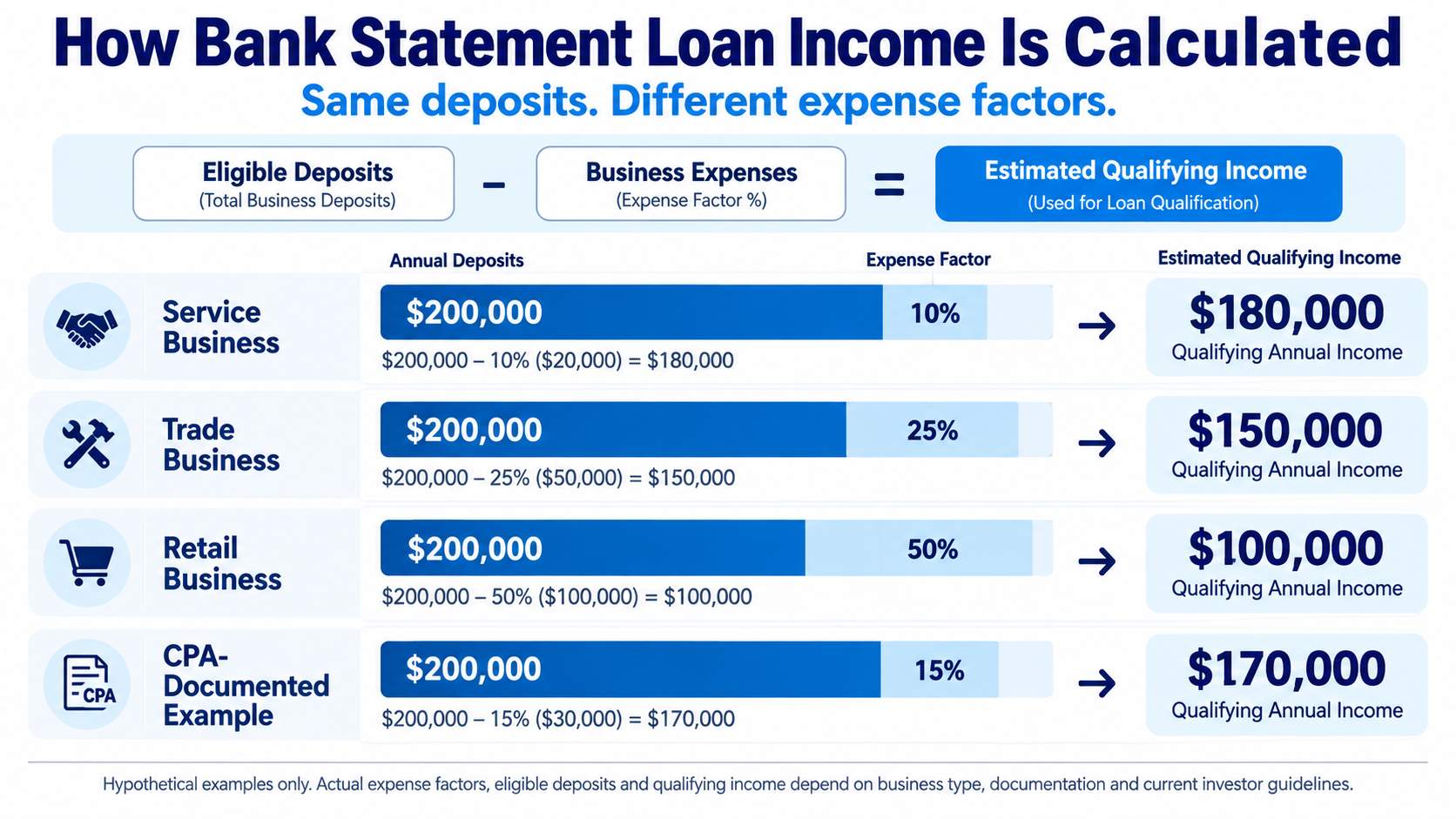
This is the most important number on the loan. The lender doesn’t take your gross deposits and call that your income. It applies an expense factor that estimates how much of your deposits went to business expenses and how much you kept. The factor varies by business type, documentation, and lender, but the working math looks like this on a typical scenario:
| Scenario | Gross Annual Deposits | Expense Factor Applied | Qualifying Income Used |
|---|---|---|---|
| Service business (low overhead: consultant, freelancer) | $200,000 | 10% | $180,000 |
| Trade business (moderate overhead: electrician, contractor) | $200,000 | 25% | $150,000 |
| Retail or product business (high overhead: restaurant, retail) | $200,000 | 50% | $100,000 |
| CPA-prepared P&L letter justifying a lower expense ratio | $200,000 | 15% (with documentation) | $170,000 |
Hypothetical numbers for illustration. Actual expense factors and qualifying income depend on business type, documentation, lender, and current investor guidelines. Confirm your scenario with John before making purchase decisions.
Business vs. Personal Bank Statements
With business bank statements, the lender typically applies a higher expense factor, because business deposits include money you’ll spend on business costs. With personal bank statements, the factor is lower, because the deposits are assumed to be money you already paid yourself after expenses. A CPA-prepared profit and loss statement on the CPA’s letterhead can sometimes justify a lower factor than the lender’s default, which can improve your qualifying income on paper. Whether that’s worth the cost of the letter depends on the gap between the default factor and your actual margins.
Try It On Your Numbers: Income Estimate Worksheet
A rough starting estimate of where your qualifying income might land. The lender’s calculation will be more precise. This is not a quote.
- Step 1: Add your total deposits across the last 12 months of business or personal bank statements = $ ______________
- Step 2: Divide by 12 to get your average monthly deposits = $ ______________
- Step 3: Pick your business type and apply the typical factor:
- Service business / consultant / freelancer (low overhead): multiply by 0.90
- Trade business / contractor / electrician / plumber (moderate overhead): multiply by 0.75
- Retail / restaurant / product business (high overhead): multiply by 0.50
- With a CPA-prepared P&L letter justifying a lower expense ratio: multiply by 0.85
- Step 4: Multiply Step 2 by your factor = estimated monthly qualifying income = $ ______________
- Step 5: Multiply Step 4 by 12 = estimated annual qualifying income = $ ______________
Educational estimate only. Actual qualifying income depends on lender review of every deposit, exclusion of non-recurring and non-business deposits, business type verification, current investor guidelines, and full underwriting. Call John Thomas at 302-703-0727 for a real scenario review before making purchase decisions.
What Deposits Count and What Deposits Do NOT Count?
Underwriters review every large deposit and back out anything that isn’t recurring business revenue. Knowing what counts before you apply prevents surprises late in the process:
- What typically COUNTS: recurring business revenue (customer payments, paid invoices, retainers, sales receipts), 1099 payments deposited to the account, recurring distributions from a verified business operating account, and consistent gig platform payouts (rideshare, delivery, online marketplaces).
- What typically DOES NOT COUNT: transfers from your own personal or business accounts, one-time deposits (asset sales, inheritances, lawsuit settlements, gifts), refunds and chargebacks, large unexplained cash deposits, loan proceeds, tax refunds, and crypto sales with no documented business connection.
- What needs EXTRA DOCUMENTATION: cash deposits over a threshold (often $1,000 or more each, varies by lender), large recurring deposits from a single payer, and seasonal spikes, which need a business explanation showing the seasonality is normal for your industry.
Before you apply, look at your last 12-24 months of statements with this filter. If a large share of your deposits would be excluded, the math may not work, and an asset qualifier, P&L, or conventional loan with your tax returns may be the better path. We run this analysis up front so you know what to expect before a full application.
12 vs 24 Months of Bank Statements: Which One Should I Use?
Use 24 months when both years are steady or growing, because 24-month files usually price better. Use 12 months when the most recent year is clearly stronger, since a weaker prior year would pull the 24-month average down. Run both calculations before choosing, because the rate savings may not offset lower qualifying income.
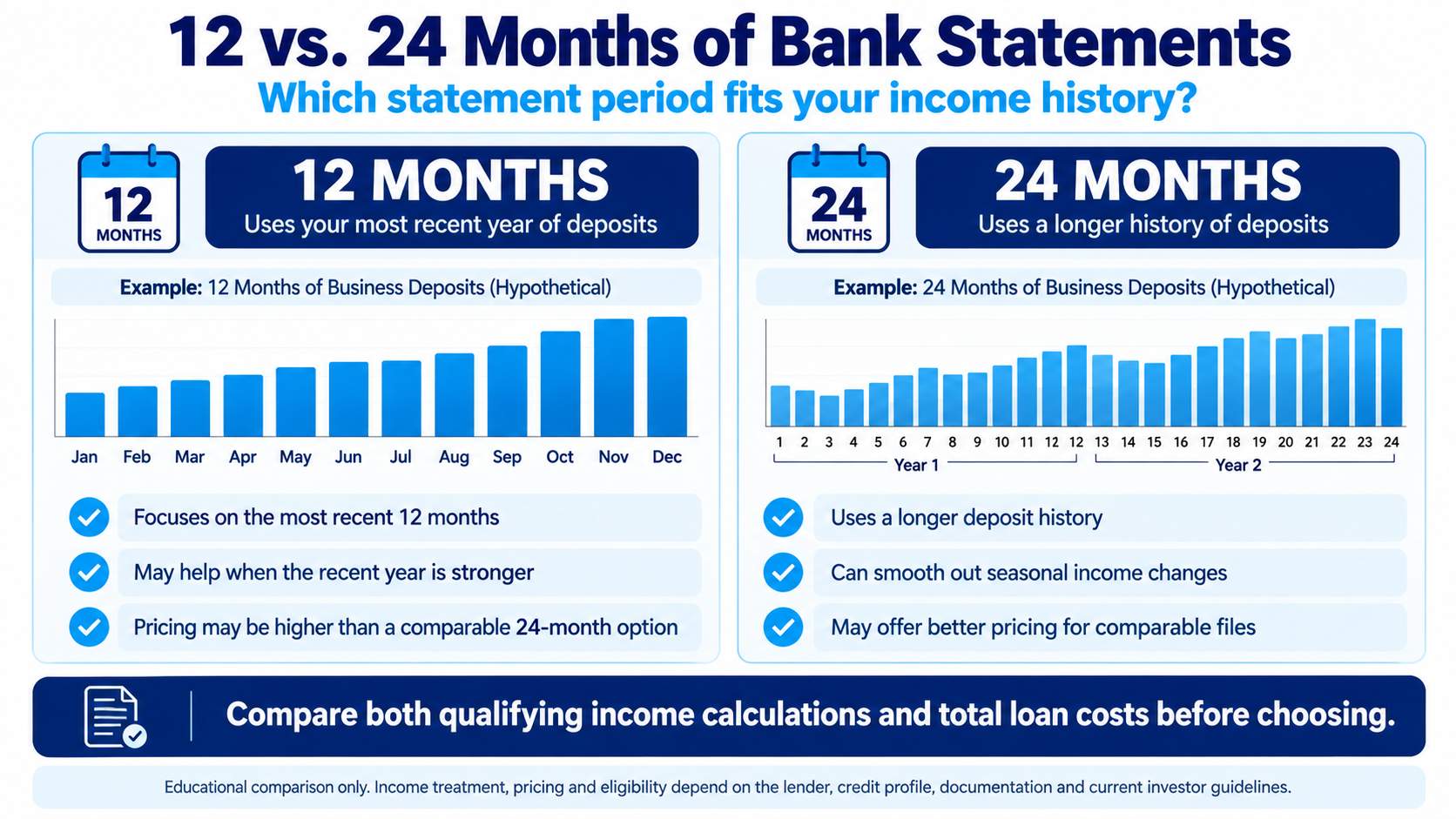
12 months is faster to gather and review and works well when your most recent year is your strongest. The trade-off: lenders typically price 12-month files slightly higher than 24-month files, because a longer track record lowers investor risk. 24 months averages two years of deposits. That can smooth out a strong year next to a slow one, or it can hurt your qualifying income if the prior year was much weaker. All else equal, 24 months usually carries the better rate.
A working rule: if your business has been steady or growing for both years, go with 24 months for the pricing. If you had a weak prior year and a strong current year, have John run the numbers both ways before you decide.
Bank Statement Loan vs. 1099 Mortgage vs. Conventional: Which Fits Your Scenario?
Conventional financing wins when tax returns already support the payment: a lower rate and as little as 3% down for eligible first-time buyers. A 1099 loan fits income paid mostly on 1099 forms. A bank statement loan fits business owners whose deductions leave adjusted gross income too low to qualify.
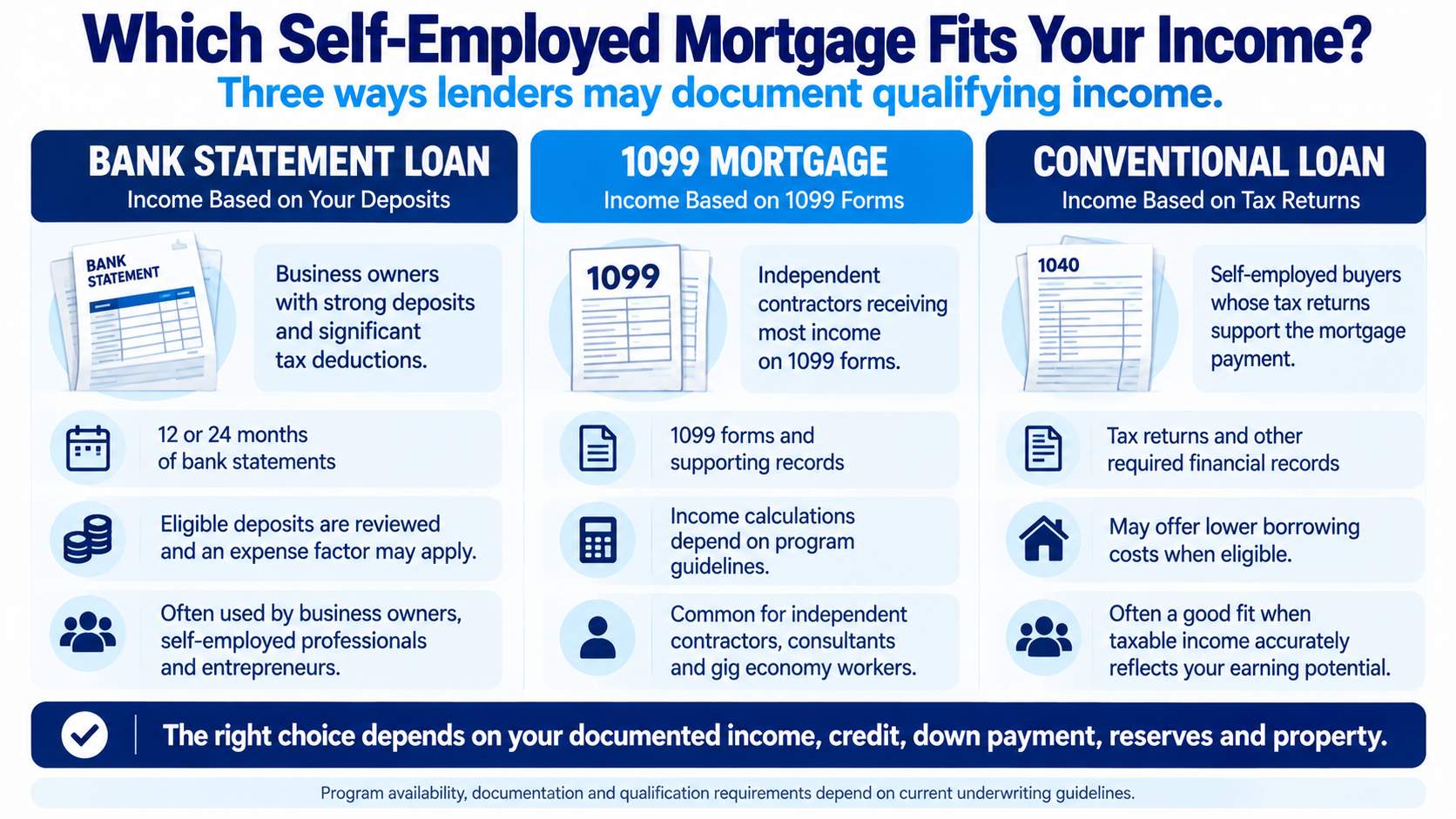
Each path takes different documents and suits a different tax picture:
| Feature | Bank Statement Loan | 1099 Mortgage | Conventional |
|---|---|---|---|
| Income docs | 12-24 months bank statements | 12-24 months of 1099s | 2 years tax returns + P&L |
| Best for | Schedule C business owners with heavy write-offs | 1099 contractors with strong gross income | Self-employed with tax returns that support the payment |
| Min. self-employment history | 1 year (2 preferred) | 1-2 years | 2 years typically |
| Min. credit score | 600 | 620 typical | 620 |
| Max LTV (purchase) | 90% | 90% | 95-97% |
| Max DTI | 55% | 50% | 45-50% |
| Max loan amount | $5,000,000 | Varies by lender | $832,750 for a 1-unit home (2026 baseline limit), or jumbo above it |
| Rate (relative) | Higher (Non-QM) | Higher (Non-QM) | Typically the lowest of the three |
General program parameters as of October 2026. Qualification depends on credit profile, reserves, property type, occupancy, and current investor guidelines. The conventional limit is the 2026 one-unit baseline set by the Federal Housing Finance Agency; loans above it are jumbo loans. Rates change daily. Confirm current rates and guidelines with John.
If your tax returns show enough income to qualify, the conventional loan almost always wins on rate and total cost. The bank statement loan exists for the gap: real cash flow that the tax return doesn’t reflect. The 1099 Mortgage Loan Program is the better answer if most of your income arrives on 1099 forms (subcontractors, freelance creatives, real estate agents, healthcare professionals on 1099 contracts). If you have significant assets but irregular income, look at the Asset Qualifier Loan Program. If your CPA can prepare a current profit and loss statement, the P&L Mortgage Loan uses that document directly.
Why Bank Statement Loan Pricing Is Higher Than Conventional
Bank statement loans typically price 0.5 to 2 percentage points above conventional 30-year fixed rates. The spread changes daily with investor pricing and depends on credit, LTV, occupancy, statement period, and loan amount. Rates change daily, so call for current pricing on your scenario rather than relying on rate language in any article. The reasons for the premium:
- Investor risk pricing. Conventional loans are sold to Fannie Mae and Freddie Mac under standard guidelines. Bank statement loans go to private Non-QM investors who price for the alternative-documentation risk.
- Underwriting cost. Reviewing 12-24 months of deposits, applying expense factors, and verifying the business takes more underwriter time than reading tax returns.
- A smaller secondary market. Non-QM loans trade in a smaller, less liquid market than conventional loans, so investors require a higher yield.
The rate premium is the trade-off for not qualifying on tax returns. When your returns can support conventional underwriting, conventional financing costs less over the life of the loan. Many bank statement borrowers refinance into conventional financing 2-3 years later, once their returns better reflect business income or they’ve built enough equity to qualify under conventional guidelines.
Documents Needed for a Delaware Bank Statement Loan
The documentation list is shorter than a conventional loan’s, but it has specific requirements. Having these ready speeds up the process:
- 12 or 24 months of bank statements (business, personal, or both, whichever shows your income most cleanly). Every page, not just the summary pages.
- Proof of business ownership and how long it has operated: business license, articles of organization or incorporation, LLC operating agreement, or sole proprietorship registration covering the statement period.
- Government-issued photo ID (driver’s license or passport).
- Asset statements: the most recent 2 months for any account used for down payment or reserves (checking, savings, investment, retirement).
- Purchase contract if you’re buying, or your current mortgage statement if you’re refinancing.
- Explanation letters for large deposits that aren’t recurring business revenue (a typical threshold is $1,000). Having them ready saves a back-and-forth with underwriting.
- CPA letter or P&L statement (optional, often helpful). A CPA-prepared profit and loss statement covering the same period can sometimes justify a lower expense factor.
- 1099 forms from the prior 1-2 years, if you have them. They help show income consistency even when the loan is documented with bank statements.
- W-2 forms and recent paystubs if you’re combining W-2 income with self-employment income.
- Credit explanation letters for recent late payments, collections, bankruptcies, or foreclosures on your report.
Delaware Bank Statement Loan Qualification Requirements
Qualification depends on credit, reserves, property type, occupancy, and current investor guidelines. Here is the working framework as of October 2026:
- Self-employment history. At least 1 year self-employed or as a business owner, with 2 years preferred and usually better priced. If you’ve been self-employed less than a year, this program probably won’t work yet. If your prior W-2 job was in the same field as your business (an electrician who went from employee to owner, a stylist who moved from a salon to her own chair, a developer who went from salaried to consulting), that history can sometimes combine with your year of self-employment to strengthen the file.
- Bank statements. 12 or 24 months. You may be able to use business statements only, personal statements only, or both, depending on how the deposits flow. Income is the average over the full period, with the expense factor applied.
- Down payment. Maximum LTV is typically 90% on a purchase, which means 10% down for the strongest credit profiles. Scores under 680 typically push the requirement to 15-20%. Down payment can come from your own funds, gift funds (with restrictions), or asset depletion.
- Credit score. Minimum 600. Lower scores mean a larger down payment and a higher rate, and pricing improves at each 20-point step up to about 760. Bank statement loans are often more flexible on bankruptcy and foreclosure seasoning: many investor guidelines allow a primary residence purchase 2 years after a Chapter 7 discharge, and some allow 1 year with a larger down payment. Conventional loans generally require a 4-year wait after a Chapter 7 discharge under the Fannie Mae Selling Guide. See the FAQ below for more on seasoning.
- Debt-to-income ratio. Debt-to-income ratio can run as high as 55% on this program, above the typical 45-50% conventional ceiling.
- Reserves. Most bank statement loans require 3-6 months of PITI (principal, interest, taxes, insurance) in reserves at closing, and more for larger loans and investment properties. Retirement assets are typically counted at 60-70% of value.
- Loan amount. $75,000 minimum to $5,000,000 maximum. The maximum varies by credit profile, occupancy, and current investor capacity.
- Property type and occupancy. Primary residence, second home, or investment property. Single-family, condo (warrantable and most non-warrantable), 2-4 unit, and townhouse are eligible. Some property types (log homes, mixed-use, certain rural properties) may need additional review.
Loan Structure Options Available
The program is flexible on structure, which is why it works for so many self-employed scenarios:
- Transaction types: purchase, rate-and-term refinance, or cash-out refinance.
- Occupancy types: primary residence, second home, or investment property.
- Loan terms: 30-year or 40-year.
- Rate structure: fixed-rate or adjustable-rate (ARM).
- Payment structure: interest-only payments for qualified scenarios, typically used by investment property buyers or borrowers planning to refinance into conventional financing within a few years.
- Income flexibility: W-2 wages can be combined with self-employed bank statement deposits.
Short Bank Statement Loan Video Overview
A 1-minute overview of the self-employed bank statement loan program. The full walkthrough is in the video at the top of this page.
When This Loan Is NOT a Good Fit
The bank statement loan is built for a specific buyer, and many self-employed Delaware buyers have better options. It’s a Non-QM loan: the federal Ability-to-Repay rule still applies (see the CFPB’s Ability-to-Repay/Qualified Mortgage rule), but the documentation flexibility comes with a rate premium. Here’s when it’s the wrong choice and what to look at instead:
- Your tax returns already support a conventional loan. If your adjusted gross income covers the payment within standard DTI limits, conventional financing usually costs 0.5 to 2 percentage points less in rate, allows a smaller down payment, and avoids Non-QM fees. Start with Delaware Conventional Loans.
- Most of your income arrives on 1099 forms. Real estate agents, healthcare contractors, IT consultants and 1099 sales reps are usually a cleaner fit for the 1099 Mortgage Loan Program, which uses the 1099s directly.
- You’ve been self-employed less than one year. Bank statement programs need at least 12 months of business activity. Wait until you have a full year of statements, or qualify on recent W-2 income if you can document continuous earnings.
- Your deposits are mostly transfers or one-time money. Transfers from your own savings, asset sales, inheritances, or other one-time deposits are excluded from qualifying income. Without clean recurring revenue, an asset qualifier or P&L program may be the better path.
- You’re a first-time buyer who could use DSHA down payment help. The DSHA Welcome Home first mortgage with Keys4You down payment assistance often costs less each month than a bank statement loan. DSHA first mortgages are agency loans underwritten with tax returns, so this path works only if your returns support the payment.
- The payment would stretch your real cash flow. The loan qualifies you on actual deposits. If the payment would take more than half of what the business nets you each month, that’s a budget problem, not a financing problem, and the better move is to wait until cash flow supports the payment comfortably.
Are You a Real Estate Agent with Self-Employed Buyers?
Self-employed buyers turned down for low adjusted gross income can often still be financed with a bank statement loan, a 1099 loan or a profit and loss loan, subject to credit, reserves and deposit history. Agents in Delaware and Maryland can refer those buyers for a scenario review before a contract is written.
If you’re a Delaware or Maryland Realtor and a self-employed buyer has been turned down because their tax return showed too little income, call me at 302-703-0727. Most of those buyers have plenty of cash flow; their bank just couldn’t see it through the tax-return lens. You can also schedule a 30-minute partnership call at schedule.johnthomasteam.com/30min.
How Do You Apply for a Delaware Bank Statement Loan?
There are three ways to start: call 302-703-0727, schedule a 30-minute consultation, or apply online at ApplywithJohnThomasTeam.com. Have 12 or 24 months of bank statements, proof of business ownership and recent asset statements ready. The team reviews the deposits first and confirms which self-employed program fits before a full application.
- Call the John Thomas Team at 302-703-0727. We can run the basic numbers on the first call and tell you whether bank statement, 1099, P&L, or conventional fits you best.
- Schedule a 30-minute consultation at schedule.johnthomasteam.com/30min, in person at the Newark office, by phone, or by Zoom.
- Apply online at ApplywithJohnThomasTeam.com. The secure application takes about 15-20 minutes. Once it’s submitted, the team reviews the file and follows up on next steps; timing depends on file completeness and current volume.
For the full menu of alternative-documentation programs, see our Non-QM Loans page. If you’re a first-time buyer in Delaware, the Delaware First-Time Home Buyer Guide walks through the process from start to finish.
FAQ: Delaware Bank Statement Loan
Can I qualify for a Delaware bank statement loan after a Chapter 7 bankruptcy?
Yes — bank statement loans are typically more flexible on bankruptcy waiting periods than conventional loans. Most investor guidelines require 2 years from the Chapter 7 discharge date for primary residence purchases, with some scenarios allowing 1 year of post-discharge seasoning at higher down payment requirements. Conventional loans typically require 4 years from discharge. The exact waiting period depends on the cause of the bankruptcy, post-discharge credit re-establishment, and current investor guidelines. Call to discuss your specific scenario.
What if my business deposits include personal money I transferred in?
This is one of the biggest underwriting issues on bank statement loans. Underwriters review every large deposit on the statements and exclude any that aren’t clearly recurring business revenue. Personal account transfers, cash deposits without documented source, asset sales, gifts, refunds, and large one-time payments will be backed out of the qualifying income calculation. Before applying, review your statements with that lens — if a meaningful chunk of deposits will be excluded, the qualifying math may not work and you may need a different program.
Can I use 12 months of bank statements if I’ve only been self-employed for 1 year?
Generally yes, but with conditions. Most bank statement programs require at least 1 year of self-employment history, which 12 months of statements satisfies. However, 1-year scenarios typically carry a rate premium versus 2-year scenarios, and some lenders will require additional documentation — like prior W-2s in the same field of work, business licenses, or CPA verification — to support the shorter history. If your prior work was in the same general field, that history can be combined with your self-employment to strengthen the file.
How does the bank statement loan handle LLC distributions versus business deposits?
It depends on which statements you’re using. If you’re using business statements (the LLC’s operating account), only business revenue deposits count. If you’re using personal statements, distributions from the LLC into your personal account count as deposits, but the underwriter will want to see the source. For S-corp owners specifically, the bank statement loan typically works better with personal statements showing K-1 distributions and W-2 wages combined, rather than the corporate operating account. The right configuration depends on your business structure and how money flows from the business to you personally.
Can I combine a bank statement loan with seller-paid closing costs?
Yes. Seller concessions are allowed on bank statement loans, with limits typically based on occupancy and LTV: usually 6% of the purchase price for owner-occupied scenarios at LTVs at or below 90%, 3% for investment property, and 9% for owner-occupied at LTV at or below 75%. Concessions can cover closing costs, prepaid items (taxes, insurance, escrows), and discount points to reduce your interest rate. Your Realtor will negotiate the concession amount as part of your purchase contract — the lender just confirms the amount falls within program limits.
What if I have W-2 income AND self-employment income — can I use both?
Yes. The bank statement loan allows you to combine W-2 wages with bank statement deposits to qualify. This is common for buyers who have a primary job plus side business income, or who recently transitioned to full-time self-employment but still have recent W-2 history. The combined income gives you a stronger qualifying picture than either source alone. Documentation in this case typically includes the most recent paystubs, W-2s for the prior 2 years, and 12 or 24 months of bank statements for the self-employed portion.
Will a bank statement loan have a higher interest rate than a conventional loan in Delaware?
Yes — bank statement loans price higher than conventional loans, typically 0.5 to 2 percentage points above conventional 30-year fixed rates. The exact spread varies daily with investor pricing and depends on your credit score, LTV, occupancy, statement period (12-month versus 24-month), and other risk factors. Rates change daily — call the John Thomas Team at 302-703-0727 for current pricing on your specific scenario. The rate premium is the trade-off for not having to qualify with tax returns; for buyers whose tax returns can support conventional underwriting, conventional financing is almost always the better total cost.
Can a bank statement loan be used for an investment property in Delaware?
Yes. The Delaware Bank Statement Loan covers primary residence, second home, and investment property purchases. Investment property scenarios typically require a higher down payment (usually 20-25% versus 10% for primary residence), a slightly higher rate, and stronger reserves (often 6 months of PITI versus 3 months for primary residence). For dedicated rental property purchases where you don’t want to use personal income at all, the DSCR (Debt Service Coverage Ratio) loan may be a better fit — it qualifies based on the property’s expected rental income rather than the borrower’s personal income.
Do I need 2 years of self-employment, or is 1 year enough?
For most conventional and government loans, you need 2 years of self-employment history before the income counts. The bank statement loan is the exception — it accepts 1 year of self-employment with 12 months of statements. The trade-off is that 1-year scenarios typically carry a small rate premium and may require additional supporting documentation. Buyers in their second year of self-employment with strong, consistent deposits typically get the cleanest qualification on this program.
Can my CPA write a letter to lower the expense factor the lender uses?
Yes — a CPA-prepared profit and loss statement on the CPA’s letterhead can sometimes justify a lower expense factor than the lender’s default assumption for your business type. This can meaningfully improve your qualifying income on paper. Whether the cost of having your CPA prepare the letter is worth it depends on the gap between the lender’s default expense factor for your business category and your actual business margins. For service businesses with truly low overhead, the difference can be significant. For high-overhead businesses, the lender’s default factor may already be reasonable. We can run the math both ways before you decide whether to commission the CPA letter.
About John Thomas, Your Delaware Self-Employed Mortgage Lender

John R. Thomas
Branch Manager & Division Vice President, John Thomas Team with AnnieMac Home Mortgage
NMLS #38783 Self-Employed Lending DSHA Approved Author
John Thomas has helped Delaware and Maryland buyers finance homes for more than 20 years from the John Thomas Team office in Newark. He is a Certified Mortgage Planner, holds a B.S. in Physics Education from the University of Delaware and an M.S. in Curriculum and Instruction from Delaware State University, and is the author of Your Guide to Buying Your First Home in Delaware. He works with W-2 buyers and self-employed business owners alike.
With self-employed buyers, John starts by comparing what the tax return shows with what the bank deposits show. When business write-offs have pushed adjusted gross income below what the business really earns, he walks through the choices that change the result: business or personal statements, 12 or 24 months, and whether a CPA-prepared profit and loss statement would support a lower expense factor. If the tax returns already qualify for a conventional loan, he says so.
John Thomas Team with AnnieMac Home Mortgage
248 E Chestnut Hill Rd, Newark, DE 19713
Phone: 302-703-0727
Email: team@johnthomasteam.com
Schedule Appointment
YouTube: youtube.com/@johnthomasteam
See John Thomas Team on Google for reviews, directions, and local office information.
State licensing: Look up John R. Thomas, NMLS #38783, on NMLS Consumer Access.
YouTube | Facebook | Instagram | TikTok | X / Twitter | LinkedIn
Talk to John About Your Bank Statement Loan
Review how your bank deposits may support a mortgage. We compare your statements, credit profile, down payment and the available programs, including 1099, P&L and conventional options, before recommending a next step.
Last Updated: October 2026 · John Thomas Team with AnnieMac Home Mortgage · Mortgage content reviewed by John R. Thomas, NMLS #38783.
John R. Thomas, NMLS #38783 | John Thomas Team with AnnieMac Home Mortgage | AnnieMac Home Mortgage NMLS #338923 | 248 E Chestnut Hill Rd, Newark, DE 19713 | 302-703-0727 | delawaremortgageloans.net
AnnieMac Home Mortgage is an Equal Housing Lender. State licensing: Look up John R. Thomas, NMLS #38783, on NMLS Consumer Access.
(c) Copyright John R. Thomas, All Rights Reserved.
