By John Thomas | NMLS #38783 | Senior Loan Officer, Primary Residential Mortgage | Last Updated: March 2026
Non-QM Loans in Delaware & Maryland: The Complete Guide to Every Non-Qualified Mortgage Program
Bank Statement · DSCR · 1099 · P&L · Asset Qualifier · Fix & Flip · Ground Up Construction · Fresh Start · ITIN · Foreign National · Land Loans · Second Mortgages · and More Available in Delaware & Maryland
Jump to a Loan Program:
Table of Contents
If a traditional lender has told you “no” — or you’ve been putting off applying because you assumed your income situation would disqualify you — this guide was written for you. Delaware Non-QM loans (Non-Qualified Mortgage loans) are fully underwritten mortgage programs designed for borrowers who do not meet the rigid income, credit, or property guidelines required for FHA, VA, USDA, or Conventional financing. They exist because the way Americans earn money has changed — and the mortgage system needs to keep up.
This is the complete guide to every major Non-QM loan program available today – including programs we actively originate in Delaware & Maryland. Whether you’re a self-employed business owner, a real estate investor scaling your portfolio, a foreign national buying U.S. property, or someone rebuilding after a financial hardship — there is a Non-QM loan built specifically for your situation.
Non-QM loans in Delaware and Maryland allow borrowers to qualify for a mortgage using bank statements, 1099 income, rental income, or assets instead of traditional W-2s and tax returns.
We help borrowers with Non-QM loans throughout Delaware and Maryland, including Wilmington, Newark, Dover, Middletown, Baltimore, and surrounding areas — providing flexible mortgage solutions for self-employed borrowers and real estate investors.
Watch: How Non-QM Loans Work in Delaware & Maryland
? Quick Answer: What Is a Non-QM Loan?
A Non-QM (Non-Qualified Mortgage) loan is a mortgage that does not follow Fannie Mae or Freddie Mac income documentation standards. Instead of W-2s and tax returns, borrowers qualify using bank statements, 1099s, rental income (DSCR), P&L statements, or liquid assets. Non-QM loans are available in Delaware and Maryland for self-employed borrowers, real estate investors, foreign nationals, and borrowers with recent credit events. Every Non-QM loan still meets federal Ability-to-Repay (ATR) standards under the Dodd-Frank Act — they are fully underwritten, regulated mortgage products, not the predatory loans of the 2008 era.
Non-QM Loans in Delaware for Self-Employed Borrowers and Real Estate Investors
Non-QM loans in Delaware and Maryland are designed specifically for borrowers whose income or financial situation does not fit traditional mortgage guidelines. This includes self-employed business owners, real estate investors, independent contractors, and high-income borrowers with complex tax returns.
Instead of relying solely on W-2s and tax returns, Non-QM lenders allow alternative income documentation such as bank statements, 1099 income, rental income, profit and loss statements, or liquid assets. This creates more flexible pathways to approval for borrowers who are financially strong but do not qualify through conventional lending.
What Is a Non-QM Loan?
A Qualified Mortgage (QM) is a loan that meets the strict underwriting standards set by the Consumer Financial Protection Bureau (CFPB) — primarily W-2 income documentation, specific debt-to-income ratio caps, and property eligibility requirements. Loans that meet these standards can be sold to Fannie Mae or Freddie Mac on the secondary market. Non-QM Loans are great options for Delaware and Maryland homebuyers who do NOT fit traditional mortgage guidelines.
A Non-QM loan does not meet those specific QM standards — but that does not mean it is a risky or predatory product. It means the lender uses alternative, flexible methods to document and verify that a borrower has the ability to repay the loan.
Because Non-QM loans are held in lenders’ portfolios or sold to private investors rather than Fannie Mae or Freddie Mac, lenders have the flexibility to set their own qualification criteria — making these programs possible.
Non-QM vs. Traditional Mortgage: Key Differences
| Traditional QM Loan | Non-QM Loan | |
|---|---|---|
| Income Verification | W-2s and tax returns required | Bank statements, 1099s, P&L, rental income, assets, or VOE |
| DTI Requirements | Strict caps (typically 43–50%) | Flexible underwriting based on full borrower profile |
| Credit Events | 2–7 year mandatory waiting periods | As little as 1 day out of bankruptcy, foreclosure, or short sale |
| Property Types | Agency-eligible properties only | Includes non-warrantable condos, mixed use, unique properties |
| Entity Ownership | Generally not permitted | LLC and corporate ownership widely available |
| Interest Rate | Lower (agency-backed) | Typically 0.5%–1.5% higher to reflect alternative documentation |
Who Uses Non-QM Loans?
Non-QM financing is commonly used by:
- Self-employed business owners and entrepreneurs with significant tax write-offs
- Independent contractors and 1099 workers
- Real estate investors building rental portfolios
- Fix & flip investors and ground-up builders
- Foreign nationals purchasing U.S. property
- ITIN borrowers without Social Security Numbers
- Borrowers with recent bankruptcy, foreclosure, or short sale
- Retirees and high-net-worth individuals qualifying on assets
- W-2 employees whose tax returns show large passive losses
- Buyers of non-warrantable condos or unique property types
When most banks say no, a Non-QM loan can typically provide a financing solution — and as Delaware and Maryland’s Non-QM specialists, we work these scenarios every day.
Not Sure If You Qualify?
If your income doesn’t fit traditional guidelines, you may still qualify with a Non-QM loan.
Call Loan Officer John Thomas at 302-703-0727 to review your scenario and get real answers or APPLY ONLINE.
Non-QM Loan Programs: Every Option Explained
1. DSCR Loans (Debt Service Coverage Ratio)
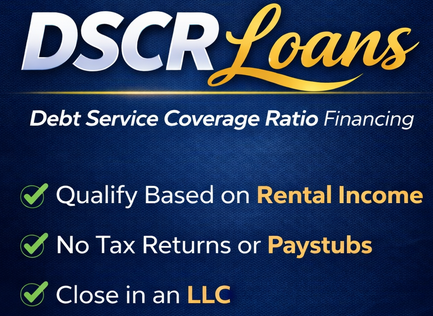
DSCR loans are the go-to product for scaling a rental portfolio. Your personal income never becomes a bottleneck — the property’s cash flow is the qualification. These loans can also be closed in an LLC, providing both liability protection and tax flexibility. Delaware is particularly well-suited for DSCR investing: no sales tax, strong LLC protections, and active rental markets in Wilmington, Newark, and Delaware’s coastal communities from Rehoboth Beach to Lewes make this one of the Mid-Atlantic’s most investor-friendly states.
DSCR = Monthly Rental Income ÷ Monthly Mortgage Payment (PITIA)
- DSCR ? 1.0: Rental income covers the full mortgage payment
- DSCR ? 1.25: Property cash-flows positively — strongest qualification
- DSCR < 1.0: Some programs available with a larger down payment
Program Highlights
- Up to 85% LTV for Purchase
- Minimum credit score as low as 600
- No personal income or tax returns required
- Can close in the name of an LLC
- Loan amounts up to $5 Million
- Cash-out refinance available using appraised value with no seasoning requirement
- Available for 1–4 unit properties, 5+ unit multifamily, and short-term rentals (Airbnb/VRBO)
- No limit on number of financed properties
- Interest-only options available
Full DSCR Loan Guide & Program Details

2. Bank Statement Loans (Self-Employed Mortgage)
Bank Statement Loans allow self-employed borrowers to use 12 or 24 months of personal or business bank deposits — instead of tax returns — to document and qualify their income. This is the most widely used Non-QM product for business owners, because it reflects actual cash flow rather than the tax-minimized income shown on a Schedule C or business return.
Best For
- Self-employed business owners with significant write-offs
- Commission-based earners with variable monthly income
- Borrowers whose tax returns dramatically understate actual cash flow
How Income Is Calculated
- Business bank accounts: Lender averages gross deposits and applies an expense factor (typically 40%–50% expense ratio)
- Personal bank accounts: Lender often uses 100% of average deposits
- 12 or 24 months of statements accepted
- 2+ years self-employment history required
- Minimum credit score typically 620+
- Down payment typically 10%–20%
Full Bank Statement Loan Guide & Program Details

3. 1099 Loans
1099 Loans are designed for independent contractors and gig workers who receive 1099 income rather than W-2 paychecks. Instead of tax returns or bank statements, the lender qualifies income using the gross amount shown on 1099 forms — eliminating the problem of business expense deductions lowering qualifying income.
These loans can be structured using 1099 forms paid to an individual or to a business entity — however, the borrower cannot have an ownership interest in the company issuing the 1099.
Program Highlights
- Most recent 1 or 2 years of 1099 forms (no tax returns required)
- Loan amounts up to $4 Million
- Up to 90% LTV for purchase and rate/term refinance
- Minimum credit score 600
- Available for primary residences, second homes, and investment properties
Full 1099 Loan Guide & Program Details

4. P&L Loans (Profit & Loss Statement Loans)
P&L Loans let self-employed borrowers qualify using a CPA-prepared or licensed tax-preparer-prepared Profit & Loss statement for their business — with no tax returns and no bank statements required. This is ideal for borrowers whose tax returns show too many write-offs to qualify, or whose bank statement deposits aren’t consistent enough month to month for a bank statement loan.
Program Highlights
- 12-month P&L statement prepared by a CPA or licensed tax preparer
- Loan amounts up to $4 Million
- Up to 90% LTV for purchase or rate/term refinance
- Up to 80% LTV for cash-out refinance
- Only 1 year of self-employment required (most programs require 2)
- CPA or tax preparer must certify the accuracy of the P&L statement
Full P&L Loan Guide & Program Details

5. Asset Qualifier Loans
Asset Qualifier Loans allow borrowers to qualify for a mortgage based on their liquid assets rather than their employment income. No job, no income, no problem — if you have the assets. This program is an excellent fit for retirees, high-net-worth individuals, and anyone who has accumulated significant wealth but doesn’t show traditional earned income.
Program Highlights
- No employment or income documentation required
- Minimum credit score 600
- Loan amounts up to $5.0 Million
- Up to 80% LTV on purchase
- Eligible assets include savings, checking, money market, CDs, stocks, bonds, and retirement accounts (with applicable discount factors)
- Can be combined with other income sources for stronger qualification
Full Asset Qualifier Loan Guide & Program Details

6. VOE Only Loans (Verification of Employment Only)
VOE Only Loans are exclusively for W-2 employees who want to qualify using only a Verification of Employment (VOE) form completed by their employer — with no tax returns, W-2s, or pay stubs required. The lender verifies your employment status and income directly with your employer.
Best For
- W-2 employees with significant passive real estate losses on their tax returns that reduce qualifying income
- Borrowers with recent job changes or gaps who have strong current income
- High earners whose tax returns reflect deductions, credits, or losses that would disqualify them conventionally
Full VOE Only Loan Guide & Program Details

7. ITIN Loans (Individual Taxpayer Identification Number Loans)
ITIN Loans are available for borrowers who file U.S. taxes using an Individual Taxpayer Identification Number (ITIN) rather than a Social Security Number. These are tax-paying residents of the United States who want to achieve homeownership and begin building generational wealth — and these programs make that possible.
ITIN borrowers can qualify for nearly all Non-QM program types, including DSCR loans, Bank Statement loans, 1099 loans, and P&L loans.
How It Works
- ITIN number used in place of Social Security Number
- Income documented through tax returns, bank statements, 1099s, or pay stubs
- Alternative credit history accepted (utility payments, rent history, cell phone accounts)
- Down payment requirements typically 10%–20%
- Available for primary residences in most states
Full ITIN Loan Guide & Program Details

8. Fresh Start Loans — Second Chance After Bankruptcy, Foreclosure, or Short Sale
The Fresh Start Loan Program provides financing for borrowers with recent major credit events — including foreclosure, bankruptcy (Chapter 7 or Chapter 13), short sale, and significant mortgage late payments. We can lend with as little as one day out of foreclosure, bankruptcy, or short sale — with no mandatory waiting period.
This program exists because financial hardship happens to good people. Medical emergencies, divorce, business failures, and economic downturns are realities of life — not permanent disqualifiers for homeownership. We help Delaware and Maryland borrowers use the Fresh Start program to get back into the market as soon as they’re ready.
Credit Events Covered
- Chapter 7 Bankruptcy — 1 day after discharge
- Chapter 13 Bankruptcy — 1 day after discharge
- Foreclosure — 1 day after completion
- Short Sale — 1 day after closing
- Recent mortgage late payments
What to Expect
- Larger down payment typically required (20%–30%)
- Interest rate will be higher to reflect recent credit event risk
- Demonstrated re-established financial responsibility helps the file
- Strong reserves or assets improve approval odds
Full Fresh Start Loan Guide & Program Details

9. Foreign National Loans
Foreign National Loans are designed for non-U.S. citizens and non-permanent residents who want to purchase property in the United States. Whether you’re buying a vacation home, a U.S. investment property, or relocating for business, this program provides a clear path to U.S. real estate ownership without requiring a Green Card, Social Security Number, or U.S. credit history.
Key Features
- No U.S. credit history required — foreign credit reports accepted
- Income documented in foreign currency (converted to USD)
- Typically 25%–30% down payment required
- Available for investment properties and second homes
- Loan amounts up to $2–3 million
- LLC and entity purchases available
Full Foreign National Loan Guide & Program Details

10. Fix & Flip Loans (Hard Money Loans)
Fix & Flip Loans — also called Hard Money Loans — are short-term real estate loans used to purchase and renovate investment properties with the goal of selling quickly for a profit, typically within 3 to 12 months. These loans are not available for owner-occupied properties and are exclusively designed for real estate investors.
Traditional mortgages are built for long-term holds and cannot be used for fix-and-flip projects. Hard money lenders fill that gap — providing fast, flexible financing based primarily on the property’s value and potential rather than the borrower’s personal income.
Three Hard Money Loan Strategies
- Fix & Flip: Buy distressed property ? renovate ? sell quickly for profit
- Fix & Rent: Buy and renovate, then refinance into a DSCR loan to hold as a long-term rental
- Bridge Loans: Short-term financing for investment properties needing fast close with minimal or no rehab
Program Guidelines
- No prior investor experience required
- 12-month interest-only loan with no prepayment penalty
- 100% rehab financing available
- Up to 90% LTV of purchase price
- Up to 80% ARV (After Repaired Value)
- Up to 90% LTC (Loan to Cost)
- Minimum loan amount: $75,000 with rehab / $100,000 without rehab
- Maximum loan amount: $4 Million for 1–4 unit properties | $7.5 Million for 5–29 unit properties
- Rehab financing available on refinances
Eligible Property Types
- Single Family Residences (SFR)
- Townhomes
- 1–4 Unit Properties
- Multifamily 5–29 Units
Full Fix & Flip Loan Guide & Program Details

11. Ground Up Construction Loans for Builders & Investors
Ground Up Construction Loans provide financing for experienced builders and real estate investors to build new properties from scratch — whether for sale (SPEC builds), long-term rental retention (build-to-rent), or multi-unit development. This is not your average construction loan. With fast approvals, interest-only payments during the build, and no income documentation required, it’s designed to keep experienced builders moving.
Who Qualifies
This program is built for experienced builders. To be eligible, applicants must meet one of the following:
- 3 completed new construction builds, OR
- 2 completed new builds + 1 major renovation valued over $200,000
Additional requirements include good credit history, strong asset position, a valid business entity (LLC or Corp), and the ability to provide project plans, permits, cost breakdown, and exit strategy.
Key Program Features
- Finance up to 85% of total project costs (land + construction)
- Up to 80% of construction costs based on approved plans
- Reimbursement for up to 60% of lot purchase price
- No income documentation or tax returns required
- 12-month and 18-month term options
- Interest-only payments during construction
- Loan origination fees can be rolled into the loan
- Available for SPEC builds and build-to-rent investment properties
Build Strategies Supported
- SPEC Builds: Construct homes to sell after completion
- Build-to-Rent: Build and hold as long-term rental, with optional DSCR refinance upon completion
- Multi-Unit Developments: Multiple homes or townhomes on subdivided land
- Land Banking: Purchase and hold land with improvement potential
Full Ground Up Construction Loan Guide & Program Details

12. Land Loans (Vacant Land & Lot Financing)
Land Loans provide financing for the purchase of vacant land or lots — a property type that most traditional lenders avoid entirely. Whether you’re purchasing land to build on, hold as an investment, or develop commercially, this program fills a critical financing gap in the market.
Most traditional lenders won’t touch vacant land — no income, limited comparables, and high illiquidity make it a category banks routinely decline. PRMI’s Non-QM Land Loan program fills that gap, providing financing for the purchase, refinance, or cash-out refinance of vacant lots, raw land, and recreational property in Delaware and Maryland.
Program Highlights
- Minimum loan amount: $100,000 | Maximum loan amount: $750,000
- Minimum credit score: 660
- Maximum LTV: 65% for purchase and rate/term refinance | 60% LTV for cash-out refinance
- Maximum loan term: 20 years
- No prepayment penalty
- No minimum or maximum acreage requirement
- No requirement to build — buy and hold indefinitely
- Available for purchase, rate/term refinance, and cash-out refinance
- Must have owned land for at least 2 years to be eligible for refinance
Eligible Property Types
- Individual building lots
- Recreational property (hunting land, acreage)
- Income-producing properties with acreage
- Raw land, unimproved land, and improved land
Ineligible: Development/speculative sites, properties adjacent to environmental hazards, and industrially or commercially zoned land are not eligible.
Types of Land: What’s the Difference?
Raw Land is completely undeveloped — no roads, utilities, or infrastructure of any kind. Unimproved Land has some basic development nearby but lacks individual utility hookups. Improved Land has road access, electricity, and water available. All three types are eligible under this program, though raw land carries the highest rate due to lender risk.
Want to Buy Land and Build?
If you plan to build on the land, a One-Time Close Construction Loan is a better fit than a standalone Land Loan — it combines the land purchase and construction financing into a single closing, with down payments as low as 0% for VA and USDA or 3.5% for FHA.
Delaware Local Advantage: As Delaware natives, John Thomas and the PRMI team understand the local zoning, environmental review, and property-access issues that routinely stall raw land purchases — particularly in Sussex County, Kent County, and Delaware’s coastal communities where land transactions have unique considerations. The team has helped buyers in Newark, Wilmington, Middletown, Smyrna, Dover, and Sussex County secure land financing and position themselves for future build-out.
Full Land Loan Guide & Program Details

13. Non-QM Stand-Alone Second Mortgages
Non-QM Second Mortgages are second lien position loans placed behind an existing first mortgage — using Non-QM income documentation for qualification. These are ideal for homeowners who want to access equity without refinancing their existing first mortgage (especially if they have a low rate worth preserving).
Common Uses
- Home improvements and renovations
- Debt consolidation
- Down payment on an investment property
- Business capital injection
- Major expenses (education, medical, life events)
Who It’s For
- Self-employed homeowners who can’t qualify for a conventional HELOC
- Borrowers who locked in a low first mortgage rate and don’t want to refinance
- Investors who need to pull equity from rental properties without showing personal income
Full Non-QM Second Mortgage Guide & Program Details

14. Tenancy in Common (TIC) Loans
A Tenancy in Common (TIC) Loan is a mortgage that allows multiple people to co-purchase a property where each individual holds their own separate unit with their own financing. TIC ownership is particularly popular in high-cost real estate markets where pooling resources with other like-minded buyers makes ownership more accessible.
Program Highlights
- All Non-QM doc types available — including DSCR
- Loan amounts from $250,000 to $2.5 Million
- LTV up to 85%
- FICO as low as 660
- All occupancy types eligible
- Formal Tenancy in Common agreement required
TIC loans are available for properties in Delaware and Maryland — contact John Thomas to discuss how this program applies to your co-purchase scenario.
Tenancy in Common Loan Guidelines
Non-QM Loan Program Quick Reference
| Program | Best For | Income Doc | Tax Returns? | Max Loan |
|---|---|---|---|---|
| DSCR Loan | Rental property investors | Rental income / lease | No | $5M |
| Bank Statement | Self-employed borrowers | 12–24 months deposits | No | $3M+ |
| 1099 Loan | Independent contractors | 1–2 years 1099 forms | No | $4M |
| P&L Loan | Complex business owners | CPA P&L statement | No | $4M |
| Asset Qualifier | Retirees / high net worth | Liquid asset statements | No | $5M |
| VOE Only | W-2 with passive losses | Employer VOE form | No | Varies |
| ITIN Loan | Non-SSN borrowers | Multiple types accepted | Sometimes | Varies |
| Fresh Start | Post-BK/foreclosure/short sale | Standard + event docs | Sometimes | Varies |
| Foreign National | Non-U.S. citizens | Foreign income/credit | No | $3M |
| Fix & Flip | Rehab investors | Asset/project based | No | $7.5M |
| Ground Up Construction | Experienced builders | Builder resume + plans | No | Varies |
| Land Loans | Vacant land buyers | Standard docs | Sometimes | Varies |
| Non-QM 2nd Mortgage | Equity access without refi | Bank stmts / 1099 / VOE | No | Varies |
Explore Non-Qm Loan Options in Delaware & Maryland
Non-QM loans include a wide range of flexible mortgage programs designed for self-employed borrowers, real estate investors, and buyers with unique financial situations.
If you’re looking for a specific solution, here are the most common Non-QM loan options available:
For Self-Employed Borrowers & Alternative Income
For Real Estate Investors
For High Net Worth & Unique Financial Profiles
Equity & Cash Flow Solutions
Specialty & Situational Loan Programs
- Fresh Start Program
- Tenancy in Common Loans
- Land Loans
- Buy Before You Sell Program
- Doctor Loan Program
Not Sure Which Non-QM Loan Is Right for You?
Every borrower’s situation is different, and choosing the right loan program depends on your income, assets, and long-term goals.
Call Loan Officer & Non-QM Loan Expert John Thomas at 302-703-0727 to review your options and get matched with the right solution.
Or start your application here: www.PRMILoanApplication.com
Which Non-QM Loan is Right for You?
Quick Reference Guide
Which Non-QM Loan Is Right for You?
Find your situation below — we originate all of these programs in Delaware & Maryland.
| Self-Employed & Alternative Income | ||
| Your Situation | Best Program | Why It Fits |
|---|---|---|
| Self-employed with consistent monthly bank deposits | Bank Statement Loan | Income qualified on 12–24 months of deposits, not tax returns |
| 1099 contractor — gross income high, net income low after deductions | 1099 Loan | Qualifies on gross 1099 income — deductions don’t reduce it |
| Self-employed less than 2 years, or income varies significantly month to month | P&L Loan | Only 1 year self-employment required; CPA prepares the income document |
| W-2 employee with large rental losses on tax return lowering qualifying income | VOE Only Loan | Employer verifies salary directly — tax return losses are ignored |
| Real Estate Investors | ||
| Buying or refinancing a rental property — want to qualify on rent, not personal income | DSCR Loan | Property cash flow qualifies the loan — no personal income docs required |
| Buying a distressed property to renovate and resell within 3–12 months | Fix & Flip Loan | Short-term, asset-based financing with fast closings and 100% rehab funding |
| Building a new property from scratch — SPEC, build-to-rent, or multi-unit | Ground Up Construction | Up to 85% of total project costs, interest-only during build, no income docs |
| Purchasing vacant land to hold, develop, or build on later | Land Loan | Up to 65% LTV on raw, unimproved, or improved land — no build requirement |
| Want to access equity from rental properties without showing personal income | Non-QM 2nd Mortgage | Access equity behind your existing first mortgage using Non-QM income docs |
| High Net Worth & Unique Financial Profiles | ||
| Retired or high net worth — significant assets but limited current income | Asset Qualifier Loan | Liquid assets divided over the loan term become your qualifying income |
| Non-U.S. citizen purchasing U.S. investment or vacation property | Foreign National Loan | No Green Card, SSN, or U.S. credit history required |
| File U.S. taxes with an ITIN number instead of a Social Security Number | ITIN Loan | ITIN accepted in place of SSN; alternative credit history accepted |
| Credit Challenges & Special Situations | ||
| Recent bankruptcy, foreclosure, or short sale — conventional waiting periods are too long | Fresh Start Loan | Finance as soon as 1 day after discharge or completion — no waiting period |
| Want to co-purchase with others where each person holds separate financing | TIC Loan | Each co-owner gets individual financing — all Non-QM doc types available |
| Have equity in your home but locked into a low rate — don’t want to refinance | Non-QM 2nd Mortgage | Access equity without touching your existing first mortgage rate |
Not sure which program fits your situation? Call John Thomas at (302) 703-0727 for a free consultation.
Schedule a Free ConsultationWhen Does a Non-QM Loan Make Sense?
A Non-QM loan is worth exploring when:
- Your tax returns dramatically understate your actual income due to business deductions
- You are self-employed and cannot provide traditional W-2 income documentation
- You own rental properties and want to qualify based on cash flow rather than personal income
- You’ve experienced a credit event (bankruptcy, foreclosure, short sale) and can’t wait for a conventional loan’s mandatory seasoning period
- You’re a foreign national purchasing U.S. real estate without a U.S. credit history
- You have significant assets but limited current income (retirees, business owners between ventures)
- You’re a real estate investor seeking financing for fix-and-flip, ground-up construction, or land
- You’re purchasing a property type that doesn’t qualify for agency financing (non-warrantable condo, mixed use, etc.)
Are Non-QM Loans Safe?
Yes. Non-QM does not mean subprime, predatory, or risky.
Every Non-QM loan must comply with federal Ability-to-Repay (ATR) standards established under the Dodd-Frank Act. Lenders are required to make a reasonable, good-faith determination that the borrower can repay the loan. Non-QM loans are fully underwritten and evaluated for risk — the key difference is simply how income and eligibility are documented.
That said, Non-QM loans do typically come with:
- Higher interest rates (typically 0.5%–1.5% above comparable conventional rates)
- Larger required down payments in some programs
- Reserve requirements
- Possible prepayment penalties on some products
These are trade-offs — not red flags. For borrowers who cannot qualify for a conventional loan, these trade-offs are often entirely worthwhile. John Thomas (NMLS #38783) and the John Thomas Team at Primary Residential Mortgage are licensed by the Delaware State Bank Commissioner (License #010608) and actively originate Non-QM loans for Delaware and Maryland borrowers
Frequently Asked Questions (FAQ): Non-QM Loans in Delaware & Maryland
What is the difference between a Non-QM loan and a conventional loan?
A conventional loan follows strict guidelines set by Fannie Mae, Freddie Mac, and the CFPB — requiring W-2 income, tax returns, and specific debt-to-income ratios. A Non-QM loan does not meet those specific standards and instead uses alternative documentation such as bank statements, 1099 forms, P&L statements, rental income, or liquid assets to verify a borrower’s ability to repay. Non-QM loans are typically held in lenders’ portfolios rather than sold to government-sponsored enterprises.
What credit score do I need for a Non-QM loan?
Most Non-QM programs we offer in Delaware and Maryland require a minimum credit score of 600–660, though some programs go as low as 580. The specific minimum varies by loan type. DSCR, 1099, Asset Qualifier, and Bank Statement loans commonly start at 600. Higher credit scores will unlock better rates and lower down payment requirements.
Do Delaware Non-QM loans have higher interest rates?
Yes, typically. Non-QM loans carry slightly higher interest rates than conventional loans — usually 0.25% to 1.5% above comparable conventional rates depending on the program, loan-to-value ratio, credit score, and documentation type. This reflects the additional risk of non-standard documentation. Many borrowers find that the ability to qualify far outweighs the rate difference.
Can I use a Maryland Non-QM loan to buy an investment property?
Absolutely. Many Non-QM programs — especially DSCR loans, Fix & Flip loans, and Ground Up Construction loans — are specifically designed for investment properties. DSCR loans offer the additional advantage of being closable in an LLC entity name, providing liability protection and potential tax benefits for investors.
Can I get a Non-QM loan in Delaware the day after bankruptcy or foreclosure?
Yes. The Fresh Start loan program allows financing with as little as one day out of Chapter 7 bankruptcy, Chapter 13 bankruptcy, foreclosure, or short sale — with no mandatory waiting period. Conventional loans require 4–7 years after foreclosure; FHA requires 2–3 years after bankruptcy. A larger down payment (typically 20–30%) and a higher interest rate are expected, but the waiting period is eliminated entirely.
Can a self-employed borrower qualify for a mortgage without tax returns?
Yes. Self-employed borrowers have multiple Non-QM options that do not require tax returns: Bank Statement Loans (using 12–24 months of deposits), 1099 Loans (for independent contractors), P&L Loans (using a CPA-prepared profit and loss statement), and Asset Qualifier Loans (for those with significant liquid assets). Each program has different income calculation methods suited to different business structures.
How long does it take to close a Non-QM loan in Delaware or Maryland?
Most Non-QM purchase loans in Delaware and Maryland close in 21–30 days, comparable to conventional mortgage timelines. Fix & Flip and hard money loans can often close faster — sometimes in as little as 10–14 business days. Ground Up Construction loans may require additional time for builder qualification and plan review before closing.
Can I refinance out of a Non-QM loan later?
Yes. Many borrowers use Non-QM loans as a stepping stone — qualifying today with bank statements or 1099 income, building equity and credit history, then refinancing into a conventional loan when they qualify. This is a common and practical strategy, particularly for newer self-employed borrowers or those who recently completed a credit recovery.
Can Non-QM loans be closed in an LLC?
Yes. DSCR loans and several other Non-QM investor programs allow — and sometimes prefer — closing in the name of an LLC or corporate entity. This is a significant advantage for real estate investors seeking liability protection, tax benefits through pass-through entity structures, and the ability to scale their portfolio under a business name.
Can I get a mortgage if I’m self-employed and write off a lot?
Yes! Non-QM Loans in Delaware & Maryland are designed for Self-employed people who write off a ton on their tax returns. We have various options to deal with large write offs on tax returns such as P&L Loans, Bank Statement Loans, 1099 Loans, DSCR Loans, No Ratio Loans such our Ally Loan and our My Community Loan.
What’s the difference between a bank statement loan and a stated income loan?
A stated income loan has no verification of the income at all, it is simply stated on the loan application as a certain amount but never verified. A Bank statement loan on the other hand, verifies and calculates your income by adding up the deposits each month and dividing over the time period which is typically either 12 months or 24 months.
Are Non-QM loans available with a 580 credit score?
Typically No, most Non-QM Loan programs start at 600 but several do go down to 580 or even lower for example our Chattel Loans go down to 550.
Can I get a Non-QM loan for a short-term rental property in Delaware?
Yes! You can get a Delaware Non-QM Loan to purchase a short term rental property using a short term rental DSCR Loan. This is great for purchasing an Airbnb property at the Delaware Beaches that might not cash flow on a long term rental.
Non-QM Loans in Delaware & Maryland: What Local Borrowers Need to Know
- Non-QM loans allow borrowers to qualify using bank statements, 1099 income, rental income, or assets instead of traditional tax returns
- Ideal for self-employed borrowers, real estate investors, and those with non-traditional income
- Available for purchases, refinances, cash-out, and investment properties
- Credit scores can go as low as 600 depending on the program
- All Non-QM loans are fully underwritten and must meet federal Ability-to-Repay (ATR) guidelines
John Thomas (NMLS #38783) and the John Thomas Team at Primary Residential Mortgage originate Non-QM loans throughout Delaware and Maryland. Whether you’re a self-employed business owner in Wilmington, a real estate investor building a portfolio in the Baltimore suburbs, or a 1099 contractor trying to buy a home in Newark or Dover — there is a Non-QM program designed for your situation.
Delaware Non-QM Highlights
- Delaware’s LLC-friendly corporate laws make it one of the best states for closing DSCR loans in a business entity — offering liability protection and pass-through tax flexibility.
- Active investor markets in Wilmington, Newark, Dover, and Delaware’s coastal communities (Rehoboth Beach, Lewes, Bethany Beach, and Fenwick Island) make DSCR and Fix & Flip loans especially relevant for Delaware buyers.
- PRMI holds Delaware State Bank Commissioner License #010608, meaning every Non-QM loan we originate is fully licensed and regulated under Delaware law.
Maryland Non-QM Highlights
- The Baltimore metro, Annapolis, Frederick, and Maryland’s Eastern Shore are active Non-QM markets — particularly for self-employed borrowers and real estate investors.
- Maryland’s strong rental demand in Baltimore City and the DC/Maryland corridor makes DSCR loans a natural fit for investors acquiring long-term rental properties.
- Bank Statement and 1099 loans are particularly valuable for Maryland’s large self-employed and contractor workforce in the tech, government contracting, and healthcare sectors.
Call (302) 703-0727 or schedule a free consultation to discuss which Non-QM program fits your Delaware or Maryland purchase, refinance, or investment property goal.
How to Apply for a Non-QM Loan
Applying for a Non-QM loan starts with a conversation — not a stack of tax returns. Here’s how the process works:
- Schedule a Consultation: Discuss your income situation, goals, and the property you’re targeting. We’ll identify which Non-QM program is the best fit.
- Gather Alternative Documentation: Depending on your program, this may include bank statements, 1099 forms, a P&L statement, lease agreements, or asset statements.
- Submit Application: Complete the mortgage application online or with your loan officer.
- Underwriting & Approval: Non-QM underwriters evaluate your full file — income documentation, credit, assets, and the property — typically within 7–14 business days.
- Close: Most Non-QM loans close in 21–30 days. Hard money and construction loans may close faster or require additional review time.
Need a Non-QM Loan? Let’s Talk.
Whether you’re self-employed, a real estate investor, rebuilding after hardship, or just don’t fit the traditional mold — if you’re in Delaware or Maryland, there’s a Non-QM program built for your situation. Call (302) 703-0727 or schedule a free consultation to find out which one.
John Thomas | NMLS #38783
Senior Loan Officer | John Thomas Team at Primary Residential Mortgage
? 302-703-0727 | team@johnthomasteam.com

John Thomas
Senior Loan Officer | John Thomas Team at Primary Residential Mortgage
NMLS #38783 | Licensed in Delaware & Maryland | PRMI License: DE State Bank Commissioner #010608
Licensed DE & MD
Non-QM Specialist
DSCR & Investor Loans
Self-Employed Mortgages
John Thomas is a Delaware-based Senior Loan Officer with Primary Residential Mortgage (PRMI) specializing in Non-QM loans, DSCR investor financing, bank statement programs, and complex income scenarios for borrowers throughout Delaware and Maryland. A lifelong Delaware native, John has spent 20+ years helping self-employed borrowers, real estate investors, and buyers who don’t fit the conventional mold find the right mortgage solution — including every Non-QM program covered on this page.
John and his team are recognized as one of Delaware’s most trusted mortgage resources, having guided more than 3,000 buyers through the homeownership process and conducted monthly first-time buyer seminars across Dover, Newark, and Wilmington for over a decade.
20+
Years Originating
Mortgages in Delaware
3,000+
Delaware Buyers
Served
14
Non-QM Programs
Available
DE & MD
Licensed & Actively
Originating
PRMI
Primary Residential
Mortgage
Disclaimer: This content is for informational and educational purposes only and does not constitute financial, legal, or lending advice. Loan programs, rates, guidelines, and terms are subject to change and are subject to individual borrower qualification. Not all programs are available in all states. Contact a licensed loan officer to discuss programs specific to your situation. John Thomas | NMLS #38783 | Primary Residential Mortgage, Inc. | Equal Housing Lender. Primary Residential Mortgage is Licensed by the Delaware State Bank Commissioner No. 010608.
