Equity First Loan Program in Delaware: No FICO, No Minimum DSCR, Up to 55% LTV


Direct Answer
The Equity First Loan Program is a business-purpose loan for non-owner-occupied investment property that qualifies you on the equity in the property instead of a credit score. There is no minimum FICO and no FICO is required, there is no minimum DSCR, and no reserves are required. Financing typically runs to a maximum of 55% loan-to-value (LTV) and 55% combined loan-to-value (CLTV) on loan amounts from $125,000 to $1,500,000, and the file must leave at least $150,000 of remaining equity in the property after closing. Borrowers can be one day out of a bankruptcy discharge, and foreign national and ITIN borrowers are eligible. This is a first-position business-purpose mortgage, not a Home Equity Line of Credit.
The Equity First Loan Program finances Delaware investment property on the strength of the equity position rather than a credit score or a rent-to-payment ratio. Typical terms are 55% maximum LTV and CLTV, $125,000 to $1,500,000, a $150,000 minimum remaining-equity floor, 30-year fixed, and no reserves. Current as of August 2026. Program terms change – call 302-703-0727 for current guidelines on your scenario.
Almost every investor loan I look at starts with the same two questions: what is your credit score, and does the rent cover the payment? The Equity First Loan Program starts somewhere else entirely. It asks how much equity is in the property, and if the answer is enough, the credit score and the rent-to-payment math largely stop driving the decision. That makes it a very different tool from the Delaware DSCR loan programs most investors are shown first, and it fills a gap those programs cannot.
I am John Thomas, a mortgage loan officer with the John Thomas Team in Newark, Delaware. This page walks through how the program actually works: the remaining-equity rule that catches most people off guard, what “no FICO required” does and does not mean, which Delaware properties qualify, the prepayment penalty you have to plan around, and the specific situations where this is the wrong loan and something else on our shelf is the right one. Everything below is business-purpose financing for property you will not live in. If you are a Delaware homeowner looking to borrow against the home you actually live in, this is the wrong page – start with a HELOC or home equity loan instead. You will also see this program called Equity First DSCR in some places, which is the same product under a slightly confusing name.
Talk Through Your Delaware Investment Property Scenario
Tell me the property value, what you owe, and what you are trying to do. I will tell you whether Equity First is the right lane or whether another program fits better. No cost to ask.
Table of Contents
What Is the Equity First Loan Program?
The Equity First Loan Program is a 30-year fixed, business-purpose mortgage for residential investment property. “Business purpose” is not marketing language – it is the legal character of the loan. The property has to be held as an investment, and neither you nor a family member is permitted to live in it. In exchange for that restriction and for a conservative loan-to-value ceiling, the program removes almost every borrower-side qualifying hurdle that stops investors on other loans.
The trade is simple to state. On a conventional investment loan you might finance 75% or 80% of the value, but you have to bring a credit score, tax returns, a debt-to-income ratio, and reserves. On a DSCR loan you drop the tax returns and the DTI, but you still need a qualifying credit score and the rent generally has to cover the payment. On the Equity First Loan Program you keep only about 55% of the value in financing, and in return there is no minimum credit score, no minimum coverage ratio, no reserve requirement, and no tradeline requirement.
You will sometimes see the product called Equity First DSCR, which is a little misleading given that no coverage ratio applies. I describe it to investors as an equity-driven loan rather than a credit-driven one, because that is what it actually is. The equity in the property is doing the work that a credit score does everywhere else.
Equity First Loan Program at a Glance
These are the current published parameters. Every one of them is scenario-dependent, and the lender makes the final call at underwriting on the complete file.
| Guideline | Equity First Loan Program |
|---|---|
| Minimum credit score | None. No minimum FICO, and no FICO score is required |
| DSCR requirement | No minimum DSCR. The rent is not required to hit a coverage ratio |
| Maximum LTV | 55% |
| Maximum CLTV | 55% |
| Loan amounts | $125,000 to $1,500,000 |
| Minimum remaining equity | $150,000 must remain in the property after closing |
| Reserves | Not required |
| Loan product | 30-year fixed. Interest-only is not permitted |
| Loan purpose | Purchase, rate-and-term refinance, cash-out refinance. No debt consolidation |
| Cash out | Unlimited |
| Occupancy | Investment only. Borrower and family members may not live in the subject |
| Tradelines | No minimum tradeline requirement |
| Bankruptcy seasoning | One day out of bankruptcy |
| Foreclosure seasoning | Minimum 12 months, applied to the subject property only. No foreclosure bailouts |
| Subject mortgage history | Must be less than 90 days past due at the time of funding |
| Prepayment penalty | 5-year fixed, 5% flat, no step-downs. Required, and buyout is not permitted |
| Seller contribution | 6% maximum |
| Gift funds | Permitted. Gift of equity is not permitted |
| First-time investor | Allowed, including first-time home buyers |
| Citizenship | U.S. citizen, permanent resident, non-permanent resident with U.S. credit and acceptable visa, foreign national, ITIN |
How the $150,000 Remaining Equity Rule Works
This is the rule that surprises people, and in my experience it is the single most common reason an Equity First scenario that looked fine on the phone comes back smaller than the investor expected. It is worth understanding before you write an offer.
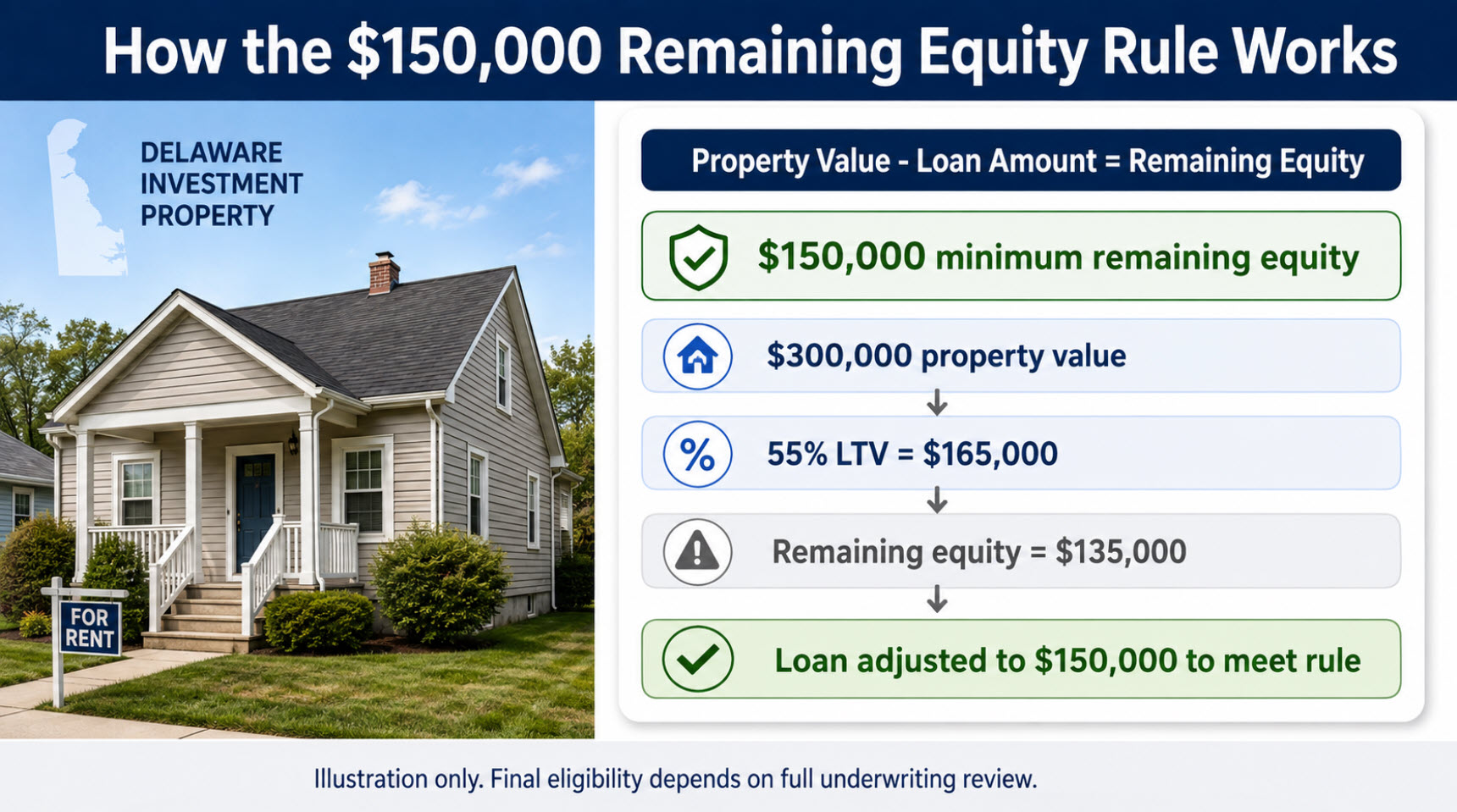
Remaining equity, often abbreviated RE, is what is left in the property after the loan closes. The calculation is:
Value – Loan Amount = Remaining Equity
Value is the lower of the sales price or the appraised value. Remaining equity must be at least $150,000. If the 55% LTV calculation would leave less than that, the loan amount is reduced until the $150,000 floor is met.
Here is the published worked example. On a $300,000 property, 55% LTV produces a $165,000 loan amount. Subtract that from the value and you get $135,000 of remaining equity, which is short of the $150,000 requirement. So the loan amount comes down to $150,000, and the file closes at 50% LTV rather than 55%.
The practical consequence is that on lower-priced Delaware properties, the remaining-equity floor – not the 55% LTV cap – is what sets your loan amount. Two rules of thumb fall directly out of the arithmetic:
- Below roughly $333,000 in value, the $150,000 remaining-equity floor governs and your effective LTV drops below 55%.
- Below roughly $275,000 in value, the math stops working entirely: the largest loan that leaves $150,000 in the property falls under the program’s $125,000 minimum loan amount.
That second point matters a lot in Delaware. There are plenty of solid rental properties in Dover, Milford, Seaford, and parts of New Castle County that trade below $275,000, and on those the Equity First Loan Program simply is not available regardless of how strong the rest of the file is. That is not a credit problem and it is not something a bigger down payment fixes – it is a floor built into the product. If your target property is in that range, the conversation should move to a standard DSCR loan or another program instead.
How Much Can You Borrow on a Delaware Investment Property?
The table below applies the two governing rules – 55% maximum LTV and the $150,000 remaining-equity floor – across a range of Delaware property values. It is a static reference table, not a quote, and it does not account for the declining-market LTV reduction described further down. Your actual maximum depends on the appraised value and the full underwriting review.
| Property value (lower of price or appraisal) | 55% LTV would be | Remaining equity floor allows | Maximum loan amount | Effective LTV |
|---|---|---|---|---|
| $250,000 | $137,500 | $100,000 | Not eligible (under $125,000 minimum) | – |
| $275,000 | $151,250 | $125,000 | $125,000 | 45.5% |
| $300,000 | $165,000 | $150,000 | $150,000 | 50.0% |
| $333,000 | $183,150 | $183,000 | $183,000 | 55.0% |
| $400,000 | $220,000 | $250,000 | $220,000 | 55.0% |
| $550,000 | $302,500 | $400,000 | $302,500 | 55.0% |
| $750,000 | $412,500 | $600,000 | $412,500 | 55.0% |
| $1,000,000 | $550,000 | $850,000 | $550,000 | 55.0% |
| $2,725,000 and above | $1,498,750 | Not binding | $1,500,000 (program ceiling) | 55.0% or less |
Read the two columns in the middle against each other and the shape of the program becomes obvious. On the smaller properties, remaining equity is the binding rule. From roughly $333,000 up, the 55% LTV cap takes over and the remaining-equity requirement is satisfied automatically. At the top, the $1,500,000 program ceiling takes over.
What Does No Minimum FICO Actually Mean?
It means what it says, and it is genuinely unusual. Most investor programs marketed as flexible still publish a floor – 620, 640, 660, sometimes 680. Our own No Ratio DSCR program carries a 660 minimum. The Equity First Loan Program publishes no minimum FICO at all, and it does not require that you have a FICO score in the first place.
Those are two different things, and both matter:
- No minimum score. A low score is not, by itself, a decline. There is no cutoff to clear.
- No score required. If you have no score at all – thin or no U.S. credit file, an ITIN borrower, a foreign national with no U.S. bureau history – the absence of a score is not a barrier. There is also no minimum tradeline requirement, so the usual “three tradelines seasoned 24 months” screen does not apply.
What this does not mean is that credit is invisible. Credit is still pulled, and a handful of specific items on the report have to be cleaned up before closing rather than merely explained. Judgments and tax liens appearing on the credit report, fraud report, or title report have to be paid off prior to closing, documented with a cancelled check or an electronic payment receipt. If the item is reflected on title, the title company verifies on company letterhead that it will not appear on the final title policy. Collections and charge-offs are treated differently – those do not require payoff.
IRS tax debt has its own path. If you can demonstrate that the debt is associated with your self-employed business, it may be paid through the proceeds of a refinance. That is a meaningful option for a Delaware business owner who is asset-rich, behind with the IRS, and locked out of conventional financing because of it. If you want the background on how scoring models weigh these items generally, the five factors of credit scoring page covers it.
What Does No Minimum DSCR Mean for a Delaware Rental?
On a standard DSCR loan, the lender divides the gross monthly rent by the monthly PITIA payment. A result of 1.00 means the rent exactly covers the payment. Most programs want 1.00 or better, and pricing improves as the ratio climbs.
The Equity First Loan Program has no minimum DSCR. There is no coverage ratio the property has to hit, which means a property that does not cash flow on day one is not disqualified for that reason. Vacant units, below-market leases inherited from a prior owner, a property mid-turnover, a Sussex County beach rental with heavy seasonality – none of those break the file the way they would on a conventional DSCR submission.
If your only obstacle is that the rent does not cover the payment and your credit is otherwise strong, you probably do not need this program. The No Ratio DSCR loan solves the cash flow problem at 80% LTV instead of 55%, which is far less cash out of your pocket. Equity First earns its place when the obstacle is on the borrower side – credit, credit events, documentation, or the absence of a U.S. credit profile – and you have substantial equity to work with. For short-term rental scenarios specifically, the DSCR short-term rental program is usually the better first look.
Bankruptcy, Foreclosure, and Mortgage Lates
Credit event seasoning is where this program separates itself from everything else on the shelf. The published rules:
| Credit event | Equity First seasoning | Typical conventional seasoning |
|---|---|---|
| Bankruptcy | One day out of bankruptcy | 2 to 4 years depending on chapter and program |
| Foreclosure | Minimum 12 months, applied to the subject property only | 3 to 7 years |
| Foreclosure bailout | Not permitted | Not permitted |
| Subject property mortgage | Must be less than 90 days past due at funding, documented | Generally must be current |
| Current residence housing history | Not required | 12 to 24 months typically required |
Read the mortgage-lates line carefully, because it is the one most often misread. The requirement applies to the mortgage on the subject property, and the standard is that it must be less than 90 days past due at the time of funding, with documentation provided at closing demonstrating that. So one or two 30-day lates on the subject do not automatically end the conversation. A file that is 90 or more days past due at funding does not meet the guideline. And the program does not do foreclosure bailouts – if the property is in active foreclosure, this is not the exit.
The pattern I see most often with these files is an investor whose personal credit took a hit from something that had nothing to do with the rental – a business failure, a medical event, a divorce, a partnership that came apart – while the underlying property held its value. Every conventional door closes on the credit report. This program looks at the property instead. If a bankruptcy is part of your history and you want the broader picture of financing after one, the Delaware mortgage after bankruptcy page covers the primary-residence side, and the Fresh Start Loan Program is the credit-event program for owner-occupied purchases.
Which Delaware Properties Qualify and Which Do Not
The eligible list is narrower than most investor programs, and the ineligible list is where deals die. Read both before you go under contract.
| Eligible | Not eligible |
|---|---|
| Single family, attached or detached | Rural properties as identified by the appraiser |
| 2 to 4 unit residential | C5 or C6 condition properties |
| Warrantable condominiums | Condotels |
| Non-warrantable condominiums | 5 to 8 unit properties |
| Properties up to 10 acres, if not appraised as rural | Manufactured and mobile homes |
| First-time investor and first-time home buyer | Agricultural property with a working farm |
| Single family homes with more than one ADU |
Two of those exclusions deserve emphasis in Delaware specifically.
Rural. The appraiser’s determination is what controls, not your impression of the neighborhood or any lender’s internal rural definition. A great deal of Kent and Sussex County reads rural on an appraisal form. Properties up to 10 acres are eligible provided the appraisal does not identify them as rural – so acreage alone is not the disqualifier, the rural checkbox is. If you are looking outside the developed corridors, this is the risk to size up early, because you will not know for certain until the appraisal comes back.
Manufactured and mobile homes. Not eligible under this program at any LTV, permanently affixed or not. Delaware has a meaningful manufactured housing stock, and investors are often surprised by this one. The Delaware manufactured home loan page covers what does work for those properties, and mobile homes on leased land are a separate lane again.
On the appraisal itself: one full appraisal is required, and a second-level appraisal review is required on all properties regardless of the Collateral Underwriter score. Transferred appraisals are acceptable. If the appraiser identifies the market as declining, a 10% LTV reduction applies off the matrix maximum – which on a 55% program means the ceiling drops to 45% and the remaining-equity math tightens with it. Build that possibility into your planning rather than discovering it after the appraisal. Our guide to understanding the home appraisal walks through how the report is put together.
Where Is the Equity First Loan Program Available?
Delaware is eligible statewide – New Castle, Kent, and Sussex Counties. Because this is a business-purpose product rather than a consumer mortgage, the availability map is drawn by the program’s own geographic restrictions rather than by the usual footprint, and it excludes several states nearby.
For Delaware investors who also buy across a state line, these are the neighbors worth knowing about:
- Maryland is not eligible under this program. That is a real departure from most of what we do, since Delaware and Maryland are our normal service area. A Cecil County or Eastern Shore property needs a different loan.
- New Jersey is restricted to non-natural-person borrowers, meaning the loan is available when the borrower is an entity such as an LLC rather than an individual.
- Pennsylvania is available, but Philadelphia is an ineligible location, and Pennsylvania has its own minimum loan amount requirement tied to the prepayment penalty.
Several other states are excluded entirely, and a handful of specific locations are carved out regardless of the state. Rather than list them all here, the short version is this: confirm eligibility for your specific property address before you spend money on an appraisal. Bring me the address and I will check it against the current matrix the same day.
Down Payment, Gift Funds, and Cash to Close
There is no polite way to put this: on a purchase, the down payment is large. At 55% maximum LTV you are bringing at least 45% of the price, and on properties under about $333,000 the remaining-equity floor pushes that higher. On a $300,000 purchase, the maximum loan is $150,000 and the down payment is $150,000 before closing costs.
What softens that is where the money is allowed to come from:
- Gift funds are permitted. That is uncommon on business-purpose investor loans, where gift funds are frequently prohibited outright.
- Gift of equity is not permitted. A below-market family sale structured as a gift of equity does not work here. This is a distinct rule from gift funds and the two are often confused – our gift funds and gift of equity guidelines page explains the difference.
- Seller contributions up to 6%. A generous cap by investor-loan standards, and worth negotiating for on a purchase.
- No reserves required. You do not need months of PITIA sitting in an account after closing, which is a real advantage for an investor who is deploying everything into the deal.
- Asset verification is 30 days minimum for the funds needed to close. If you are closing with business assets, you will need evidence of 100% ownership of the business.
On the refinance side the arithmetic runs the other way and is often more attractive. If you already own a Delaware rental free and clear or with a small balance, a cash-out refinance at 55% LTV pulls real money out, cash out is unlimited, and no reserves are required afterward. The one purpose restriction to note is that debt consolidation is not an eligible loan purpose on this program. If pulling equity out of a property you already own is the actual goal and your credit supports it, compare this against a HELOC or home equity loan before committing, since the prepayment penalty below changes the calculus.
The 5-Year Prepayment Penalty You Have to Plan Around
This is the term I make sure every investor hears twice, because it is the one that can quietly cost real money.
Read this before you sign a contract
The prepayment penalty is a 5-year fixed, 5% flat penalty with no step-downs. It is required – it is not an option you can price your way out of – and buyout is not permitted. The 5% does not decline in years two, three, or four the way a step-down structure would.
Practically, that means this loan is designed to be held. If your plan is to buy, stabilize, and refinance into better terms inside a year or two, or to flip the property, the penalty will take a bite out of the exit. On a $300,000 loan a 5% flat penalty is $15,000, and it is the same $15,000 in month 11 as it is in month 47.
So the honest framing is this: the Equity First Loan Program is a five-year-plus hold, or a bridge you enter with your eyes open and the penalty priced into the plan. When an investor tells me the plan is to season the file for twelve months and refinance out, I say so directly – that plan and this loan do not fit together well, and we should look at a different structure. Note also that Pennsylvania has its own minimum loan amount requirement connected to the prepayment penalty, and Ohio limits the program to 3 to 4 unit properties.
Foreign National and ITIN Borrowers
The citizenship list is broad. Eligible borrowers include U.S. citizens, permanent resident aliens, non-permanent resident aliens with U.S. credit and an acceptable visa, foreign nationals, and ITIN borrowers.
Pair that with the no-FICO-required rule and you have a combination that is genuinely hard to find. A foreign national investor buying a Delaware rental typically has no U.S. credit bureau file at all. On most programs that pushes the borrower toward a 25% to 30% down payment with a DSCR requirement layered on top. Here, the absence of a U.S. score is not the qualifying obstacle – the equity position is what is being underwritten – and there is no coverage ratio to satisfy.
For ITIN borrowers, the trade to weigh is leverage. The Equity First Loan Program asks for substantially more equity than our ITIN home loan program, which is built for primary residences and allows much higher financing. If you are buying a home to live in, that is the page to read, not this one. This program is only for property you will not occupy – and neither will a family member.
When Investors Use Equity First Instead of a Standard DSCR Loan
A standard DSCR loan is the better product for most Delaware investors most of the time, and I say so on the phone regularly. It finances 75% to 80% instead of 55%, which is a large difference in cash out of pocket. Equity First earns its place in a narrow set of situations, and these are the ones I actually see.
Refinancing out of a hard money loan
This is the most common one. An investor buys with hard money or a short-term bridge, the maturity date arrives, and the takeout financing falls apart because the credit report will not support a conventional or standard DSCR approval. The property itself is fine and there is real equity in it. A rate-and-term refinance under Equity First can retire the hard money note without a credit score entering the decision.
Two constraints shape whether it works. First, the payoff has to fit inside 55% of value and still leave $150,000 in the property, so a hard money loan taken at 70% or 75% of value generally will not fit. Second, the loan is designed to be held: the 5-year prepayment penalty means this is a destination, not a second bridge.
A file that was declined somewhere else on credit
Standard DSCR programs generally publish a credit floor in the 600 to 660 range, and our own No Ratio DSCR program sits at 660. Below those floors the answer is usually no, regardless of how good the property is. Equity First starts below every one of them, because there is no floor to clear. If the decline was about the score rather than the asset, this is the lane worth checking.
Cash-out after a bankruptcy, a foreclosure, or a rough stretch
One day out of bankruptcy, with a 12-month floor on subject-property foreclosure seasoning, is far shorter than the multi-year wait every conventional and standard DSCR program imposes. Combined with unlimited cash out, that makes the program a way to access equity during the window when other financing is closed. What it will not do is stop a foreclosure in progress on the subject property, since foreclosure bailouts are not permitted and the subject mortgage must be less than 90 days past due at funding.
Vacant units, mid-turnover properties, and seasonal coastal rentals
With no minimum DSCR, a property that is empty, between tenants, or carrying a below-market inherited lease is not disqualified on cash flow. Along the Sussex County coast, where a rental can look very different in February than it does in July, that removes an argument you would otherwise be having with an underwriter. If the property is the only problem and your credit is fine, though, compare this against No Ratio DSCR first, since it solves the same problem at 80% financing.
No U.S. credit profile at all
A foreign national investor with no U.S. bureau file is not a low-score borrower, but most programs treat the two the same way and respond with a larger down payment requirement plus a DSCR test. Because Equity First does not require a score to exist and has no minimum tradeline requirement, the absence of a U.S. credit history is not the qualifying obstacle here.
When a standard DSCR loan is still the better answer
If your credit clears the floor and the property covers the payment, take the DSCR loan. Choosing 55% leverage when 80% is available costs you 25% of the purchase price in cash on every deal, which is capital that could be a second property. Equity First is a solution to a specific problem, not an upgrade.
Equity First vs DSCR vs No Ratio DSCR: Which Investor Loan Fits?
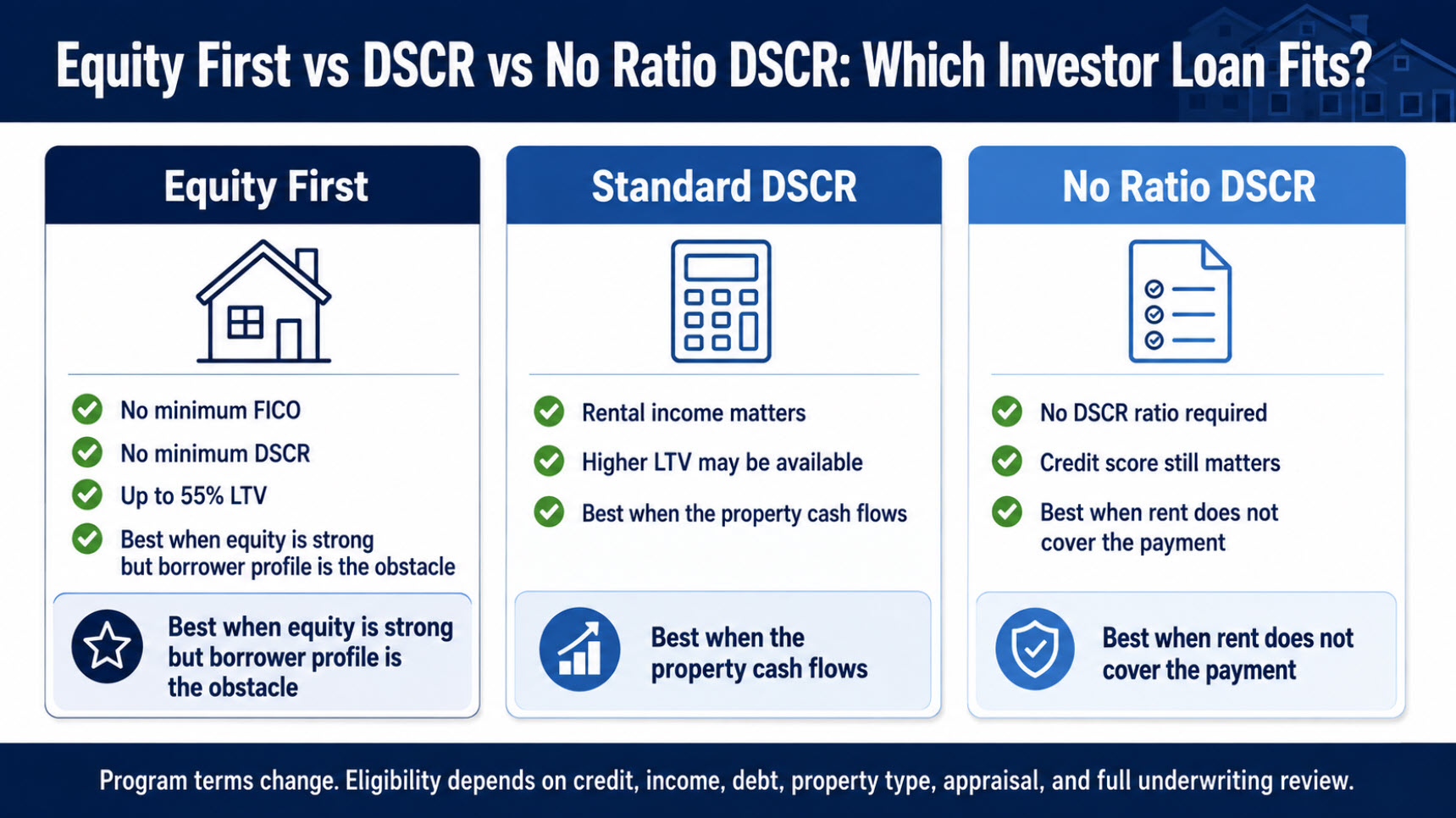
Most investors who land on this page are choosing among three or four programs without realizing they solve different problems. Here is how I sort them.
| Equity First | Standard DSCR | No Ratio DSCR | Asset Qualifier | |
|---|---|---|---|---|
| Solves for | Borrower credit profile | No tax returns needed | Property does not cash flow | Assets instead of income |
| Minimum FICO | None | Typically 600 and up | 660 | 600 to 660 depending on structure |
| DSCR requirement | None | Generally 1.00 or a reserves offset | None | Not applicable |
| Max LTV (purchase) | 55% | Typically 75% to 80% | 80% | Up to 85% on investment |
| Reserves | None | Commonly 3 to 6 months | Often 12 months | Required as part of the calculation |
| Bankruptcy seasoning | 1 day | Multi-year | Multi-year | Multi-year |
| Occupancy | Investment only | Investment only | Investment only | Primary, second home, or investment |
The decision rule I use is short. If the property is the problem, look at DSCR or No Ratio DSCR. If documenting income is the problem, look at the bank statement loan, the P&L mortgage loan, the 1099 mortgage loan, or the VOE only loan program. If assets are the strength, look at the asset qualifier loan or the no income, no employment loan. Equity First is the answer when the borrower profile itself is the obstacle – no score, a recent credit event, no U.S. credit history – and there is enough equity in the property to carry the file.
Common Mistakes Delaware Investors Make on These Files
| Mistake | What actually happens |
|---|---|
| Assuming 55% LTV always applies | Under about $333,000 in value, the $150,000 remaining-equity floor governs and the loan comes in smaller |
| Writing an offer on a sub-$275,000 property | The maximum loan falls below the $125,000 program minimum, so the property is not financeable here at all |
| Treating the prepayment penalty as negotiable | It is required, 5% flat for 5 years, no step-downs, and buyout is not permitted |
| Planning a 12-month refinance exit | The full 5% penalty applies in year one exactly as it does in year four |
| Assuming acreage is the rural test | The appraiser’s rural determination controls; up to 10 acres is fine if the appraisal does not read rural |
| Ignoring the declining-market rule | A declining market identified by the appraiser triggers a 10% LTV reduction off the matrix maximum |
| Confusing gift funds with gift of equity | Gift funds are permitted; gift of equity is not |
| Planning to house a family member in the unit | Neither the borrower nor a family member may live in the subject property |
| Leaving a judgment or tax lien for later | Both must be paid off prior to closing with documented proof, unlike collections and charge-offs |
| Counting on a Maryland purchase | Maryland is not an eligible state for this program |
When the Equity First Loan Program Is Not a Good Fit
I would rather tell you this before an appraisal fee than after. This program is likely the wrong choice if:
- You want to live in the property, or house a family member in it. Occupancy is investment-only and the restriction extends to family. For an owner-occupied purchase, start with the Delaware conventional loan or one of the government programs instead.
- Your credit is solid and the property cash flows. A standard DSCR loan will generally get you to 75% or 80% financing. Choosing 55% leverage without needing to is expensive.
- The property is under about $275,000 in value. The remaining-equity floor and the $125,000 minimum loan amount collide and there is no version of the file that works.
- You plan to sell or refinance within five years. The 5% flat prepayment penalty does not step down and cannot be bought out.
- The property is manufactured, a condotel, 5 to 8 units, a working farm, in C5 or C6 condition, or appraises rural. These are hard exclusions.
- You need debt consolidation. That is not an eligible loan purpose here.
- You are trying to stop a foreclosure on the subject property. Foreclosure bailouts are not permitted, and the subject mortgage must be less than 90 days past due at funding.
- The property is in Maryland. Not an eligible state for this program, even though Maryland is otherwise part of our normal service area.
Landing in one of those categories does not mean there is no loan for you. It usually means a different one. That is the conversation worth having before you spend money.
How to Apply for the Equity First Loan Program in Delaware
Because the qualifying logic is different, the sequence is different too. There is no point gathering two years of tax returns for a program that does not use them.
- Start with the property, not the borrower. Give me the address, the estimated value or contract price, and what is currently owed. I run the 55% LTV and the $150,000 remaining-equity calculation and tell you the maximum loan amount before anything else happens.
- Confirm property type and location eligibility. Property type, condition, unit count, ADU status, and whether the address sits in an eligible location. This is the step that saves appraisal money.
- Review the credit report for the specific blockers. Not for the score – for judgments, tax liens, the subject property mortgage history, and any foreclosure inside 12 months. These are the items that have to be resolved, and knowing about them early is what keeps a closing on schedule.
- Document the funds to close. Minimum 30 days of asset verification. If gift funds are part of the plan, we set up the documentation correctly at the start. Business assets require evidence of 100% ownership.
- Order the appraisal and the second-level review. One full appraisal plus a second-level review on every property regardless of CU score. Transferred appraisals are acceptable, which can save time if you already have one.
- Confirm the hold plan against the prepayment penalty. Before you commit, we talk through the five-year window one more time.
You can start by phone at 302-703-0727, schedule a 30-minute appointment, or complete the online application. Exceptions to program guidelines are considered on a case-by-case basis, so a scenario that sits slightly outside a published parameter is still worth a phone call rather than an assumption.
Serving Delaware Real Estate Investors
The John Thomas Team works with investors across all three Delaware counties from our office in Newark. The pattern that runs through the Equity First files I see is geographic as much as financial: the program’s remaining-equity floor and its rural exclusion both push it toward the developed New Castle County corridor and the higher-value Sussex County coastal market, and away from the lower-priced inland properties where a lot of Delaware rental inventory actually sits.
In practice that means investors buying in Newark, Wilmington, Bear, Middletown, and Hockessin usually clear the value thresholds comfortably, and coastal Sussex properties in Lewes, Rehoboth Beach, and Bethany Beach clear them easily – though the coastal files are also where seasonal rent patterns make a no-minimum-DSCR structure most useful. Kent County and inland Sussex need the value and rural questions answered first. I would rather run those two checks in a five-minute phone call than have you find out at the appraisal.
Everything on this page is business-purpose financing for non-owner-occupied property. If you are buying a home to live in, start at the Delaware first-time home buyer page or with conventional financing instead.
Equity First Loan Program FAQs
Do I need a credit score to qualify for the Equity First Loan Program?
No. The program publishes no minimum FICO and does not require that you have a FICO score at all, and there is no minimum tradeline requirement. Credit is still pulled, and specific items still have to be resolved: judgments and tax liens appearing on the credit report, fraud report, or title report must be paid off prior to closing with a cancelled check or electronic payment receipt. Collections and charge-offs do not require payoff. Qualification centers on the equity position in the property rather than on a score.
What is the minimum remaining equity requirement and how is it calculated?
At least $150,000 of equity must remain in the property after closing. The calculation is value minus loan amount, using the lower of the sales price or the appraised value. If the 55% LTV calculation would leave less than $150,000, the loan amount is reduced until the floor is met. On a $300,000 property, 55% would produce a $165,000 loan, which leaves only $135,000, so the loan is cut to $150,000 and the file closes at 50% LTV.
Can I use the Equity First Loan Program one day after a bankruptcy discharge?
The published seasoning is one day out of bankruptcy, which is among the shortest available on any residential investment product. Foreclosure seasoning is a minimum of 12 months and applies to the subject property only, and foreclosure bailouts are not permitted. As with every guideline on this page, eligibility depends on the complete file and the lender makes the final determination at underwriting, so bring the specifics rather than assuming either way.
Can I qualify if I have late mortgage payments on the property?
Often yes, within a defined limit. The subject property mortgage must be less than 90 days past due at the time of funding, and you provide documentation at closing demonstrating that. So 30-day and 60-day lates on the subject do not automatically end the file the way they would on conventional financing. Housing history on your current residence is not required at all. A subject mortgage that is 90 or more days past due at funding does not meet the guideline.
Can foreign nationals and ITIN borrowers use this program?
Yes. Eligible borrowers include U.S. citizens, permanent resident aliens, non-permanent resident aliens with U.S. credit and an acceptable visa, foreign nationals, and ITIN borrowers. Because no FICO score is required, the absence of a U.S. credit bureau file is generally not the obstacle it is on other investor programs. ITIN borrowers buying a primary residence rather than an investment property should look at the ITIN home loan program instead, which allows substantially higher financing.
Can I refinance out of a hard money loan or an existing DSCR loan?
Often yes. Rate-and-term refinance and cash-out refinance are both eligible purposes, so paying off a maturing hard money note or replacing an existing DSCR loan are common uses. Two limits decide it: the payoff has to fit inside 55% of value while still leaving $150,000 of equity in the property, so a hard money loan taken at 70% or 75% of value generally will not fit. And because the 5-year prepayment penalty does not step down, treat this as the loan you keep rather than a second bridge. Debt consolidation is not an eligible purpose.
Is there a prepayment penalty, and can it be bought out?
Yes, and no. The prepayment penalty is a 5-year fixed, 5% flat penalty with no step-downs. It is required rather than optional, and buyout is not permitted. Because the 5% does not decline over the term, an early payoff in year one costs the same percentage as one in year four. Plan on holding the loan for at least five years, or price the penalty into your exit before you commit.
Can I use this loan on a manufactured home or a rural Sussex County property?
Manufactured and mobile homes are not eligible under this program. Rural properties are also excluded, and the appraiser’s rural determination is what controls, not acreage – properties up to 10 acres are eligible provided the appraisal does not identify them as rural. Because a meaningful share of Kent County and inland Sussex County reads rural on an appraisal form, that is the question worth answering before ordering the appraisal.
Can gift funds cover the down payment?
Gift funds are permitted, which is uncommon on business-purpose investor loans. Gift of equity is not permitted, so a discounted family sale structured that way does not work here. Seller contributions are capped at 6%, no reserves are required after closing, and a minimum of 30 days of asset verification is required for the funds to close. Business assets used to close require evidence of 100% ownership of the business.
Is the Equity First Loan Program available in Maryland?
No. Maryland is not an eligible state for this program, which is a departure from most of what the John Thomas Team offers, since Delaware and Maryland are our normal service area. Delaware is eligible statewide across New Castle, Kent, and Sussex Counties. New Jersey is limited to entity borrowers rather than individuals, and Pennsylvania is available outside Philadelphia. Confirm your specific property address before ordering an appraisal.

About John R. Thomas, NMLS #38783
John R. Thomas is a mortgage loan officer and Branch Manager with the John Thomas Team in Newark, Delaware, with more than 20 years of origination experience and more than 3,000 Delaware buyers and investors served. He holds a BS in Physics Education from the University of Delaware and an MS in Curriculum and Instruction from Delaware State University, and he is the author of a Delaware home buyer guide used at the monthly first-time buyer seminars he has led for over a decade.
On equity-driven investor files specifically, the step John takes first is running the loan amount before anything else: the 55% LTV calculation and the $150,000 remaining-equity calculation together, against the lower of price or appraisal, because on Delaware properties under roughly $333,000 those two rules produce different answers and it is the smaller one that governs. Running that arithmetic at the start is what keeps an investor from writing an offer sized to a loan amount the program was never going to support.
Licensed in 17 states as a mortgage loan officer: AL, DC, DE, FL, GA, IN, KS, MD, MN, MO, NC, NJ, OH, PA, SC, TN, VA. NMLS #38783. Operational service area for delawaremortgageloans.net is Delaware and Maryland; note that the Equity First Loan Program itself is not available in Maryland.
John Thomas Team
248 E Chestnut Hill Rd, Newark, DE 19713
Phone: 302-703-0727 | Email: team@johnthomasteam.com
Find Out What Your Delaware Property Will Support
Send me the address, the value, and the current balance. I will run the 55% LTV and the $150,000 remaining-equity calculation and tell you the real number before you spend anything.
Last Updated: August 2026. Mortgage content reviewed by John R. Thomas, NMLS #38783, John Thomas Team.
John Thomas Team, 248 E Chestnut Hill Rd, Newark, DE 19713. Phone 302-703-0727. Email team@johnthomasteam.com.
The Equity First Loan Program is a business-purpose loan for non-owner-occupied investment property. Program guidelines, availability, and pricing change and are subject to lender approval of the complete file. This page is an informational overview and is not a loan offer, quote, or commitment to lend. Nothing on this page should be read as investment, tax, or legal advice.
(c) 2026 John R. Thomas. All Rights Reserved.
