Delaware Construction Loans: How a One-Time Close Works, Down Payment & Builder Rules in 2026
A Delaware construction loan with a one-time close finances the lot, the build and your permanent mortgage with one closing. During the build, interest is charged only on the money drawn, and FHA buyers can finance it into the build cost. Conventional needs about 5% down, FHA 3.5%, and VA 0% for eligible veterans. Current as of October 2026.
Maybe you’ve lost three bidding wars, or every house you tour needs $60,000 of work before it fits your family. Building starts to look like the only way to get the home you actually want, and then the financing looks complicated: a loan for the lot, a loan for the build, a mortgage at the end. I’m John Thomas, NMLS #38783, and my goal on this page is to show you how a one-time close construction loan rolls all of that into one loan in Delaware, with the rate set before the build starts, what your builder has to do, and what it really costs while the house goes up. If you haven’t picked a lot yet, our page on Delaware land loans covers buying land on its own, and each program has its own guide linked in the comparison table below.
Planning to Build in Delaware? Start With the Numbers
Tell us about the lot, the builder and your budget. We’ll show you which construction program fits, what you’d need for the down payment, and what the interest during the build could look like before you sign a building contract.
Table of Contents
What Is a One-Time Close Construction Loan?
A one-time close construction loan, also called a single-close construction-to-permanent loan, is one mortgage that pays for the lot and the build, then becomes your long-term mortgage when the home is finished. The borrower qualifies and closes once, before construction starts, as long as the build finishes within the loan’s construction term.
The older way to build was a two-time close: a short-term construction loan from one lender, then a separate mortgage once the house was done, with a second application, a second set of closing costs and a second underwriting decision at the end. A one-time close removes that second closing. The permanent loan terms are set in your closing documents, and when the builder finishes, the loan converts or is modified into the permanent mortgage. Fannie Mae describes this structure in its Selling Guide section on single-closing construction-to-permanent loans.
One loan doesn’t mean nothing happens at the end. Before it converts, the home needs a certificate of occupancy and a completion inspection by the appraiser, and if your documents have aged out or the value came in lower, the lender rechecks your file. I cover that in the steps below so it isn’t a surprise.
How Does a Construction Loan Work in Delaware, Step by Step?
A Delaware one-time close construction loan runs in seven steps: get pre-approved, pick a builder the lender accepts, sign a fixed-price building contract, appraise the plans, close once, build with inspected draws, then convert to the permanent mortgage. Builder acceptance has to happen before the loan application moves forward, so it comes early.
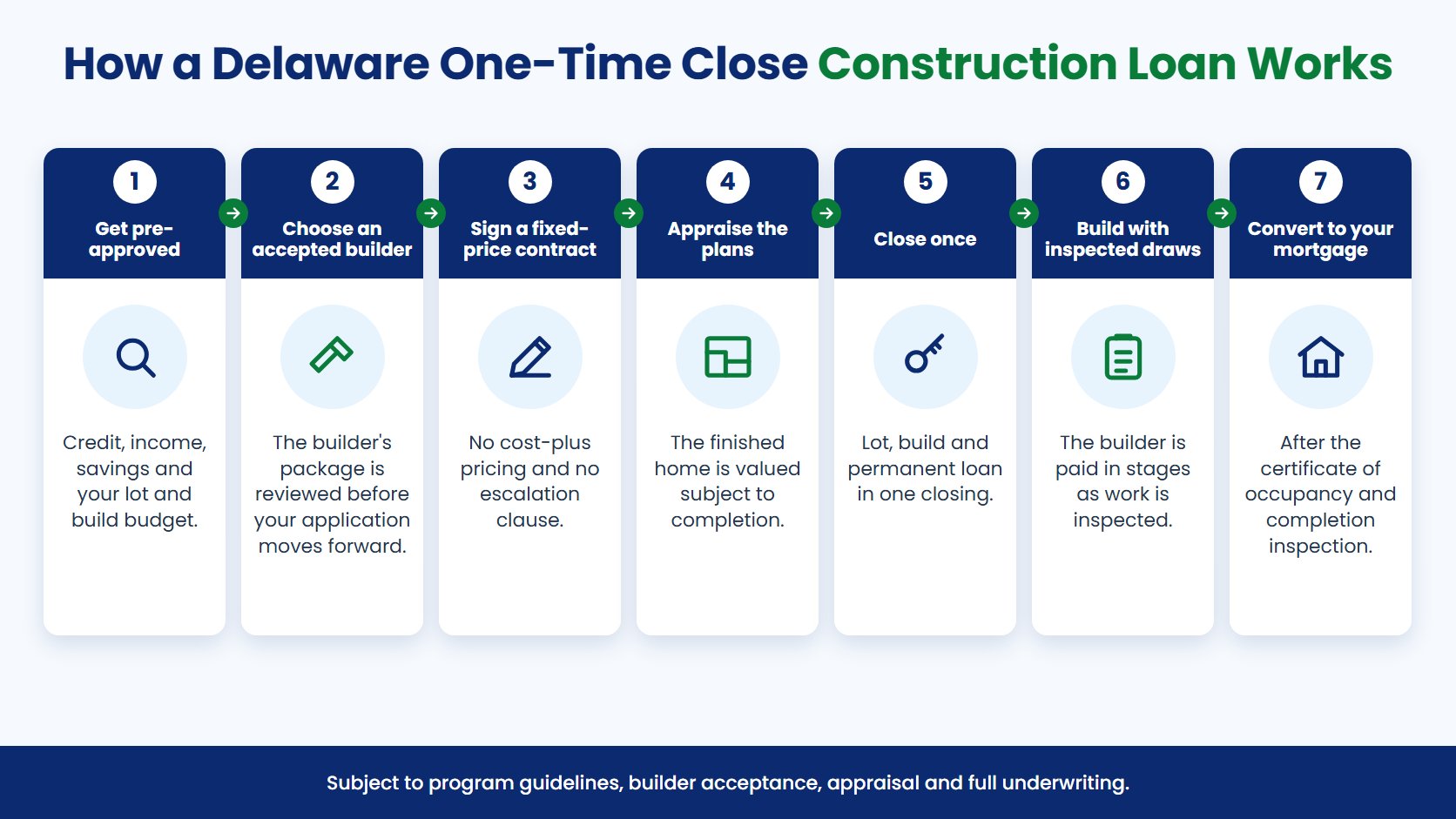
- Get pre-approved. We review your credit, income, savings and the rough budget for the lot and the house, and tell you which program fits.
- Choose a builder the lender accepts. Your builder sends a package (license, insurance, experience, references and financials) for review. You can’t act as your own general contractor.
- Sign a fixed-price contract. The contract has a set price, not cost-plus, with no clause that lets the price rise if materials go up. It also says who pays the interest during the build.
- Appraise the plans. The appraiser values the finished home “subject to completion,” using your contract, plans and specifications, and the land contract or deed.
- Close once. The loan pays off or buys the lot, and the construction and permanent terms are set in one set of documents. Your rate is fixed for the build, with a float-down option before conversion if rates drop.
- Build with inspected draws. The builder is paid in stages as an inspector confirms the work, usually five progress draws plus a final draw.
- Convert to your permanent mortgage. After the certificate of occupancy and the appraiser’s completion inspection, the loan becomes your regular principal-and-interest mortgage.
In my experience, the construction files that stall early usually aren’t about the buyer’s credit. They stall on paperwork from the builder side: a builder package that’s missing an insurance certificate, or a contract written as cost-plus or with a price-escalation clause that has to be rewritten before anything moves. That’s why I ask for the builder’s name and a draft contract at the pre-approval stage, not after you’ve fallen in love with a floor plan.
Which Construction Loan Programs Can You Use in Delaware?
As of October 2026, Delaware buyers can build with a conventional, FHA, VA or USDA one-time close loan, and larger builds can use a jumbo construction loan. Conventional needs about 5% down, FHA 3.5%, and VA and USDA can allow 0% down when the borrower meets that program’s rules.
| Program | Minimum down payment | Credit score | Occupancy | Who it fits |
|---|---|---|---|---|
| Conventional one-time close | 5% (95% loan-to-value) | 640 | Primary residence or second home | Solid credit, some savings, wants PMI that can come off later |
| FHA one-time close | 3.5% (96.5% loan-to-value) | 640 | Primary residence | Smaller down payment, more flexible debt ratios |
| VA one-time close | 0% with full entitlement | 640; 680 above the conforming limit | Primary residence | Eligible veterans and service members |
| USDA one-time close | 0% | See the USDA page | Primary residence | Moderate income, building in a USDA-eligible area |
| Jumbo one-time close | See the jumbo page | See the jumbo page | See the jumbo page | Builds above the conforming loan limit |
HUD sets the 3.5% FHA minimum on its FHA loans page, VA explains how entitlement and the funding fee work on its funding fee and closing costs page, and USDA describes its zero-down program on the Single Family Housing Guaranteed Loan page, and you can check whether a lot is in an eligible area with USDA’s property eligibility lookup. The 2026 conforming loan limit that separates a standard loan from a jumbo is $832,750 for a one-unit home, set by FHFA. Each program page linked in the table goes into that program’s own rules in detail.
How Much Down Payment Do You Need to Build a Home in Delaware?
As of October 2026, most Delaware buyers need 5% down to build with a conventional one-time close loan, 3.5% with FHA, and 0% with VA or USDA when eligible. The down payment is figured on the lot price plus the building contract, and equity in a lot you already own can count toward it.
Your total cost to build is the building contract plus the price of the land, if you’re buying it. The loan-to-value is measured against the lower of that total cost or the “as completed” appraised value. So if the appraiser values the finished home below your contract, the down payment is figured on the lower number and you’d cover the difference.
Let’s say a buyer is purchasing a $90,000 lot and signing a $360,000 fixed-price contract to build a primary residence, for a total cost of $450,000, and the home appraises “as completed” at $455,000. With a conventional one-time close loan at 95%, the loan would be $427,500 and the down payment $22,500. With FHA at 96.5%, the base loan would be $434,250 and the down payment $15,750, before FHA’s upfront mortgage insurance premium. Closing costs, the transfer tax covered below and insurance are extra. Illustrative example only, not a loan offer or commitment.
Gift funds from an eligible family member can cover the down payment on a primary residence under each program’s rules. The one restriction buyers don’t expect: the donor can’t be the builder, the real estate agent or anyone else with a stake in the sale. Cash kept at home and “sweat equity” from doing work yourself don’t count as down payment funds.
Do You Make Payments While Your Home Is Being Built?
Not always. Construction interest is charged only on the money already paid out to the builder and is billed monthly, unless it is financed. FHA one-time close buyers can finance it into the build cost and make no payments during construction, and under current VA one-time close guidelines the builder pays it.
On an FHA one-time close loan you choose between two ways to handle it: pay the interest monthly on what has been drawn, or finance it into the build cost so there are no payments while the house goes up. Financing it makes it part of the total cost the loan and down payment are figured on, so we run the numbers both ways before you sign. On a conventional loan, the building contract says whether you or the builder pays the monthly interest.
When interest is paid monthly, the payment starts small and grows as the house goes up, because it is charged only on what has been drawn. Early in the build, when the loan has paid for the lot and the foundation, you’re paying interest on that amount, not on the full loan. Near the end, most of the loan has been drawn and the interest payment is close to what interest on the whole loan would be. Principal payments start after the loan converts.
Two details matter here. First, a monthly interest bill has to be paid each month: the lender can hold the next draw until it is, which can slow your builder down. Second, your interest rate is set at closing and stays the same through the build. If rates drop while the house goes up, a float-down option can let you move to the lower rate during the 30 days before the loan is modified into your permanent mortgage, under the program’s terms at that time. If the build runs long, the rate lock may need an extension, and on these loans the builder pays for lock extensions, with a cap on how many the lender allows. Some builders offer to pay the construction interest as part of the contract price, so it’s worth asking before you sign.
Property taxes and homeowners insurance aren’t paid out of escrow during construction; you keep them current yourself until the loan converts. If your permanent loan will have an escrow account, it’s set up at closing with an initial deposit.
What Does Your Builder Need to Qualify for a Construction Loan?
A builder needs to be accepted by the lender before the loan application moves forward. The review covers the builder’s license where the state requires one, general liability and workers’ compensation insurance, construction experience, financials, recent completed homes and references. Acceptance lasts one year, and the borrower can never be the general contractor.
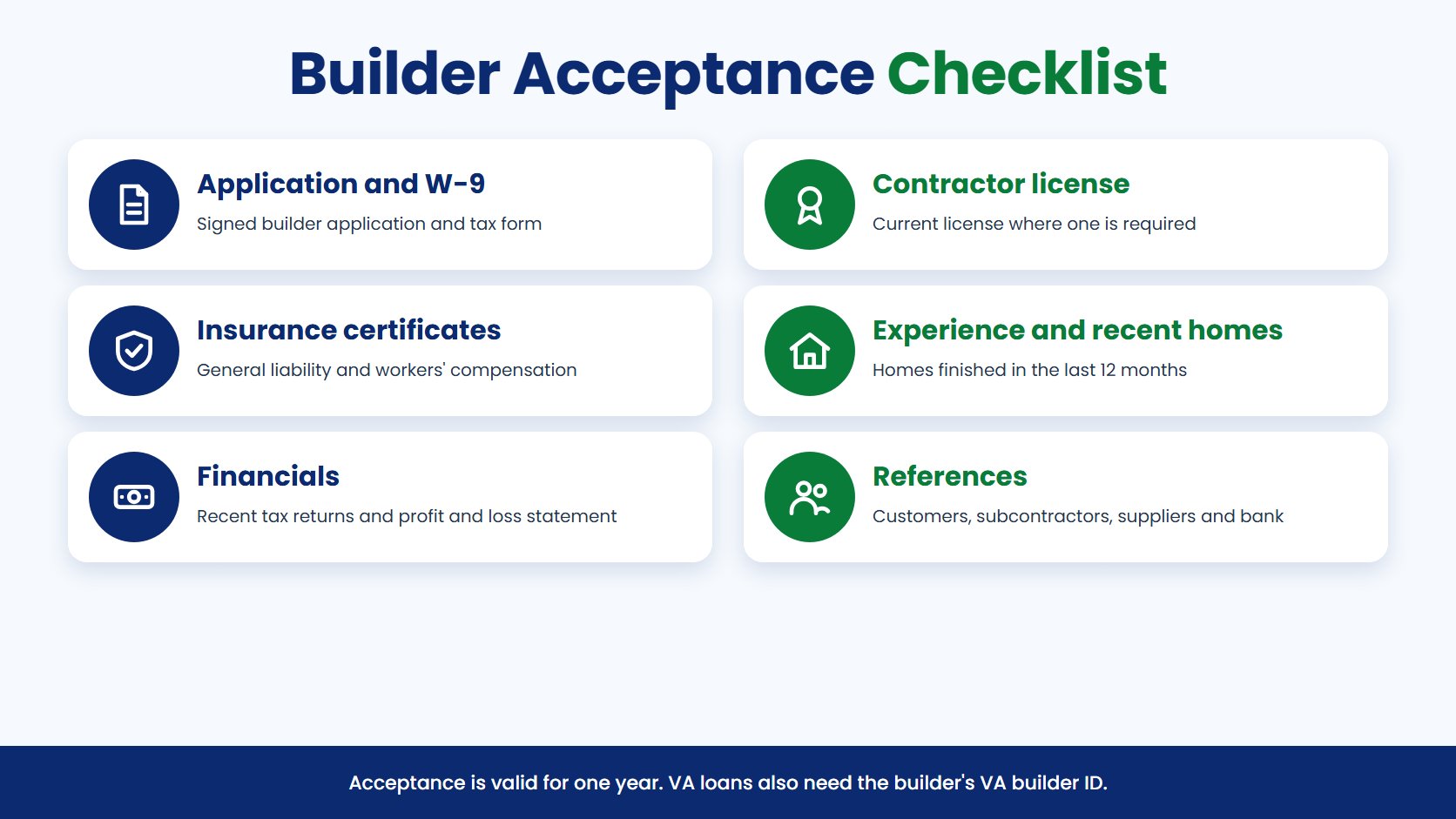
Builder acceptance protects you as much as the lender. It’s a check that the company is licensed, insured, financially stable and has finished homes like yours recently. Here is what a builder is usually asked to send:
- A signed builder application and a W-9
- A current contractor or dealer license where one is required
- Certificates of general liability insurance and workers’ compensation (or a signed exemption if every trade is subcontracted)
- A written overview of construction experience and a list of homes finished in the last 12 months
- Recent tax returns and a profit and loss statement
- Customer, subcontractor, supplier and bank references
- For a VA loan, the builder’s VA builder ID
Once accepted, a builder stays accepted for a year and can renew with updated license and insurance documents. If you’ve already chosen a builder, send me their name early: if they’re already accepted, that step is done, and if they’re not, we start the package while you finish your plans. Changing builders after closing needs the lender’s written consent and the new builder has to be accepted first, so it’s worth getting this right at the start.
How Do Construction Draws and Inspections Work?
A one-time close construction loan pays the builder in stages called draws: usually five progress draws plus a final draw, each released after an inspector confirms the work. Up to 10% can be released at closing when permits are in hand, and the final draw is at least 10% of the construction cost.
| Stage | What happens | What it needs |
|---|---|---|
| At closing | Lot paid off or purchased; up to 10% can go to the builder | Building permits if the builder takes the initial release |
| First draw | Paid after the foundation stage | Permits, a foundation survey where required, title update (a check that no new liens were filed), lien waiver (the builder’s signed statement that it was paid for the work), inspection |
| Progress draws | Paid as framing, systems and finishes are completed | Inspection of completed work, title update, lien waivers |
| Final draw (at least 10%) | Paid when the home is complete | Certificate of occupancy, final survey, completion inspection by the appraiser, one year of paid homeowners insurance |
| Conversion | Loan becomes the permanent mortgage | Final title endorsement, taxes current, last construction interest paid |
The inspector isn’t checking quality the way your own home inspector would; they confirm the work being paid for is done. I still recommend hiring your own inspector at key stages, such as before drywall goes up. Change orders, like an upgraded kitchen or a moved wall, have to be approved by the lender before the work is done, and because these loans don’t include a contingency reserve, an upgrade that raises the price is usually paid in cash rather than added to the loan.
Can You Use a Construction Loan to Build on Land You Already Own?
Yes. When you already own the lot, a one-time close construction loan pays off any loan on the land and finances the build, and your equity in the lot can count toward the down payment. Equity is based on the appraised land value, and the loan can’t give you cash back at closing.
On a conventional loan, building on land you own is set up as a limited cash-out refinance, and closing costs can be rolled into the loan amount when the value supports it. Any existing loan on the lot has to be paid off at closing, either from the new loan or with your own funds. FHA and VA have their own land rules, including how long you’ve owned the lot and how its value is counted. On a VA loan, land equity can also lower the VA funding fee.
If you want to buy land now and build in a few years, that’s a different loan. A one-time close construction loan expects construction to start soon after closing. For land you’ll hold for a while, see Delaware land loans, and when you’re ready to build, the lot you own becomes your equity.
What Kinds of Homes Can You Build With a One-Time Close Loan?
As of October 2026, a one-time close construction loan finances a one-unit site-built home, including homes in planned communities, and on custom builds also a modular or new manufactured home on a permanent foundation. Tiny homes, post-frame builds, condos, two-to-four-unit properties and homes you build yourself are not eligible.
| Usually eligible | Not eligible |
|---|---|
| One-unit site-built single-family home | Tiny homes |
| Home in a planned unit development (PUD) | Post-frame (pole barn style) construction, 3-D printed homes, shed or container conversions |
| Modular home (custom build on your lot) | Condominiums and 2-4 unit properties |
| New manufactured home on a permanent foundation (custom build) | Owner-builder or do-it-yourself projects |
| Site-built home with an accessory dwelling unit that meets program rules | Farms and other primarily agricultural properties; investment properties |
Lenders split builds into two types. A custom build is a one-off home on its own lot, even if the builder has used the floor plan before. A tract build is a home in a builder’s subdivision built from a few repeated plans. Modular and manufactured homes are financed as custom builds. Barndominiums are reviewed case by case: it depends on how the home is built (post-frame construction is not eligible), the program, and whether the appraiser can find comparable sales nearby. For manufactured homes in general, see our Delaware manufactured home loans guide.
What Costs Should You Budget for When You Build in Delaware?
Beyond the down payment and closing costs, Delaware buyers who build should budget for the state’s 2% realty transfer tax on construction contracts over $10,000, interest during the build, per-draw inspection and title-update fees, a builder’s risk insurance policy, and property taxes until the loan converts. Tax rules as of October 2026.
The transfer tax is the one Delaware buyers are least likely to hear about from a national lender. Delaware’s realty transfer tax law treats a contract to build a house as a taxable document when it is signed, or work starts, before the land transfers to you or within one year after. The state rate on those contracts is 2% of the amount over $10,000, and the law puts that tax on the owner of the building, which is you. It’s in Title 30, Chapter 54 of the Delaware Code (sections 5401 and 5402). Counties and towns can have their own transfer tax rules, so the title company confirms the total for your property.
Using the same $360,000 building contract from the example above, signed within a year of buying the lot, the state tax would be 2% of $350,000 (the amount over $10,000), or $7,000. That is in addition to the realty transfer tax on the lot purchase itself. Illustrative example only, based on the state rate in 30 Del. C. 5402(f); not tax advice. Your title company or tax advisor confirms the amount for your transaction.
- Interest during the build: interest only on the amount drawn, paid monthly by you or the builder per your contract, or on FHA financed into the build cost.
- Draw fees: an inspection fee and a title-update fee for each draw, plus a final completion inspection. Extra draws beyond the standard schedule cost more.
- Insurance: a builder’s risk policy, which insures the house while it is being built, covering the construction period, paid at or before closing, plus a one-year homeowners policy for when the home is finished. In a flood zone, flood insurance is required.
- Program fees: FHA’s upfront mortgage insurance premium and the VA funding fee can be financed; conventional loans under 20% down carry private mortgage insurance.
- Builder credits: a builder can pay some of your closing costs if the contract says so, within each program’s limits. On VA loans, seller and builder concessions are capped at 4% of the home’s value.
- Upgrades and overruns: no contingency reserve is built into the loan, so keep cash aside for changes you choose after closing.
Is a One-Time Close Better Than a Two-Time Close Construction Loan?
For most buyers building a primary residence with a lender-accepted builder, a one-time close costs less and carries less risk: one closing, one set of closing costs, one appraisal and title search up front, and a rate set before construction starts. A two-time close can fit an owner-builder project or a very long timeline.
| Feature | One-time close | Two-time close |
|---|---|---|
| Closings | One, before construction | Two: construction loan, then the mortgage |
| Closing costs | One set | Two sets |
| Appraisal and title | One appraisal and title search at the start, plus a completion inspection and title updates during the build | Separate appraisal and title work for each loan |
| Permanent rate | Set at closing, before the build, with a float-down option in the 30 days before conversion | Set at the second closing, at the rates of that day |
| Qualifying | Once, with a recheck at conversion only if documents age out, the value drops or terms change | Twice; a job change or new debt during the build can affect the second loan |
| Builder | Must be accepted by the lender | Set by the construction lender |
The risk with two closings is the second one. If rates rise, your hours are cut or the appraisal comes in short while the house is going up, the mortgage you were counting on can change or fall through after the construction money is already spent. A one-time close locks the permanent financing at the start, which is why I steer most Delaware buyers who are building their main home toward it.
When a One-Time Close Construction Loan Is Not a Good Fit
A one-time close construction loan is generally not the right tool if:
- You plan to act as your own general contractor or do much of the work yourself. These loans require a builder the lender accepts.
- You’re buying land now but won’t build for a few years. A land loan fits that timing better.
- You want to buy an existing house and fix it up rather than build new. A renovation loan finances the purchase and the repairs together.
- The home will be a rental, a tiny home, a post-frame build, a condo or a two-to-four-unit property.
- You’re counting on a down payment assistance second mortgage. FHA and VA one-time close construction loans don’t allow secondary financing, so the down payment has to come from your own funds, land equity or an eligible gift. Our Delaware first-time home buyers guide covers assistance options for buying an existing home.
- Your builder works only on cost-plus contracts or with price-escalation clauses, or the build will clearly run past 12 months.
Delaware Construction Loans – FAQ
What credit score do I need for a construction loan in Delaware?
For a one-time close construction loan, the usual minimum is a 640 credit score for conventional, FHA and VA, as of October 2026. VA loans above the conforming loan limit need 680. Every file also needs an automated underwriting approval, so the score is the starting point, not the whole answer. I’d rather run your actual file than guess from a single number.
Can I be my own general contractor on a construction loan?
No. One-time close construction loans require a builder that the lender has accepted, and the borrower can’t act as the contractor or build the home themselves. Sweat equity also can’t count toward the down payment. If you’re set on building it yourself, that usually means a different kind of financing, and I can talk through what that looks like for your situation.
Do I make mortgage payments while my house is being built?
Not always. Interest during construction is charged only on the money paid out to the builder so far and is billed monthly from the month after the first draw, unless it is financed. On an FHA one-time close loan you can finance the interest into the build cost, so there are no payments during construction. Under current VA one-time close guidelines the builder pays it, and on a conventional loan your contract says whether you or the builder pays. Principal and interest payments start after the loan converts to your permanent mortgage.
Can I use the equity in land I already own as my down payment?
Yes, in most cases. When you own the lot, the loan pays off any existing land loan and your equity, based on the appraised land value, can count toward the down payment. You can’t take cash back at closing. Each program counts land value its own way, for example by how long you’ve owned the lot, so bring your deed and any payoff statement to our first conversation.
What happens if construction goes over budget?
One-time close construction loans don’t include a contingency reserve, and the loan amount can’t be increased when it converts. That’s why the contract has to be fixed-price, with no cost-plus pricing and no escalation clause for materials. If you choose upgrades through a change order, the lender has to approve it before the work starts, and the extra cost is usually paid in cash. I always suggest keeping some savings aside for the changes most people decide on mid-build.
What if my home takes longer to build than planned?
Construction terms are usually 6, 9 or 12 months, and the build and conversion need to finish within 10 to 12 months depending on the program. If the build runs long, the rate lock can be extended for a fee, which the builder pays, but the number of extensions is capped and the lender isn’t required to grant them. A realistic schedule from the builder at the start matters more than anything else here.
Can I build a second home or a rental with a construction loan?
A conventional one-time close loan can finance a second home with a larger down payment, usually 10%, as of October 2026. FHA, VA and USDA construction loans are for a primary residence only. Investment properties aren’t eligible for one-time close construction financing under any of these programs.
Can I build a barndominium, tiny home or modular home?
Modular homes are eligible as custom builds on your own lot, and so are new manufactured homes on a permanent foundation. Tiny homes are not eligible. Barndominiums are reviewed case by case: post-frame construction isn’t eligible, and the appraiser needs comparable sales nearby, which can be hard to find in parts of Delaware. Send me the plans and I’ll tell you how they’re likely to be treated before you commit.
Do I have to re-qualify when construction is finished?
Not in most cases. You qualify once, before closing. The lender rechecks your file at conversion only if your income, employment or credit documents have aged out, the completion inspection shows the value has dropped, or the loan terms change. If that happens, updated pay stubs and a new credit report are run back through underwriting, so try not to take on new debt or change jobs while the house is going up.
Does Delaware charge transfer tax on a new construction contract?
Yes. Delaware’s realty transfer tax law taxes a contract to build a home when it is signed, or work starts, before the land transfers to you or within one year after. The state rate is 2% of the contract amount over $10,000, paid by the building’s owner, under 30 Del. C. 5401 and 5402 as of October 2026. Counties and towns can add their own rules, so your title company confirms the total. Ask us to include it in your cash-to-close estimate from the start.
About the Author – John R. Thomas

John R. Thomas is Branch Manager and Division Vice President with the John Thomas Team in Newark, Delaware, and has helped Delaware families finance homes for more than 20 years. On a construction loan, John starts with the builder and the contract before the borrower’s paperwork: whether the builder is already accepted, whether the price is fixed, and who pays the interest during the build. Sorting those out up front is what keeps the draws moving once the foundation is poured.
John holds a BS in Physics Education from the University of Delaware and an MS in Curriculum and Instruction from Delaware State University. He is the author of Your Guide to Buying Your First Home in Delaware and a frequent host of Delaware home buyer seminars. State licensing: Look up John R. Thomas, NMLS #38783, on NMLS Consumer Access. Read more on his loan officer bio page.
Years 3,000+
Buyers Helped 1,000+
Govt Loans DE & MD
Service Area CMP
Certified Mortgage Planner
John Thomas Team with AnnieMac Home Mortgage
248 E Chestnut Hill Rd, Newark, DE 19713 | 302-703-0727 | team@johnthomasteam.com
Schedule Appointment (30 min)
See John Thomas Team on Google for reviews, directions, and local office information.
YouTube | Facebook | Instagram | TikTok | X / Twitter | LinkedIn
Send us your builder’s name, the lot address and a draft contract. We’ll check whether the builder is already accepted, match you with the conventional, FHA, VA or USDA construction program that fits, and show you the down payment and the interest during the build before you sign.
Last Updated: October 2026 · John Thomas Team with AnnieMac Home Mortgage · Mortgage content reviewed by John R. Thomas, NMLS #38783.
John R. Thomas, NMLS #38783 | John Thomas Team with AnnieMac Home Mortgage | AnnieMac Home Mortgage NMLS #338923 | 248 E Chestnut Hill Rd, Newark, DE 19713 | 302-703-0727 | delawaremortgageloans.net
AnnieMac Home Mortgage is an Equal Housing Lender. State licensing: Look up John R. Thomas, NMLS #38783, on NMLS Consumer Access.
(c) Copyright John R. Thomas, All Rights Reserved.
