Manufactured home buyers: looking for conventional financing options that cost significantly less than site-built homes? You can often find a manufactured home at half the cost of a traditional house in many markets. I’m John Thomas, a loan officer with Primary Residential Mortgage, and I help buyers understand conventional loan options for single-wide, double-wide, and multi-wide manufactured homes.
Here’s what you need to know upfront
Manufactured homes require stricter guidelines than site-built properties. Most conventional loans for manufactured homes require a minimum credit score of 620 and a down payment of 5% in most cases. You’ll also need mortgage insurance for down payments under 20%, and rates typically run higher compared to traditional home loans.
The good news? Special programs like Fannie Mae’s MH Advantage and Freddie Mac’s CHOICEHome allow qualified buyers to put down as little as 3% instead of the standard 5%. These programs can make manufactured home ownership more affordable if you meet their requirements.
Ready to explore your conventional loan options?
Call 302-703-0727 or APPLY ONLINE to discuss your manufactured home financing needs.
In this guide
- How conventional loans work for manufactured homes
- Credit, income, and down payment requirements
- Property standards and documentation needed
- Alternative financing options if conventional doesn’t work
- Step-by-step process to get approved
- Why buyers choose manufactured home financing
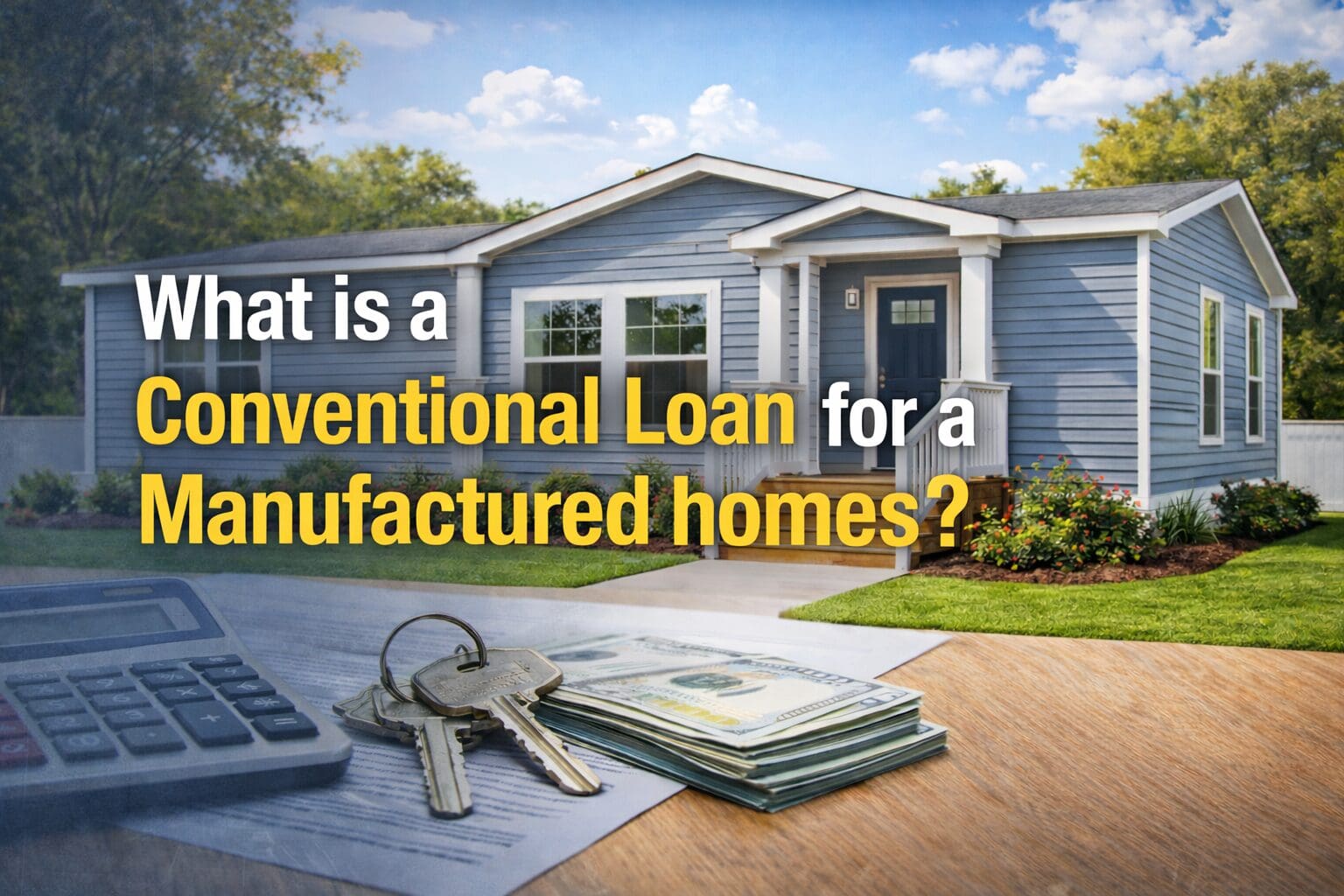
What Is a Conventional Loan for Manufactured Homes?
Conventional loans are mortgages that aren’t backed by government programs like FHA, VA, or USDA loans. Unlike government loans, conventional loans typically offer lower costs but come with more stringent qualification requirements.
These loans fall into two categories:
- Conforming loans that meet guidelines set by Fannie Mae and Freddie Mac
- Non-conforming loans with terms that vary widely between lenders
Why Lenders View Manufactured Homes as Different
Manufactured homes present unique challenges that affect loan approval. Lenders consider several risk factors when evaluating these properties:
- Resale concerns: These properties can be more difficult to sell on the open market.
- Historical depreciation: Unlike traditional houses that typically appreciate over time, manufactured homes have been perceived to potentially lose value.
Here’s what’s changed recently. Studies show that conventionally financed manufactured homes have appreciated at essentially the same rate as site-built homes between 2000 and 2024. This data challenges old assumptions about manufactured home values.
Construction standards matter. Manufactured homes must meet specific requirements to qualify for conventional financing. They must comply with HUD codes established after June 15, 1976. Homes built before this date don’t qualify for conventional loans.
Can You Get a Conventional Loan on a Manufactured Home?
Yes, you can get a conventional loan for a manufactured home if certain conditions are met. Both Fannie Mae and Freddie Mac provide financing options for manufactured homes that meet their guidelines.
Standard requirements include:
- Credit score: Minimum of 620
- Down payment: At least 5% in most cases
- Foundation: Home must be permanently affixed to a foundation
- Property classification: Must be legally classified as real property, not personal property
- Size requirements: At least 12 feet wide with 600 square feet of living area for Freddie Mac
Special programs offer better terms. Fannie Mae’s MH Advantage and Freddie Mac’s CHOICEHome programs provide down payments as low as 3% and interest rates closer to those of site-built homes. These programs recognize that properly financed manufactured homes perform similarly to traditional homes.
If your manufactured home meets these requirements and you qualify financially, conventional financing can provide competitive rates and terms comparable to site-built home loans.

Property Requirements: Does Your Manufactured Home Qualify?
Before you apply for conventional financing, your manufactured home must meet specific eligibility standards. I’ll walk you through the exact requirements lenders use to determine if your property qualifies.
Construction Date and Size Standards
Construction date requirements: Your manufactured home must have been built on or after June 15, 1976 — the date when national HUD construction standards took effect. This requirement ensures the home meets basic safety standards required for conventional financing.
Minimum size requirements vary by lender:
- Fannie Mae requirements:
- At least 12 feet wide
- Minimum 400 square feet of living area
- Freddie Mac requirements:
- At least 12 feet wide
- Minimum 600 square feet of gross living area
Multi-section homes (double-wides or larger) qualify for more financing options, including second home loans. Single-wide units are primarily limited to primary residence financing.
Foundation and Real Estate Classification Requirements
The foundation requirement is critical for conventional approval. Your manufactured home must be permanently affixed to a foundation that makes it part of the real property.
Required foundation elements:
- Complete removal of all wheels, axles, and towing hitches
- Attachment to a permanent foundation system that transfers all loads to the underlying soil
- Connection to utilities according to local requirements
- Foundation constructed of durable materials (concrete, mortared masonry, or treated wood)
Real estate classification: The home must be legally classified as real property rather than personal property. This process varies by state but typically requires surrendering the vehicle title and having the home assessed as real estate.
HUD Documentation Requirements
All manufactured homes need proper HUD compliance documentation. Two critical documents are required:
- HUD Certification Label (metal tag) — attached to the exterior of each section
- HUD Data Plate — paper document inside the home with manufacturer information, model number, and construction details
During the appraisal process: The appraisal report must include photos of either the HUD Data Plate or Certification Label. If original documentation is missing, lenders can accept a verification letter with equivalent information from the Institute for Building Technology and Safety.
My team can help verify your home meets these requirements before you apply. Call 302-703-0727 to discuss your specific property.
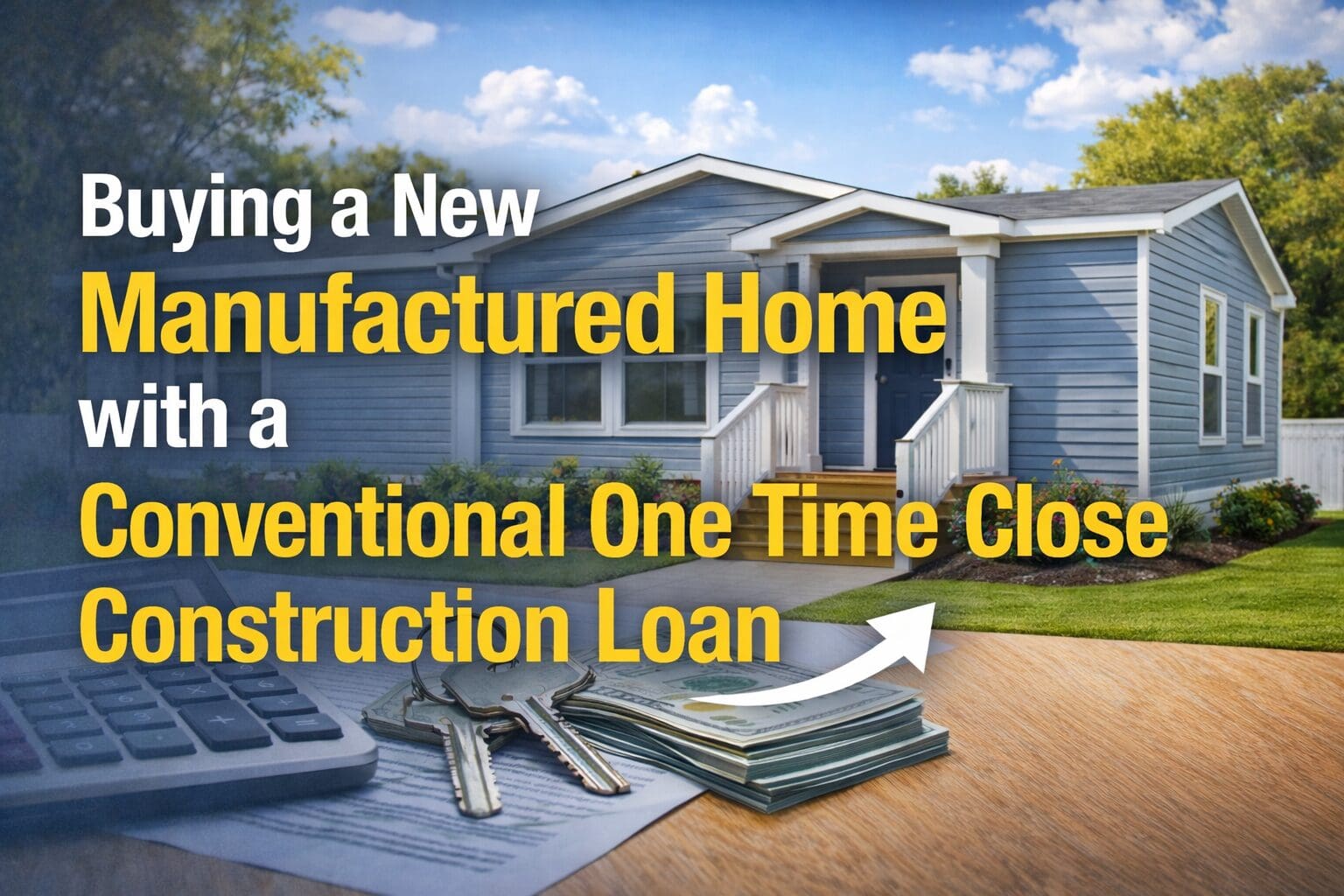
Buying a New Manufactured Home with a Conventional One-Time Close Construction Loan
If you’re planning to buy a brand-new manufactured home and place it on your own land, a Conventional One-Time Close Construction Loan may be the right financing option.
This loan allows you to finance the construction and permanent mortgage in a single loan, instead of taking out a separate construction loan and refinance later. That means fewer closing costs, one approval process, and one long-term interest rate.
How a One-Time Close Construction Loan Works for Manufactured Homes
With a conventional one-time close loan, the lender approves you upfront for both the build and the final mortgage. Funds are released in stages as the manufactured home is built, delivered, installed, and permanently affixed to the foundation.
Once construction is complete, the loan automatically converts into a standard conventional mortgage—no second closing required.
Not every manufactured home qualifies, and not every builder meets lender requirements. That’s where proper planning matters.
Why Buyers Choose One-Time Close Construction Financing
- One loan, one approval, one closing
- No construction-to-permanent refinance later
- Lower total closing costs compared to two-loan setups
- Lock your long-term financing earlier in the process
If you’re considering a new manufactured home purchase, I walk buyers through the full process—from builder approval to final conversion—so there are no surprises.
Learn more about how this loan works here:
Conventional One-Time Close Construction Loan for Manufactured Homes
If you want to confirm whether your land, builder, and credit profile qualify, call me at 302-703-0727 or apply online to get started.
What You Need to Qualify as a Borrower
Your financial profile determines whether you can get conventional financing for a manufactured home. Here are the key requirements so you know exactly where you stand.
Credit Score and Income Guidelines
- Credit score: Minimum of 620 for most conventional manufactured home loans
- DTI: Your debt-to-income ratio should stay at or below 43%
- Income: Lenders want to see stable income that covers your monthly obligations and leaves room for the new mortgage payment
Some programs have income limits, especially those designed for low and moderate-income borrowers. I can help you determine which programs you qualify for based on your specific situation.
Down Payment Options
- Standard requirement: 5% down payment for conventional manufactured home loans
- Special programs: MH Advantage and CHOICEHome allow down payments as low as 3% for qualified borrowers
- Lower credit scores: Expect higher down payments — sometimes up to 20%
Ready to explore your options? APPLY NOW to determine your eligibility.
Loan Terms and Refinance Options
Available loan types:
- 30-year fixed-rate mortgages
- 7/6 and 10/6 adjustable-rate mortgages
- Loan terms up to 30 years
Refinancing: Rate/term and cash-out refinances are available. Cash-out refinances require 35% equity and aren’t available for single-wide homes.
I can help you compare these options to find the best fit for your financial goals and monthly budget.
Alternative Financing Options When Conventional Doesn’t Work
When conventional financing isn’t available for your manufactured home, several other loan programs can help make homeownership possible.
FHA Manufactured Loans for Lower Credit Scores
The Federal Housing Administration offers more flexible credit requirements than conventional loans. The FHA Manufactured Home Loan program can finance manufactured homes even with credit scores as low as 580 with 3.5% Down payment.
Requirements: The home must meet HUD standards and serve as your primary residence. Credit flexibility comes with the trade-off of loan limits that may not cover higher-priced homes.
VA Loans for Eligible Veterans
Military members and veterans have access to strong benefits through VA loans. These loans offer 100% financing with no down payment. The property must be permanently affixed to land you own and meet VA minimum property requirements. VA loans also feature competitive interest rates and no private mortgage insurance. You can read More about VA Manufactured Home Loans
For eligible veterans, this often represents the best financing option available for manufactured homes.
Chattel Loans for Mobile Home Parks
Chattel loans finance manufactured homes as personal property rather than real estate. These work well for homes in leased communities or mobile home parks. Interest rates typically range between 5.99% and 12.99%, which is higher than traditional mortgages, but chattel loans offer faster approval—often within 30 days. You can read more about Chattel Loans for Mobile Homes
The trade-off: Higher rates in exchange for financing homes that don’t qualify for conventional mortgages.
I can help you evaluate which financing option makes the most sense for your specific situation and credit profile. Call me at 302-703-0727 or APPLY NOW to explore all your manufactured home financing possibilities.
Step-by-Step Process to Get Approved
- Confirm the property qualifies. We check build date (post-6/15/1976), foundation, real estate classification, and HUD documentation.
- Review your credit and income. We look at score, DTI, and stability of income.
- Choose the best loan option. Standard conventional (often 5% down) or MH Advantage / CHOICEHome (as low as 3% down if eligible).
- Get a full pre-approval. We collect documents and run automated underwriting.
- Order appraisal and title work. The appraiser confirms HUD tags/data plate and compares to local sales.
- Clear conditions and close. Final review, closing disclosure, and signing.
Why Buyers Choose Manufactured Home Financing
Manufactured homes offer an affordable path to homeownership when you choose the right financing approach. Conventional loans work well for qualified buyers who can meet stricter requirements: permanent foundation, proper size, post-1976 construction, and a 620+ credit score.
Next Steps: Getting Your Manufactured Home Financed
Your financing options depend on your situation:
- Conventional loans: Best rates and terms if you qualify
- FHA loans: Flexible credit requirements down to 550 credit scores
- VA loans: Zero down payment for eligible veterans
- Chattel loans: Option for homes without permanent foundations
The key is matching your financial profile with the right loan program while ensuring your manufactured home meets all requirements. Each option has different benefits and limitations that affect your monthly payment and long-term costs.
Ready to explore your manufactured home financing options? I can help you determine which loan program works best for your situation and guide you through the application process.
Call 302-703-0727 to discuss your manufactured home financing needs or APPLY ONLINE to get started today.
John Thomas, NMLS 38783
Manufactured Home Loan Specialist
Primary Residential Mortgage
Key Takeaways
- Conventional loans require strict criteria: Homes must be built after June 15, 1976, permanently affixed to foundations, and classified as real property with minimum 620 credit score.
- Down payments start at 3–5%: Special programs like MH Advantage offer 3% down payments, while standard conventional loans typically require 5%.
- Alternative financing expands options: FHA loans accept credit scores as low as 550, VA loans offer zero down for veterans, and chattel loans work for non-permanent foundations.
- Manufactured homes can appreciate like site-built homes: Recent data shows conventionally financed manufactured homes appreciated at the same rate as traditional homes from 2000–2024.
- Documentation is critical: Homes must have HUD certification labels and data plates to prove compliance with federal construction standards for loan approval.

Conventional Manufactured Home Loans FAQs
Q1. What are the main requirements for getting a conventional loan on a manufactured home?
To qualify for a conventional loan on a manufactured home, you typically need a credit score of at least 620, a down payment of 5% (though some programs offer 3%), and the home must be built after June 15, 1976, permanently affixed to a foundation, and classified as real property.
Q2. How do manufactured homes compare to traditional homes in terms of appreciation?
Recent studies show that conventionally financed manufactured homes have appreciated at essentially the same rate as site-built homes between 2000 and 2024, challenging the old perception that manufactured homes always depreciate.
Q3. What alternative financing options are available if I don’t qualify for a conventional loan?
If you don’t qualify for a conventional loan, you can consider FHA loans (which accept lower credit scores), VA loans for eligible veterans, chattel loans for homes not on permanent foundations.
Q4. What documentation is required to prove a manufactured home meets HUD standards?
To prove HUD compliance, a manufactured home must have a HUD Certification Label (metal tag) attached to the exterior of each section and a HUD Data Plate inside the home. These documents are crucial for loan approval.
Q5. Can I get a conventional loan for a single-wide manufactured home?
Yes, you can get a conventional loan for a single-wide manufactured home, but options may be more limited. Single-wide units are primarily restricted to primary residence financing, while multi-section homes qualify for more options, including second home loans.
