1099 Mortgage Loan Program in Delaware & Maryland
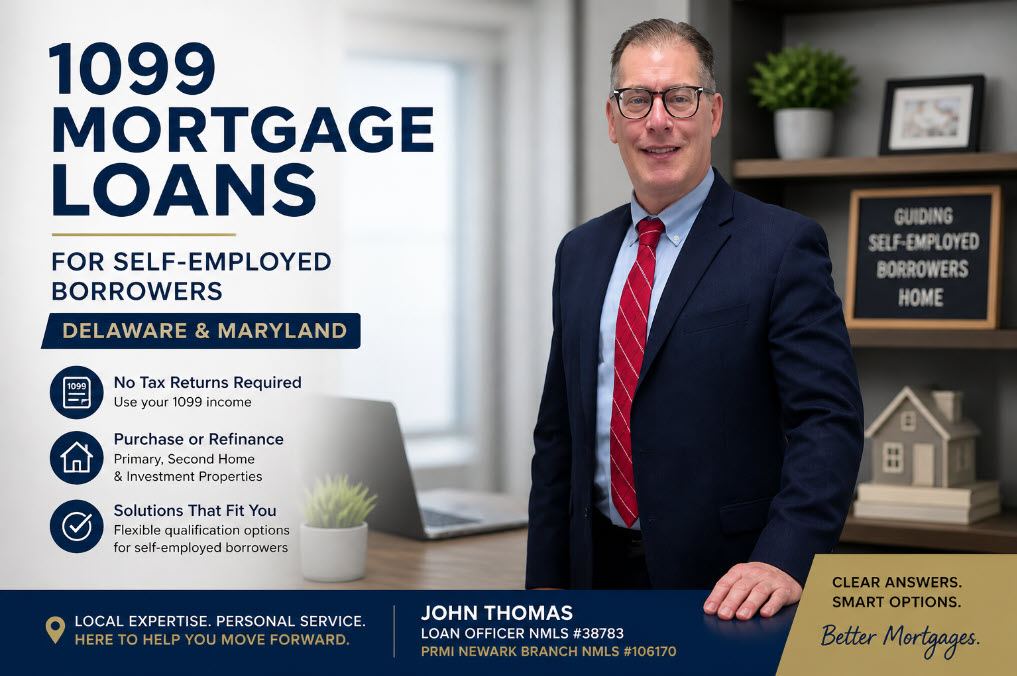
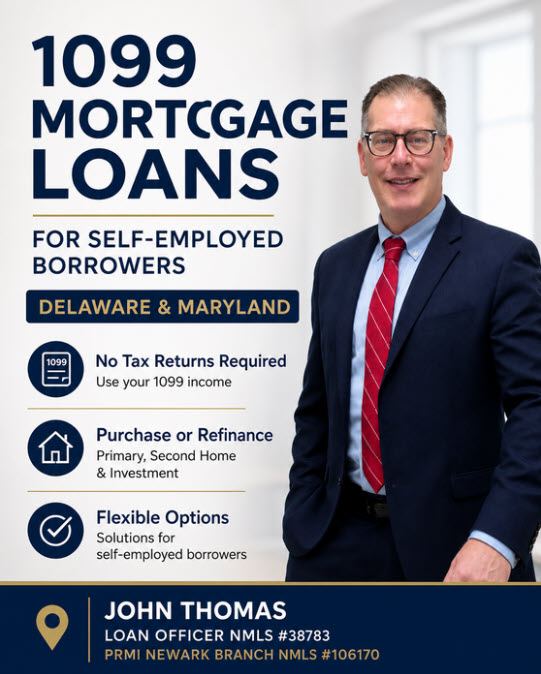
Quick Answer: The 1099 Mortgage Loan Program lets self-employed and independent-contractor borrowers in Delaware and Maryland qualify using gross 1099 income with an expense factor applied – instead of net income from tax returns. Loans up to $3 million are typically available; minimum credit score is generally 600 with scenario variation; minimum down payment starts at 10% for qualified borrowers. Call John Thomas, NMLS #38783, at 302-703-0727.
Current as of May 2026.
If you earn your income on a 1099 and you’ve been told you can’t qualify for a mortgage, I hear that story all the time – and it’s not always true. The 1099 Mortgage Loan Program was built specifically for borrowers in your situation: strong income, a real business, but tax returns that don’t tell the whole story.
My name is John Thomas, and my team at Primary Residential Mortgage has helped many self-employed borrowers in Delaware and Maryland get into homes without filing tax returns with their lender. This program doesn’t require tax returns. It doesn’t penalize you for writing off business expenses. And in most scenarios it’s available for purchases, refinances, second homes, and investment properties up to $3 million. Here’s what you need to know – and if you’d rather just talk it through, you can also see the full Non-QM loan lineup or call me directly.
Ready to See If You Qualify?
Three ways to get started – pick whichever works best for you.
Table of Contents
Want a deeper walkthrough of the program in video form? See the full 1099 Mortgage Loan Program video page.
How a 1099 Mortgage Loan Works
A 1099 mortgage loan is designed to qualify self-employed borrowers using their actual income – not just what shows on their tax returns after deductions.
Here’s how the process typically works:
Step 1: Review Your 1099 Income
Instead of relying solely on tax returns, we start by reviewing your 1099 forms to determine your total gross income. This is especially important for commission-based professionals, independent contractors, and freelancers whose income may be reduced on paper due to business write-offs.
Most borrowers we work with use 1099-NEC forms (the standard form for independent contractor income since the 2020 tax year), but 1099-MISC and 1099-K forms are also accepted in most scenarios. If you receive multiple form types from different payers, bring all of them – we work with the full picture.
Step 2: Apply an Expense Factor
Because 1099 income does not reflect business expenses, lenders apply a standardized expense factor to estimate your true usable income. This replaces the need to rely on your net income from tax returns.
The expense factor can vary depending on the program and borrower profile, but the goal is to create a realistic and consistent way to evaluate income.
Step 3: Calculate Qualifying Income
After applying the expense factor, we determine your qualifying income – which is then used to evaluate your debt-to-income ratio and overall loan eligibility.
In many cases, this results in a higher qualifying income compared to traditional mortgage guidelines.
Step 4: Review Credit, Assets, and Overall Profile
Like any mortgage, we also review:
- credit score
- down payment and reserves
- overall financial profile
The 1099 loan program provides flexibility on income – but the rest of the loan still follows standard underwriting principles.
Step 5: Structure the Loan Based on Your Situation
Every borrower is different. The goal is to determine whether a 1099 loan is the best option – or if another program, such as a bank statement loan or traditional mortgage, may offer better terms based on your specific situation.
Why This Matters
Traditional mortgage guidelines often rely heavily on tax returns, which can significantly reduce qualifying income for self-employed borrowers.
A 1099 mortgage loan provides a more flexible approach by focusing on how you actually earn – not just how your income is reported after deductions.

Example: How a 1099 Mortgage Loan Works in Real Life
Let’s look at a real-world scenario to show how this program works.
A Delaware-based real estate agent earns approximately $120,000 per year in commission income, all reported on 1099 forms. Like many self-employed professionals, they take advantage of business deductions – reducing their taxable income to around $45,000 on their tax returns.
With a traditional mortgage, the lender would use that $45,000 figure to determine qualification. In most cases, that significantly limits how much home they can afford – or prevents approval altogether.
With a 1099 mortgage loan, we can take a different approach.
Instead of relying solely on tax returns, we review the borrower’s 1099 income and apply an expense factor to estimate usable income. In this case, the borrower may be able to qualify based on a much higher income figure that better reflects their actual earning power.
The result is a more accurate qualification – and in many cases, the ability to purchase a home that would not have been possible using traditional guidelines.
This is one of the most common scenarios we see with real estate agents, consultants, and commission-based professionals throughout Delaware and Maryland.
Who Is the 1099 Mortgage Loan Program Best Suited For?
If you receive a 1099 instead of a W-2, and you’ve been with the same employer or client source for at least two years, this program was designed with you in mind. The most common borrowers we see qualify through this program include:
- Real estate agents paid 1099 by their brokerage
- Mortgage loan officers on commission
- Independent IT consultants and technology contractors
- Freelance designers, marketers, and creative professionals
- Gig economy workers – Uber, Lyft, DoorDash, Instacart, Amazon Flex, and similar platforms
- Content creators and online entrepreneurs – YouTubers, podcasters, and social media creators paid on 1099
- Traveling nurses and healthcare professionals on 1099 contracts
- Salespeople on straight commission
- Self-employed tradespeople – electricians, plumbers, HVAC techs
- Financial advisors and insurance agents
- Any independent contractor who files using a W-9
The common thread: you make good money. Your bank account shows it. But because you write off business expenses the way any smart self-employed person should, your net income on paper looks a lot smaller than what you actually bring home. Traditional lenders look at that number and show you the door. We don’t.

Are You a Real Estate Agent? This Loan Was Made for You.
I want to speak directly to real estate agents for a moment, because you are the single largest group of 1099 earners I work with – and the group most frequently told by other lenders that they “can’t qualify.”
Here’s the reality. Most agents are paid 1099 by their brokerage. Your income is strong. But because you deduct marketing, MLS fees, E&O insurance, mileage, and a dozen other legitimate business expenses, your Schedule C often shows a fraction of your gross income. A conventional underwriter sees that net number and declines you.
The 1099 Mortgage Loan Program uses your gross 1099 income – not your net taxable income – to determine what you can borrow. That single difference is often the gap between a denial and an approval. This program is part of a broader category of alternative lending options often referred to as Non-QM loans. You can explore all available options here: https://delawaremortgageloans.net/non-qm-loans/
And there’s a referral angle here too. When your buyer clients are self-employed, don’t send them to a bank that’s going to run them through traditional underwriting and come back empty-handed. Send them to me. I’ll tell you in one conversation whether the 1099 program – or one of our other Non-QM loan options – looks like a fit, depending on credit, reserves, and the rest of the underwriting picture. Call or text 302-703-0727.

How Is Your Income Calculated on a 1099 Mortgage Loan?
This is the question I get most often, and it’s the most important thing to understand about this program.
Traditional lenders use your net income after deductions. They look at your tax return, see all the expenses you wrote off, and base your loan qualification on whatever’s left. For most 1099 earners, that number is artificially low – by design. You’re doing the right thing by reducing your taxable income. But traditional underwriters penalize you for it.
The 1099 program uses your gross 1099 income. We look at the actual dollar amounts reported on your 1099 forms – before business deductions – and use that figure to calculate your qualifying income. Typically we use either one or two years of 1099s, and we may also consider a year-to-date earnings letter or recent pay stubs.
Here’s a simple example: if your 1099s show $120,000 in gross earnings but your tax return shows $45,000 in net income after expenses, a traditional lender qualifies you on $45,000. We may be able to qualify you using your gross $120,000 figure (with an expense factor applied), depending on credit, reserves, and overall underwriting. That’s often the difference between being told no and being handed keys.
The specific income calculation can vary depending on your loan scenario, credit profile, and down payment. We’ll walk through the exact numbers with you on our first call.

1099 Mortgage Loan Program Guidelines
Here are the current qualification guidelines for the 1099 Mortgage Loan Program in Delaware and Maryland:
| Guideline | Requirement |
|---|---|
| Minimum Credit Score | Generally 600; better rates and terms typically available at 620, 660, and 700+ |
| 1099 Source | Single payer, brokerage, contract source, or limited number of consistent income sources (varies by lender) |
| 1099 Form Types | 1099-NEC (most common since 2020), 1099-MISC, and 1099-K accepted in most scenarios |
| Employment History | Typically 2 years self-employed in same line of work; 1 year may be considered with strong overall profile |
| Income Verification | 1099 forms; year-to-date earnings letter or recent pay stubs may also be requested |
| Loan Amounts | Up to $3 million in most scenarios; higher amounts case-by-case |
| Maximum LTV | Up to 90% (10% minimum down payment for qualified borrowers) |
| Property Types | Owner-occupied primary residences, second homes, and investment properties |
| Transaction Types | Purchase, cash-out refinance, rate/term refinance |
| Tax Returns Required? | No – not required for the 1099 program |
| Reserves (post-closing assets) | Typically 3 to 12 months of PITIA depending on credit profile, occupancy, and property type – see explanation below |
| Seasoning Requirements | Typically 2 years after foreclosure, short sale, bankruptcy, or deed-in-lieu; specific seasoning varies by lender |
Guidelines are subject to change. For the most current qualification requirements for your specific scenario, call us at 302-703-0727 or apply online.
What Are Reserves, and How Much Do You Need?
Reserves are the months of mortgage payments (PITIA – principal, interest, taxes, insurance, and any HOA dues) you can show you have available after closing – verified through bank statements, retirement accounts, brokerage accounts, or other liquid or near-liquid assets. Reserves prove to the underwriter that you can keep paying the mortgage if your 1099 income hits a slow month.
Typical reserve requirements on a 1099 mortgage loan:
- Owner-occupied primary residence: 3 to 6 months of PITIA in most scenarios
- Second homes: 6 to 12 months of PITIA in most scenarios
- Investment properties: 6 to 12 months of PITIA per property; some scenarios may require more
- Lower credit profiles or higher loan amounts: Reserve requirements typically scale up
Retirement accounts (401(k), IRA) can usually be counted toward reserves at 60 to 70% of their balance, since not all of it is liquid. We’ll review your specific asset picture and tell you exactly what counts and how much.
Is the 1099 Mortgage Loan a Standard Government Program?
No. The 1099 Mortgage Loan is a Non-QM lender program, not a federal loan type like FHA, VA, or USDA. There’s no single national rulebook – specific guidelines vary by lender, investor, property type, credit profile, and overall borrower file. The figures on this page reflect typical scenarios for the 1099 borrowers we work with at Primary Residential Mortgage. Your specific program parameters depend on full underwriting review.
That’s actually one of the reasons it pays to work with a lender who closes 1099 loans regularly. The flexibility is real – but it also means two borrowers with similar 1099 income can end up with different rate, down payment, and reserve options depending on which investor and program structure fits their file best. We’ll walk through the options that match your scenario.
What Does Your Credit Score Mean for Your Rate and Down Payment?
The minimum credit score is 600, but your score has a real impact on your options:
- 600-619: You may qualify, typically with a higher rate and at least 10% down
- 620-659: Better rate options open up; standard down payment requirements apply
- 660-699: Good rates, more flexible LTV options
- 700+: Best available rates and most flexible program terms
If your score is below 600 right now, don’t stop reading. Call us anyway. We can often help you build a 60 to 90 day plan to get your score where it needs to be to qualify.
1099 Loan vs. Bank Statement Loan vs. Traditional Mortgage Loan: Which Is Right for You?
The 1099 program is one of several Non-QM loan options we offer for self-employed borrowers. If you’re self-employed or earn 1099 income, there are several different ways to qualify for a mortgage. The right option depends on how your income is structured, how much you write off, and how your tax returns look.
Here’s a clear breakdown of how a 1099 mortgage loan compares to other common options:
| Feature | 1099 Mortgage Loan | Bank Statement Loan | Traditional Mortgage |
|---|---|---|---|
| Income Used | Gross 1099 income | Bank deposits | Tax return (net income) |
| Tax Returns Required | Not required | Not required | Required |
| Best For | High write-offs, commission income | Business owners with strong deposits | W-2 borrowers or clean tax returns |
| Qualification Flexibility | High | Moderate | Low |
| Approval Difficulty | Moderate | Moderate | Strict |
Key Differences Explained
1099 Mortgage Loan
This option is ideal if your tax returns don’t reflect your true earning power. Instead of focusing on your net income after deductions, we can often use your gross 1099 income to help you qualify. This is a strong fit for real estate agents, consultants, and commission-based professionals.
Bank Statement Loan
This program looks at your actual deposits over 12 to 24 months. It works well for business owners who have consistent income flowing through their accounts but may not receive 1099s or want to rely on them for qualification. Some borrowers may also qualify using a profit and loss statement instead of 1099s: https://delawaremortgageloans.net/pl-mortgage-loan/
Traditional Mortgage
This is the most common type of loan, but also the most restrictive for self-employed borrowers. Lenders use your tax returns and typically average your net income over two years, which can significantly reduce your qualifying income if you take advantage of write-offs.
Which Option Is Best for You?
There isn’t a one-size-fits-all answer.
- If your 1099 income is strong but your tax returns show lower income, a 1099 loan is often the best option
- If your bank deposits are consistent and higher than your reported income, a bank statement loan may work better
- If your tax returns already show strong, stable income, a traditional mortgage may give you the best rates and terms
The key is choosing the program that reflects your true financial picture, not just what shows up on paper.
Not sure which option fits your situation? That’s what we’re here for. Call 302-703-0727 and we’ll match you to the right program in one conversation. We offer all three of these programs, plus Asset Qualifier, VOE-Only, DSCR, and more through our full suite of Non-QM loan options.
How to Apply for a 1099 Mortgage Loan in Delaware or Maryland
The application process is straightforward. Here’s what to expect:
- Call us at 302-703-0727 or apply online here
- We’ll review your 1099s, credit, and scenario to review whether you may qualify
- We issue a pre-approval letter so you can shop with confidence
- We walk you through the process start to finish – no surprises
Documents you’ll typically need:
- Last 1 to 2 years of 1099 forms
- Year-to-date earnings statement or recent pay stubs (if available)
- 2 months of bank statements
- Asset documentation showing funds for down payment and reserves
- Government-issued ID
- Signed purchase contract (for purchase transactions)

Why Work With John Thomas for Your 1099 Mortgage?

– John Thomas, NMLS #38783, Primary Residential Mortgage
Quick Answers About 1099 Mortgage Loans
Quick reference answers – see the full FAQ below for detail.
What is a 1099 mortgage loan?
A 1099 mortgage loan is a Non-QM home loan designed for self-employed and contract workers, allowing you to qualify using 1099 income instead of traditional tax returns. In most scenarios, lenders use your gross 1099 income (with an expense factor applied) rather than your net income after deductions.
Can I get a mortgage with 1099 income?
Yes – specialized programs are designed for independent contractors, freelancers, and commission-based professionals who may not qualify under standard tax-return-based guidelines.
Do I need tax returns?
In most scenarios, tax returns are not required for the 1099 mortgage loan program. Lenders review your 1099 forms and apply an expense factor to determine qualifying income.
What credit score do I need?
Minimum credit score is generally 600 in most scenarios, with specific minimums varying by lender overlay and overall borrower profile. Higher scores unlock better rate and down-payment options.
Is this the same as a bank statement loan?
No. A 1099 loan uses your reported 1099 income; a bank statement loan uses your actual deposits over 12-24 months. The two programs serve overlapping borrower types but use different documentation methods.
Who is this loan best for?
Self-employed borrowers with strong 1099 income whose tax returns show lower net income due to legitimate business deductions and write-offs.
Can real estate agents use a 1099 mortgage?
Yes – real estate agents are one of the most common borrower types for this program, since their commission income is reported on 1099 forms.
FAQ – 1099 Mortgage Loans in Delaware and Maryland
Can I get a mortgage if I only have 1099 income?
Yes. The 1099 Mortgage Loan Program is specifically designed for borrowers who receive 1099 income instead of W-2 wages. In most scenarios you do not need tax returns to qualify – your 1099 forms are used in place of traditional income documentation.
Do I need two years of 1099s to qualify?
Typically yes – most scenarios require two years of 1099 history from the same employer or client source. In some cases, one year of 1099s may be considered depending on overall borrower profile, credit, reserves, and lender overlay. We assess the specific situation during our initial consultation.
How is my qualifying income calculated on a 1099 Loan?
In most scenarios we use your gross 1099 income – the total dollar amount reported on your 1099 forms before business deductions – with an expense factor applied (typically 10% to 25% depending on profession and lender). This is the key distinction from traditional underwriting, which uses net taxable income after deductions. Using gross income often allows you to qualify for significantly more than a conventional lender would approve.
What credit score do I need for a 1099 mortgage?
The minimum credit score is generally 600 in most scenarios, with specific minimums varying by lender overlay and overall borrower profile. Your score also affects rate and down-payment requirements – scores of 620+ typically unlock better rate options, and scores of 700+ generally access the most competitive terms available through the program.
How much down payment do I need on a 1099 loan?
The minimum down payment starts at 10% for qualified borrowers in most scenarios. Down-payment requirements may increase based on credit score, loan amount, or property type – investment properties typically require a higher down payment than owner-occupied primary residences. We confirm the specific requirement based on your scenario during pre-approval.
Can I use a 1099 loan to buy a second home or investment property?
Yes. The 1099 Mortgage Loan Program is generally available for owner-occupied primary residences, second homes, and investment properties. Loan amounts go up to $3 million in most scenarios, with higher amounts available case-by-case depending on borrower profile and lender appetite.
What is the difference between a 1099 loan and a bank statement loan?
Both programs serve self-employed borrowers without requiring tax returns. The 1099 loan uses your 1099 forms to verify income and works best when your income comes from a single employer or limited number of clients. A bank statement loan uses 12 to 24 months of bank deposits to calculate income and works better for borrowers with income from multiple sources or cash-heavy businesses. We recommend whichever program produces the better outcome for your scenario.
Can real estate agents use a 1099 mortgage?
Absolutely – and real estate agents are among the most common borrowers we help through this program. Agents are paid 1099 by their brokerage, and their gross commission income often far exceeds what their tax returns show after deductions. The 1099 program is generally a strong fit for agents with two-plus years of consistent commission income.
Is this loan available in Delaware and Maryland?
Yes. We are licensed and actively closing 1099 Mortgage Loans in Delaware and Maryland – all three Delaware counties (New Castle, Kent, Sussex) plus Maryland borrowers in the Baltimore metro area and surrounding counties. John Thomas is also licensed in 15 additional states; the 1099 program is available in most of those markets subject to investor and state-specific guidelines.
What happens if I have a past foreclosure, short sale, or bankruptcy?
You may still qualify in many scenarios. The program typically requires a two-year seasoning period after a foreclosure, short sale, bankruptcy, or deed-in-lieu, though specific seasoning requirements vary by lender and overall borrower profile. If it has been at least two years and your credit and income meet program guidelines, we can evaluate the full scenario.
How long does it take to close a 1099 mortgage?
Closing timelines for Non-QM loans are similar to conventional loans – typically 30 to 45 days from application to closing in most scenarios, depending on how quickly documentation is provided and the complexity of the file. We give you a realistic timeline at the start of your application.
Are rates higher on a 1099 mortgage than a conventional loan?
Generally yes. Non-QM loans like the 1099 program carry slightly higher rates than conventional or government-backed loans because they fall outside standard agency guidelines. For many self-employed borrowers, however, the alternative is not qualifying at all – so the rate trade-off is secondary to the ability to purchase or refinance. We show you all available options and help you make the best decision for your scenario.
Can I qualify if my 1099 income went down this year?
Declining 1099 income is reviewed case-by-case. Most underwriters want to see why income declined and whether it has stabilized. In some scenarios we can use a more conservative qualifying figure – for example, the lower of the two years, or a year-to-date average that reflects the current run rate. In other scenarios the 1099 program may not be the right fit and we’ll discuss alternatives such as a bank statement loan or waiting until the income trend stabilizes. We’ll review your specific scenario before making any commitments.
Can I qualify with only one year of 1099 income?
In some scenarios, yes. One-year 1099 history is most often considered when the borrower has documented prior W-2 employment in the same line of work, strong credit, and substantial reserves. The standard documentation is two years of 1099 history; one-year scenarios are case-by-case and depend on the full borrower profile, lender overlay, and the specific program structure that fits the file. We’ll review your scenario and tell you whether a one-year path looks viable before you commit to anything.
Can I use income from more than one 1099 client?
Yes – most 1099 mortgage programs accept income from multiple payers, brokerages, or contract sources. The underwriter aggregates qualifying income across sources, with each source typically needing the standard two-year history. Borrowers with income from many small clients (especially gig-economy borrowers earning from several platforms) may instead benefit from a bank statement loan, which uses bank deposits rather than form-by-form 1099 totals. We’ll recommend the better-fitting program during the initial conversation.
Ready to Get Started? Let’s Talk.
If you’re a 1099 earner in Delaware or Maryland and you’ve been turned away by a traditional lender – or you’re not sure where to start – call me. My team and I have helped borrowers in exactly this situation get to closing when they thought it wasn’t possible.
We’ll review your 1099s, your credit, and your goals in one conversation and tell you straight – whether you may qualify, what you may qualify for, and what it takes to move forward. No runaround, no wasted time. Just a straight answer from an experienced loan officer who knows this product.
Get Your 1099 Pre-Approval Started Today
Pick whichever option works best for you. We respond same-day during business hours.
Call 302-703-0727 Schedule Appointment Apply Online
John R. Thomas, NMLS #38783 | Primary Residential Mortgage, Inc. | 248 E Chestnut Hill Rd, Newark, DE 19713
Helpful Resources for 1099 Borrowers
If you want to read further on the underlying topics, these are the official sources we trust:
- NMLS Consumer Access – verify John R. Thomas, NMLS #38783
- IRS – About Form 1099-MISC and Form 1099-NEC
- CFPB – What is a Qualified Mortgage? (helpful background on Non-QM lending)
Related Loan Programs from the John Thomas Team
- Non-QM Loans – Full Overview
- Self-Employed Bank Statement Loan Program
- P&L Mortgage Loan
- Asset Qualifier Loan Program
- DSCR Loans for Real Estate Investors
- VOE Only Loan Program
- 1099 Mortgage Loan Program – Video Walkthrough
Primary Residential Mortgage, Inc. is licensed by the Delaware State Bank Commissioner. John R. Thomas NMLS #38783, PRMI Corporate NMLS #3094, Newark Branch NMLS #106170. This information is for educational purposes only and does not constitute a commitment to lend. All loan programs are subject to credit approval and program guidelines which are subject to change without notice. Mortgage content reviewed by John R. Thomas, NMLS #38783.
Last Updated: May 2026
John Thomas Team – Primary Residential Mortgage, Inc.
248 E Chestnut Hill Rd, Newark, DE 19713 | 302-703-0727 | JohnThomasTeam@primeres.com
See John Thomas Team on Google
Copyright (c) 2026 John R. Thomas, All Rights Reserved.
