No Income, No Employment Loan in Delaware: The My Community Mortgage
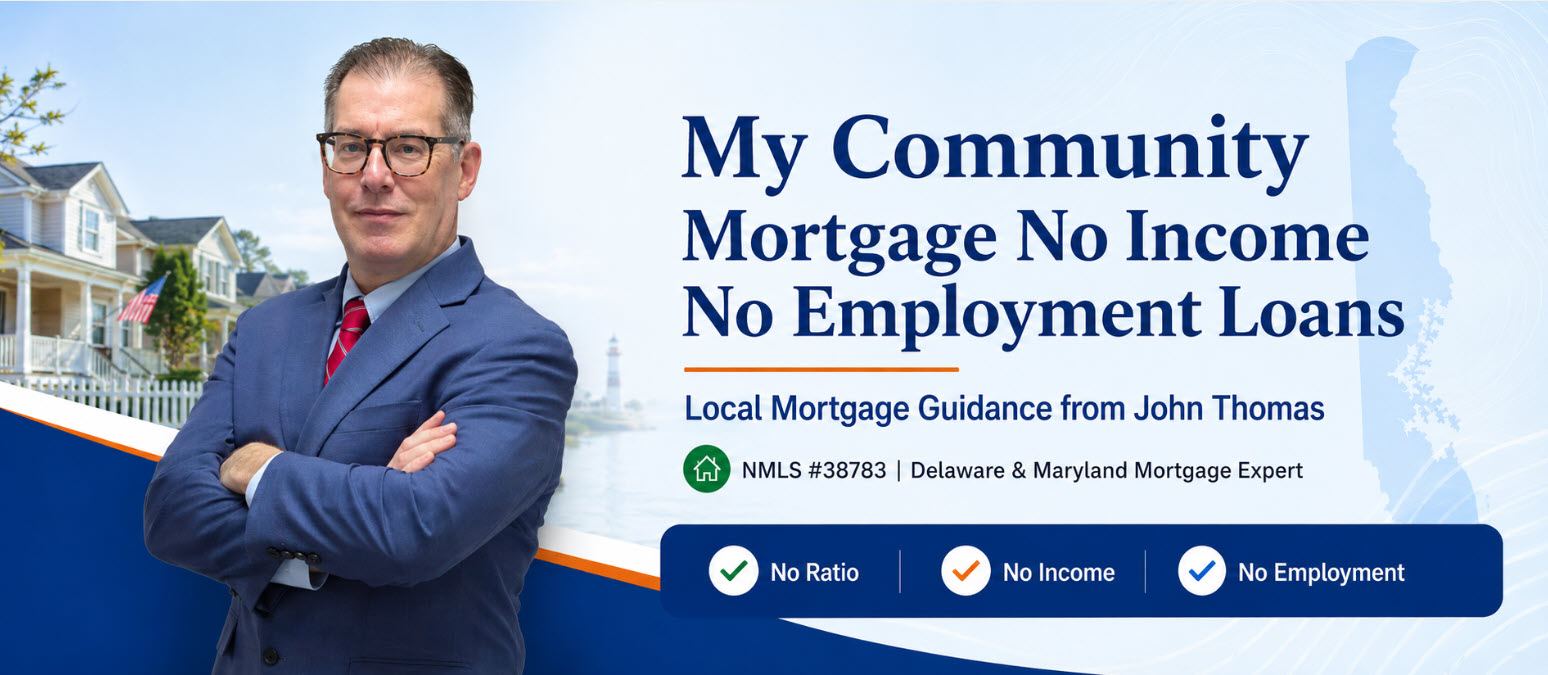

Quick answer: The My Community Mortgage is John Thomas’s No Income, No Employment Loan in Delaware – an asset-based home loan that may let eligible Delaware borrowers qualify using credit, a down payment of at least 20%, and verified assets instead of income. No income documents, no employment verification, and no debt-to-income ratio. Primary residence or second home; not available for investment property. Credit scores down to 620 may qualify at lower loan-to-value tiers. Current as of October 2026.
My Community Mortgage at a glance:
| Feature | Detail (as of October 2026) |
|---|---|
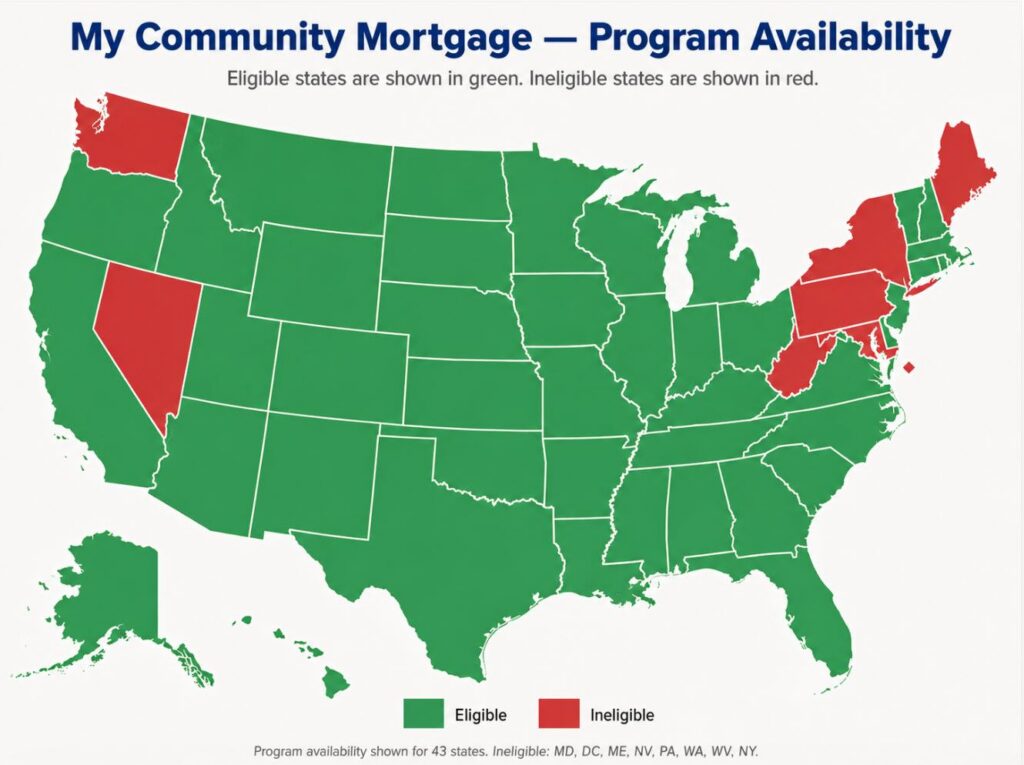
| State availability | Delaware and 13 other states where John is licensed (not MD, DC, ME, NV, PA, WA, or WV) |
| Occupancy | Primary residence or second home |
| Income documents | Not required |
| Employment verification | Not required |
| DTI ratio | Not calculated |
| Minimum down payment | 20% |
| Minimum credit score | 620 FICO (60% max LTV at 620) |
| Reserves | 6-9 months PITIA (as little as 2 months for first-time buyers) |
| Investment property | Not eligible |
Snapshot only – figures reflect current program guidelines and can change; your exact tier and requirements depend on the matrix in effect when you lock.
Strong credit and real savings should count for something, but when your tax returns or a recent job change make your income look weaker than it is, a standard loan can stall on the paperwork. I am John Thomas, NMLS #38783, and I have spent more than 20 years helping Delaware buyers find financing that fits their real financial picture – not just the picture their tax returns paint. The My Community Mortgage – my No Income, No Employment Loan – is one of the most useful tools I offer for that gap. If you have strong credit and real assets but your documented income does not tell the whole story, this program may let you qualify on what you actually have rather than what a W-2 says. Many of the buyers I see for the My Community Mortgage first looked at a Delaware self-employed mortgage or a bank statement loan and ran into a wall – this page walks through how the My Community Mortgage is different, who it fits, and how qualifying actually works.
Watch: John Thomas explains how the My Community Mortgage qualifies you on credit, at least 20% down, and verified assets, with no pay stubs, W-2s or tax returns (10:36).
Think a No Income, No Employment Loan might fit your situation?
Talk it through with John directly – no income paperwork to gather first.
Table of Contents
What Is a No Income, No Employment Loan?
A No Income, No Employment Loan is a Non-QM mortgage for a primary residence or second home that qualifies a borrower on credit, at least 20% down, and verified reserves instead of income. No pay stubs, tax returns, employment verification, or debt-to-income ratio are used. As of October 2026, the My Community Mortgage accepts credit scores down to 620.
The My Community Mortgage is a No Income, No Employment Loan – a Non-QM (non-qualified mortgage) program that may allow eligible Delaware borrowers to qualify without income documents, employment verification, or a debt-to-income (DTI) ratio. Across the industry this kind of financing goes by several names: a no-doc or no-ratio mortgage, a no income verification loan, or an asset-based / asset-qualifier loan. They all describe the same idea – because the underwriter is not looking at your income, there is no ratio of debt to income to calculate. Instead, the loan is underwritten on three pillars: your credit profile, the size of your down payment, and the assets you can verify in reserve.
This is not a pre-2008 “stated income” loan where a borrower could simply assert an income and skip verification. The My Community Mortgage replaces income verification with real, documented strength – a 620-or-higher credit score, at least 20% down, and verified assets held in reserve – so the file still has to stand on its own. It is a documented asset-and-credit decision, not a no-questions-asked one.
Conventional, FHA, VA, and USDA loans are “qualified mortgages” under federal rules, which means the lender must document that you can repay – typically through pay stubs, W-2s, tax returns, or, for self-employed borrowers, two years of returns or bank statements. The My Community Mortgage takes a different but well-established path. Certain community-development and specially structured mortgage programs – including those offered through Community Development Financial Institutions (CDFIs), which are certified by the U.S. Treasury – may be exempt from the standard ability-to-repay (ATR) documentation rules, as the Consumer Financial Protection Bureau explains. That exemption does not mean approval is automatic – eligibility still depends on credit, assets, down payment, property type, and current program guidelines. What it does mean is that the file can skip income documentation and lean on assets and credit, which makes for a clean, fast process for the right borrower – no tax returns, no profit-and-loss statements, no explaining a slow quarter.
One thing to be clear about up front: this program is for a primary residence or second home. It is built for homes you live in, not for rental or investment property. If you are buying an investment property and want to qualify on the property’s rental income instead of your own, that is a different tool – a Delaware DSCR loan – and I am happy to point you there.
Who Is the No Income, No Employment Loan For?
The No Income, No Employment Loan generally fits buyers whose paperwork understates their real financial strength: self-employed owners with heavy write-offs, buyers who recently left a W-2 job, retirees living on savings, and high-net-worth buyers. It works only when the buyer also has at least 20% down, a 620 or higher credit score, and verifiable reserves.
This program tends to fit buyers whose documented income understates their true financial strength. In my experience the most common profiles are:
- Self-employed owners and business owners who write off heavily, so their net taxable income looks low even though cash flow is strong.
- Buyers in transition – for example, someone who just left a high-paying W-2 job to go self-employed. A bank statement loan can fail here because the deposit history dips during the switch, even when assets and credit are excellent.
- Retirees living on savings and investments rather than a paycheck, who have substantial assets but little “income” on paper.
- First-time buyers with family help. Gift funds from immediate family can cover the whole down payment, and first-time buyers may need as little as two months of reserves.
- High-net-worth buyers with significant verifiable assets who simply prefer not to paper a file with returns and statements.
A real-world example
A New Castle County buyer I worked with had a high credit score, solid assets, and more than 20% to put down – but had recently moved from a high-paying salaried role into self-employment. The bank statement option fell apart because the deposits dipped during the transition, even though nothing about their actual financial strength had changed. The My Community Mortgage allowed the file to be reviewed based on credit, down payment, and reserves instead of traditional income documentation. That gap – strong buyer, weak-looking income paper – is exactly what this program is built for.
How Do You Qualify Without Income or Employment?
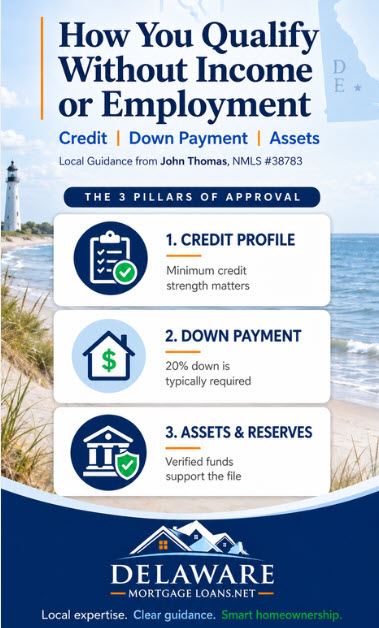
Qualifying rests on three items: a credit score of at least 620, a down payment of at least 20%, and 6 to 9 months of reserves, as of October 2026. The loan-to-value tier depends on how those combine: a 620 score allows up to 60% LTV, and the 80% tier requires a 720 score.
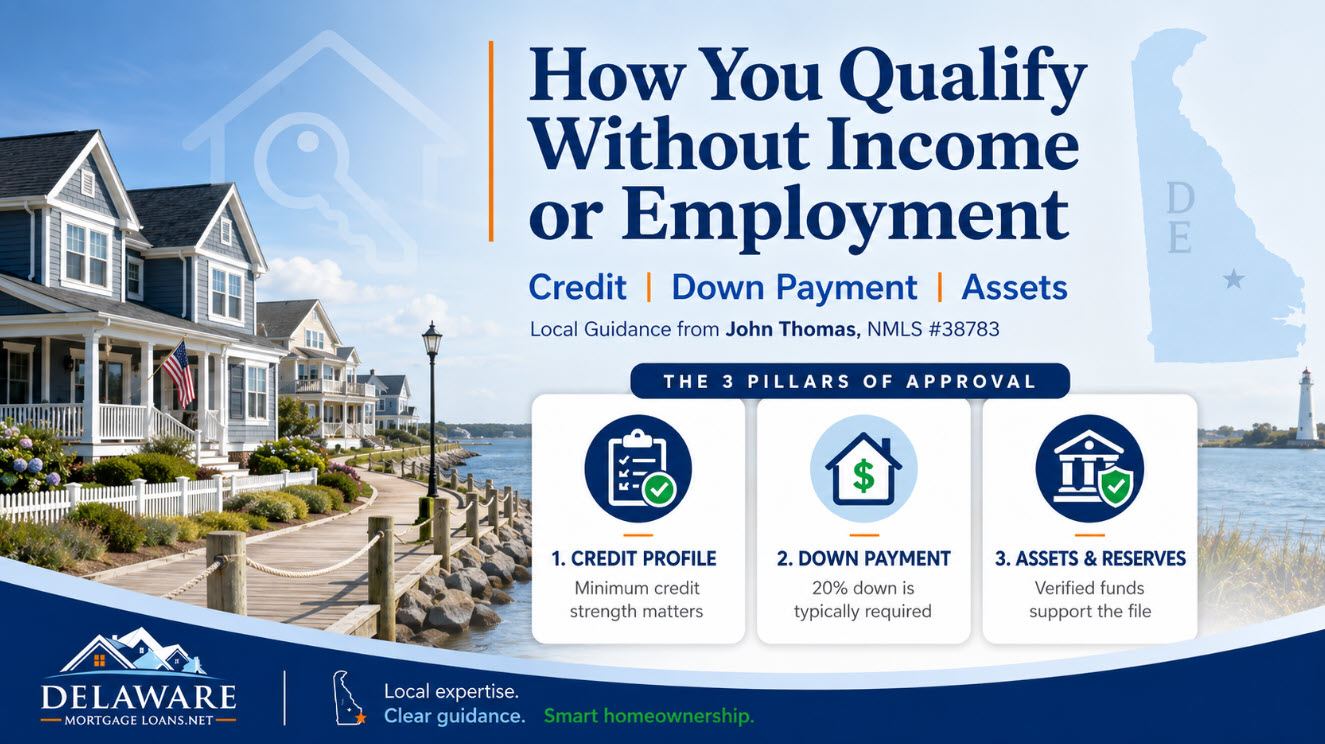
Because there is no income on the file, the three pillars below carry the approval. The specific tier you land in depends on how they combine – generally, a larger down payment and higher credit score qualify you for a higher loan-to-value (LTV) and a lower reserve requirement.
- Credit. A minimum 620 FICO is required, with a 620 to 639 score limited to 60% LTV on a purchase or rate-and-term refinance. You also need a qualifying credit history – typically at least two tradelines reporting for 12 or more months, or one tradeline open 24 or more months with recent activity (at least one borrower must meet this). First-time buyers may use a 12-month verification of rent toward the tradeline requirement.
- Down payment. Plan on at least 20% down. The program tops out at 80% LTV, and the highest LTV tiers require the strongest credit and the most reserves.
- Assets and reserves. Reserves are measured in months of full housing payment (PITIA). Most files need 6 months at 75% LTV or less and 9 months above 75%; first-time buyers may need as little as 2 months. The number of months required scales with your tier – more on what counts in the reserves section below.
What you will not provide: pay stubs, W-2s, tax returns, profit-and-loss statements, bank statements used to calculate income, or any employment verification. There is no DTI calculation. The qualifying rate is the note rate, and the loan is a 30-year fixed.
Skipping income documentation can also shorten the timeline. Because there are no tax transcripts to order (the 4506-C request), no employment to verify, and no income to recalculate, the underwriter has fewer moving parts to chase – which often means a faster, smoother path to closing for a well-prepared file.
A quick Delaware example of the down-payment math: on a $500,000 primary residence at the 80% tier, a 20% down payment is $100,000 before closing costs, plus the required reserves based on your monthly housing payment. A larger down payment moves you into a lower-LTV tier, which can ease the credit-score and reserve requirements.
Requirements at a Glance
| Feature | Detail (current guidelines, as of October 2026) |
|---|---|
| Income documentation | None – no income docs, no employment verification, no DTI |
| Occupancy | Primary residence or second home (investment property ineligible) |
| Loan structure | 30-year fixed only (no ARM, no interest-only) |
| Minimum credit score | 620 FICO |
| Maximum LTV / CLTV | Up to 80% (highest tier requires strongest credit + reserves) |
| Loan amount range | $100,000 minimum to $3,000,000 maximum |
| Loans above $1,000,000 | Capped at 80% LTV/CLTV; loans above $2,000,000 may require two appraisals; loans above $2,500,000 need at least a 660 score |
| Cash-out | Available; no stated cap on cash-out amount within program limits |
| Prepayment penalty | None |
| Down payment gifts | Allowed from immediate family for down payment and closing costs (not for reserves; no gifts of equity) |
| Seller concessions | Up to 6% |
| Reserves | 6 months at 75% LTV or less, 9 months above 75%; as little as 2 months for first-time buyers |
| Homebuyer education | May be required, depending on the program option |
| State availability | Delaware and most states where John Thomas is licensed; not offered in MD, DC, ME, NV, PA, WA, or WV (see FAQ) |
These figures reflect current program guidelines and can change. The exact tier, score floor, and reserve requirement that apply to your file depend on the matrix in effect when you lock – so treat this table as a planning guide and let me confirm the live numbers for your scenario.
LTV, Credit Score, and Reserve Tiers
The program uses a tier grid that ties your maximum LTV to a minimum credit score and a minimum number of months of reserves. Reserves are counted in months of PITIA (principal, interest, taxes, insurance, and any association dues). Purchase and rate-and-term refinances use one grid; cash-out refinances use a slightly more conservative one.
Purchase and Rate-and-Term ($100,000 to $2,500,000)
| Max LTV / CLTV | Min FICO | Min reserves |
|---|---|---|
| 80% / 80% | 720 | 9 months |
| 75% / 75% | 680 | 6 months |
| 70% / 70% | 660 | 6 months |
| 65% / 65% | 640 | 6 months |
| 60% / 60% | 620 | 6 months |
Cash-Out Refinance ($100,000 to $2,500,000)
| Max LTV / CLTV | Min FICO | Min reserves |
|---|---|---|
| 75% / 75% | 700 | 9 months (6 months at a 740+ score) |
| 70% / 70% | 680 | 6 months |
| 65% / 65% | 660 | 6 months |
| 60% / 60% | 640 | 6 months |
| 55% / 55% | 620 | 6 months |
Larger Loans ($2,500,001 to $3,000,000)
| Min FICO | Purchase / rate-and-term max LTV | Cash-out max LTV |
|---|---|---|
| 740 | 80% | 70% |
| 720 | 75% | 70% |
| 680 | 75% | 65% |
| 660 | 65% | 60% |
The maximum loan amount is $3,000,000. Reserves are 6 months at 75% LTV or less and 9 months above 75%, and first-time buyers may need as little as 2 months of reserves on any tier.
A few notes that affect which row you land in: a declining-market appraisal reduces the maximum LTV by 5%, loans above $1,000,000 are capped at 80% LTV, and additional financed properties add to the reserve requirement (see below). These grids reflect current guidelines as of October 2026 and are subject to change – I will confirm the exact tier for your file.
What this means for you: if you want to finance the maximum 80% of the price (the smallest down payment this program allows), expect to need the strongest credit – around a 720 score – and about nine months of reserves. If your score is closer to 620, you can still qualify, but plan on at least 40% down, because a 620 score allows up to 60% LTV. In short, more down payment and higher credit each pull the other requirements in your favor. Current as of October 2026.
What Counts Toward Your Assets and Reserves
Since assets do the heavy lifting on this loan, it helps to know what the program will and will not count. One month of reserves equals one full monthly housing payment (PITIA).
- Fully counted (100%): stocks, bonds, mutual funds, and retirement accounts such as 401(k), IRA, and deferred compensation.
- Business funds: counted in proportion to your ownership percentage in the business.
- Cryptocurrency: acceptable once it has been liquidated to U.S. dollars.
- Cash-out proceeds: can be applied toward reserves; on some program options only when the LTV is 70% or lower.
- Foreign accounts: funds must be moved to a U.S. bank and seasoned for 30 days before they count.
Two limits to keep in mind: gift funds cannot be used for reserves (they are fine for down payment and closing costs from immediate family), and if you own additional financed properties, the program adds reserves equal to roughly 1.5% of the aggregate unpaid balance on those properties. Most assets need to be sourced and seasoned for 30 days. The maximum number of financed properties, including the home you are buying, is 10.
A simple way to estimate reserves: take your full monthly housing payment (PITIA) and multiply it by the number of months your tier requires. For example, if your PITIA works out to $3,000 a month, six months of reserves is $18,000 and nine months is $27,000. Those funds stay in your accounts as reserves – they are not paid at closing.
Eligible Properties and Loan Amounts
Loan amounts run from $100,000 to $3,000,000. Because the program is for a primary residence or second home, the eligible property types center on homes people actually live in:
- Eligible: single-family homes, PUDs, detached condos (up to 75% LTV), warrantable and attached condos (up to 70% LTV), non-warrantable condos (up to 50% LTV), 2-4 unit owner-occupied properties, modular homes, rural properties, and mixed-use properties when the primary purpose is residential and at least half of the property is residential.
- Not eligible: manufactured and mobile homes, log homes, investment properties, condotels, co-ops, commercial-only property, lots over 20 acres, and Florida condos in projects 20-plus years old.
If you are buying a manufactured or mobile home, that is a different program – take a look at our Delaware FHA loan options or call me and we will match you to the right one.
No Income, No Employment Loan vs Bank Statement and Conventional
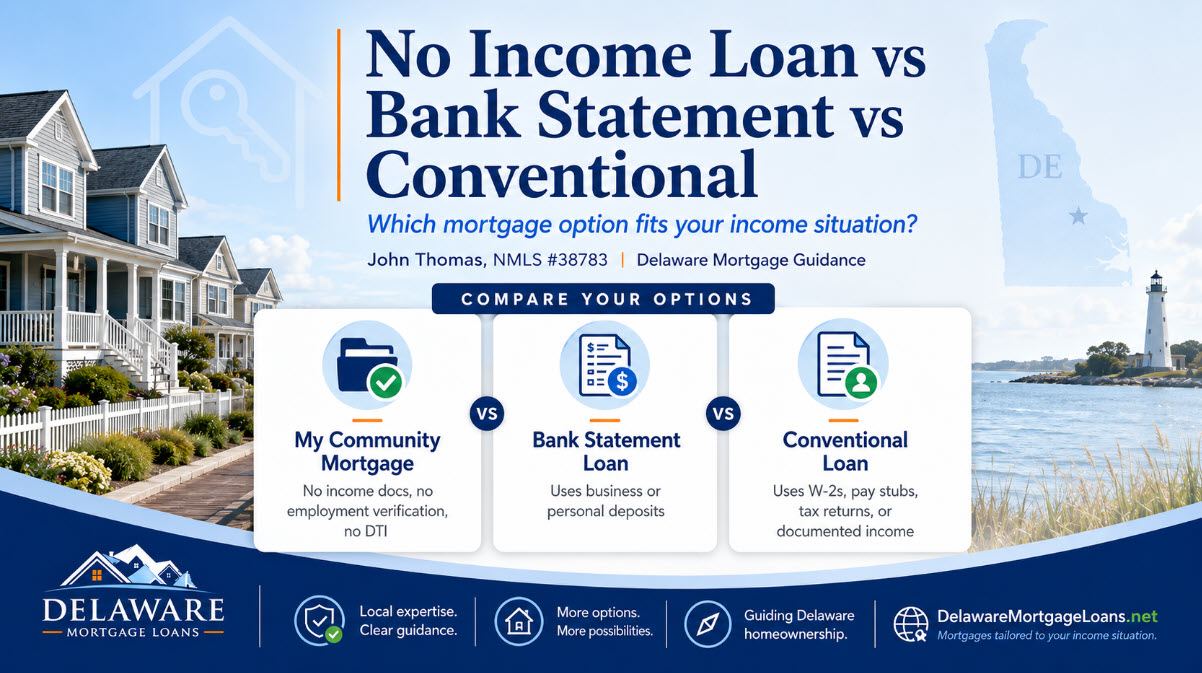
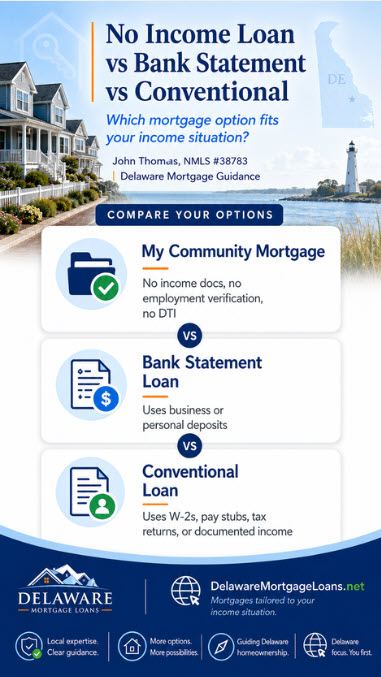
The three programs below all serve buyers whose income is more complicated than a single W-2, but they qualify you in very different ways. This comparison is the fastest way to see where the My Community Mortgage fits.
| My Community Mortgage (No Income, No Employment) | Bank Statement Loan | Conventional | |
|---|---|---|---|
| Income documentation | None | 12-24 months of bank statements | Pay stubs, W-2s, or 2 years of tax returns |
| DTI ratio | Not calculated | Calculated from deposits | Calculated, with limits |
| Qualifies on | Credit, down payment, assets | Deposit-based income, credit | Documented income, credit |
| Typical minimum down | 20% | Varies (often 10-20%) | As low as 3-5% |
| Minimum credit | 620 | Varies by lender | Often 620+ |
| Best for | Strong assets, income that looks weak on paper, or buyers in transition | Self-employed with steady deposits | W-2 buyers with clean, documentable income |
| Occupancy | Primary residence or second home | Often primary or investment | Primary, second home, or investment |
If your deposits tell a clean story, a bank statement loan may cost you less. If your income is genuinely documentable, a Delaware conventional loan is usually the cheapest path. The My Community Mortgage earns its place when neither of those works – when the income paper does not match the buyer. For a deeper look at how lenders normally weigh income against debt, see our guide to your debt-to-income ratio – and notice that this loan removes that calculation entirely.
Rates, Costs, and Tradeoffs of a No Income, No Employment Loan
It would not be honest to talk about the flexibility of this loan without being just as clear about the tradeoffs. Because the lender is taking on more risk by not verifying income, a My Community Mortgage typically carries a higher interest rate than a comparable conventional loan would for the same borrower, and it asks for a larger down payment and more cash in reserve. I do not quote specific rates on a web page – rates change daily and depend on your full profile – but you should go in expecting to pay something for the convenience and flexibility, and we will talk through exactly what that looks like for your scenario when we speak.
So when does paying that premium make sense? When the alternative is not qualifying at all, or having to wait two years to re-document income after a job change or a move into self-employment. For a buyer with strong assets and credit whose paperwork simply does not reflect their real ability to pay, the My Community Mortgage can be the difference between buying now and sitting on the sidelines. For a buyer who can document income cleanly, a conventional loan will almost always be cheaper – which is exactly why I will tell you when that is the better path.
When Is This Loan Not the Right Fit?
This loan is usually the wrong choice for buyers who can document income cleanly, buyers of investment property, and buyers with less than 20% down or a credit score below 620. In those cases a conventional, FHA, DSCR, or Fresh Start loan will generally cost less or fit the situation better.
Be honest with yourself about these scenarios – in each one, a different loan will usually serve you better:
- You can document your income cleanly. If you have W-2s or tax returns that support the payment, a conventional or government loan will almost always come with a lower rate and a smaller down payment.
- You are buying an investment property. This program covers a primary residence or second home only. A DSCR loan, which qualifies on the property’s rental income, is the right tool there.
- You have less than 20% to put down. The program tops out at 80% LTV, so it is not built for low-down-payment buyers – an FHA loan may fit better.
- Your credit is below 620 or your housing history is shaky. The program needs a 620 floor and a clean recent mortgage history; if you are rebuilding, a Fresh Start path may be a better first step.
- Your strength is income, not assets. If you do not have meaningful reserves, the asset-based structure has nothing to lean on.
How Do You Apply for a No Income, No Employment Loan in Delaware?
Applying takes five steps: a conversation about credit, assets, and the property; a credit pull and asset review; homebuyer education where required; appraisal and underwriting; and closing on a 30-year fixed loan with no prepayment penalty. No income documents are collected at any step, though asset statements and a purchase contract are.
The application is refreshingly light, because there is no income to document. Here is how it usually goes:
- A quick conversation. We talk through your credit, your down payment, the property, and the assets you can verify. That is enough for me to tell you whether the My Community Mortgage fits and which tier you are likely to land in.
- Credit and asset verification. We pull credit and review your asset statements. No tax returns, no pay stubs, no bank statements for income.
- Homebuyer education. Most program options require a homebuyer education or counseling course – I will point you to an approved option if yours does.
- Appraisal and underwriting. The property is appraised (loans above $2,000,000 may need two appraisals), and underwriting confirms credit, down payment, reserves, and property eligibility.
- Close. A 30-year fixed loan with no prepayment penalty.
Even with no income to document, a few items still come together to close the file. Plan to have ready:
- Photo ID
- Credit authorization
- Asset statements (bank, brokerage, and retirement accounts)
- The purchase contract
- A homeowners insurance quote
- The appraisal (we order it)
- Your homebuyer education certificate, if your program option requires one
- A gift letter, if you are using gift funds for the down payment or closing costs
I help primary-residence and second-home buyers with this program across Delaware – from Newark buyers using asset-based financing and Wilmington buyers with strong assets but complicated income to Middletown buyers in a career transition. John helps Delaware buyers review this program across New Castle County, Kent County, and Sussex County. The My Community Mortgage is also available in most other states where John is licensed, though several – including Maryland – are excluded (see the FAQ for the full list); call to confirm your state.
If you are weighing this against other options, our 1099 mortgage, No-Ratio DSCR loan, and self-employed mortgage pages cover related paths, and the five factors of credit scoring and understanding your mortgage payment guides are good background reading. Buyers over 62 sitting on home equity may also want to compare a reverse mortgage. First-time buyers can start with our Delaware first-time home buyer guide. When you are ready, the fastest next step is a phone call.
No Income, No Employment Loan FAQ
Do I really not have to show any income for a No Income, No Employment Loan?
Correct – the My Community Mortgage requires no income documents, no employment verification, and no debt-to-income ratio. The loan is underwritten on your credit, your down payment, and your verified assets instead. You will not provide pay stubs, W-2s, tax returns, or profit-and-loss statements.
Is the No Income, No Employment Loan available outside Delaware?
Yes. As of October 2026 the My Community Mortgage is available in Delaware and most other states where John Thomas is licensed – DE, AL, FL, GA, IN, KS, MN, MO, NC, NJ, OH, SC, TN, and VA. It is not offered in Maryland, the District of Columbia, Maine, Nevada, Pennsylvania, Washington, or West Virginia. If you are buying in one of those excluded states – including Maryland – call me at 302-703-0727 and we will look at the asset-based and self-employed options available there.
Can I use a No Income, No Employment Loan for an investment property?
No. The program covers a primary residence or second home, so investment and rental properties are not eligible. If you want to qualify on a property’s rental income rather than your own income, a DSCR loan is the right tool, and I am glad to walk you through it.
What credit score and down payment do I need?
You need a minimum 620 FICO and at least 20% down. The strongest tier – up to 80% loan-to-value – typically requires a 720 score and 9 months of reserves, while a 620 score allows up to 60% LTV with 6 months of reserves. Your exact tier depends on the current matrix when you lock.
How much do I need in reserves?
Reserves are measured in months of full housing payment (PITIA). Depending on your tier you will usually need 6 to 9 months, and first-time buyers may need as little as 2 months. Stocks, bonds, mutual funds, and retirement accounts count at 100%; business funds count by ownership percentage; and cryptocurrency counts once liquidated. Gift funds cannot be used for reserves.
How is this different from a bank statement loan?
A bank statement loan still calculates income – it just uses your deposits instead of tax returns. The No Income, No Employment Loan skips income entirely. That matters most for buyers in transition, such as someone who recently left a W-2 job for self-employment, whose deposits dip temporarily even though their assets and credit are strong.
Can I use gift funds?
Yes, for the down payment and closing costs, from an immediate family member such as a parent, sibling, spouse, or child. Gift funds cannot be counted toward your required reserves, and gifts of equity are not permitted on this program.
Is a no income, no employment loan legal?
Yes. A no-doc loan is legal when it is offered within the rules that apply to it. Some My Community Mortgage options run through community-development programs that may be exempt from the federal ability-to-repay documentation rule, as the CFPB explains, and every file is still underwritten on documented credit, a down payment of at least 20%, and verified reserves. It is not a pre-2008 stated-income loan, where a borrower could simply state an income.
How fast can a no income, no employment loan close?
It often moves faster than a fully documented loan, because there are no tax transcripts to order, no employment to verify, and no income to calculate. The timeline still depends on how quickly your asset statements come in, the appraisal, and any homebuyer education course your program option requires. Send complete asset statements up front and the file has fewer places to stall.
Is the higher rate on a no income, no employment loan worth it?
It can be, when the alternative is not qualifying at all or waiting two years to re-document income after a job change. If you can document income cleanly, a conventional loan will usually cost less, and I will tell you so. Rates change daily, so I compare the actual options for your scenario on a call rather than quoting a rate on a web page.
Ready to see whether your credit, down payment, assets, and property fit the current guidelines?
Call John Thomas directly. If the My Community Mortgage is not the right fit, he will tell you which loan is.

About the Author: John R. Thomas
Branch Manager & Division Vice President, John Thomas Team with AnnieMac Home Mortgage
NMLS #38783 My Community Mortgage Specialist DSHA Approved Published Author
John R. Thomas is a Branch Manager and Division Vice President with the John Thomas Team with AnnieMac Home Mortgage in Newark, Delaware, with more than 20 years of experience and over 3,000 Delaware and Maryland families helped into homes. He matches buyers with complicated income pictures – self-employed owners, retirees, and high-net-worth buyers – to the right financing, including the My Community Mortgage. The pattern he sees most with this program is a buyer whose deposits dipped during a move from salaried work into self-employment while their credit and savings stayed strong.
A graduate of the University of Delaware (B.S., Physics Education) and Delaware State University (M.S., Curriculum and Instruction), John brings a teacher’s clarity to explaining how these programs actually work. He is the author of a published guide for Delaware first-time buyers. State licensing: Look up John R. Thomas, NMLS #38783, on NMLS Consumer Access.
John Thomas Team with AnnieMac Home Mortgage
248 E Chestnut Hill Rd, Newark, DE 19713
Phone: 302-703-0727 | Schedule Appointment
Email: team@johnthomasteam.com
See John Thomas Team on Google for reviews, directions, and local office information.
YouTube · Facebook · Instagram · TikTok · X / Twitter · LinkedIn
Last Updated: October 2026 · John Thomas Team with AnnieMac Home Mortgage · Mortgage content reviewed by John R. Thomas, NMLS #38783.
John R. Thomas, NMLS #38783 | John Thomas Team with AnnieMac Home Mortgage | AnnieMac Home Mortgage NMLS #338923 | 248 E Chestnut Hill Rd, Newark, DE 19713 | 302-703-0727 | delawaremortgageloans.net
AnnieMac Home Mortgage is an Equal Housing Lender. State licensing: Look up John R. Thomas, NMLS #38783, on NMLS Consumer Access.
(c) Copyright John R. Thomas, All Rights Reserved.
