Delaware Self-Employed Mortgage Loans: Bank Statement, 1099 & How to Qualify in 2026
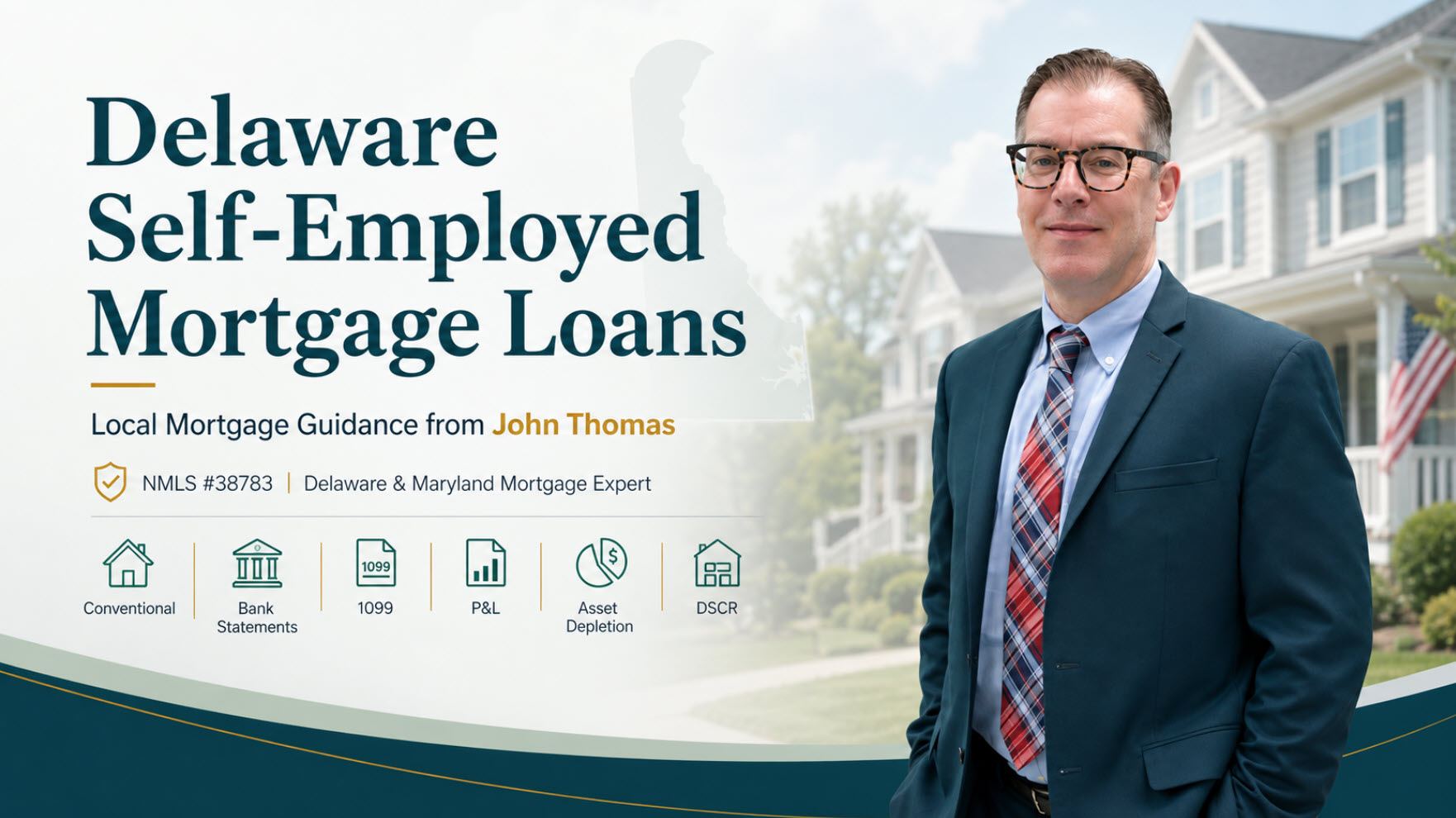
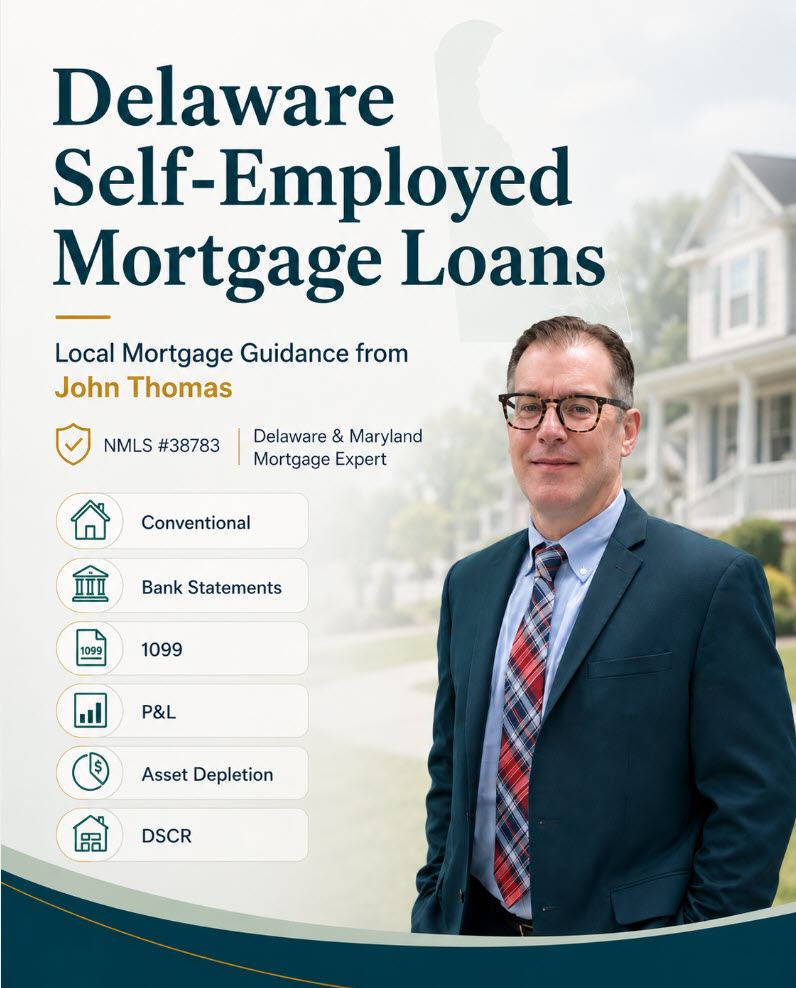
Delaware self-employed mortgage loans let business owners, 1099 contractors, and freelancers qualify using income documentation that fits how they earn – tax returns, 12 to 24 months of bank statements, 1099s, profit-and-loss statements, qualifying assets, or rental cash flow. The right path depends on your business structure and how your write-offs affect taxable income. Current as of June 2026.
Quick answer for Delaware buyers:
Self-employed borrowers in Delaware may qualify through conventional, FHA, VA, or USDA guidelines when their tax-return income supports the loan. When legitimate business deductions reduce that income, eligible borrowers may instead be able to use bank statements, 1099s, a profit-and-loss statement, qualifying assets, or – for an investment property – rental cash flow through a non-QM program. Final approval depends on a full underwriting review of your credit, debts, reserves, and documentation.
If you are self-employed and shopping for a mortgage in Delaware, you have probably heard the discouraging version: “Lenders make it hard for business owners.” There is a kernel of truth in it – your tax returns are written to lower your taxable income, and a loan officer who only glances at the bottom line of page one can talk themselves out of your file in about thirty seconds. But that does not always mean your loan cannot work. It often just means the income has not been fully analyzed yet. I am John Thomas, NMLS #38783, and my team at Primary Residential Mortgage in Newark works with self-employed buyers regularly. The job is to figure out which income-calculation method tells the truest, strongest, and fully legitimate version of your story – and then match it to the right loan program. This page walks you through how that works, what to look for in a loan officer, and the questions that separate a real pre-approval from a guess.
John R. Thomas, NMLS #38783 | 20+ years helping Delaware & Maryland buyers | Newark, DE office | Self-employed & non-QM experience | A clear income review before you make an offer
Talk through your self-employed scenario with a Delaware lender
You do not need every document ready to start. We can begin with what you have, explain which income method may fit, and walk through the next steps together.
Table of Contents
One quick note before we dig in: if you are early in the process, the most useful next step is usually our Delaware first-time home buyer guide, which covers the whole journey from credit to closing. If you already know your income is the tricky part, keep reading – that is exactly what this page is about.
What makes a self-employed mortgage different in Delaware?
For a W-2 employee, qualifying income is mostly a matter of reading a pay stub. For a self-employed borrower, income is something a lender has to calculate. Most guidelines treat you as self-employed when you own 25% or more of a business, and the reason the calculation matters is the same thing that helps you at tax time: legitimate business deductions, depreciation, and write-offs lower your taxable income, which is good for your tax bill but can make your mortgage income look smaller than the cash you actually live on. A strong self-employed file starts with a loan officer who understands that gap and knows how to work it correctly and legally – not by ignoring your tax returns, but by reading all of them carefully.
Fannie Mae’s guidelines require lenders to evaluate the stability of your income, the strength of the business, your distributions and expenses, the income trend over time, and whether the business can reasonably keep producing income. When self-employment income is used, the lender must perform a written cash-flow analysis. That is why a careful loan officer asks for more than the front page of your 1040 – and why a meaningful pre-approval should come after that analysis, not before it. If someone hands you a maximum purchase price after looking only at your gross revenue, treat the number as a guess.
Self-employed mortgage terms, defined
- Bank statement loan
- A non-QM loan that reviews 12 to 24 months of eligible business or personal deposits instead of the adjusted gross income on your tax returns. Transfers, non-business deposits, and other excluded funds are removed, and business programs may apply an expense factor before arriving at qualifying income.
- 1099 mortgage
- A non-QM program that uses documented 1099 earnings rather than relying only on net taxable income. Some programs apply an expense factor or require additional business documentation, depending on current investor guidelines.
- Profit-and-loss (P&L) loan
- A program that qualifies you from a business profit-and-loss statement, sometimes prepared or reviewed by a CPA.
- Asset-qualifier loan
- A program that converts qualifying liquid assets into a calculated income figure for borrowers with a large asset base.
- DSCR loan
- A debt-service-coverage-ratio loan that qualifies an investment property on its rental cash flow rather than your personal income. It is an investment-property tool, not a way to buy a primary residence.
What this means for you: your gross deposits or gross 1099 income are not automatically the final income used for approval. The figure depends on the program and a full underwriting review.
What loan options do self-employed Delaware buyers have?
There is no single “self-employed loan.” There is a menu, and the right choice depends on whether your tax-return income tells your full story. The first question a good loan officer asks is whether you qualify the traditional way, because traditional financing usually carries the most competitive pricing for borrowers who fit it.
If your tax returns show solid income, you may qualify for a standard conventional loan, an FHA loan, a VA loan if you are a veteran, or a USDA loan in eligible rural parts of Delaware. Self-employed borrowers use these every day – being self-employed does not disqualify you from conventional or government financing. It just adds an income-calculation step.
If your tax returns understate your real cash flow, Delaware buyers may instead fit a non-QM (non-qualified mortgage) program that documents income a different way. The most common options are a bank statement loan, a 1099 mortgage program, a profit-and-loss-only program, or an asset-qualifier loan. If you are buying an investment property, a DSCR loan can qualify on the property’s rental cash flow instead of your personal income. These programs typically ask for a higher credit score and a larger down payment than a conventional loan, and pricing reflects the flexibility – which is exactly why they should be compared against the traditional path, not presented as your only option.
Self-employed loan options at a glance
| Program | How income is documented | Best fit when | Typical trade-off |
|---|---|---|---|
| Conventional / FHA / VA / USDA | 1-2 years of tax returns + written cash-flow analysis | Your tax-return income supports the payment | Most competitive pricing; needs returns that hold up |
| Bank statement loan | 12-24 months of business or personal bank deposits | Heavy write-offs make tax returns understate income | Higher credit score and larger down payment typical |
| 1099 income loan | 1099 forms before business write-offs | You are a 1099 contractor with strong gross income | Non-QM pricing; reserves often required |
| Profit-and-loss (P&L) program | Business P&L statement, sometimes CPA-prepared | Business cash flow is strong but newly documented | Documentation and credit requirements are stricter |
| Asset-qualifier loan | Qualifying liquid assets converted to income | Large asset base, lower or lumpy documented income | Requires substantial verified reserves |
| DSCR loan | Property rental cash flow, not personal income | Buying an investment / rental property | Investment-property pricing; not for a primary home |
Which path should I start with?
| Your situation | Start by reviewing |
|---|---|
| Tax returns show enough stable income | Conventional, FHA, VA, or USDA |
| Write-offs reduce your taxable income | Bank statement loan |
| Most of your income is reported on 1099s | 1099 mortgage |
| Current business cash flow is strong | Profit-and-loss (P&L) program |
| You have substantial liquid assets | Asset-qualifier loan |
| You are buying a rental property | DSCR loan |
How lenders calculate self-employed income by business type
On the traditional path, how your income is calculated depends on how your business is structured. The table below is a plain-English map of where a lender looks for each entity type. The exact qualifying figure always comes from a full cash-flow analysis of your specific returns – this is the framework, not a formula that produces your number.
| Business structure | Where income is reported | What the lender reviews |
|---|---|---|
| Sole proprietor | Schedule C on your personal return | Net profit, with possible add-backs for depreciation and certain non-cash expenses |
| Partnership / multi-member LLC | Form 1065 + Schedule K-1 | Your ownership share, K-1 distributions, and whether business income is stable and likely to continue |
| S corporation | Form 1120-S + Schedule K-1 + W-2 wages to you | W-2 wages plus your share of business income/distributions, reviewed for stability |
| C corporation | Form 1120 + any W-2 wages and dividends | Wages and documented distributions; retained earnings generally are not personal income |
| Mixed W-2 + self-employed household | W-2s plus the schedules above | Both income sources, using only what is needed and fully documented |
A few things worth knowing: lenders look at the income trend, not just the most recent year, so a year-over-year decline does not automatically disqualify you but it may mean the lender uses the lower figure or asks for more current documentation. Debts paid by the business, ownership percentage, and whether distributions are consistent can all affect the calculation. And if your current year is running differently from your last filed return, a year-to-date profit-and-loss statement and recent business bank statements help tell that story.
What this means for you: your business structure changes which tax forms the lender reviews, but it does not decide your approval by itself. The goal is to document income that is stable, available to you, and likely to continue.
What credit, DTI, reserves, and down payment will I need?
These vary by program and by lender overlay, so the honest answer is “it depends” – but here is the conditional version so you know what underwriting is weighing:
- Credit score: Conventional and government loans follow the same credit guidelines for self-employed borrowers as for W-2 borrowers – FHA can go as low as 580 with 3.5% down, conventional generally starts around 620, and DSHA programs require a 620 minimum. Non-QM programs typically want a higher score in exchange for flexible income documentation.
- Debt-to-income (DTI): Your calculated self-employed income drives your DTI, which is why the income method you use matters so much. There is no single cutoff – it depends on the program and your overall profile.
- Reserves: Non-QM programs often require cash reserves (a number of months of payments in the bank) on top of your down payment. Conventional and government loans may require reserves in some situations.
- Down payment: Traditional loans can start as low as 3% to 3.5% down depending on the program; bank statement and other non-QM programs typically ask for more. Your loan officer should tell you the down payment for each program you are comparing.
Self-employed status by itself does not create a separate closing-cost category, but a specialty program may carry different pricing, points, reserve requirements, or appraisal requirements than a conventional loan – another reason to compare programs side by side rather than assuming the non-QM route is your only choice.
What this means for you: there is no single credit, DTI, reserve, or down-payment number that applies to every self-employed buyer. The program you use and your calculated income shape all four, which is why comparing two or three programs is usually more useful than chasing one rule of thumb.
A Delaware self-employed income example
Illustration: A Newark business owner reports $180,000 in annual gross revenue. After ordinary business expenses, the tax return shows $82,000 in net income. The return also includes $12,000 of depreciation.
Depending on the loan program and a full cash-flow analysis, some eligible non-cash expenses such as depreciation may be added back. The lender would also review the income trend, business liquidity, debts, ownership percentage, and current-year performance before determining qualifying income.
What this means for you: gross revenue is not automatically your qualifying income – but the taxable-income figure on the front of your return is not always the end of the calculation either. This is an illustration only. It is not a commitment to lend, a guarantee of qualifying income, or a quote; your actual figures depend on full underwriting.
What should I look for in a self-employed loan officer?
The best loan officer for a self-employed buyer is not simply the one advertising the lowest rate. The cheapest quoted rate means nothing if the loan officer miscalculates your income, pushes you into the wrong program, or cannot get you to the closing table. Here is what actually matters.
- They review your tax returns before issuing a meaningful pre-approval. Expect them to look at personal and business returns, the relevant schedules and forms (Schedule C, Schedule E, K-1, 1065, 1120, or 1120-S depending on your structure), a year-to-date profit-and-loss statement, and your bank statements – not just your gross revenue.
- They compare traditional and alternative-documentation loans. A good loan officer checks whether you qualify on tax returns first, then explains alternatives like bank statement, 1099, P&L, or asset-qualifier programs – and shows you a side-by-side, not a single take-it-or-leave-it option.
- They understand that two years is not always mandatory. More on this below, but a loan officer who reflexively says “come back in two years” without looking at your prior work history may be costing you a home you could buy now.
- They know how to handle business funds. If you plan to use money from a business account for your down payment or reserves, that can trigger an extra business cash-flow analysis – and a good loan officer flags it before you write an offer, not during underwriting.
- They know Delaware-specific programs. Down payment and closing-cost help through the Delaware State Housing Authority works through participating lenders; your loan officer should know how those programs interact with self-employed income.
- They give you a real pre-approval, not a basic prequalification. For a complex self-employed file, the strongest position is a pre-approval backed by a detailed income calculation or an underwriter review before you make an offer.
What documents will I need as a self-employed borrower?
Every file is a little different, but for most self-employed Delaware buyers the document list is some combination of the following. Gathering these early is the single biggest thing you can do to speed up your approval.
- Personal and business federal tax returns (often the most recent one to two years)
- Schedule C, Schedule E, K-1, 1065, 1120, or 1120-S forms, depending on how your business is structured
- A year-to-date profit-and-loss statement and a business balance sheet
- Personal and business bank statements
- Evidence of business ownership and how long the business has operated
- If you filed a tax extension, documentation of that, plus current-year records that show how the business is performing now
A scenario-qualified pre-approval built from these should clearly state the income being used, the loan program, your maximum purchase price, the estimated payment, the required down payment, the required cash reserves, and any remaining conditions. If your pre-approval letter does not name those things, ask for the version that does.
Common mistakes self-employed buyers make
Most self-employed approvals that go sideways trace back to a handful of avoidable missteps. Steering clear of these puts you in a stronger position before you ever write an offer.
- Assuming gross business revenue is your qualifying income.
- Waiting until underwriting to disclose that the down payment is coming from a business account.
- Providing only summary pages of your tax returns instead of the complete returns and schedules.
- Mixing personal and business deposits without clear records, which makes a bank statement loan harder to document.
- Making large undocumented transfers or deposits right before applying.
- Ignoring a year-over-year income decline instead of explaining it.
- Filing or amending a return during the transaction without telling your loan officer.
- Accepting a pre-approval before the income calculation has actually been completed.
The self-employed mortgage process, step by step
- Review your business structure and income sources together.
- Collect your tax returns, schedules, profit-and-loss statement, balance sheet, and bank statements as applicable.
- Calculate your income under traditional (tax-return) guidelines first.
- Compare alternative-documentation options – bank statement, 1099, P&L, asset-qualifier – when the traditional path understates your income.
- Review credit, debts, assets, property type, reserves, and any assistance you may be eligible for.
- Complete an underwriter review and issue a scenario-qualified pre-approval that names your income, program, and maximum purchase price.
- Keep your documentation current through closing, since underwriting may ask for updated statements.
Do I really need two full years of self-employment?
Not always. Two years of self-employment history is the general expectation, but it is not an absolute rule. Fannie Mae’s guidelines allow some borrowers with at least 12 months in their current business to qualify when there is documented prior experience in the same field or a closely related occupation. Certain well-established businesses may also be evaluated with one year of returns under specific conditions. So if you left a salaried job to do the same kind of work for yourself, your earlier experience may count – and a loan officer who waves you off with “wait until you have two years” without examining your background may be wrong about your situation. The honest answer is that it depends on your work history, your business structure, and how the numbers actually look, which is exactly why this is worth a real conversation rather than a rule of thumb.
What this means for you: if you have not been self-employed a full two years, do not assume you are automatically ruled out. Your prior experience in the same line of work may bridge the gap – it is worth a review before you write yourself off.
Can I use business funds for the down payment?
Often, yes – but with an extra step. Using money from a business account for your down payment, closing costs, or reserves can require an additional business cash-flow analysis, because the lender has to confirm that pulling those funds out will not harm the operation of the business. This is very solvable, but it is the kind of thing you want identified before you go under contract, not discovered in final underwriting when the clock is running. If business funds are part of your plan, tell your loan officer up front so the documentation can be lined up early.
One related point that comes up a lot: self-employed buyers sometimes ask whether they should change their write-offs or adjust their tax strategy in the year before buying to show more income. That is a decision for your CPA or tax advisor, not your loan officer – the trade-off between a lower tax bill and a stronger mortgage application is genuinely your call to make with the right professional. What I can do is tell you how a given set of returns will read for qualifying purposes, so you can have an informed conversation with your accountant.
Which Delaware programs can self-employed buyers use?
Being self-employed does not lock you out of Delaware’s homebuyer assistance. If you qualify on tax-return income, you may be able to pair a first mortgage with help from the Delaware State Housing Authority (DSHA). DSHA’s current structure runs through two first-mortgage tracks: Welcome Home for qualifying first-time buyers, and Open Door for both first-time and repeat buyers, which currently lists a 620 minimum credit score. Either track can pair with down payment assistance – for example, First State at 3% or Keys4You at 4% – subject to DSHA income limits, purchase-price limits, and homebuyer-education requirements.
The catch for self-employed buyers is that DSHA programs are documented on tax-return income, so they generally pair with the traditional loan path rather than with a bank statement or 1099 program. If your returns support the loan, assistance may be on the table; if you need a non-QM program to qualify, assistance usually is not. A loan officer who knows both worlds can tell you which side of that line you fall on. You can also explore the full menu of Delaware down payment assistance programs to see what may fit.
Self-employed mortgage scenarios across Delaware
Self-employed income shows up in a lot of different shapes across the state. These are illustrative profiles of the kinds of buyers we work with – not specific clients – to give you a sense of how the path changes with the situation:
- A Wilmington consultant with S-corporation income and K-1 distributions, where the calculation blends W-2 wages and business income.
- A Newark contractor who recently moved from W-2 work into the same field on their own, where prior experience may help with a shorter self-employment history.
- A Middletown trades business owner planning to use business funds toward closing, which triggers a business cash-flow review.
- A Lewes or Rehoboth Beach seasonal business owner with uneven monthly deposits, where a bank statement loan may tell the income story better than tax returns.
- A Dover household combining 1099 self-employment income with a spouse’s W-2 income.
Questions to ask before you choose a lender
The Consumer Financial Protection Bureau (CFPB) recommends getting Loan Estimates from more than one lender, because products and pricing vary and shopping can save you real money. Compare the same loan amount, property type, down payment, and rate-lock period using official written Loan Estimates – not verbal rate quotes – and pay attention to the APR, points, lender fees, lender credits, and cash needed at closing. To make those comparisons meaningful for a self-employed file, ask each loan officer:
- What is my calculated qualifying income after you review my tax returns?
- Which expenses or depreciation can legitimately be added back?
- Do I qualify for a conventional or government loan before we consider a non-QM loan?
- Can you compare a tax-return loan, a bank statement loan, a 1099 loan, and a P&L loan side by side?
- Will an underwriter review my income before I make an offer?
- Can I use business funds, and what documentation will that require?
- What are the rate, APR, points, total lender fees, reserves, and estimated cash to close?
- Are you currently approved to originate mortgages in Delaware?
You can independently verify any Delaware loan officer through the Delaware State Bank Commissioner’s approved mortgage-loan-originator list or through NMLS Consumer Access. That is a healthy thing to do for anyone you are about to trust with a six-figure decision.
When a self-employed mortgage is not the right move yet
Honest framing, because the right answer is sometimes “wait a few months.” A self-employed mortgage may not be the best move right now if:
- You have been self-employed only a few months and have no prior experience in the same field – building toward a documented history (or using a co-borrower with W-2 income) is often the stronger play than forcing a file now.
- Your tax-return income comfortably supports the payment and your credit is strong – in that case a standard conventional or government loan will usually beat a non-QM program on cost, so you may not need a specialty product at all.
- You are about to file a return that will substantially change your income picture – it can be worth timing your application around the documentation rather than against it.
- You need DSHA down payment assistance but can only qualify on bank statements – assistance is documented on tax-return income, so the two generally do not combine.
None of these are dead ends. They are timing and strategy questions, and they are exactly the kind of thing worth a fifteen-minute call before you start writing offers.
FAQ – Delaware Self-Employed Mortgage
Can I get a Delaware mortgage if I’m self-employed?
Yes. Self-employed borrowers buy homes in Delaware every day using conventional, FHA, VA, and USDA loans on tax-return income, or using bank statement, 1099, profit-and-loss, or asset-qualifier programs when tax returns understate their cash flow. The key is working with a loan officer who calculates self-employed income correctly and matches you to the right program rather than ruling you out.
What credit score do I need for a self-employed mortgage in Delaware?
It depends on the program. Conventional and government loans follow the same credit guidelines for self-employed borrowers as for W-2 borrowers – FHA can go as low as 580 with 3.5% down, conventional generally starts around 620, and DSHA programs require a 620 minimum. Bank statement and other non-QM programs typically want a higher score and a larger down payment in exchange for the flexible income documentation. Your overall borrower profile, not just the score, drives the final answer.
Can I qualify with only one year of self-employment?
Sometimes. Two years of self-employment is the general expectation, but Fannie Mae guidelines allow some borrowers with at least 12 months in their current business to qualify when there is documented prior experience in the same or a similar field, and certain established businesses may be evaluated with one year of returns under specific conditions. Whether it works depends on your work history and how the numbers read, so it’s worth reviewing your situation directly rather than assuming you must wait two years.
What is a bank statement loan and is it right for me?
A bank statement loan qualifies you on 12 to 24 months of business or personal bank deposits instead of the adjusted gross income on your tax returns. It can be a good fit for a Delaware business owner whose legitimate write-offs make tax returns understate real cash flow. The trade-off is that bank statement loans typically require a higher credit score and a larger down payment, and they generally do not pair with DSHA down payment assistance. A side-by-side comparison against a conventional loan is the best way to see whether it actually saves you money.
Can I use 1099 income to qualify for a Delaware mortgage?
Yes. If you are an independent contractor, a 1099 mortgage program can qualify you on your 1099 income before major business write-offs are applied. This can produce a stronger qualifying income than your tax returns for some contractors. Like other non-QM options, it usually carries higher pricing and reserve requirements than a conventional loan, so it should be compared against qualifying the traditional way first.
Can I use money from my business account for the down payment?
Often, yes, but it can require an additional business cash-flow analysis to confirm that withdrawing the funds will not harm the operation of the business. This is very workable, but it should be identified before you go under contract so the documentation can be prepared early rather than discovered during final underwriting. Tell your loan officer up front if business funds are part of your down payment plan.
Should I change my tax write-offs to qualify for more?
That is a question for your CPA or tax advisor, not your loan officer. There is a real trade-off between lowering your tax bill and strengthening your mortgage income, and the decision is yours to make with the right professional. What a loan officer can do is show you how a given set of returns will read for qualifying purposes, so you can make an informed choice with your accountant before you file.
What happens if my self-employed income declined last year?
A year-over-year decline does not automatically disqualify you, but it does get a closer look. The lender reviews the trend and the reasons behind it, and may use the lower income figure, ask for more current documentation such as a year-to-date profit-and-loss statement, or determine that the income is not yet stable enough to use. If the decline was a one-time event and the business has recovered, current-year records can help tell that story.
Can I qualify if my spouse is W-2 and I am self-employed?
Yes, and it is a common and often strong scenario. The lender may use one or both income sources depending on what is needed and what can be fully documented. A steady W-2 income from your spouse can strengthen the application, and in some cases your self-employed income may not even be needed to qualify. Note that if your business shows a loss, that loss can still be reviewed because it may affect the overall picture even when the income is not being used.
How do I compare lenders as a self-employed buyer?
Get written Loan Estimates from more than one lender, not verbal rate quotes, and compare the same loan amount, property type, down payment, and rate-lock period. Look at the APR, points, lender fees, lender credits, and cash to close – and for a self-employed file, ask each loan officer what qualifying income they calculated from your tax returns, whether you qualify on tax returns before considering a non-QM loan, and whether an underwriter will review your income before you make an offer. The CFPB recommends shopping multiple lenders because pricing and products vary.
Sources: This guide references current guidance from Fannie Mae (self-employment income evaluation and written cash-flow analysis), the Consumer Financial Protection Bureau (comparing Loan Estimates from multiple lenders), the Delaware State Housing Authority (Welcome Home and Open Door program structure), the Delaware State Bank Commissioner (approved mortgage-loan-originator list), and NMLS Consumer Access (license verification). Program details current as of June 2026 and subject to change.

About John R. Thomas, NMLS #38783
NMLS #38783 Self-Employed & Non-QM Experience DSHA Approved Lender Author
John R. Thomas is a Branch Manager and mortgage loan officer with Primary Residential Mortgage, Inc. in Newark, Delaware, with more than 20 years of experience helping Delaware and Maryland buyers – including business owners, 1099 contractors, and other self-employed borrowers – find the income-documentation path and loan program that fit how they actually earn. He works across traditional financing and the full menu of self-employed options, from tax-return loans to bank statement, 1099, profit-and-loss, and asset-based qualification.
John is the author of Your Guide to Buying Your First Home in Delaware and regularly hosts homebuyer seminars and publishes plain-English guides so buyers understand their options from application to closing. He holds a B.S. in Physics Education from the University of Delaware and an M.S. in Curriculum and Instruction from Delaware State University – the teaching background shows up in how he explains a complicated self-employed file. John Thomas is licensed as a mortgage loan officer in 17 states (AL, DC, DE, FL, GA, IN, KS, MD, MN, MO, NC, NJ, OH, PA, SC, TN, VA). NMLS #38783. For Delaware self-employed mortgage questions, his operational focus is Delaware and Maryland.
John Thomas Team – Primary Residential Mortgage, Inc.
248 E Chestnut Hill Rd, Newark, DE 19713
Phone: 302-703-0727 | Schedule Appointment
Email: JohnThomasTeam@primeres.com
See John Thomas Team on Google for reviews, directions, and local office information. | YouTube
Ready to review your self-employed mortgage options?
We’ll look at how your income is documented, compare the programs that may fit, and explain what to prepare next. You can start with what you have – approval depends on a full underwriting review.
Last Updated: June 2026. Mortgage content reviewed by John R. Thomas, NMLS #38783.
John R. Thomas, Loan Officer NMLS #38783 | Newark Branch NMLS #106170 | Primary Residential Mortgage, Inc. Corporate NMLS #3094 | 248 E Chestnut Hill Rd, Newark, DE 19713 | 302-703-0727 | delawaremortgageloans.net | Licensed by the Delaware State Bank Commissioner | Equal Housing Lender
Copyright John R. Thomas, All Rights Reserved.
