

UAD 3.6 appraisal changes take effect November 2, 2026, when the new Fannie Mae and Freddie Mac appraisal report becomes required for new conventional appraisals. Lenders granted a temporary exception may use the old format until May 19, 2027. Homes are valued the same way; the report changes. Plan for longer appraisal timelines. Current as of October 2026.
On November 2, 2026, the appraisal report on every new conventional loan changes. I taught this to Delaware real estate agents in our Realtor Success Seminar on September 30, and one question kept coming up: what happens to the deals we are writing right now? This post is the short version of that class. The value still comes from the market. What changes is how the appraiser collects and reports it, and that can change your timeline.
If you want the basics of how any appraisal works first, start with our guide to understanding the home appraisal in Delaware. This post covers what is new for conventional loans in Delaware and Maryland, and what to do about it now.
Written by John R. Thomas, NMLS #38783 · 20+ years originating mortgages in Delaware and Maryland · 3,000+ homebuyers helped · instructor of the Realtor Success Seminar for Delaware agents.
Buying, Selling, or Writing a Contract Around November 2?
The appraisal report is changing. We can check which format your file is on and whether the contract dates leave enough room.
Table of Contents
What Is UAD 3.6?
UAD 3.6 is the redesigned Uniform Appraisal Dataset and appraisal report from Fannie Mae and Freddie Mac. It is not a new way to value a home. It replaces the old fixed forms with one dynamic report built on structured data, and it is required for new conventional appraisals submitted on or after November 2, 2026, as of October 2026.
All that means is the appraiser fills out a different, more detailed report. The appraiser still inspects the home, picks comparable sales, and forms an independent opinion of value. The new report is the redesigned Uniform Residential Appraisal Report (URAR), built on the MISMO 3.6 data standard and sent to the lender through the Uniform Collateral Data Portal (UCDP). Fannie Mae keeps the official material on its Uniform Appraisal Dataset page.
The full one-hour class is above. Jump to the part you need:
- What is UAD 3.6? (1:14)
- The November 2 mandate (2:02)
- Turn times, fees and short closings (6:24)
- Where the value is on the new report (18:48)
- Quality ratings vs. condition ratings (23:04)
- Square footage above and below grade (30:06)
- How appraisers pick comparable sales (37:27)
- Five appraisal myths (42:34)
- Low appraisals and reconsideration of value (48:43)
- Appraisal Assurance (52:29)
When Does UAD 3.6 Start?
November 2, 2026 is the mandatory date for new conventional appraisals submitted to the Uniform Collateral Data Portal, as of October 2026. Lenders that requested and received a temporary Fannie Mae or Freddie Mac exception may keep submitting the old UAD 2.6 format until May 19, 2027. The submission date controls the format, not the contract date.
| Phase | Dates | What it means |
|---|---|---|
| Broad production | January 26 to November 1, 2026 | Lenders may submit either UAD 2.6 or UAD 3.6. Many appraisers and lenders have already switched. |
| Mandate | November 2, 2026 | New conventional appraisals submitted to the Uniform Collateral Data Portal must be UAD 3.6, unless the lender holds a temporary exception. |
| Exception window (approved lenders only) | November 2, 2026 to May 19, 2027 | Lenders with an exception may keep submitting UAD 2.6. From March 1, 2027, those reports lose some benefits for the lender, so most will switch sooner. |
| UAD 2.6 revisions (standard timeline) | Until May 3, 2027 | A UAD 2.6 report first submitted before November 2 can still be revised in the old format. |
| UAD 2.6 retired | June 28, 2027 | No UAD 2.6 reports are accepted after this date. |
The exception came from a September 30, 2026 announcement by Fannie Mae and Freddie Mac (Fannie Mae Lender Letter LL-2026-08). It applies only to lenders that asked for it and were approved, so two buyers closing the same week can get different reports.
Here’s a hypothetical that shows why the submission date matters. The appraiser inspects a home on October 28 but submits the report on November 3. If the lender is on the standard timeline, that report must be UAD 3.6, and an appraiser who visited expecting the old form may need to go back. Watch the November 2 mandate (2:02).
Which Loans Does UAD 3.6 Affect?
As of October 2026, the November 2 mandate applies to conventional loans delivered to Fannie Mae and Freddie Mac. FHA accepts UAD 3.6 on an optional basis with no mandatory date announced, VA and USDA have not announced adoption dates, and jumbo, portfolio, and non-QM loans follow each investor’s own rules.
| Loan type | UAD 3.6 status (as of October 2026) |
|---|---|
| Conventional | Mandatory for new submissions on November 2, 2026 |
| FHA | Optional for FHA-approved lenders; no mandatory date announced |
| VA and USDA | No adoption dates announced |
| Jumbo, portfolio, and non-QM | Each investor sets its own requirements |
Two appraisals on your desk the same week may look nothing alike. That’s the transition working, not a mistake. Ask your lender which format each file is on rather than assuming. Watch which loans are affected (4:23).
Will Appraisals Take Longer and Cost More Under UAD 3.6?
Probably, at least during the transition. In a March 2026 survey of 900 appraisers, 52% expected fees to rise and 63% expected longer turn times, and one industry estimate puts the early learning curve at 25% to 50% more time per report. Actual timing varies by appraiser, software, and market.
Some of that delay fades as appraisers learn the new report. Some of it doesn’t: the appraisal visit itself runs longer because the report asks for more photos, more condition detail, and more measurements. Tell sellers to expect a longer visit. Rural parts of Delaware and Maryland have fewer appraisers, so expect more variability there.
I’m just being honest with you: I would not write a 14-day or 21-day closing right now. Add extra days to appraisal contingencies on contracts written from late October through November, and confirm local turn times before you promise anyone a closing date. Watch turn times and fees (6:24).
Four questions to ask on any deal already in motion
- Are you on the standard November 2 timeline, or do you have a temporary exception?
- Which format are you ordering: legacy UAD 2.6 or UAD 3.6?
- If it is legacy, will it be submitted before November 2 (or within your exception window)?
- Does the appraisal contingency leave room for a UAD 3.6 report?
For conventional loans through our team, appraisal fees were about $505 in New Castle County and about $525 in Kent and Sussex Counties as of September 30, 2026, with an increase of about $50 expected as appraisers adjust. The lender our team works with manages its own panel of local appraisers, so report questions go straight to its appraisal team. Confirm the current fee on your loan estimate. Watch local appraisal fees (10:48).
What Changes on the New Appraisal Report?
The value moves to page one. The UAD 3.6 report opens with a summary showing the opinion of market value, the condition rating, and any required repairs with an estimated cost. One dynamic report replaces separate forms such as the 1004, 1073, and 1025, and it shows only the sections that apply to the property.
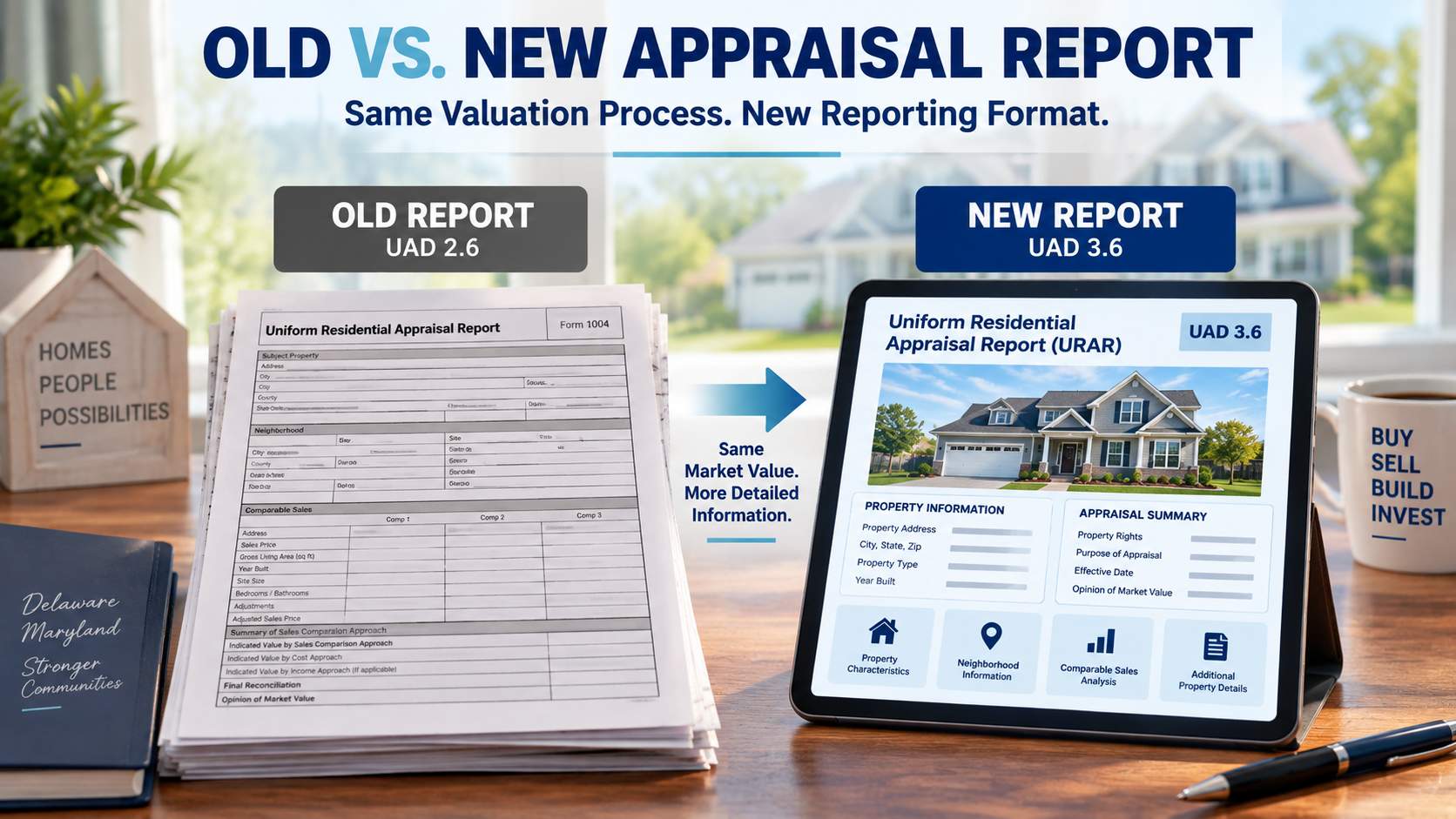
| What you see | Old forms (UAD 2.6, Form 1004 and others) | New report (UAD 3.6 URAR) |
|---|---|---|
| Where the value appears | Bottom of page two | Page one summary, with the condition rating and any required repairs |
| Number of forms | Separate forms (1004, 1073, 1025, 2055 and others) | One dynamic report that shows only the sections that apply |
| How details are recorded | Fixed boxes plus narrative addendums | Structured data fields, each with its own line and comment |
| Condition rating | One overall rating | Separate ratings for exterior, interior and individual rooms |
| Square footage | One gross living area figure | Four categories: finished and unfinished, above and below grade (ANSI Z765-2021) |
| Photos | Grouped at the back | Placed in the section they document |
| Data standard | UAD 2.6 | UAD 3.6, aligned to MISMO 3.6 |
On the old Form 1004 the value sat at the bottom of page two, which never made much sense to anyone reading it. Now you find the result first, then check that the rest of the report supports it. A few more changes are worth knowing:
- Features get their own lines. A steep lot, solar, an accessory dwelling unit, outbuildings, and disaster mitigation features now have defined places in the report instead of hiding in an addendum.
- Defects are documented. Visible defects are photographed with a written comment and an estimated repair cost.
- The result is stated plainly. As is, subject to repair, subject to inspection, or subject to completion appears on page one. For the final inspection, a Completion Report replaces the old combined form.
What does not change
The valuation method stays the same. The appraiser still forms an independent opinion of value from market evidence, appraiser independence rules still apply, and agents can still provide facts and comparable sales. A more detailed report does not mean the home will appraise at the contract price. Watch where the value is on the new form (18:48) and what does NOT change (20:52).
What Is the Difference Between a Quality Rating and a Condition Rating?
Quality ratings, Q1 to Q6, describe how a home was designed and built. Condition ratings, C1 to C6, describe its current physical state and upkeep. UAD 3.6 can rate condition for the exterior, the interior, and individual rooms, instead of one overall rating that averaged a new kitchen together with a failing roof.
| Kitchen (hypothetical) | Quality | Condition |
|---|---|---|
| 15 years old, custom solid wood cabinets and stone counters, but worn finishes and a chipped counter edge | High | Lower |
| Brand-new flip with laminate counters and stock cabinets | Standard | Top |
A dated bathroom can now stand out on its own line instead of disappearing into an average. Walk the house the way the appraiser will: room by room, inside and out. Watch quality ratings vs. condition ratings (23:04).
How Does UAD 3.6 Report Square Footage?
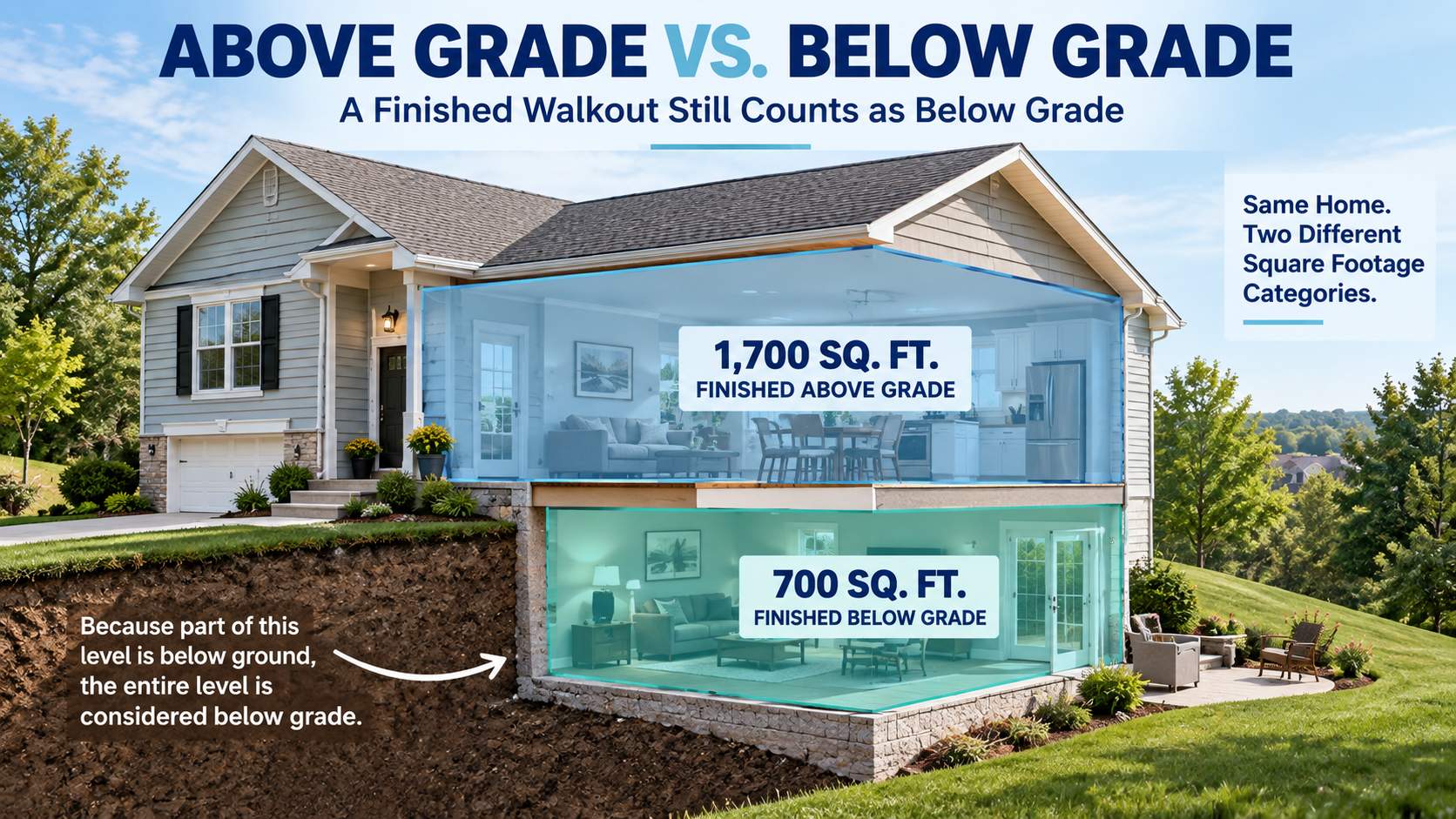
UAD 3.6 replaces the single gross living area figure with four categories: finished above grade, finished below grade, unfinished above grade, and unfinished below grade, measured to the ANSI Z765-2021 standard. If any part of a level is below grade, the whole level counts as below grade, as of October 2026.
The split-level with a finished walkout is one of the most common square footage arguments in our market. The lower level is underground in the front and walks out to the yard in the back. Grade is decided by the level, not by the wall, so that walkout is finished below-grade area no matter how much of the back wall is exposed.
Here’s a hypothetical. A split-level advertised at 2,400 square feet shows up on the report as 1,700 square feet finished above grade and 700 square feet finished below grade. Nothing was lost; it’s classified differently than the listing presented it. Finished below-grade space still contributes value. It’s just reported where it belongs.
Just because it’s on the MLS doesn’t mean it’s true. I once caught a contract where the ZIP code had been copied wrong from the MLS listing. If a ZIP code can be wrong, a square footage figure copied from an old listing or a tax record can be wrong too, and under UAD 3.6 the appraiser’s measurement is the number that counts.
What to do at the listing appointment
- List above-grade and below-grade finished square footage as separate numbers.
- Give the source for each number: measurement, floor plan, survey, or public record.
- Describe the walkout in the remarks: finished lower level, full-height ceilings, and size.
- Check ceiling heights on older split-levels before you publish any figure.
Watch the four area categories (30:06) and the split-level walkout example (31:42).
Not Sure How a Listing’s Square Footage Will Be Reported?
Send it over before it goes live. We’ll look at the levels, the sources, and the timeline with you.
What Should Listing Agents Give the Appraiser?
Give facts, not pressure: install years for the roof, HVAC, water heater, windows, and electrical panel; improvements with the year, scope, and permit status; permits, invoices, and warranties; floor plans or surveys; special features such as solar, an accessory dwelling unit, or a private road; and recent local sales the appraiser may not find.
- Comparable sales: before you send one, ask whether the same buyer would have toured both homes. If yes, explain why. If no, the appraiser likely won’t use it.
- Concessions: write seller-paid closing costs and repair credits clearly. The appraiser sees the contract and reports them.
- Personal property: keep it out of the sales contract and put it on a separate addendum at no value, because personal property can’t be financed in a mortgage.
- Solar: say whether the system is leased or owned. In my experience, leased panels generally don’t add value the way an owned system can.
Appraisal prep starts at the listing appointment. Specific facts create credibility, but renovation cost does not establish market value; buyers do. Watch appraisal prep at the listing appointment (36:12) and how appraisers pick comps (38:12).
What Happens If the Appraisal Comes In Low?
First sort the problem: a factual error, an eligibility or condition issue, an analysis concern, or a true value gap with no error. Factual errors get corrected, analysis concerns get competing sales, and a borrower can request one reconsideration of value per appraisal with up to five comparable sales, as of October 2026.
Send competing comps, not twenty higher sales. A useful request names the exact report item, the correct fact or competing sale, a reliable source such as the MLS number, and why it could change the analysis. Everything goes through the lender, which sends it to the original appraiser. When there is nothing to fix, the gap is real, and the usual options are more cash from the buyer, a lower price, or splitting the difference. Our guide to the home appraisal in Delaware covers those choices. Watch value gaps and ROV (48:43).
Worried about a low appraisal? Ask about Appraisal Assurance before you write the offer.
Through our team, eligible conventional buyers can use a program called Appraisal Assurance. Before the offer, the lender’s appraisal team reviews the property and, if approved, issues a certificate with a warranted value. If the home later appraises below that value, the lender covers the difference, subject to the certificate terms and full loan approval. That is what lets a certified buyer write without an appraisal contingency.
It doesn’t fit every buyer. As of September 30, 2026, the program is for conventional loans only, on a primary residence or second home with a value up to $2 million, a single-family home or condo listed on the MLS with photos, and a buyer who qualifies at 95% loan-to-value through automated underwriting with funds for at least 10% down. FHA, VA, and USDA buyers aren’t eligible, and the contract must be signed within 30 days of the certificate date. Above 80% loan-to-value, mortgage insurance still applies.
Send us the address before the offer goes in, and we will check whether the home can be certified. Watch Appraisal Assurance (52:29).
Appraisal-Ready Checklist for Listing and Buyer Agents
| Stage | Listing agent | Buyer agent |
|---|---|---|
| Before listing or offer | Verify finished areas, additions, permits, solar, HOA, and condition. Start a property information sheet for the appraiser. | Spot unusual features, condition concerns, and appraisal-gap risk. Ask about Appraisal Assurance. Allow extra appraisal days. |
| After contract | Clarify concessions and personal property. Send the property facts to the lender. | Write clear concession, repair, and personal property terms. |
| During the appraisal | Provide full access and let the appraiser work independently. | Keep the lender informed and confirm expected timing. |
| If a problem appears | Separate repair, eligibility, factual, and value issues before responding. | Gather credible evidence quickly and follow the lender’s reconsideration process. |
Preparation cannot control the value. It can reduce avoidable surprises. If you are buying for the first time, our Delaware first-time home buyer guide and our list of mortgage do’s and don’ts cover the rest of the process. Watch the listing and buyer playbook (57:58).
UAD 3.6 FAQ: Common Questions From Delaware Buyers, Sellers, and Agents
What is UAD 3.6?
UAD 3.6 is the new Uniform Appraisal Dataset report from Fannie Mae and Freddie Mac. It replaces the old appraisal forms, such as the 1004 and 1073, with one dynamic report built on structured data, and it is required for new conventional appraisals submitted on or after November 2, 2026, as of October 2026.
When does UAD 3.6 become mandatory?
November 2, 2026, for new conventional appraisals submitted to the Uniform Collateral Data Portal. Lenders could choose either format from January 26 through November 1, 2026. Lenders granted a temporary Fannie Mae or Freddie Mac exception may keep submitting the old format until May 19, 2027, and the old format is retired on June 28, 2027.
Can my lender still use the old appraisal form after November 2?
Only if the lender asked Fannie Mae or Freddie Mac for a temporary policy exception and was approved, under an announcement made September 30, 2026. Those lenders may keep submitting UAD 2.6 reports until May 19, 2027. Lenders without an exception must use UAD 3.6 for new submissions starting November 2, 2026. Ask your lender which timeline it is on.
My contract was signed in October. Which appraisal form will be used?
The submission date decides, not the contract date or the inspection date. If the appraiser inspects on October 28 but first submits the report on November 3, a lender on the standard timeline must use UAD 3.6. Ask your lender which format is being ordered, whether it holds an exception, and whether a legacy report will be submitted before November 2.
Does UAD 3.6 change how homes are valued?
No. The appraiser still forms an independent opinion of value from comparable sales and market evidence, and the lender still decides whether the property meets loan requirements. What changes is how the information is collected, organized, and reported, which can expose inconsistencies in a listing or contract that the old form hid.
What is the difference between quality and condition ratings?
Quality, rated Q1 to Q6, measures how the home was designed and built. Condition, rated C1 to C6, measures its current state and upkeep. UAD 3.6 can rate condition separately for the exterior, the interior, and individual rooms, so a worn custom kitchen can rate high quality and lower condition.
Does finished basement or walkout space still count?
Yes. Finished space on a level that is partly below grade is reported as finished below-grade area instead of above-grade living area, and it still contributes value. A 2,400 square foot split-level might show 1,700 square feet above grade and 700 below. Listing agents should report the two numbers separately with a source for each.
Can real estate agents talk to the appraiser?
Yes. Agents can provide facts, a property information sheet, and comparable sales with an explanation of why each one competes with the home. Agents cannot pressure the appraiser toward a value or the contract price, and appraiser independence rules still apply.
Will appraisals take longer under UAD 3.6?
At first, likely yes. A March 2026 survey of 900 appraisers found 63% expected longer turn times, and one industry estimate puts the learning curve at 25% to 50% more time per report. Appraisal visits also run longer because more photos and measurements are required, so avoid very short closing timelines during the transition.
Does UAD 3.6 apply to FHA, VA, and USDA loans?
Not as a mandate yet. As of October 2026, the November 2 mandate covers conventional loans. FHA accepts UAD 3.6 on an optional basis with no mandatory date announced, and VA and USDA have not announced adoption dates. Jumbo and non-QM loans follow each investor’s own rules.

About John R. Thomas
Branch Manager & Division Vice President of Sales, John Thomas Team with AnnieMac Home Mortgage
NMLS #38783Realtor Success Seminar InstructorDSHA ApprovedAuthorJohn R. Thomas has originated mortgages in Delaware and Maryland for more than 20 years and has helped more than 3,000 homebuyers. Before mortgage lending he taught high school for 12 years, and he still teaches: he leads the Realtor Success Seminar for local agents and wrote Your Guide to Buying Your First Home in Delaware. He holds a B.S. in Physics Education from the University of Delaware and an M.S. in Curriculum and Instruction from Delaware State University, and he is a Certified Mortgage Planner (CMP).
In the appraisal class he teaches Delaware agents, the question he hears most is the split-level walkout, and his answer is always the same: list the above-grade and below-grade numbers separately, give the source for each, and let the appraiser work. Read John’s full bio or meet the John Thomas Team.
Years
Buyers Helped
Years Teaching
Markets
Certified Mortgage Planner
John Thomas Team with AnnieMac Home Mortgage
248 E Chestnut Hill Rd, Newark, DE 19713 | 302-703-0727 | team@johnthomasteam.com
Schedule Appointment | YouTube | See John Thomas Team on Google for reviews, directions, and local office information.
NMLS #38783. State licensing: Look up John R. Thomas, NMLS #38783, on NMLS Consumer Access.
YouTube · Facebook · Instagram · TikTok · X / Twitter · LinkedIn
Plan Your Next Appraisal Around the New Report
Get the Appraisal Timeline Right Before You Write the Contract
Whether you are listing, buying, or helping a client through either side, a short call can confirm the format, the timing, and whether Appraisal Assurance fits. No application fee and no upfront fees; soft-pull pre-qualification.
Last Updated: October 2026 · John Thomas Team with AnnieMac Home Mortgage · Mortgage content reviewed by John R. Thomas, NMLS #38783.
John R. Thomas, NMLS #38783 | John Thomas Team with AnnieMac Home Mortgage | AnnieMac Home Mortgage NMLS #338923 | 248 E Chestnut Hill Rd, Newark, DE 19713 | 302-703-0727 | delawaremortgageloans.net
AnnieMac Home Mortgage is an Equal Housing Lender. State licensing: Look up John R. Thomas, NMLS #38783, on NMLS Consumer Access.
(c) Copyright John R. Thomas, All Rights Reserved.