No Ratio DSCR Loans for Negative Cash Flow Investment Properties

NO RATIO DSCR LOAN — QUICK ANSWER
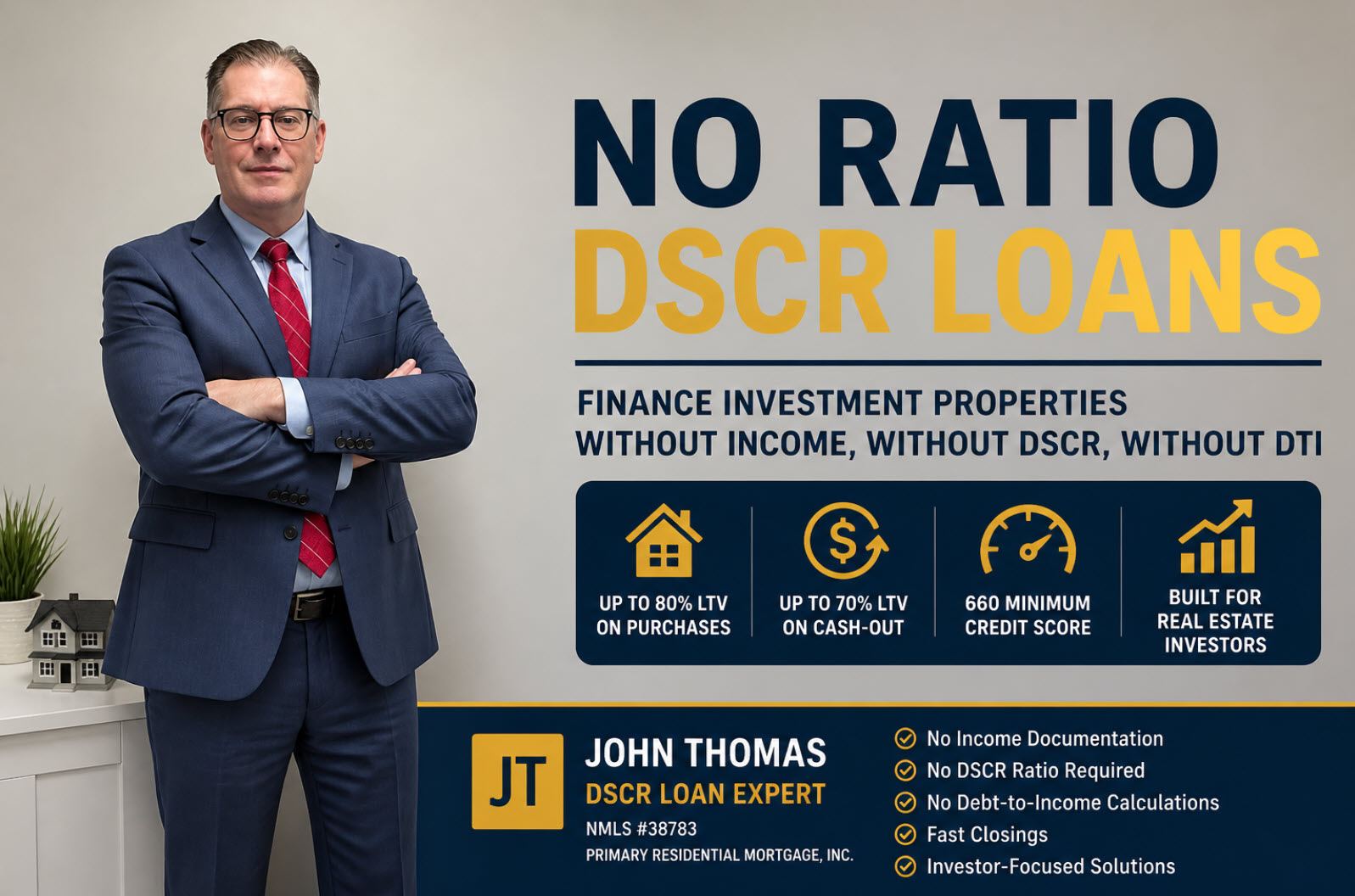
A No Ratio DSCR loan is a Non-QM investor mortgage that finances rental property without requiring rental income to meet a debt service coverage ratio — meaning negative cash flow properties qualify. Approval is based on credit, down payment, property value, and assets — not rent or personal income. Standard guidelines: 660 minimum FICO, 20% down on purchase (80% LTV), 70% LTV on cash-out refinance, no income docs, no DTI calculation, LLC vesting allowed. Loan amounts $100,000 to $3,000,000. Available to Delaware and Maryland investors by John Thomas, NMLS #38783.
Current as of May 2026. Rates and program guidelines change daily — call 302-703-0727 for current pricing on your scenario.
No Ratio DSCR Glossary — Quick Definitions
- DSCR (Debt Service Coverage Ratio)
- Gross monthly rent divided by monthly PITIA. The ratio standard DSCR loans require — usually 1.00 minimum.
- No Ratio DSCR
- A DSCR program variant that removes the DSCR ratio requirement entirely. The property does not need to produce rent at any specific level; qualification shifts to credit, down payment, property value, and assets.
- PITIA
- Principal, Interest, Taxes, Insurance, and Association dues — the full monthly mortgage payment used in standard DSCR calculations (and that No Ratio DSCR specifically waives).
- Negative Cash Flow Property
- An investment property where projected or actual rent is below the full PITIA payment. Common on appreciation plays, repositioning projects, and properties in fast-appreciating markets where rents trail prices.
- Appreciation Play
- An investment thesis based on the property’s expected value growth rather than its current cash flow. Common Delaware appreciation plays: gentrifying Wilmington row-home blocks, Newark properties near University of Delaware expansion zones, and Sussex County coastal areas.
- Reposition / Reposition Project
- Buying a property currently underperforming on rent or condition with a plan to renovate, re-tenant, or change use (long-term to short-term rental, for example) to drive rents materially higher post-improvement.
- Personal Guarantee
- When a No Ratio DSCR loan closes in an LLC, members holding 20%+ interest sign personally guaranteeing the loan. The LLC owns the property; the guarantor remains personally liable.
No Ratio DSCR Loan Requirements at a Glance
| Minimum credit score | 660 FICO (higher score = better pricing) |
| Minimum down payment | 20% on purchase (80% LTV maximum) |
| DSCR ratio required | None — negative cash flow allowed |
| Maximum LTV (purchase) | 80% |
| Maximum LTV (cash-out refinance) | 70% |
| Income documentation | None — no tax returns, W-2s, or pay stubs |
| Personal DTI calculation | Not calculated |
| LLC vesting | Yes — with personal guarantee from members holding 20%+ interest |
| Loan amount range | $100,000 minimum to $3,000,000 maximum |
| Borrower citizenship | US Citizens, Permanent Residents, some Non-Permanent Residents, ITIN, and DACA borrowers eligible |
| Investor experience | Not required — first-time investors eligible |
| Property occupancy at purchase | Vacant properties allowed |
| Seller assistance | Up to 6.0% allowed |
If you’re a real estate investor, you already know this: not every great deal shows positive cash flow on paper. Some properties are appreciation plays. Some are short-term repositioning projects. Some are in high-growth markets where rents haven’t caught up yet. Standard Delaware DSCR loans require the property to meet a minimum rent-to-payment ratio — typically 1.00 or higher. A No Ratio DSCR loan removes that requirement, and that changes everything for experienced investors.
Have a Property That Doesn’t Pencil at 1.00 DSCR?
Send the address, estimated rent, and your credit range — I’ll tell you in 15 minutes whether No Ratio DSCR is the right fit.
Table of Contents
What Is a No Ratio DSCR Loan?
A standard DSCR (Debt Service Coverage Ratio) loan requires rental income to cover the mortgage payment — usually at a 1.00 to 1.25 ratio. A No Ratio DSCR loan:
- Does not require rental income to meet a ratio
- Does not require income documentation
- Does not calculate personal debt-to-income
Approval is based solely on:
- Credit score
- Down payment
- Property value
- Investor experience (helpful but not required)
- Liquid assets and reserves
This is a Non-QM (non-qualified mortgage) investor loan designed for flexibility — the kind of loan that lets you close a deal that wouldn’t pencil under standard DSCR underwriting.
What Are the Guidelines for a No Ratio DSCR Loan?
Below is a summary of the guidelines to qualify for a No Ratio DSCR loan to purchase or refinance an investment property:
- No income documentation required — no tax returns, W-2s, pay stubs, or personal DTI calculations
- No rental income requirement — property doesn’t need to show positive cash flow or meet a DSCR threshold
- Up to 80% LTV on purchases
- Up to 70% LTV on cash-out refinances
- Minimum 660 credit score required
- Available for US Citizens, Permanent Residents, and some Non-Permanent Residents
- Available for ITIN borrowers and DACA borrowers
- No investor experience required — first-time investors eligible
- Property may be vacant on a purchase transaction
- Seller assistance up to 6.0%
- Can close in the name of an LLC with personal guarantee
- Maximum loan amount: $3,000,000
- Minimum loan amount: $100,000

What Property Types Are Eligible for a No Ratio DSCR Loan?
The No Ratio DSCR loan can be used to purchase or refinance any of the following property types — including properties showing negative cash flow:
- Single Family Residence (SFR)
- Townhouses
- PUDs (Planned Unit Developments)
- 2-4 unit residential properties
- Warrantable condos
- Non-warrantable condos (Wilmington high-rises included)
Can You Finance a Negative Cash Flow Property?
Yes. With a No Ratio DSCR loan, the property does not need to:
- Show positive cash flow
- Meet a DSCR threshold
- Provide lease income to qualify
That allows investors to purchase or refinance properties where:
- Rents are temporarily below market
- The property is being improved or repositioned
- Appreciation potential outweighs short-term cash flow
- Market rents are rising rapidly and the deal pencils on a 2–4 year horizon, even if not on day one
That flexibility is exactly why experienced investors use No Ratio DSCR as a portfolio growth tool — the deals that don’t pencil at 1.00 DSCR today are often the highest-conviction long-term plays.
Key Benefits of the No Ratio DSCR Loan Program
Here’s exactly how the program works for Delaware investors:
No Income Documentation Required
No tax returns, no W-2s, no pay stubs, no personal DTI calculations. Your personal income is not the qualifying factor.
No Rental Income Requirement
The property does not need to hit a DSCR ratio. Negative cash flow is allowed.
Simplified Qualification
Approval is based primarily on:
- Credit score
- Down payment or equity
- Property value
- Liquid reserves
Investor-Friendly Structure
Ideal for investors with:
- Multiple properties already on their tax return
- Complex tax returns
- Large write-offs that depress reportable income
- Business income that’s hard to document conventionally
Portfolio Expansion Tool
Because you bypass income and rental restrictions, you can:
- Scale faster than conventional financing allows
- Refinance strategically when rates or values move
- Acquire appreciation-based assets in fast-moving markets
Leverage Guidelines
- Up to 80% LTV on purchases
- Up to 70% LTV on cash-out refinances
- Minimum 660 FICO required
Who Is the No Ratio DSCR Loan Best For?
This program works best for:
- Seasoned real estate investors with proven portfolios
- Investors scaling portfolios quickly past the conventional 10-property cap
- Buyers in high-appreciation Delaware markets (gentrifying Wilmington blocks, beach-area properties)
- Investors with strong credit and liquidity but properties that don’t pencil at 1.00 DSCR
- Property owners who can’t qualify with traditional DTI rules
- Investors closing repositioning projects where post-rehab rent will support DSCR but pre-rehab rent doesn’t
It’s not ideal for:
- Borrowers below 660 credit
- First-time investors without meaningful liquid reserves
- Owner-occupied properties (No Ratio DSCR is investment-only — owner-occupancy is occupancy fraud)
- Investors whose property does meet a 1.00+ DSCR — the standard Delaware DSCR loan program usually prices better in that case
Credit, Down Payment, and Qualification Requirements
Minimum Credit Score
660 FICO minimum. Higher credit unlocks better pricing and tighter spreads. 720+ scores see the most aggressive No Ratio DSCR rate sheets.
Down Payment
20% down on purchases (80% LTV maximum). 25%+ down often unlocks meaningfully better pricing.
Cash-Out Refinance
Up to 70% LTV. The 30% equity floor is a meaningful constraint if you’re tapping appreciation in a property that’s been held for under a year.
Income Documentation
None required. No tax returns, W-2s, or pay stubs.
Debt-to-Income Ratio
Not calculated.
Reserves
Most No Ratio DSCR programs require 6–12 months of PITIA in liquid reserves at closing. The reserve requirement is typically higher than standard DSCR because the lender is assuming negative cash flow risk. Plan for it during your liquidity planning — don’t drain everything into the down payment.
How No Ratio DSCR Differs from a Standard DSCR Loan
| Feature | Standard DSCR | No Ratio DSCR |
|---|---|---|
| Rental income required | Yes | No |
| DSCR ratio required | Yes (typically 1.00+) | No |
| Income docs | No | No |
| Negative cash flow allowed | Usually no (some programs allow with extra reserves) | Yes |
| Personal DTI calculated | No | No |
| Minimum credit score | 600 (better at 680+) | 660 |
| Maximum LTV (purchase) | Up to 85% | 80% |
| Maximum LTV (cash-out) | Up to 80% | 70% |
| Pricing | Standard DSCR pricing | Higher than standard DSCR (the trade-off) |
| Best fit | Cash-flowing rentals at 1.00+ DSCR | Appreciation plays, repositioning, sub-1.00 DSCR deals |
If your property does meet a 1.00+ DSCR, the standard Delaware DSCR loan program almost always prices better. No Ratio DSCR exists for the deals that don’t pencil — and pricing reflects that risk premium. The right answer depends entirely on the property’s rent-to-PITIA math, which is the first thing we run on a 15-minute strategy call.
Three Real Delaware No Ratio DSCR Scenarios
The fastest way to see whether No Ratio DSCR fits is to walk through scenarios. Here are three I’ve closed variations of recently:
SCENARIO 1 — APPRECIATION PLAY, FAST-GROWING SUBMARKET
Property: Single-family rental in a fast-appreciating Delaware submarket, $500,000 purchase price.
Borrower: Seasoned investor, 720 credit, strong liquidity, vesting in an LLC.
Numbers: Projected market rent $2,800/mo · PITIA at 80% LTV $3,100/mo · DSCR = 0.90 (negative cash flow ~$300/mo).
Standard DSCR: Declined.
Result with No Ratio DSCR: Approved at 80% LTV with no rent ratio review. The investor’s thesis: 3% annual rent growth gets the property to break-even in 4 years, with appreciation upside meanwhile.
SCENARIO 2 — BETHANY BEACH STR THAT DIDN’T PENCIL ON AIRDNA
Property: Bethany Beach 3-bed townhouse, mid-purchase conversion to short-term rental.
Borrower: Repeat investor with two existing Sussex County rentals, 705 credit.
Numbers: AirDNA report supported $42K projected annual STR revenue. PITIA on the new loan amount required ~$56K to hit 1.00 DSCR. Property didn’t pencil for standard DSCR.
Result: Closed on No Ratio DSCR at 70% LTV. The borrower had liquid reserves to cover the 12-month PITIA cushion the program required. They’re now operating the property and rebuilding the rent picture before refinancing into a standard DSCR in 12–18 months.
SCENARIO 3 — WILMINGTON ROW HOME REPOSITION
Property: Wilmington row home in a gentrifying corridor, $215,000 purchase price.
Borrower: Mid-sized investor with 8 existing rentals, 685 credit, vesting in a Delaware LLC.
Numbers: Pre-rehab market rent $1,400/mo (well below standard DSCR threshold). Post-rehab projected rent $2,100/mo.
Result: No Ratio DSCR closed the purchase based on credit, down payment, and property value alone. Rehab completed, property leased at $2,150/mo, then refinanced 14 months later into a standard DSCR loan at the new appraised value with cash-out — recovering the original capital for the next acquisition.
No Ratio DSCR Worked Example: Rent Growth to Break-Even
Returning to Scenario 1 above — the appreciation play with $2,800 rent against $3,100 PITIA — here’s how the rent picture evolves with a 3% annual rent increase, the kind of pattern Delaware’s stronger submarkets have supported over multi-year periods:
Starting rent: $2,800
Annual increase: 3% every 12 months
Year-by-year:
- After 12 months: $2,800 × 1.03 = $2,884
- After 24 months: $2,884 × 1.03 = $2,970.52
- After 36 months: $2,970.52 × 1.03 = $3,059.64
- After 48 months: $3,059.64 × 1.03 = $3,151.43
So it would take 4 years (48 months) for the rent to reach (and pass) $3,100 with 3% annual increases. During those four years, the investor is also accumulating equity through principal paydown and (ideally) appreciation in a fast-growing submarket. That’s the No Ratio DSCR thesis: monthly negative cash flow now in exchange for equity capture, appreciation upside, and a refinance opportunity once the property’s standard DSCR clears 1.00.
Worth flagging the obvious: this thesis only works if the rent growth assumption is realistic for the specific submarket. Sussex County beach areas, gentrifying Wilmington corridors, and Newark properties near University of Delaware expansion zones have historically supported rent growth at or above 3% annually. Other Delaware submarkets have not. Run your specific submarket’s rent comps before you commit capital to a negative-cash-flow purchase.
Common Myths About No Ratio DSCR Loans
Myth: “Negative cash flow means automatic denial.”
Not on this program. The whole point of No Ratio DSCR is to underwrite the deal on credit, down payment, property value, and assets — not on whether the property pencils at 1.00 DSCR.
Myth: “No income documentation means risky underwriting.”
Approval still requires strong credit and equity. The lender takes on more risk by waiving the income and DSCR requirements, and prices accordingly — but the underwriting framework is rigorous on the dimensions it does evaluate (credit, LTV, reserves, property type, appraisal). Risky and flexible aren’t the same thing.
Myth: “These are subprime loans.”
No. These are Non-QM investor loans designed for flexibility on a specific use case — financing investment property where rent doesn’t meet a DSCR threshold. Subprime lending is a specific regulatory category these loans don’t fall into.
Myth: “Only small investors use these.”
In reality, many large portfolio investors rely on No Ratio structures to scale into deals that don’t pencil on day one. The borrowers using No Ratio DSCR most aggressively in Delaware right now are mid-sized portfolio investors who’ve already exhausted standard DSCR capacity on conventional cash-flowing properties.
Common Mistakes Investors Make on No Ratio DSCR Loans
After closing No Ratio DSCR loans for Delaware investors, the same expensive mistakes keep showing up. Avoid these:
- Reaching for No Ratio DSCR when standard DSCR would have priced better. If the property does meet 1.00+ DSCR, the standard program almost always wins on rate. Don’t pay the No Ratio premium unless the property actually needs it.
- Underestimating the reserve requirement. No Ratio DSCR programs typically require 6–12 months of PITIA in liquid reserves — higher than standard DSCR — because the lender is taking on the negative cash flow risk. Plan for it during your liquidity planning.
- Building the appreciation thesis on shaky comps. If your “rent will grow into the payment” thesis depends on 5%+ annual rent growth in a submarket that’s done 2% historically, the math is going to disappoint. Pull real rent comps from the last 3–5 years before committing capital to a negative-cash-flow purchase.
- Forgetting the refinance plan. No Ratio DSCR is often the right tool to get into a deal, but refinancing into a standard DSCR loan once the property pencils at 1.00+ recovers most of the rate premium. Have the refinance horizon mapped before you close the No Ratio loan.
- Forming the LLC the wrong way. If your LLC is for “general business purposes” instead of real estate specifically, the underwriter will require an amended Operating Agreement before closing. Form the LLC for real estate from day one.
- Submitting a Delaware LLC for a Maryland property without Foreign Qualification. If your LLC is Delaware-formed but the property is in MD, the entity needs to be qualified to do business in MD before closing.
Step-by-Step: How to Qualify for a No Ratio DSCR Loan
- Contact a No Ratio DSCR lender and apply for a pre-approval (call 302-703-0727 to start with John Thomas Team).
- Credit check confirms you meet the 660 minimum credit score requirement.
- Provide asset statements to source funds for down payment, closing costs, and reserves.
- Confirm 20% down payment is available (or 30% equity if cash-out refi).
- Submit property details to confirm it meets eligible property type guidelines.
- Appraisal ordered to determine value and market rent (rent figure is documented but not used for DSCR ratio qualification).
- Title search ordered.
- Underwriting reviews credit, appraisal, title, assets, and reserves for approval — no DSCR ratio review.
- If closing in an LLC: LLC formation documents and Operating Agreement reviewed by lender, personal guarantee paperwork prepared.
- Clear remaining conditions and schedule closing. Standard timeline: 21–30 days from contract for a clean file.
The process is streamlined compared to traditional income-based loans, and meaningfully faster than standard DSCR for borderline-DSCR properties because there’s no rent-comp negotiation with the appraiser.
Why Investors Work with John Thomas on No Ratio DSCR Loans
I’m a Non-QM loan expert and an active real estate investor myself — I’ve personally invested in single-family fix-and-flips, long-term rentals, short-term rentals, commercial properties, and commercial development. So I don’t just originate loans; I’ve been on the borrower side of these deals, and I can advise on both the financing structure and the underlying real estate strategy.
Where that matters most for No Ratio DSCR borrowers:
- Structuring financing for long-term growth or short-term income — choosing the right loan to match the hold horizon
- Choosing the right leverage strategy on appreciation plays where over-leveraging amplifies risk
- Navigating Non-QM guidelines without surprises mid-underwriting
- Mapping the refinance plan from No Ratio DSCR into standard DSCR once the property pencils
- Cross-routing to a different program (Bank Statement, P&L, Asset Qualifier, ITIN, or Foreign National) when No Ratio DSCR isn’t actually the right tool for the file
When you’re scaling a real estate investment portfolio, details matter. The lender who understands which deal needs a No Ratio structure vs. which deal pencils as standard DSCR vs. which deal belongs in a Bank Statement program saves you both rate and time.
How Do You Apply for a No Ratio DSCR Loan?
If you’re ready to talk through your specific scenario or want to start an application, you can apply online, schedule a 30-minute strategy call, or call me directly at 302-703-0727. I’m a licensed mortgage loan officer in 17 states with operational service in Delaware and Maryland.
Fast review tip: Send the property address, estimated market rent, your credit score range, and your down payment plan. I’ll tell you in 15 minutes whether No Ratio DSCR is the right fit — or whether the standard Delaware DSCR loan program would price better.

FAQ — No Ratio DSCR Loans
What is a No Ratio DSCR loan?
A No Ratio DSCR loan is a Non-QM investor loan that does not require rental income to meet a debt service coverage ratio. Standard DSCR loans require the property’s rental income to cover PITIA at a 1.00+ ratio; No Ratio DSCR removes that requirement entirely. Approval shifts to credit, down payment, property value, and liquid assets.
Can I qualify if the property has negative cash flow?
Yes. The whole purpose of the program is to allow financing on properties where rent does not cover the mortgage payment. Common use cases: appreciation plays in fast-growing submarkets, repositioning projects where pre-rehab rent is below market, and properties in markets where rents have not caught up with prices.
What credit score is required for a No Ratio DSCR loan?
Minimum 660 FICO. Higher credit scores unlock better pricing — 720+ scores typically see the most aggressive No Ratio DSCR rate sheets. Below 660 the program is not available; consider credit repair before applying or look at the standard DSCR program with a 600 floor.
How much can I borrow on a No Ratio DSCR loan?
Loan amounts range from $100,000 minimum to $3,000,000 maximum. Maximum LTV is 80% on purchases (meaning 20% minimum down) and 70% on cash-out refinances (meaning 30% minimum equity).
Do I need to provide tax returns for a No Ratio DSCR loan?
No. No income documentation is required — no tax returns, W-2s, or pay stubs. Personal debt-to-income ratio is not calculated. Qualification is based on credit, down payment, property value, and liquid assets.
Is a No Ratio DSCR loan available for owner-occupied homes?
No. This program is strictly for non-owner-occupied investment property. If you intend to occupy any unit as your primary residence, you need an FHA, VA, USDA, conventional, or DSHA loan instead. Owner-occupancy on a No Ratio DSCR loan is occupancy fraud.
Is the borrower’s debt-to-income ratio calculated on a No Ratio DSCR loan?
No personal debt-to-income ratio is calculated. The lender does not require pay stubs, tax returns, or W-2s, and does not calculate the borrower’s DTI. The qualification framework is asset-and-property-based, not income-based.
Who is the No Ratio DSCR loan best for?
Experienced investors who want to scale without income verification limitations, buyers in high-appreciation Delaware submarkets where rent growth lags price growth, investors closing repositioning projects where post-rehab rent will support standard DSCR but pre-rehab rent does not, and borrowers whose tax returns understate true earnings due to write-offs or complex business income.
Can I close a No Ratio DSCR loan in the name of an LLC?
Yes. LLC vesting is allowed. The LLC must be formed for the purchase or management of real estate, and any member with greater than 20% interest signs a personal guarantee. The lender will need the Operating Agreement, Certificate of Formation, and Certificate of Good Standing. If the LLC is Delaware-formed but the property is in another state, a Certificate of Foreign Qualification will also be required.
Are short-term rentals (Airbnb / VRBO) eligible for No Ratio DSCR financing?
Yes. Because No Ratio DSCR doesn’t require the property to meet a rent ratio at all, the AirDNA / projected STR income question is moot for qualification purposes. The property still needs to be eligible by type and pass appraisal, but the STR income projection is not a qualifying constraint.
What’s the difference between No Ratio DSCR and standard DSCR pricing?
No Ratio DSCR pricing runs higher than standard DSCR — typically 50-150 basis points depending on credit, LTV, and the property profile. The trade-off is real: pay a premium to close a deal that wouldn’t pencil otherwise. Many investors use No Ratio DSCR as the entry tool, then refinance into standard DSCR once the property’s rent picture clears the 1.00 threshold.
Are reserves required for a No Ratio DSCR loan?
Yes. Most No Ratio DSCR programs require 6 to 12 months of PITIA in liquid reserves at closing — higher than standard DSCR, because the lender is assuming the negative cash flow risk. Reserves can be held in checking, savings, money market, or qualifying retirement accounts. Don’t drain liquidity into the down payment without confirming reserve coverage first.
Can ITIN borrowers qualify for a No Ratio DSCR loan?
Yes. The program is open to US Citizens, Permanent Residents, certain Non-Permanent Residents, ITIN borrowers, and DACA borrowers. Pricing and reserve requirements may run higher for non-citizen borrowers and the LTV cap can be tighter, but the program is genuinely available.
About John Thomas — Delaware’s Investor Lending Specialist

John R. Thomas
Branch Manager & Mortgage Loan Officer · Primary Residential Mortgage, Inc.
NMLS #38783 DSCR & Non-QM Specialist DSHA Approved Lender Active Investor
John R. Thomas is the Branch Manager of Primary Residential Mortgage, Inc.’s Newark, Delaware office and one of the longest-tenured DSCR and Non-QM lenders in the state. Over 20+ years in mortgage lending he has helped 3,000+ Delaware families and investors close, including 1,000+ investor and Non-QM transactions across DSCR, No Ratio DSCR, Bank Statement, 1099, P&L, Asset Qualifier, ITIN, and Foreign National programs. John is a Bachelor of Science in Physics Education graduate of the University of Delaware and holds a Master of Science in Curriculum and Instruction from Delaware State University — a teaching background that shapes how he walks investors through the math and structure of every Non-QM loan structure.
John is also an active real estate investor himself, with personal experience in single-family fix-and-flips, long-term rentals, short-term rentals, commercial properties, and commercial development. That dual perspective — lender and investor — is why portfolio investors choose him for the deals that need creative structuring.
John is the author of Your Guide to Buying Your First Home in Delaware (ISBN 0557349826), runs the Delaware Mortgage YouTube channel, and hosts free Delaware Home Buyer Seminars. License is verifiable on the NMLS Consumer Access registry (NMLS #38783).
Licensing: Licensed in 17 states (AL, DC, DE, FL, GA, IN, KS, MD, MN, MO, NC, NJ, OH, PA, SC, TN, VA), with operational service for John Thomas Team mortgage clients in Delaware and Maryland. NMLS #38783.
CONTACT JOHN THOMAS TEAM
Primary Residential Mortgage, Inc.
248 E Chestnut Hill Rd, Newark, DE 19713
Phone: 302-703-0727 · Email: JohnThomasTeam@primeres.com
Schedule Appointment (30 min) · See John Thomas Team on Google · YouTube Channel · Verify NMLS License
SERVING DELAWARE INVESTORS FROM OUR NEWARK MORTGAGE OFFICE
248 E Chestnut Hill Rd, Newark, DE 19713 · Just off I-95 in Newark, 5 minutes from the New Castle County Courthouse · See John Thomas Team on Google
Have a Property That Doesn’t Pencil?
Whether it’s a Wilmington appreciation play, a beach STR that’s borderline on AirDNA projections, or a Newark reposition where pre-rehab rent doesn’t pencil — let’s talk through whether No Ratio DSCR is the right structure. No tax returns required. No commitment to apply.
Last Updated: May 2026
John Thomas, NMLS #38783 | Primary Residential Mortgage, Inc. | 248 E Chestnut Hill Rd, Newark, DE 19713 | 302-703-0727 | delawaremortgageloans.net
Copyright John R. Thomas, All Rights Reserved.
