DSCR Loans for Short-Term Rentals in Delaware

Quick overview: DSCR loans for short-term rentals in Delaware qualify a 1-4 unit Airbnb or VRBO property on its projected rental income, not your personal tax returns. Across the non-QM lenders we work with, financing is available from a 700 credit score, up to 80% LTV, and up to $3,000,000, with terms varying by lender. Current as of June 2026.
Quick Answer for Delaware Investors: Yes – you can finance an Airbnb or VRBO in Delaware with a DSCR loan that qualifies on the property’s projected short-term rental income instead of your personal income. Most short-term rental DSCR loans add a small loan-to-value reduction compared with a long-term rental, because nightly income is seasonal and less predictable. The income is typically supported with a 12-month rental history, an AirDNA projection, or an appraiser’s market-rent analysis. For Delaware beach markets like Lewes, Rehoboth Beach, Bethany Beach, and Dewey Beach, you should also confirm the town allows short-term rentals before you write the offer, because several coastal towns license or limit them.
I am John Thomas, NMLS #38783, and I have helped Delaware real estate investors finance rental properties for more than 20 years. Short-term rentals – homes marketed nightly or weekly through Airbnb, VRBO, and similar platforms – have become one of the most common reasons investors call my office, especially for properties at the Delaware beaches and in walkable downtowns. The challenge is that a traditional mortgage wants to see your personal income and debt-to-income ratio, which does not work well for investors who already own several properties or who run their finances through a business. DSCR loans for short-term rentals solve that by qualifying the property on its own projected cash flow. This page explains how short-term rental DSCR loans work in Delaware, what it takes to qualify across the lenders I work with, and when a different program is a better fit.
Talk Through Your Short-Term Rental Deal With John
Get a straight answer on what your Airbnb or VRBO can qualify for in Delaware.
Table of Contents
What Is a Short-Term Rental DSCR Loan?
DSCR loans for short-term rentals are non-QM investment-property mortgages that qualify the loan on the property’s projected rental income rather than on your personal income. DSCR stands for Debt Service Coverage Ratio – the relationship between the rent a property is expected to produce and the full monthly payment it has to cover. Because the property qualifies itself, you generally do not provide tax returns, W-2s, or a personal debt-to-income calculation. That is a meaningful advantage for active investors, self-employed owners, and anyone whose tax returns understate their real ability to carry a property.
The “short-term” part matters because lenders treat a property marketed nightly or weekly (through Airbnb, VRBO, FlipKey, and similar platforms) differently from a property leased to a tenant for a year. Short-term rental income can be higher per night, but it is also seasonal and less predictable, so lenders apply extra documentation rules and usually a small loan-to-value reduction. If you want the broader picture on how income-qualified investment loans work, start with our Delaware DSCR loan overview, then come back here for the short-term-rental specifics.
How DSCR Is Calculated for a Short-Term Rental
DSCR compares the property’s qualifying monthly rent to its full monthly payment, which lenders call PITIA – principal, interest, taxes, insurance, and any HOA dues. The formula is:
DSCR = Qualifying Monthly Rent / PITIA
PITIA = principal, interest, taxes, insurance, and any HOA dues – the full monthly payment the property must cover.
A DSCR of 1.00 means the property’s income exactly covers its payment. Above 1.00 means positive coverage; below 1.00 means the income does not fully cover the payment on its own.
With short-term rentals, lenders rarely use 100 percent of gross nightly revenue. To account for vacancy, cleaning, management, advertising, and furnishing costs, most lenders qualify on roughly 75 to 80 percent of the projected or documented rental income before dividing by PITIA. A common approach is to take the gross short-term rents, multiply by 0.80, and divide by PITIA. When an AirDNA projection is used, lenders typically take the projected annual revenue, divide by 12, multiply by 0.80, and divide by PITIA. The exact factor depends on the lender and the documentation method you choose.
Example only (not a quote): Suppose a Rehoboth Beach condo projects $60,000 in gross annual short-term rental revenue. At an 80 percent qualifying factor, that is $48,000 per year, or $4,000 per month of qualifying income. If the full PITIA payment is $3,600, the DSCR is $4,000 / $3,600 = 1.11. That property would clear a 1.00 minimum comfortably. These numbers are an illustration of the math only – they are not an offer, a rate, or a guarantee of approval, and your actual figures depend on the property, your credit, and current lender guidelines.
If you want to understand each piece of the PITIA payment in more detail, our guide to understanding your mortgage payment breaks down principal, interest, taxes, insurance, and HOA. For properties that do not cover their own payment, a no-ratio DSCR loan may still be possible at a reduced loan-to-value.
Here is a simple worksheet showing how the pieces fit together on a Delaware short-term rental deal. The figures below are an illustration only – not an offer, rate, or quote:
| Deal input | Example | Why it matters |
|---|---|---|
| Purchase price | $650,000 | Sets the loan amount and down payment |
| Down payment | 20-25% | Short-term rental loans often need more equity than a long-term rental |
| Projected annual STR income | $60,000 | Source may be AirDNA, a 12-month history, or an appraiser analysis |
| Qualifying income factor | 75-80% | Accounts for seasonality, vacancy, and operating costs |
| PITIA | $3,600/month | The full monthly payment used in the DSCR calculation |
| Estimated DSCR | 1.11 | Helps determine which lender and program fit |
Short-Term Rental DSCR Loan Requirements in Delaware
The John Thomas Team works with several non-QM investors, and the guidelines for DSCR loans for short-term rentals differ from one lender to the next. The table below shows the most favorable terms currently available across our lender network as of June 2026. Read it as the outer edge of what is possible, not as a single product: no one lender offers every most-favorable term at the same time, and qualifying for the highest loan-to-value usually means a higher credit score and stronger projected coverage. Your actual terms depend on the property, your credit, the loan amount, and the lender’s current matrix.
| Guideline | Most favorable available across our lenders |
|---|---|
| Minimum credit score | From 700 |
| Max LTV – purchase | Up to 80% |
| Max LTV – rate/term refinance | Up to 75% |
| Max LTV – cash-out refinance | Up to 70% |
| Minimum DSCR | 1.00 standard; some lenders allow below 1.00, including no-ratio options, at a reduced LTV |
| Loan amounts | $100,000 to $3,000,000 |
| Reserves | Commonly about 3 months of PITIA; larger loans or lower coverage may require more |
| Eligible property types | Single-family, condo, non-warrantable condo, PUD, condotel, 2-4 units (varies by lender) |
| Short-term rental experience | Not required by every lender, though documented STR history can unlock the most favorable income treatment |
| Income documentation | 12-month rental lookback, AirDNA Rentalizer/Overview report, or appraiser market-rent analysis |
| Seller concessions | Up to 6% toward closing costs |
| Prepayment penalty | Options available, including no prepayment penalty |
| Citizenship | U.S. citizens, plus Foreign National and Non-Permanent Resident options at reduced LTV |
One detail trips up many first-time DSCR borrowers: short-term rental income almost always carries a small loan-to-value reduction compared with a long-term lease – commonly around 5 percent – because nightly income is seasonal. If a property would qualify at 80 percent loan-to-value as a long-term rental, the same property used as a short-term rental might cap closer to 75 percent. That is normal and built into the guidelines, not a penalty on your file.
What this means for you: a Delaware beach rental with strong projected income may qualify without tax returns – but the town’s short-term-rental rules, any HOA or condo restrictions, your credit score, reserves, and the property’s DSCR all still matter. We walk through each of those pieces together before you write an offer, so there are no surprises in underwriting.
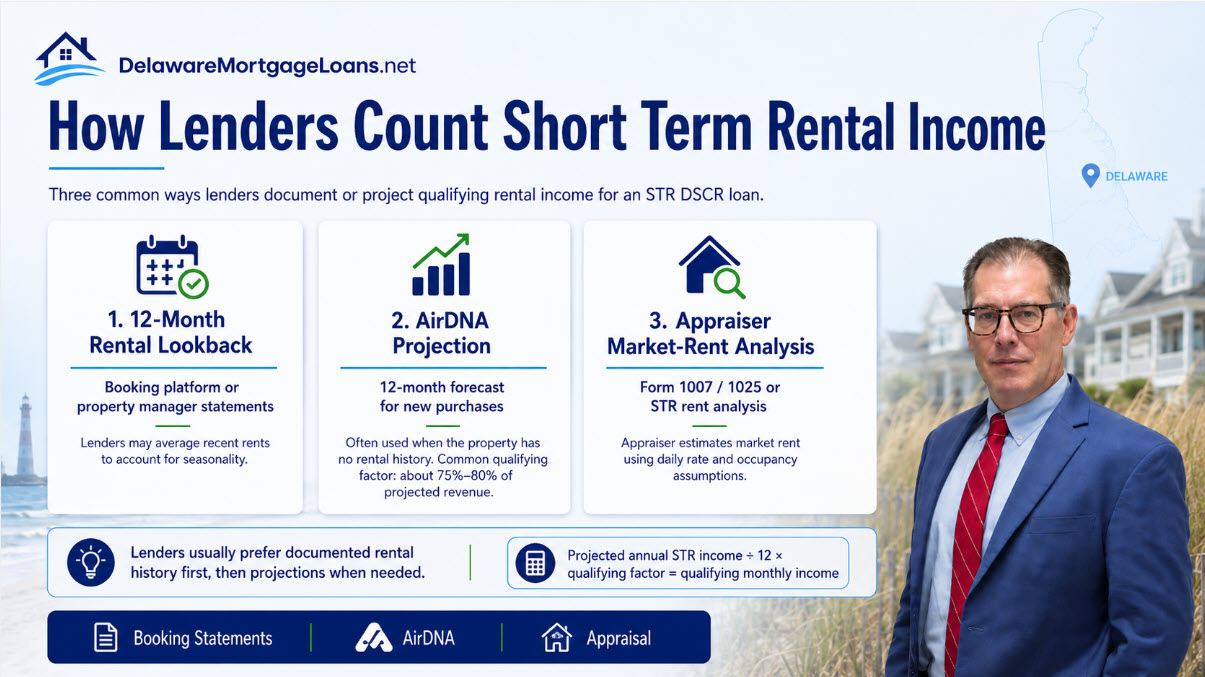
How Lenders Count Short-Term Rental Income
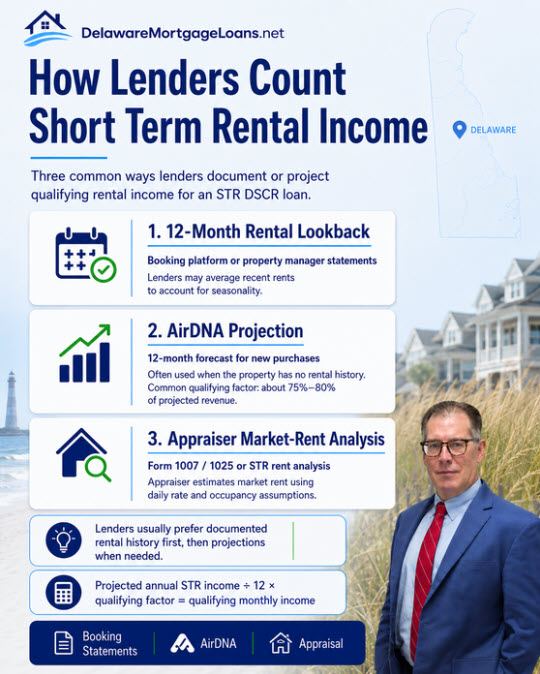
Across DSCR loans for short-term rentals, there are three main ways to document the rental income that drives your DSCR. Lenders generally give priority to documented history when it exists, and fall back to projections when it does not.
1. Twelve-month rental lookback
If the property already operates as a short-term rental, lenders can average the last 12 months of rents to account for seasonality. The income is documented with monthly or annual statements from the booking platform or a property manager, and on a refinance the borrower provides them, while on a purchase the seller provides them. If only six months of history exist because the property was recently acquired, some lenders will average what is available. The lookback usually has to be paired with an appraiser market-rent analysis so the lender can cross-check the numbers.
2. AirDNA projection
When a property has no rental history – for example, a new purchase that has not been operated as a short-term rental yet – lenders can use an AirDNA Rentalizer and Overview report to project income. Lenders that accept AirDNA generally require the forecast to cover 12 months, be dated within about 90 days of the note, include at least three comparable properties, and show a market score at or above 60. Most lenders then qualify on roughly 80 percent of the projected revenue. AirDNA is most commonly accepted on purchases; on refinances it is often limited to recently completed new construction or renovation.
3. Appraiser market-rent analysis
Lenders also accept the appraiser’s market rent from a Form 1007 or 1025, or an alternative short-term rental analysis that includes a daily rate and occupancy percentage. When the appraiser uses short-term rents, they are expected to address seasonality. Some lenders will let you qualify on the higher of the market-rent figure or the documented lookback, subject to a cap. The right method depends on the property’s history and which lender fits your file – that is part of what I sort out with you up front.
Which Properties Qualify for an STR DSCR Loan?
Most short-term rental DSCR programs are built for one-to-four-unit residential properties. The most commonly eligible property types across our lenders are single-family homes, townhomes, planned-unit developments, warrantable and non-warrantable condos, and condotels, plus 2-4 unit buildings with some lenders. A few program details to keep in mind:
- Condos and condotels are common at the beach, and many lenders allow them – but the condo association’s rules still have to permit short-term rentals, and condotels often carry their own loan-amount and credit-score limits.
- 2-4 unit short-term rentals are accepted by some lenders but not all. Several programs restrict short-term rental income to one-unit properties and condos, so a multi-unit STR may narrow your lender options.
- The property must be in a jurisdiction that allows short-term rentals. Many lenders now require evidence that the governing town or county permits nightly rentals – this is the single most important thing to confirm before you make an offer in Delaware.
- It has to be a true investment property. DSCR loans are for non-owner-occupied properties. If you plan to live in the home, a DSCR loan is not the right tool.
Short-Term Rental Investing at the Delaware Beaches
Sussex County’s coastal towns – Lewes, Rehoboth Beach, Dewey Beach, Bethany Beach, and Fenwick Island – are Delaware’s strongest short-term rental market, with peak summer demand that can drive high nightly rates from Memorial Day through Labor Day. That seasonality is exactly why lenders average a full 12 months of income and apply a coverage haircut: a property that books solid in July has to be underwritten knowing January is quiet. When I run your numbers, I am looking at the whole year, not just the peak weeks. My office is in Newark, about an hour and a half up the Route 1 corridor from the Sussex beaches, and I work with coastal investors remotely from application through closing – you do not need to come to the office.
Because DSCR loans for short-term rentals depend on income the property can legally earn, the most important local step is confirming that the town allows what you intend to do. Several Delaware beach towns license, cap, or restrict short-term rentals, and the rules change. Before you write an offer, verify the property’s town ordinance and any rental-license requirement – many lenders will ask for evidence that nightly rentals are permitted at that address. If you are weighing a beach-area purchase, our Milford and central-Sussex mortgage resource covers the wider region, and I am happy to talk through specific coastal towns by phone. Investors who run their finances through a business may also want to review our bank statement loan and self-employed mortgage options for any non-investment financing they need.
Before You Buy a Delaware Beach Rental
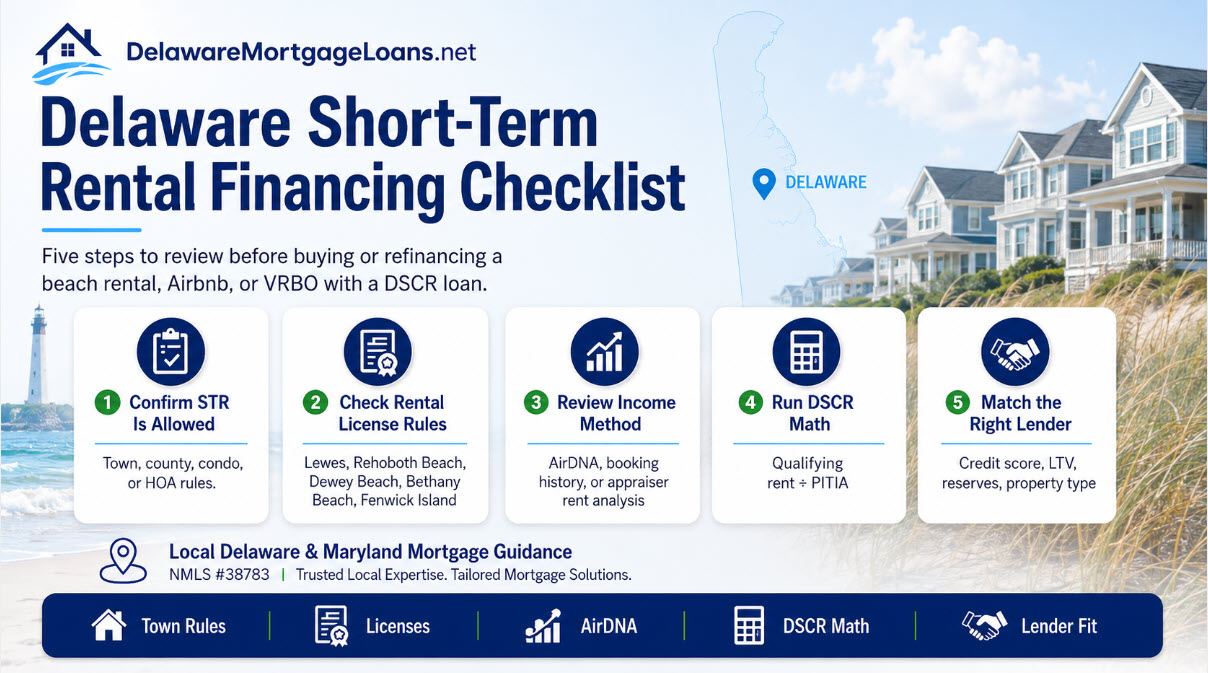
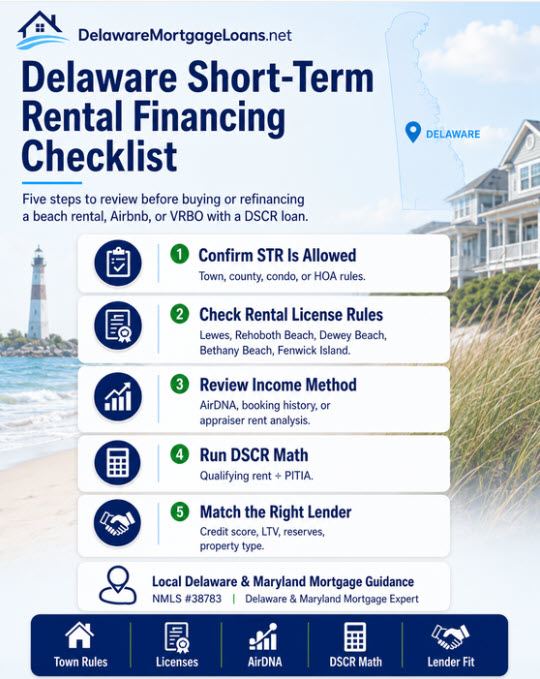
Here is how the main Delaware beach markets compare for investors weighing DSCR loans for short-term rentals, along with the local rules to confirm in each town before you write an offer:
| Delaware STR market | Why investors look there | Local due diligence (verify before offer) |
|---|---|---|
| Rehoboth Beach | Peak summer demand, boardwalk and walkability | Confirm rental license, any lodging/gross-rental tax, and condo/HOA short-term rules |
| Lewes | Historic town, beach access, family vacation demand | Confirm rental license and any local rental requirements |
| Dewey Beach | Nightlife and seasonal visitor demand | Confirm residential rental license and occupancy rules |
| Bethany Beach | Quieter family beach rental market | Confirm rental license and any gross-rental tax |
| Fenwick Island | Smaller beach market with vacation-rental appeal | Confirm town and HOA short-term-rental restrictions |
DSCR Loans for Short-Term Rentals vs. Conventional Financing
A conventional investment-property loan can also finance a rental, but it qualifies you on your personal income and debt-to-income ratio and limits how many financed properties you can carry. A short-term rental DSCR loan trades some loan-to-value and pricing for the ability to qualify on the property and to scale across many properties. Here is how they compare for a Delaware short-term rental:
| Feature | Short-Term Rental DSCR Loan | Conventional Investment Loan |
|---|---|---|
| Qualifies on | Property’s projected rental income | Your personal income and DTI |
| Tax returns required | Generally no | Yes |
| Short-term rental income used | Yes, with STR-specific documentation | Limited; conventional leans on long-term market rent |
| Number of financed properties | Designed to scale across many | Capped under agency limits |
| Typical max LTV | Up to ~80% purchase (with STR reduction) | Often higher LTV available |
| Best for | Active investors, self-employed owners, portfolio builders | W-2 buyers with one or two rentals and clean DTI |
If your tax returns support the property and you only own a couple of rentals, a Delaware conventional loan may cost less. If you are scaling a portfolio or your returns understate your real cash flow, the DSCR path usually wins. The right answer is specific to your situation, and that comparison is exactly what a quick call sorts out.
When DSCR Loans for Short-Term Rentals Are Not a Good Fit
DSCR loans for short-term rentals are powerful, but they are not the right tool for every buyer. Here are the scenarios where a different program usually serves you better:
- You plan to live in the property. DSCR loans are for non-owner-occupied investments only. If this is your primary or even a part-time second home you will personally occupy, look at conventional, FHA, or VA financing instead.
- The town does not allow short-term rentals. If the jurisdiction prohibits nightly rentals or your purchase would violate a condo association’s rules, the short-term income cannot be counted – and the deal may not work as planned.
- The property does not cover its payment and you want maximum leverage. If the DSCR is well below 1.00, your loan-to-value drops and pricing rises. A long-term rental strategy or a larger down payment may be the better move.
- You are a W-2 buyer with strong income and only one or two rentals. A conventional investment loan often offers higher loan-to-value and better pricing when your personal income and debt-to-income ratio already support the property.
- Your credit is below the program floor. Short-term rental DSCR programs across our lenders generally start at a 700 credit score. If you are below that today, it can be worth a short credit-improvement plan before applying.
How Do I Apply for a Delaware STR DSCR Loan?
The process for DSCR loans for short-term rentals is straightforward, and most of the work is on the property side rather than the personal-income side. Here is what to expect:
- Start with a quick conversation. Tell me the property, the town, your target purchase price or current value, your credit range, and how much you plan to put down or pull out.
- Confirm short-term rental is allowed. We verify the town or county permits nightly rentals and that any condo or HOA rules allow it.
- Choose the income method. Based on whether the property has a rental history, we pick a 12-month lookback, an AirDNA projection, or an appraiser market-rent analysis.
- Match the file to the right lender. Because guidelines vary, I align your credit score, loan amount, and projected coverage to the lender whose short-term rental program fits best.
- Order the appraisal and finalize documentation. The appraisal addresses market rent and seasonality; you provide reserves, entity documents if you are buying in an LLC, and the income documentation.
- Clear conditions and close. Once the DSCR and file requirements are satisfied, we move to closing.
New investors often start with our Delaware homebuyer resources for the basics, then move into DSCR financing as they build a portfolio. Whatever stage you are at, the fastest way to get a real answer is to call.
What John reviews on your short-term rental deal
Have these ready when you call and we can give you a fast read on whether the deal works:
- Property address and town
- Whether short-term rentals are allowed at that address
- HOA or condo association rental rules
- AirDNA projection or 12-month rental history
- Estimated PITIA (principal, interest, taxes, insurance, HOA)
- Your credit range
- Available reserves
- Down payment or cash-out goal
- Whether you are buying in an LLC
FAQ – Delaware Short-Term Rental DSCR Loans
Can I get a DSCR loan for an Airbnb in Delaware?
Yes. A short-term rental DSCR loan can finance an Airbnb or VRBO investment property in Delaware by qualifying on the property’s projected nightly rental income rather than your personal income. The property has to be a non-owner-occupied investment, the town has to allow short-term rentals, and most lenders apply a small loan-to-value reduction compared with a long-term rental because nightly income is seasonal.
What credit score do I need for a short-term rental DSCR loan?
Across the non-QM lenders the John Thomas Team works with, short-term rental DSCR programs generally start at a 700 minimum credit score as of June 2026. A higher score typically unlocks higher loan-to-value and better pricing. If you are below 700 today, a short credit-improvement plan before applying can meaningfully expand your options.
How much down payment do I need for an STR DSCR loan?
Down payment depends on loan-to-value, which for short-term rental purchases reaches up to about 80 percent for the strongest profiles, meaning roughly 20 percent down. Cash-out refinances usually cap lower, around 70 percent loan-to-value. Most short-term rental programs add about a 5 percent loan-to-value reduction versus a long-term rental because of seasonality, so plan for a slightly larger down payment than a standard long-term DSCR deal.
How do lenders calculate income if my property has no rental history?
When a property has no short-term rental history, lenders can use an AirDNA Rentalizer and Overview report to project income, typically requiring a 12-month forecast dated within about 90 days of the note, at least three comparable properties, and a market score of 60 or higher. Lenders generally qualify on roughly 80 percent of the projected revenue. AirDNA is most commonly accepted on purchases; on refinances it is often limited to recently completed new construction or renovation.
Do I need prior short-term rental experience to qualify?
It depends on the lender. Some lenders require a documented history of owning and operating a short-term rental, often 12 months of activity within the last 36 months, before they will count short-term rents. Other lenders do not require prior experience for a purchase. Documented experience tends to unlock the most favorable income treatment, so it can be worth establishing a track record on a first property.
Can I buy a short-term rental in an LLC?
Yes. DSCR loans commonly allow title to be held in an LLC or other business entity, which is one reason active investors prefer them. You will provide the entity’s formation documents and operating agreement, and a personal guarantee is typically required. Tell me up front if you plan to vest in an entity so we match you to a lender that supports it.
What happens if my Delaware beach town restricts short-term rentals?
If the town prohibits or has not licensed short-term rentals at that address, the short-term rental income generally cannot be used to qualify, and the property may need to be underwritten as a long-term rental or a different strategy entirely. Several Delaware coastal towns license or limit nightly rentals, so confirming the local ordinance and any rental-license requirement before you write an offer is the single most important step.
What is the minimum DSCR for a short-term rental loan?
A DSCR of 1.00, where the qualifying rent exactly covers the full PITIA payment, is the standard minimum. Some lenders allow a DSCR below 1.00, and a few offer no-ratio options where coverage is not the gate, but those come with a reduced loan-to-value and typically a higher credit-score requirement. The lower the coverage, the more equity the lender will expect you to bring.
Can I do a cash-out refinance on my existing Delaware short-term rental?
Yes. A cash-out refinance on a short-term rental is available, typically up to about 70 percent loan-to-value, using a 12-month rental history to document income. The property usually must be actively marketed as a short-term rental, and seasoning and reserve requirements apply. Cash-out proceeds generally cannot be used to pay off unrelated personal debt under some programs, so we confirm the use of funds up front.
How is a short-term rental DSCR loan different from a regular DSCR loan?
A regular DSCR loan usually qualifies on long-term market rent from an appraiser’s Form 1007 or a signed lease. A short-term rental DSCR loan qualifies on projected or documented nightly income from Airbnb, VRBO, or similar platforms, which requires extra documentation, a seasonality review, and usually a small loan-to-value reduction. Everything else – qualifying on the property, allowing LLC vesting, and scaling across properties – works the same way.

John R. Thomas
Branch Manager, Primary Residential Mortgage, Inc.
John Thomas has helped more than 3,000 Delaware buyers and investors finance homes and rental properties over a 20-plus-year career, including hundreds of investors building short-term and long-term rental portfolios across New Castle, Kent, and Sussex counties. He works with a network of non-QM lenders so investors can match each deal to the program that fits – whether that is a DSCR loan qualified on projected Airbnb income, a bank statement loan, or conventional financing.
A former physics teacher with a BS in Physics Education from the University of Delaware and an MS in Curriculum and Instruction from Delaware State University, John is known for explaining complex loan structures in plain language. He is the author of a published guide for Delaware homebuyers and a frequent host of free homebuyer education sessions.
Licensed in 17 states (AL, DC, DE, FL, GA, IN, KS, MD, MN, MO, NC, NJ, OH, PA, SC, TN, VA). NMLS #38783. Read more about John on his loan officer bio page.
248 E Chestnut Hill Rd, Newark, DE 19713 | 302-703-0727 | Schedule Appointment | YouTube
Finance Your Delaware Short-Term Rental With Confidence
Whether you are buying your first Airbnb at the beach or refinancing a VRBO portfolio, John matches your deal to the right lender for DSCR loans for short-term rentals and gives you a clear path to closing.
Last Updated: June 2026. Mortgage content reviewed by John R. Thomas, NMLS #38783.
John Thomas, NMLS #38783 | Branch NMLS #106170 | Primary Residential Mortgage, Inc., NMLS #3094 | 248 E Chestnut Hill Rd, Newark, DE 19713 | 302-703-0727 | delawaremortgageloans.net. Loan programs, guidelines, and the most favorable terms described on this page vary by lender and are subject to change, credit approval, property eligibility, and current lender matrices; the figures shown are a composite of the most favorable terms available across the John Thomas Team lender network and are not an offer, rate, or guarantee of approval. Copyright John R. Thomas, All Rights Reserved.
