Delaware USDA Manufactured Home Loans: Zero Down, Home Age Rules & How to Qualify in 2026
Delaware USDA manufactured home loans are zero-down USDA Section 502 Guaranteed mortgages for a manufactured home on a permanent foundation, legally part of the land, in a USDA-eligible area. New homes and, since 2025, existing homes built within 20 years of closing that were never moved can qualify, within county income limits. Current as of October 2026.
I’m John Thomas, NMLS #38783, and I wrote this page for Delaware buyers who want to know one thing fast: can a USDA loan buy this manufactured home with no money down? The answer depends less on you and more on the home – how old it is, whether it has ever been moved, what it sits on, and whether the land comes with it. USDA’s rules changed in 2025 to allow many existing manufactured homes, so a home that didn’t qualify a couple of years ago may qualify now. If you’re new to USDA, start with our guide to Delaware USDA Rural Housing loans, and if you’re comparing every way to finance a manufactured home, our Delaware manufactured home loans guide lays out the options side by side.
Find Out if Your Manufactured Home Qualifies for USDA
Send us the address and the home’s year and we’ll check the USDA map, the home’s age and your household income before you write an offer – or start with our quick property check.
Table of Contents
What Is a USDA Manufactured Home Loan in Delaware?
A USDA manufactured home loan is a Section 502 Guaranteed mortgage used to buy a manufactured home and its land as one piece of real estate. A private lender makes the loan and USDA Rural Development guarantees it, so eligible buyers in USDA-eligible Delaware areas can finance up to 100% of the appraised value.
It is the same USDA Guaranteed program used for site-built homes, with extra property rules for the home itself. The home has to be permanently attached to a foundation and treated as real property – legally part of the land, not a vehicle or personal property. That is the line between a USDA mortgage and a chattel loan, which finances the home alone.
The everyday benefits carry over: no down payment, a 30-year fixed rate, a 1% upfront guarantee fee that can be financed, and a 0.35% annual fee that runs below FHA’s monthly mortgage insurance on most loans. The two USDA filters carry over too – the property must be in a USDA-eligible area, and your household income must be at or below the county limit.
This page covers the USDA Guaranteed program, where an approved lender like the John Thomas Team makes the loan. USDA also runs a separate Direct program that lends to lower-income households through Rural Development itself, with its own income and loan limits – our USDA Rural Housing loans guide compares the two.
Which Manufactured Homes Qualify for a USDA Loan?
A manufactured home generally qualifies for USDA when it carries a HUD certification label and data plate, has at least 400 square feet, sits on a certified permanent foundation, has never been installed on another site and is legally part of the land. A new home must be built within 12 months of closing; an existing one, within 20 years.
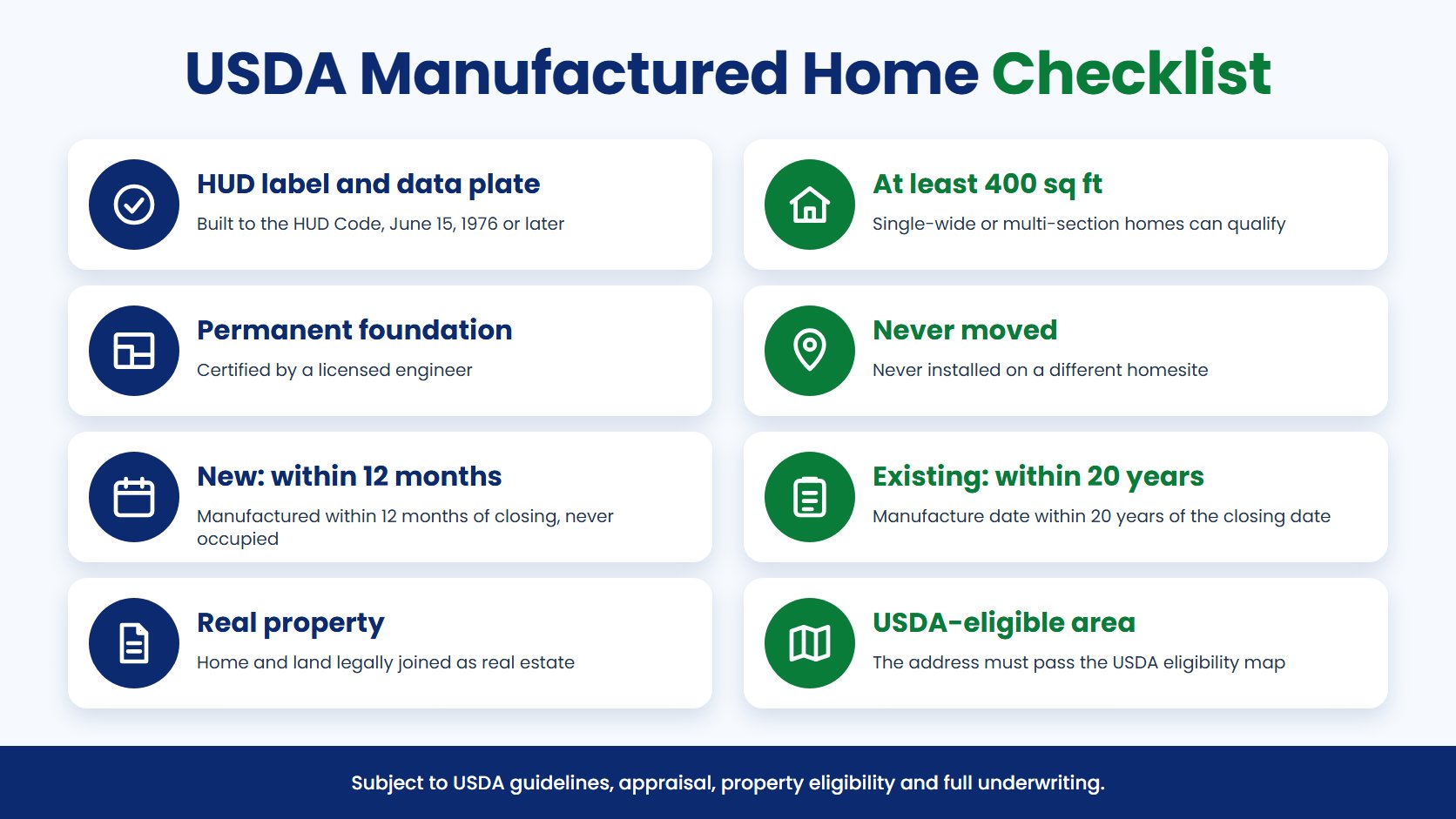
These are USDA’s program rules as of October 2026. Here is what each one means when you are looking at a specific home:
- Built to the HUD Code: the home must meet the Federal Manufactured Home Construction and Safety Standards, shown by the HUD certification label on each section and the HUD data plate inside. Homes built before the HUD Code took effect on June 15, 1976 – often called mobile homes – are not eligible.
- Size: at least 400 square feet of floor area. USDA’s rule does not limit the program to double-wides, and we follow USDA’s rule: a single-wide or a multi-section home can qualify with us when it meets the 400 square foot minimum and every other rule here. Some lenders add their own width or size limits, so a single-wide turned down elsewhere may still be worth a second look.
- Permanent foundation: installed to the manufacturer’s requirements and HUD installation standards, with a certification that the foundation is proper – in practice, a licensed engineer’s foundation certification.
- Never moved: the home cannot have been installed on a different homesite before. A home that went from the factory or dealer to its current site is fine; a home relocated from a park or another lot is not.
- No major alterations: nothing changed since the factory except porches, decks or similar structures built to engineered designs and approved and inspected by local code officials.
- Energy standard: the home must meet or exceed the HUD Code thermal (Uo value) zone for its area.
- Real property: the home and land must be legally joined as real estate, not titled separately as personal property, and the title insurance policy must include an ALTA 7 manufactured home endorsement.
- USDA-eligible location: the address must pass the USDA eligibility map, the same as any USDA home.
| Rule | New manufactured home | Existing manufactured home |
|---|---|---|
| Age | Manufacture date within 12 months of loan closing | Manufacture date within 20 years of loan closing |
| Occupancy and moves | Never occupied, never installed at another site | Never installed on a different homesite |
| HUD label and data plate | Required | Required |
| Minimum size | 400 sq ft | 400 sq ft |
| Foundation | Permanent, with foundation certification | Permanent, with foundation certification |
| Alterations | None | Only porches, decks or similar, code-approved |
| Common way to finance | USDA purchase, or USDA construction-to-permanent loan for land + home + setup | USDA purchase loan |
One clarification that saves a lot of confusion: a modular home is built to state and local building codes, not the HUD Code, and is generally financed like a site-built house rather than under these manufactured home rules.
Answer what you know about the home. Nothing you enter is sent or saved – it stays in your browser. This is a preliminary property screen, not a loan application, credit check or approval.
Can You Get a USDA Loan on an Existing Manufactured Home?
Yes, since 2025. USDA’s Guaranteed program can finance an existing manufactured home when its manufacture date is within 20 years of the loan closing date, it has never been installed on another homesite, and it meets the foundation, size, alteration and HUD label rules. Before the change, most used manufactured homes were not eligible.
USDA published the rule change in the Federal Register in January 2025, and it took effect on May 5, 2025; USDA Rural Development’s August 2025 lender bulletin on existing manufactured homes lists the age, size, foundation and never-moved requirements. Older articles – and some lender pages that haven’t been updated – still say USDA only finances brand-new manufactured homes. That was true for most of the country before the change, but it isn’t the rule now.
The 20 years is counted from the manufacture date on the data plate to the day the loan closes, not to the day you sign the contract. That matters for homes close to the line.
Let’s say a Sussex County double-wide has a data plate showing it was manufactured in November 2006. If the loan closes in October 2026, the home is just under 20 years old and can still meet USDA’s age rule. If the closing slips into December 2026, it no longer does. When a home is within a few months of the line, we build the closing date into the contract timeline. Illustrative example only, not a loan offer or commitment.
In my experience, the rule that stops existing manufactured home deals most often isn’t the age – it’s the “never moved” rule. A home that was set up in a park years ago and later hauled to a private lot can look perfect, sit on a new foundation, and still be ineligible, and the seller often doesn’t know the history. That’s why I ask for the data plate, the HUD label numbers and any setup or permit records before you write an offer, not after the appraisal.
Documents to Ask for Before You Make an Offer
- The HUD data plate: a paper label inside the home, often near the electrical panel or in a cabinet or closet, showing the manufacture date and the thermal zone.
- The HUD certification label numbers: the metal tag on the outside of each section of the home.
- Setup and permit records: proof the home has stayed on the site where it was first installed.
- Any foundation certification: if the seller has an engineer’s certification, ask for it; if not, one will be ordered during the loan.
- The deed and property tax bill: showing the home and land are owned and taxed together as real property.
Without these, the same information has to be tracked down during the purchase, which can cause delays – or a denied loan if it can’t be obtained.
Do You Have to Own the Land for a USDA Manufactured Home Loan?
In almost every case, yes. The home and the land must be financed together as real estate, so homes on rented lots in a manufactured home park generally do not qualify. USDA allows a land lease only in narrow cases, such as a lease running at least 45 years past closing, which most park leases do not.
Buyers usually fit one of three situations:
- Buying a manufactured home that already sits on its own lot. This is a standard USDA purchase, as long as the home and the address pass the rules above.
- Buying land and placing a new manufactured home. A USDA one-time-close construction loan can combine the land, the home, delivery, the foundation and setup into one loan with one closing.
- Buying a home in a park or on a rented lot. USDA usually won’t work here. A chattel loan is the common path – see our guide to mobile home loans on leased land.
If you already own a lot and are weighing how to buy or build on it, our page on Delaware land loans covers the land side.
What Are the Borrower Requirements for a USDA Manufactured Home Loan?
Borrowers generally need household income at or below the USDA limit for the county, a payment near 29% of gross monthly income with total debts near 41%, and the home as their primary residence. USDA sets no fixed minimum credit score, but lenders do; the John Thomas Team’s minimum is 600.
The borrower rules are the same as for any USDA home. These are program guidelines, not a promise of approval:
- Credit score: USDA’s handbook sets no fixed minimum, and lenders set their own. Our minimum for a USDA manufactured home loan is a 600 credit score, as of October 2026. At 640 and above, with an Accept recommendation from USDA’s Guaranteed Underwriting System (GUS), a file generally gets a streamlined credit review; from 600 to 639, or without an Accept, credit is reviewed manually and the rest of your profile – payment history, debts and savings – carries more weight. A 600 score is a starting point, not a promise of approval.
- Debt ratios: housing payment (principal, interest, taxes, insurance and the USDA annual fee) generally near 29% of gross monthly income, and total debts near 41%. Higher ratios may be approved with compensating factors.
- Household income: USDA counts the income of every adult in the household, not just the borrowers, and allows deductions such as for dependents and childcare.
- Occupancy and status: the home must be your primary residence, and you must be a U.S. citizen, U.S. non-citizen national or qualified alien.
| Delaware County | 1-4 person household | 5-8 person household |
|---|---|---|
| New Castle County | $141,100 | $186,300 |
| Kent County | $123,900 | $163,550 |
| Sussex County | $123,350 | $162,850 |
The full breakdown of the income test, the eligible-area maps for each county and the towns that lost eligibility is on our USDA Rural Housing loans page. You can check any address yourself on the USDA Property Eligibility site.
What Does a USDA Manufactured Home Loan Cost Up Front?
As of October 2026, a USDA manufactured home purchase needs no down payment. It carries a 1% upfront guarantee fee, which can be financed into the loan, and a 0.35% annual fee paid monthly. Closing costs still apply, but the seller may contribute up to 6% of the price toward them.
- Down payment: $0 for eligible buyers – USDA can finance up to 100% of the appraised value.
- Upfront guarantee fee: 1% of the loan amount, usually rolled into the loan.
- Annual fee: 0.35% of the balance per year, collected monthly – lower than FHA’s 0.55% annual mortgage insurance on most loans.
- Manufactured-home extras: expect a foundation certification and, on many files, a more involved appraisal. If the appraisal comes in above the price, eligible closing costs may be financed.
Let’s say a buyer is purchasing a $220,000 manufactured home on its own lot in a USDA-eligible part of Kent County. With USDA, the down payment can be $0. The 1% guarantee fee would be about $2,200, which can be financed, making the loan about $222,200. The annual fee would run about $65 a month in the first year. Closing costs and prepaid items still apply, and a seller contribution or gift funds can help cover them. Approval still depends on credit, income, debts, the home and USDA guidelines. Illustrative example only, not a loan offer or commitment.
How Does USDA Compare to FHA and VA for a Manufactured Home?
USDA and VA can both finance a Delaware manufactured home with no down payment, but only USDA has an income limit and an eligible-area map. FHA needs 3.5% down and works anywhere in Delaware. For buyers who fit both USDA filters, USDA’s 0.35% annual fee usually costs less each month than FHA’s.
| Feature | USDA | FHA | VA |
|---|---|---|---|
| Minimum down payment | 0% | 3.5% | 0% |
| Who it is for | Low-to-moderate income, USDA-eligible area | Most buyers, including lower credit | Eligible veterans and service members |
| Income limit? | Yes – county limit | No | No |
| Location limit? | Yes – USDA-eligible area only | No | No |
| Loan limit | None – capped by income, debts and appraised value | County FHA loan limit applies | No limit with full entitlement |
| Upfront fee | 1% guarantee fee | 1.75% MIP | VA funding fee (varies; waived for many disabled veterans) |
| Annual / monthly insurance | 0.35% | 0.55% (most loans) | None |
| Existing (used) manufactured home | Yes, within 20 years of closing and never moved | Yes, subject to FHA property rules | Yes, subject to VA property rules |
For details on the other two programs, see Delaware FHA manufactured home loans and VA manufactured home loans. A veteran who qualifies for both usually comes out ahead with VA, because it has no income limit, no eligible-area map and no monthly mortgage insurance.
How Does the USDA Manufactured Home Loan Process Work?
A Delaware USDA manufactured home purchase moves through seven steps: check the address, test household income, confirm the home qualifies, get pre-approved, complete the appraisal and foundation certification, get lender and USDA approval, then close. Many USDA purchases close in roughly 30 to 45 days from a complete application.
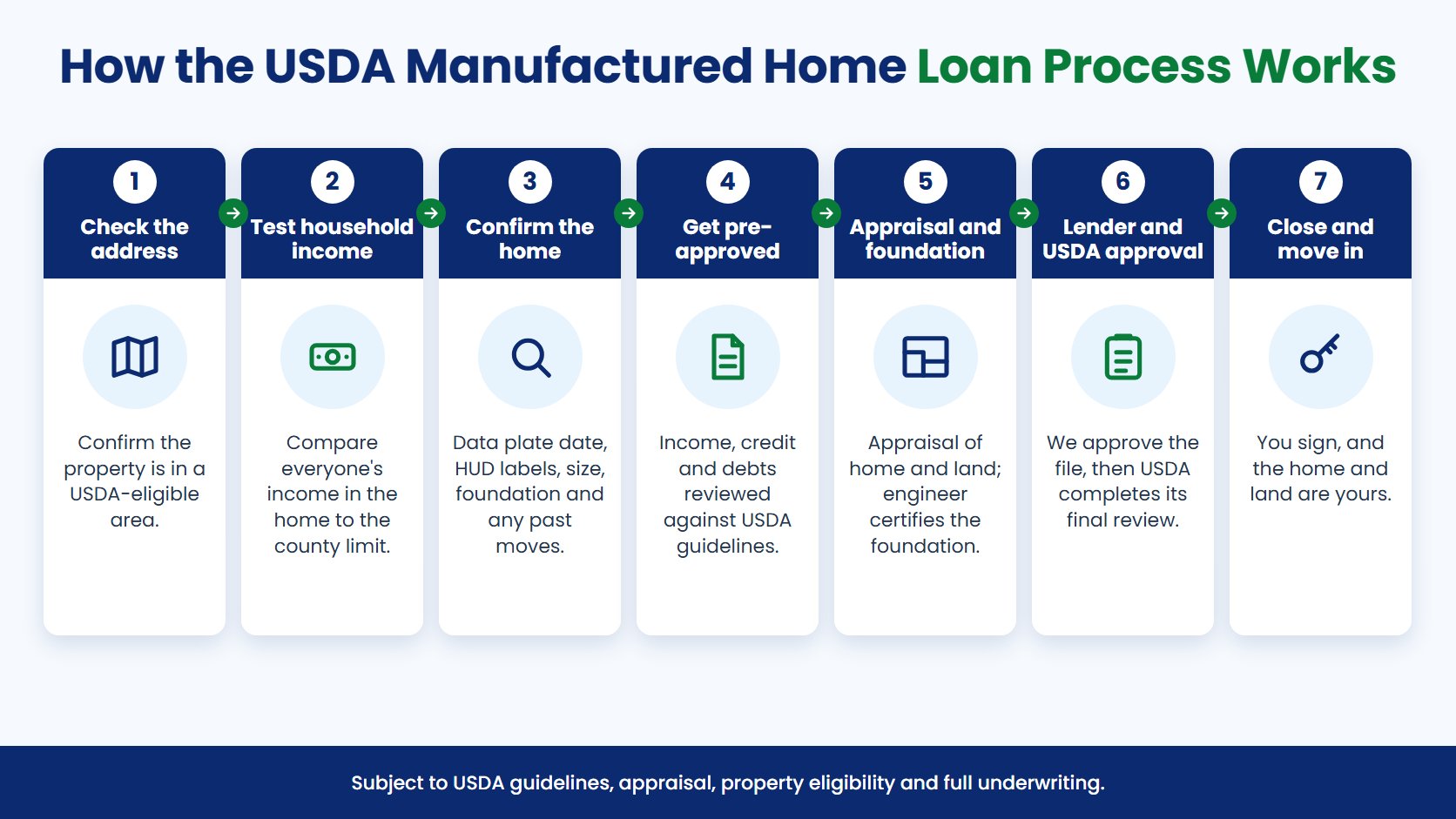
The John Thomas Team handles your file from application through underwriting. Our underwriting is local and typically takes 24 to 48 hours on a complete file; then USDA puts its final approval on the loan. A foundation certification or a missing data plate can add time, which is why we confirm the home first:
- Check the address. Confirm the property is in a USDA-eligible area.
- Test household income. Compare everyone’s income in the home to the county limit.
- Confirm the home. Data plate date, HUD labels, size, foundation, and whether it has ever been moved.
- Get pre-approved. We review your income, credit and debts and issue your pre-approval.
- Appraisal and foundation certification. The appraiser values the home and land; a licensed engineer certifies the foundation.
- Lender and USDA approval. We approve the file, then USDA completes its final review.
- Close and move in. You sign, and the home and land are yours.
When a USDA Manufactured Home Loan Is Not a Good Fit
USDA can be the lowest-cost way into a manufactured home, but it is generally not the right tool if:
- The home is on a rented lot or in a manufactured home park – a chattel loan usually fits instead (leased-land options).
- The home has ever been moved to a second site, or its manufacture date is more than 20 years before your closing date – an FHA manufactured home loan may still work, depending on the home.
- The home was built before June 15, 1976, or is missing its HUD label and data plate with no way to verify them.
- The address is outside the USDA-eligible area or your household income is over the county limit – FHA or conventional financing usually fits.
- You are an eligible veteran – a VA manufactured home loan often costs less.
Delaware USDA Manufactured Home Loans – FAQ
Can I use a USDA loan for a manufactured home in Delaware?
Yes, when the home and the land both qualify. The home has to be on a permanent foundation, legally part of the land as real estate, at least 400 square feet, built to the HUD Code with its label and data plate, and never installed on another site. The address has to be in a USDA-eligible area, and your household income has to be at or below the county limit. New homes must be manufactured within 12 months of closing; existing homes, within 20 years.
What credit score do I need for a USDA manufactured home loan?
USDA itself sets no fixed minimum credit score, but lenders set their own. With the John Thomas Team, the minimum for a USDA manufactured home loan is a 600 credit score, as of October 2026. A score of 640 or higher with an Accept recommendation from USDA’s automated underwriting system generally gets a streamlined credit review, while files from 600 to 639, or without an Accept, are reviewed manually, so payment history, debts and savings carry more weight. A qualifying score is a starting point, not a promise of approval.
Can I buy a manufactured home in a park with a USDA loan?
Usually not. USDA finances the home and the land together as real estate, so a home on a rented lot in a manufactured home park generally doesn’t qualify. USDA allows a land lease only in narrow cases, such as a lease running at least 45 years past closing, which most park leases don’t meet. For a home on leased land, a chattel loan is the common path – see our guide to mobile home loans on leased land.
Can a manufactured home that was moved qualify for USDA?
No. USDA requires that the home has never been installed on a different homesite. Moving a home from the factory or dealer to its first site is expected and allowed, but a home that was set up somewhere else and later relocated is not eligible, even if it now sits on a new permanent foundation. Setup records, permits and the seller’s history of the home usually answer the question, and it’s worth asking before you write an offer.
Does USDA finance single-wide manufactured homes?
Yes, when it meets the rules. USDA doesn’t limit the program to double-wides – the home needs at least 400 square feet of floor area and has to meet every other manufactured home rule, and we follow USDA’s rule rather than adding a width limit. Some lenders do add their own width or size requirements, so a single-wide that was turned down elsewhere may still qualify with us. Send us the home’s size and data plate details and we’ll tell you where it stands.
Can USDA finance the land and a new manufactured home together?
Yes. A USDA one-time-close construction loan can combine the lot, the new manufactured home, delivery, the foundation and setup into one loan with one closing, keeping the zero-down advantage for buyers and properties that qualify. The home has to be new – manufactured within 12 months of closing and never installed anywhere else – and the lot has to be in a USDA-eligible area.
What if the manufactured home is missing its HUD label or data plate?
USDA uses the HUD certification label and the HUD data plate as proof the home was built to federal standards, so a missing one has to be resolved before closing. HUD’s label contractor can issue a label verification letter, and a replacement data plate can sometimes be obtained from the manufacturer or HUD’s contractor. Whether the replacement documentation is accepted is part of the lender and USDA review, so we check this at the start.
Is a mobile home built before 1976 eligible for USDA?
No. USDA’s manufactured home rules apply only to homes built to the federal HUD Code, which took effect on June 15, 1976. Homes built before that date – usually called mobile homes – don’t carry a HUD certification label and are not eligible for USDA financing. If you’re buying an older home, a chattel loan or a cash purchase is usually the only route, and we can talk through what that looks like.
Do USDA manufactured home loans have mortgage insurance?
USDA loans don’t have private mortgage insurance, but they carry two USDA guarantee fees that work like it. As of October 2026, there is a 1% upfront guarantee fee, which can be financed into the loan, and a 0.35% annual fee paid monthly as part of your payment. That annual fee is lower than FHA’s 0.55% annual mortgage insurance on most loans, which is a big reason USDA payments often come in lower for eligible buyers.
About the Author – John R. Thomas

John R. Thomas is Branch Manager and Division Vice President with the John Thomas Team in Newark, Delaware, and has helped Delaware families finance homes for more than 20 years. On a manufactured home purchase, John recommends asking for the data plate, the HUD labels and the home’s move history up front. Without them, that information has to be tracked down during the purchase, which can cause delays – or a denied loan if it can’t be obtained.
John holds a BS in Physics Education from the University of Delaware and an MS in Curriculum and Instruction from Delaware State University. He is the author of Your Guide to Buying Your First Home in Delaware and a frequent host of Delaware home buyer seminars. State licensing: Look up John R. Thomas, NMLS #38783, on NMLS Consumer Access. Read more on his loan officer bio page.
Years 3,000+
Buyers Helped 1,000+
Govt Loans DE & MD
Service Area CMP
Certified Mortgage Planner
John Thomas Team with AnnieMac Home Mortgage
248 E Chestnut Hill Rd, Newark, DE 19713 | 302-703-0727 | team@johnthomasteam.com
Schedule Appointment (30 min)
See John Thomas Team on Google for reviews, directions, and local office information.
YouTube | Facebook | Instagram | TikTok | X / Twitter | LinkedIn

Send us the address and the home’s data plate year. We’ll check the USDA map, the home’s eligibility and your household income – and if USDA isn’t the fit, we’ll line up the program that is.
Last Updated: October 2026 · John Thomas Team with AnnieMac Home Mortgage · Mortgage content reviewed by John R. Thomas, NMLS #38783.
John R. Thomas, NMLS #38783 | John Thomas Team with AnnieMac Home Mortgage | AnnieMac Home Mortgage NMLS #338923 | 248 E Chestnut Hill Rd, Newark, DE 19713 | 302-703-0727 | delawaremortgageloans.net
AnnieMac Home Mortgage is an Equal Housing Lender. State licensing: Look up John R. Thomas, NMLS #38783, on NMLS Consumer Access.
(c) Copyright John R. Thomas, All Rights Reserved.
