Delaware Land Loans: Finance Vacant Land and Lots
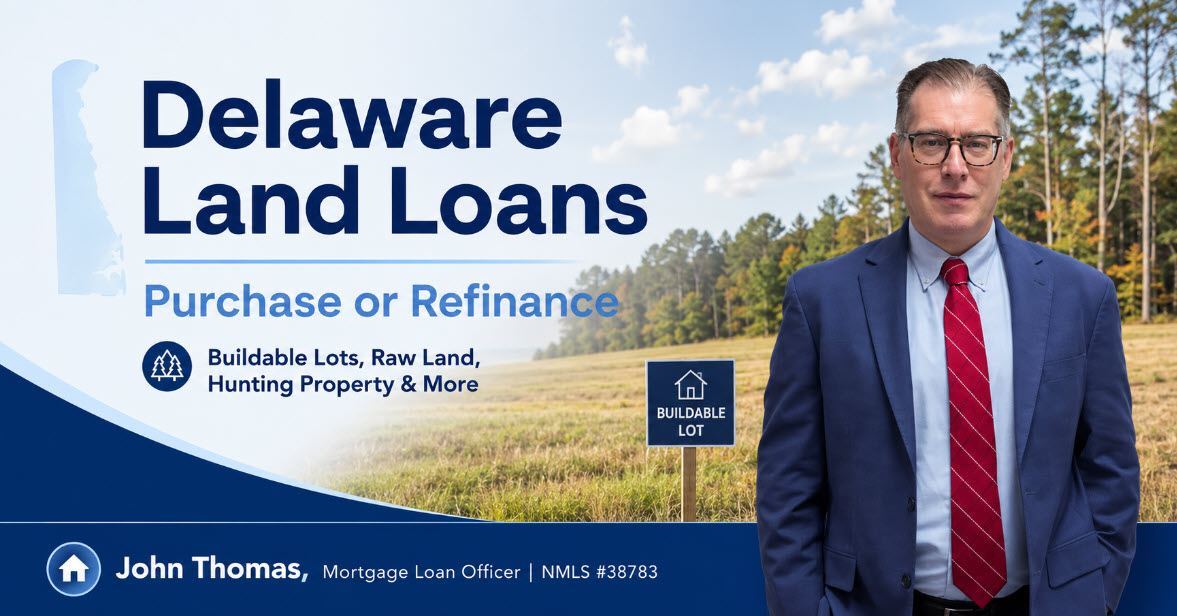
Delaware land loans let you finance vacant land, building lots, and recreational acreage that does not yet have a home on it – so you can build later or simply own the land now. John Thomas (NMLS #38783) at Primary Residential Mortgage in Newark offers two fixed-rate land loan options: a 10-year program for investment and future-build residential land, and a 20-year program with larger loan amounts. Current as of June 2026. Mortgage content reviewed by John R. Thomas, NMLS #38783.
If you are buying land in Delaware, you have probably already learned that a regular mortgage will not finance a vacant lot. I am John Thomas, NMLS #38783, and the team at AnnieMac Home Mortgage in Newark has helped buyers across New Castle, Kent, and Sussex Counties finance raw land, building lots, and recreational acreage for more than 20 years. Whether you want to lock in a lot today and build a home down the road, or you are an investor acquiring residential land to hold, a Delaware land loan can make it possible. If you already know you want to buy the land and build right away, a one-time close construction loan is usually the better path – more on that below. You can start a land loan by calling 302-703-0727 or applying online.
Talk Through Your Delaware Land Loan Options
A quick look at the lot, zoning, credit, and down payment usually tells us which program fits – and what it takes to qualify.
In this short video, John Thomas explains how Delaware land loans work, when they make sense, and when a construction loan may be the better fit.
Table of Contents
Delaware Land Loan Requirements at a Glance
Delaware land loan requirements (current as of June 2026). Eligible borrowers may be able to finance vacant land, a building lot, or recreational acreage in Delaware with one of two fixed-rate programs. Final approval always depends on credit, equity, the appraisal, reserves, property type, and the full underwriting review.
10-Year Fixed (investment / future-build residential land): 680 minimum credit score, up to 80% LTV, $50,000-$500,000, up to 20 acres, non-owner-occupied only, residential highest-and-best-use, 20% borrower contribution from your own funds, no requirement to build, no prepayment penalty.
20-Year Fixed (Non-QM, larger loans): 660 minimum credit score, up to 65% LTV (60% cash-out), $100,000-$1,200,000, no acreage limit and no land-type restriction – raw land, unimproved land, hunting and recreational property, and agricultural land may be eligible when the appraisal supports the value and the file meets full underwriting guidelines, no requirement to build, no prepayment penalty.
What Is a Delaware Land Loan?
A Delaware land loan is a loan used to finance the purchase of vacant land, a building lot, or recreational acreage that does not yet have a home on it. Also called a vacant land loan or lot loan, it fills a gap that ordinary home financing leaves open: conventional mortgages backed by Fannie Mae and Freddie Mac, along with FHA, VA, and USDA loans, are designed around a completed dwelling, so they generally cannot be used to buy bare ground. A Delaware land loan lets you own the land today and build later, or simply hold it. Because land without a structure is harder to value and harder to sell than a finished home, land loans use shorter terms, lower loan-to-value limits, and stronger credit and down payment requirements than a typical home loan, and the rate is usually higher. The two programs below cover most Delaware land scenarios.
Delaware Land Loan Options: 10-Year vs 20-Year Fixed
We offer two fixed-rate Delaware land loan programs. The 10-year fixed program is built for investment and future-build residential land – non-owner-occupied parcels you intend to develop into a one-to-four-unit home down the road – and allows a higher loan-to-value with a shorter payoff. The 20-year fixed program offers larger loan amounts and lower monthly payments at a more conservative loan-to-value, and it is the program most buyers use when they want to hold a lot, refinance land they already own, or pull cash out. The table below shows how they compare. Final eligibility on either program depends on credit, the property, and the full underwriting review.
| Feature | 10-Year Fixed Land Loan | 20-Year Fixed Land Loan |
|---|---|---|
| Best for | Investment / future-build residential land (non-owner-occupied) | Holding a lot, larger loan amounts, refinance, or cash-out |
| Term | 10-year fixed, principal and interest | 20-year fixed, principal and interest |
| Loan amount | $50,000 to $500,000 | $100,000 to $1,200,000 |
| Minimum credit score | 680 | 660 |
| Max LTV – purchase or rate/term refinance | Up to 80% | Up to 65% |
| Max LTV – cash-out refinance | Not offered on this program | Up to 60% |
| Acreage limit | Up to 20 acres | No acreage limit (appraisal must support value) |
| Eligible land types | Residential-use lots; agricultural, recreational, or unclassified land allowed only with a residential highest-and-best-use appraisal (2% rate add-on) | Raw, unimproved, improved, recreational, hunting, and agricultural land – no land-type restriction (appraisal must support value) |
| Occupancy | Investment / non-owner-occupied only | Vacant land – build later or hold |
| Prepayment penalty | None | None |
| Requirement to build | None | None |
Example: buying a $200,000 Delaware lot. Land loans need more money down than a regular mortgage because the loan-to-value limits are lower. Here is roughly what a buyer would bring on each program (before closing costs):
- 10-year program (up to 80% LTV): finance up to about $160,000, bring about $40,000 of your own funds.
- 20-year program (up to 65% LTV): finance up to about $130,000, bring about $70,000.
What this means for you: the exact down payment depends on the appraised value, your credit, reserves, and program fit. This is a simplified illustration of equity, not a payment quote – we review the lot, zoning, and your numbers before recommending a program.

10-Year Fixed Land Loan Guidelines
The 10-year fixed land loan is a manually underwritten program for buyers acquiring residential land as an investment. The loan purpose must reflect residential investment use – the lot must be a parcel where a one-to-four-unit home could be built in the future – and there is no requirement to build right away. Buyers who meet the credit, down payment, reserve, property, and appraisal guidelines below may qualify, but final approval always depends on the full underwriting review.
- Term: 10-year fixed rate, principal and interest, no prepayment penalty
- Loan amount: $50,000 minimum to $500,000 maximum
- Minimum credit score: 680
- Maximum loan-to-value: up to 80% for qualified borrowers (purchase or refinance)
- Minimum borrower contribution: 20% from the borrower’s own funds (gift funds are not used as reserves on this program)
- Occupancy: investment / non-owner-occupied only – primary residences and second homes are not eligible
- Acreage: maximum 20 acres
- Intended future use: construction of a one-to-four-unit residential dwelling (no immediate build requirement)
- Eligible borrowers: U.S. citizens and permanent resident aliens; non-occupant borrowers, tenancy-in-common, and property held in an LLC are allowed (a personal guarantee is required on LLC-held loans)
- Reserves: generally none required below 50% LTV; about 3 months at 50.01% to 65% LTV; about 6 months above 65% LTV (from the borrower’s own funds)
- Property tax escrow required; title insurance required
- Available for purchase or refinance; first lien only
Lot eligibility is determined primarily by the appraisal, including zoning and the appraiser’s analysis of highest and best use. Residentially zoned lots and lots in areas with no formal zoning are eligible when the appraisal supports residential use, with no rate add-on. Lots zoned agricultural, recreational, or unclassified (raw land, forest, timber, future development) can still be considered when the appraisal documents residential highest and best use – but a 2.00% rate add-on applies and income from the land may not be used to qualify. Land that could produce income may be eligible only as a non-owner-occupied residential investment, with no value attributed to any commercial or business use, and the transaction may not reflect commercial acquisition intent.
20-Year Fixed Land Loan Guidelines
The 20-year fixed land loan is our Non-QM program for buyers who want a larger loan amount, a longer term that may mean a lower monthly payment than a shorter-term land loan (depending on loan amount, rate, and final terms), or the ability to refinance or pull cash out of land they already own. It carries a more conservative loan-to-value than the 10-year program in exchange for the longer term and higher loan ceiling.
- Term: 20-year fixed rate, principal and interest, no prepayment penalty
- Loan amount: $100,000 minimum to $1,200,000 maximum
- Minimum credit score: 660
- Maximum loan-to-value: up to 65% on a purchase or rate-and-term refinance
- Cash-out refinance: up to 60% loan-to-value
- No acreage limitation (the appraisal must support the value)
- No requirement to build
- No subdividing the land while the land loan holds the lien
- Gift funds and un-sourced funds are not eligible on a purchase land loan
- To refinance, you generally must have owned the land for at least 2 years
What Types of Land Can You Finance in Delaware?
The two programs differ a lot on what kind of land they will finance. The 20-year program has no land-type restriction – raw land, unimproved land, improved lots, recreational and hunting property, and agricultural land may be eligible, with no acreage limit, as long as the appraisal supports the value and the file meets full underwriting guidelines. The 10-year program is narrower: it is built for residential-investment land, so the lot must support a residential highest-and-best use, is capped at 20 acres, and agricultural, recreational, or unclassified parcels qualify only with a 2% rate add-on. Eligible land generally includes:
- Individual residential building lots (both programs)
- Recreational and hunting land (no restriction on the 20-year program; allowed on the 10-year program with a residential highest-and-best-use appraisal and a rate add-on)
- Raw, unimproved, or improved land (the 20-year program finances all three with no land-type limit; the 10-year program requires residential use)
- Agricultural and unclassified acreage (no acreage cap on the 20-year program; up to 20 acres with a 2% add-on on the 10-year program)
A few property situations are difficult on either program – these are about use class and access, not rural land character, so the 20-year program’s flexibility does not extend to them. They generally include:
- Landlocked lots (no legal access) and leasehold land
- Commercial property (retail, office, restaurants, service businesses)
- Industrial property (factories, distribution centers, storage facilities)
- Mixed-use parcels combining residential and commercial
- RV lots and campgrounds operated as a business, and parcels containing or adjacent to environmental hazards
A land loan can sometimes be used on a parcel that has an existing structure, but only when the appraisal assigns the structure no contributory value – the loan-to-value is calculated on the land alone. If the appraisal attributes any value to a building or improvement, that scenario falls outside the land loan program. Flood insurance is required only when an existing structure is present and the property sits in a special flood hazard area; on bare land with no structure, hazard and flood insurance are generally not required.
Raw, Unimproved, and Improved Land: What Is the Difference?
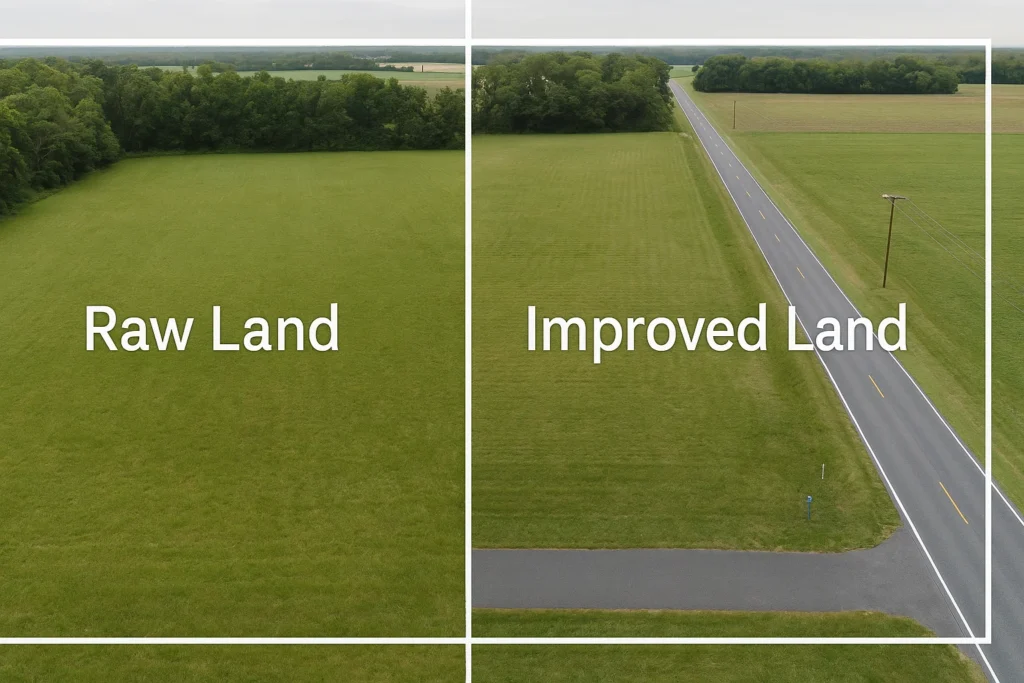
Lenders group land into three categories, and the category affects how the lot appraises and how it is financed. Raw land is completely undeveloped – no electricity, no sewer, no roads. Unimproved land is similar to raw land but tends to have some development or partial utilities, while still lacking things like an electric meter, phone box, or gas meter. Improved land has access to road frontage, electricity, and water. Improved lots are generally the easiest to finance because they are easier to value and to build on, but all three categories can be eligible when the appraisal supports residential use.
What Makes a Delaware Lot Harder to Finance?
Two lots at the same price can underwrite very differently. Before you make an offer, it helps to know what an appraiser and underwriter look at on vacant land. The factors below most often affect whether a Delaware lot is easy to finance, harder, or not a fit:
- Legal access and road frontage. A parcel with no recorded legal access (landlocked) is generally not financeable; shared or easement access needs documentation.
- Utilities. Public water and sewer, or a documented path to them, make a lot easier to value and build on; raw land with no utilities is financeable but appraises more conservatively.
- Septic and site feasibility. Where there is no public sewer, a perc test or septic feasibility can matter for future build potential.
- Easements and boundaries. Recorded easements, encroachments, or unclear boundaries can require a survey and affect value.
- Wetlands and flood zone. Wetlands, tidal areas, and special flood hazard areas can limit buildable area and add review – common in parts of Sussex County.
- Zoning and highest-and-best use. The appraiser’s zoning and highest-and-best-use analysis drives eligibility, especially on the 10-year program, which requires a residential use.
- Title. Title insurance is required; clouded title, liens, or boundary disputes need to be cleared.
What you should check varies a little by county. This is general guidance, not legal or zoning advice – confirm specifics with the county land-use or building office before you buy.
| Delaware County | What land buyers should check |
|---|---|
| New Castle County | Zoning and permitted use, public water/sewer availability, road access, and future residential build potential |
| Kent County | Septic feasibility on parcels without public sewer, agricultural vs. residential zoning, and acreage use |
| Sussex County | Wetlands and tidal areas, flood zone and coastal development rules, and private well/septic where there are no public utilities |
Can I Refinance Vacant Land I Already Own?
Yes. You can refinance land you already own. A rate-and-term refinance on the 20-year program is capped at 65% loan-to-value, the same ceiling as a purchase. If you want to take equity out, the cash-out refinance is capped at 60% loan-to-value. To be eligible for a refinance, you generally must have owned the land for at least 2 years. As with a purchase, the appraisal has to support the value, and final terms depend on credit and the full underwriting review.
Want to Buy Land and Build a Home?
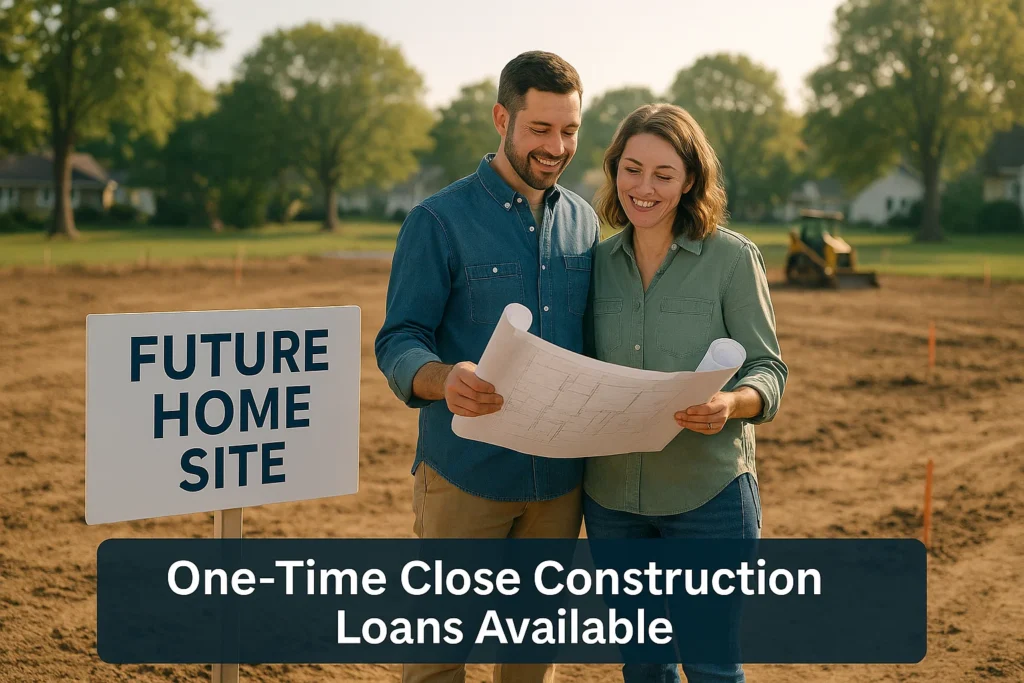
If you plan to buy the land and build a home on it right away, a land loan is usually not the most cost-effective path. A one-time close construction loan lets you finance the lot purchase and the home construction in a single loan with one closing, and the down payment can be much lower than a land loan – as little as 3.5% down, or even 0% down on a USDA or VA option. If you are not ready to build yet, the land loan keeps your options open; if you are, the construction loan is almost always the better choice. Delaware one-time close construction options include:
- FHA One-Time Close Construction Loan (3.5% down)
- USDA One-Time Close Construction Loan (0% down in eligible rural areas)
- VA One-Time Close Construction Loan (0% down for eligible veterans)
When a Delaware Land Loan Is Not the Right Fit
A land loan is the right tool in some situations and the wrong one in others. It may not be the best fit if:
- You want to buy the land and build a home right away – a one-time close construction loan usually means a single closing and a much lower down payment.
- You are buying commercial, industrial, or mixed-use land – those property types are not eligible, and a commercial loan is the right product.
- You have very little to put down – land loans require meaningful equity (20% borrower contribution on the 10-year program, and 35% to 40% equity implied by the 20-year LTV limits), so a low-down-payment buyer may want to wait and save, or look at a construction loan instead.
- You want to live on the parcel as a primary residence or second home using the 10-year program – that program is investment / non-owner-occupied only.
- The parcel is landlocked, leasehold, or has an appraised structure with contributory value – those fall outside the land loan guidelines.
Why Work With the John Thomas Team for Your Land Loan?
As Delaware natives, we understand the local zoning, environmental review, and property-access issues that often stall raw-land purchases. When you work with John Thomas, you are working with a team that has helped buyers across Newark, Wilmington, Middletown, Smyrna, Dover, and Sussex County finance land and position themselves for a future build. Because we offer two distinct land loan programs, we can match you to the structure that actually fits your lot, your timeline, and your goals.
- Delaware-based loan officer with 20+ years of experience
- Two fixed-rate land loan options plus construction loan and investor financing under one roof
- Personalized local guidance from application to closing
- Trusted by 3,000+ Delaware buyers and agents
How to Apply for a Delaware Land Loan
If you are interested in purchasing or refinancing land that you are not planning to build on immediately, a Delaware land loan may be the right option for you. The quickest way to find out which program fits is a short conversation about the lot and your goals. Get started by calling John Thomas, NMLS #38783, and the team at Primary Residential Mortgage at 302-703-0727, scheduling a time online, or applying online. If a land loan is not the best fit, I will tell you that too – and point you to the option that is, whether that is a construction loan, a conventional loan, or something else.
Ready to Finance Your Delaware Land?
Whether you are buying a building lot, holding acreage, or refinancing land you already own, we will match you to the right program and walk you through every step.
Delaware Land Loan FAQ
What is a Delaware land loan?
A Delaware land loan finances the purchase of vacant land or a lot that does not yet have a home on it. Regular mortgages, FHA, VA, and USDA loans are built around a finished dwelling and generally cannot buy bare ground, so a land loan fills that gap – letting you own the land now and build later, or simply hold it.
What is the difference between the 10-year and 20-year land loan?
The 10-year fixed program is for investment and future-build residential land (non-owner-occupied), allows up to 80% loan-to-value, and runs from $50,000 to $500,000, up to 20 acres. The 20-year fixed program offers larger loans from $100,000 to $1,200,000 at up to 65% loan-to-value (60% for cash-out), with no acreage limit and no land-type restriction. The right one depends on your loan size, credit, equity, and what kind of land you are buying.
Can I buy land in Delaware without building right away?
Yes. Neither land loan program requires you to build. You can purchase and hold the land for as long as you like. If and when you are ready to build, you can look at a one-time close construction loan at that time.
What credit score do I need for a Delaware land loan?
The 20-year program has a minimum credit score of 660 and the 10-year program has a minimum of 680. Those are floors – your actual terms also depend on the property, your down payment or equity, reserves, and the overall underwriting picture.
Can I get a land loan for raw, recreational, hunting, or agricultural land in Delaware?
Yes. The 20-year program has no land-type restriction – raw land, unimproved land, recreational and hunting property, and agricultural land may be eligible, with no acreage limit, when the appraisal supports the value and the file meets full underwriting guidelines. The 10-year program can also finance agricultural, recreational, or unclassified parcels, but only with a residential highest-and-best-use appraisal, up to 20 acres, and with a 2% rate add-on (and income from the land may not be used to qualify).
Can I use gift funds for the down payment on a land loan?
On a purchase, gift funds and un-sourced funds are not eligible on the 20-year program, and on the 10-year program the 20% minimum borrower contribution must come from your own funds (gift funds are not allowed as reserves). Plan on bringing your own down payment and reserves to a land purchase.
Can I refinance or pull cash out of land I already own?
Yes, on the 20-year program. A rate-and-term refinance is capped at 65% loan-to-value and a cash-out refinance is capped at 60%. You generally need to have owned the land for at least 2 years to be eligible, and the appraisal must support the value.
Can I finance land in an LLC in Delaware?
On the 10-year investment program, yes – title can be held in an LLC with a personal guarantee from the members, and non-occupant borrowers and tenancy-in-common are also allowed. Entity vesting on the 20-year program depends on the scenario, so call to confirm how your LLC or trust would be handled.
Can I use my land equity toward a future construction loan?
Often yes. If you buy a lot now with a land loan and build later, the equity in your land can usually count toward your down payment or required equity on a one-time close construction loan, depending on the program and the appraised value when you build. We can map the path from your land loan to an FHA, USDA, VA, or conventional construction loan.
What if I want to buy land and build a home at the same time?
If you plan to build right away, a one-time close construction loan is usually a better fit than a land loan – it combines the lot purchase and construction into one loan and one closing, often with a much lower down payment (3.5% on FHA, or 0% on USDA or VA for eligible borrowers). Call to compare the two paths for your situation.

John R. Thomas – Branch Manager and Mortgage Loan Officer
John R. Thomas has helped more than 3,000 Delaware buyers and investors finance homes and land over a career spanning 20+ years. He works with land buyers across New Castle, Kent, and Sussex Counties on everything from individual building lots to recreational acreage, and pairs land financing with construction and conventional options so buyers can move from raw ground to a finished home on a single team.
A graduate of the University of Delaware (B.S. in Physics Education) with a Master of Science in Curriculum and Instruction from Delaware State University, John is also the author of “Your Guide to Buying Your First Home in Delaware.” Licensed in 17 states (AL, DC, DE, FL, GA, IN, KS, MD, MN, MO, NC, NJ, OH, PA, SC, TN, VA). NMLS #38783.
Experience 3,000+ Buyers
Helped DE & MD
Service Area PRMI
Branch Manager
4.8 / 5 Star Rating – 285 Google Reviews. See John Thomas Team on Google for reviews, directions, and local office information.
John Thomas Team – Primary Residential Mortgage, Inc.
248 E Chestnut Hill Rd, Newark, DE 19713 | 302-703-0727 | team@johnthomasteam.com
Schedule an Appointment | YouTube | About John Thomas
Visit Our Newark Office
Last Updated: June 2026. Mortgage content reviewed by John R. Thomas, NMLS #38783, Branch Manager at Primary Residential Mortgage, Inc. | 248 E Chestnut Hill Rd, Newark, DE 19713 | 302-703-0727 | delawaremortgageloans.net
Copyright John R. Thomas, All Rights Reserved.
