DSHA Smart Start Home Loan Delaware: The DSHA Loan Without Down Payment Assistance
Quick Answer for Delaware Buyers: The DSHA Smart Start Home Loan is the Delaware State Housing Authority first mortgage taken without down payment or closing cost assistance. It may fit Delaware buyers who meet DSHA income, credit, property and purchase price rules and who have enough verified savings, documented gift funds or negotiated seller credits to close without a DSHA second mortgage. Because no assistance is attached, DSHA prices it below every assisted option in the same track.
DSHA Smart Start Home Loan: Smart Start is the Delaware State Housing Authority first mortgage taken without down payment assistance. It currently carries the lowest interest rate of the DSHA options in its tier, but you bring your own down payment and closing costs. Current as of September 2026.
John R. Thomas, NMLS #38783 | 20+ Years in Delaware Mortgages | 3,000+ Delaware Buyers Helped | DSHA-Approved Lender | Newark, DE Office
Serving Delaware buyers from the Newark office, including New Castle, Kent and Sussex Counties.
I get asked about Smart Start almost every time I walk a Delaware buyer through the DSHA menu, and it is the one option most people skip past without understanding what they are giving up. Every other Delaware State Housing Authority product pairs a below-market first mortgage with a zero-interest second mortgage for down payment and closing cost help. Smart Start is the same below-market first mortgage with none of that attached, and because there is no assistance layered on top, DSHA prices it lower than every assisted option in the same track. If you have your own savings, or a gift from family, that lower rate follows you for the life of the loan. If you are short on cash to close, one of the Delaware down payment assistance programs is almost certainly the better trade. This page walks through exactly how Smart Start works, how much lower the rate actually runs against the 3 percent, 4 percent and 5 percent assistance options, the 2026 income and purchase price limits, and how to tell which side of that decision you fall on. If you would rather just talk it through, call me at 302-703-0727.
See If Smart Start Is Your Best DSHA Option
We will look at what you actually have available for down payment and closing costs, then compare Smart Start against the 3 percent, 4 percent and 5 percent DSHA assistance options side by side so you can see the trade in your own numbers. No application required for the first call.
Table of Contents
What Is the DSHA Smart Start Home Loan?
| Item | Smart Start answer |
|---|---|
| Program type | DSHA first mortgage taken without down payment assistance |
| Assistance amount | None |
| Loan term | 30-year fixed rate |
| Underlying loan types | FHA, VA, USDA or Freddie Mac Conventional |
| Minimum credit score | 620 generally; 660 for manufactured homes |
| Rate position | Lowest priced DSHA option within its track |
| Counties served | New Castle, Kent and Sussex – statewide |
| Occupancy | Delaware primary residence only |
| Income and price limits | Yes, they still apply even though no assistance is attached |
| Best fit | Buyers with funds to close who want the lower DSHA rate |
| Not a fit | Buyers who need assistance to reach the closing table |
I recorded a full walkthrough of how Smart Start compares with the DSHA down payment assistance options, including how the rate trade-off actually plays out for a Delaware buyer:
The DSHA Smart Start Home Loan is a 30-year fixed-rate first mortgage offered through the Delaware State Housing Authority’s Delaware Mortgage Program, taken without any down payment or closing cost assistance attached. DSHA describes it plainly as a first mortgage loan with no down payment and closing costs assistance, and it was known for years inside the industry as the DSHA unassisted loan.
Smart Start is not itself an FHA, VA, USDA or Conventional loan. It sits on top of one of those loan types, the same way every DSHA first mortgage does. Your underlying loan is a Delaware FHA loan, a Delaware VA loan, a USDA rural housing loan, or a Freddie Mac conventional loan. What DSHA adds is an interest rate set through its bond program rather than by the individual lender, and that rate generally sits below standard market pricing for the same borrower profile.
The thing that makes Smart Start different from every sibling product is what it leaves off. First State Home Loan adds a zero-interest second mortgage worth 3 percent of the first mortgage amount. Keys4You adds 4 percent. Take5 adds 5 percent. Diamond in the Rough adds 5 percent alongside FHA 203(k) Limited renovation financing. Smart Start adds nothing, and in exchange DSHA prices it below all four.
Smart Start is available statewide, in all three Delaware counties. If you have read elsewhere that it is limited to Kent and Sussex County buyers, that is wrong and appears to trace back to an outdated third-party summary. New Castle County buyers use Smart Start routinely.
Smart Start Means No Assistance, Not No Down Payment
This is the single most misread thing about the program, and the phrasing DSHA uses does not help. “No down payment and closing costs assistance” means there is no assistance for your down payment and closing costs. It does not mean there is no down payment required.
Under Smart Start, whatever down payment your underlying loan type requires still applies, and you are the one supplying it. FHA still wants its 3.5 percent minimum. Freddie Mac conventional still wants its minimum contribution. The two exceptions are VA and USDA, which are zero-down loan types in their own right, so an eligible veteran or an eligible rural buyer using Smart Start may genuinely put nothing down, but that is the underlying loan doing the work, not Smart Start.
Closing costs work the same way. With an assisted DSHA loan, leftover assistance dollars can typically flow toward closing costs after the down payment is covered. With Smart Start, your closing costs come from your own funds, from a documented gift, or from a seller credit you negotiated into the purchase contract.
Who Qualifies for the DSHA Smart Start Home Loan?
Smart Start eligibility follows whichever DSHA track you sit in, because Smart Start is a way of taking Welcome Home or Open Door rather than a separate program with its own rulebook. In general terms, a Smart Start borrower needs to meet all of the following:
- A qualifying track. Welcome Home if you have not owned a primary residence in the past three years, or you are a qualified veteran, or you are buying in a DSHA-designated targeted census tract. Open Door if you are a repeat buyer or your qualifying income runs above the Welcome Home limit.
- Minimum 620 credit score. Manufactured homes require 660.
- HUD-approved housing counseling if your score is 620 to 659. Borrowers at 660 and above are exempt. The course runs 8 hours and typically costs around $125.
- Income at or below the DSHA limit for your track, county and household size. Effective April 15, 2025, Welcome Home counts only the income of borrowers on the Note and/or Mortgage, and Open Door counts only qualifying income on the loan application. Household size still sets which tier applies.
- Purchase price at or below the DSHA county limit.
- A Delaware property used as your primary residence. Investment properties, second homes and vacation homes are not eligible.
- Application through a DSHA-approved lender. DSHA does not take loan applications directly.
- Enough of your own verified funds to cover the down payment your underlying loan type requires plus your share of closing costs, since no assistance is attached.
Your underlying loan type layers its own rules on top. FHA has minimum property standards, VA requires a Certificate of Eligibility, USDA requires the property to sit in an eligible rural area. Debt-to-income still gets tested the ordinary way, so if you are close to the edge it is worth reading through how debt-to-income ratio works before you shop.
What Are the 2026 Smart Start Income and Purchase Price Limits?
Smart Start uses the same income and purchase price limits as the track it sits in. The figures below took effect for new reservations on or after June 8, 2026 and are current as of August 2026. Verify with your DSHA-approved lender before relying on them, since DSHA adjusts these periodically.
| Track and county | 1 or 2 person household | 3 or more person household |
|---|---|---|
| Welcome Home, New Castle | $122,700 | $141,105 |
| Welcome Home, Kent and Sussex | $111,400 | $128,110 |
| Open Door, New Castle | $147,240 | $184,050 |
| Open Door, Kent and Sussex | $133,680 | $167,100 |
| Welcome Home in a targeted area, New Castle | $147,240 | $171,780 |
| Welcome Home in a targeted area, Kent and Sussex | $133,680 | $155,960 |
| County | Non-targeted purchase price limit | Targeted area purchase price limit |
|---|---|---|
| New Castle | $659,385 | $805,916 |
| Kent and Sussex | $566,354 | $692,211 |
The April 15, 2025 income counting rule matters more than most buyers expect. If your spouse, parent, sibling or roommate is not on the loan with you, their income does not test against the DSHA limit. Household size still sets your tier. I regularly talk to buyers who ruled themselves out of DSHA entirely because they added up everyone under the roof.
How Much Lower Is the Smart Start Rate Than the DSHA Assistance Options?
DSHA publishes a rate sheet organized by product and track, and the numbers below are taken from the sheet dated September 14, 2026. These are DSHA program rates for comparison between products. They are not a quote, not an APR, and not a rate lock, and your APR will be higher than the rate shown once financed costs are included. DSHA reprices on its own schedule, so call 302-703-0727 for the current sheet before you make a decision or lock. What the table shows that a single rate never does is the price of assistance: how much rate you give up at each step up the DSHA menu, which is the whole Smart Start decision.
| Product | Assistance | Welcome Home government | Open Door government | Welcome Home conventional | Open Door conventional |
|---|---|---|---|---|---|
| Smart Start | None | 5.625% | 7.000% | 6.125% | 7.375% |
| First State Home Loan | 3% | 5.875% | 7.625% | 6.375% | 8.000% |
| Keys4You Home Loan | 4% | 6.125% | 7.750% | 6.500% | 8.125% |
| Take5 Home Loan | 5% | 6.625% | Not offered | 7.000% | Not offered |
| Diamond in the Rough | 5% | 6.625% | Not offered | Not available | Not offered |
Read the table as a price list for assistance, and read across your own row. Under Welcome Home on a government loan, the 3 percent First State option costs a quarter point over Smart Start, Keys4You at 4 percent costs half a point, and Take5 or Diamond in the Rough at 5 percent costs a full point. Conventional runs slightly cheaper at the 4 and 5 percent steps, at 0.375 and 0.875 of a point. Under Open Door the shape is different in two ways that matter: Smart Start itself starts 1.375 points higher on government and 1.25 points higher on conventional, and each assistance step then costs 0.625 of a point to reach 3 percent and 0.75 to reach 4 percent. So an Open Door buyer still pays roughly two and a half times what a Welcome Home buyer pays for the same 3 percent of help.
What this means for you: if you already have the cash to close, Smart Start is likely to cost you less over the life of the loan, because you are not paying a higher first-mortgage rate to receive assistance you did not need. If you do not have the cash, the rate step is what buys you the closing.
Two structural points worth holding onto. First, government loans price below conventional at every DSHA tier and in both tracks, so your underlying loan type interacts with the assistance decision rather than sitting separate from it. Second, these rates move. DSHA sets them through its bond program and reprices on its own schedule, so the sheet above is a snapshot dated September 14, 2026 and the numbers on the day you lock are the ones that matter. That is a call, not a web page.
Smart Start Under Welcome Home vs. Open Door: Which Track Are You In?
Smart Start exists in both DSHA tracks, and the two are not priced alike. Welcome Home Smart Start sits well below Open Door Smart Start. On the September 14, 2026 sheet the gap is 1.375 percentage points on government loans (5.625% against 7.000%) and 1.25 percentage points on conventional (6.125% against 7.375%). That is a larger gap than most buyers expect, and it is the single biggest reason to confirm which track you are in before comparing anything else.
| Factor | Welcome Home Smart Start | Open Door Smart Start |
|---|---|---|
| Who can use it | First-time buyers, plus qualified veterans and targeted-area buyers | First-time and repeat buyers, no first-time requirement |
| Rate position | Lowest DSHA pricing available (5.625% government / 6.125% conventional) | 1.25 to 1.375 points above Welcome Home at the same product tier (7.000% government / 7.375% conventional) |
| 2026 income limit, New Castle, 1 to 2 people | $122,700 | $147,240 |
| 2026 income limit, Kent and Sussex, 1 to 2 people | $111,400 | $133,680 |
| If you later want assistance instead | Five options, including Take5 and Diamond in the Rough | Three options, no Take5 and no Diamond |
| Cost of stepping to 3% assistance | 0.25 percentage points | 0.625 percentage points |
| Cost of stepping to 4% assistance | 0.375 to 0.50 percentage points | 0.75 percentage points |
What this means for you: the same 3 percent of assistance is priced very differently depending on which track you are in. Under Welcome Home it is a modest rate step. Under Open Door it is 0.625 of a point, and it sits on top of a base rate that is already well above Welcome Home, which is why repeat buyers with savings should price Smart Start before assuming assistance is the default.
The practical takeaway is that the Smart Start case is strongest for Open Door buyers. Under Welcome Home, buying 3 percent of your loan amount for a quarter point is a reasonable trade for a lot of people. Under Open Door, the same 3 percent costs 0.625 of a point, on top of a starting rate that is already 1.25 to 1.375 points higher. Repeat buyers and higher-income buyers who have savings should look hard at Smart Start before assuming assistance is the default. Open Door replaced the former Home Again program in DSHA’s April 2026 rebrand, so if you are working from older research you may still see the Home Again name.
Do Targeted Areas Give Smart Start Buyers a Better Rate?
No, and this one surprises people. Targeted areas are DSHA-designated census tracts, concentrated in parts of Wilmington, Dover and Sussex County, that carry more generous program terms. Buying in one raises your income limit, raises your purchase price limit, and waives the first-time buyer requirement so a repeat buyer can use Welcome Home.
What targeted areas do not do is lower your rate. On the DSHA rate sheet as of August 4, 2026, targeted-area pricing runs about an eighth of a percentage point above the standard Welcome Home rate at every product tier, Smart Start included. Targeted-area rates are also available only under Welcome Home, not Open Door.
So the targeted-area question is about access, not pricing. If a targeted tract is what lets you qualify at all, or lets you buy at a price you otherwise could not, the eighth of a point is a small cost for a large benefit. If you already qualify comfortably under standard Welcome Home limits, there is no rate reason to steer your home search toward a targeted tract. Whether a specific address sits inside one is something your DSHA-approved lender can confirm before you write an offer, and it is worth asking early rather than after you are under contract. Buyers looking in Wilmington in particular should ask, since several city tracts qualify.
Should You Take Smart Start or a DSHA Down Payment Assistance Loan?
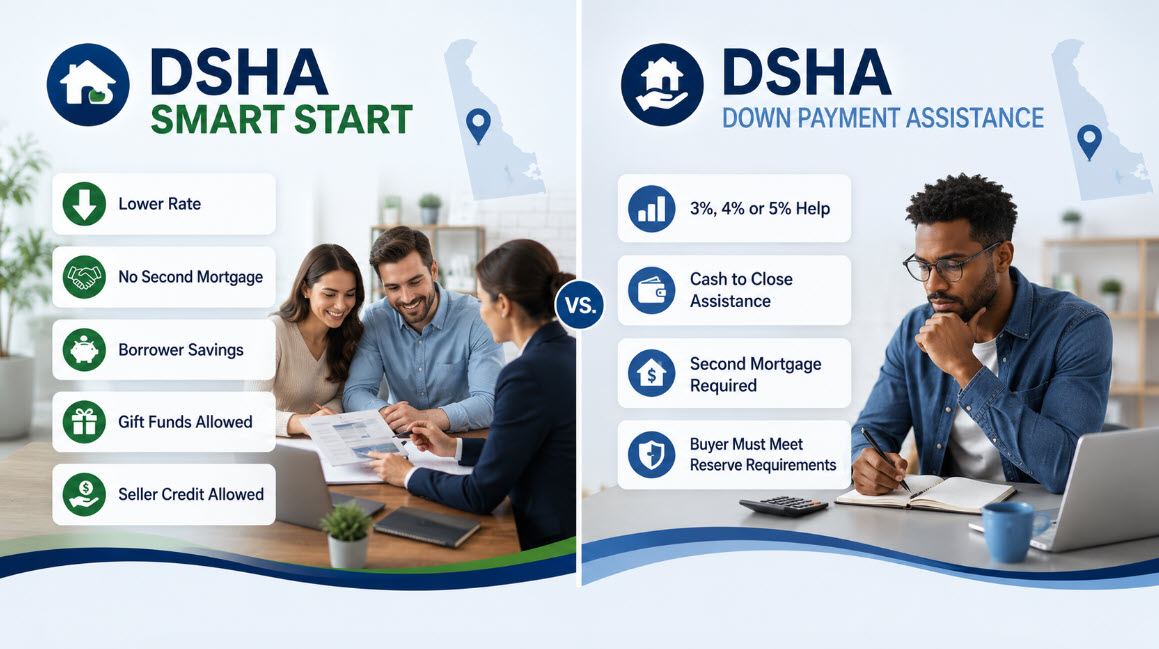
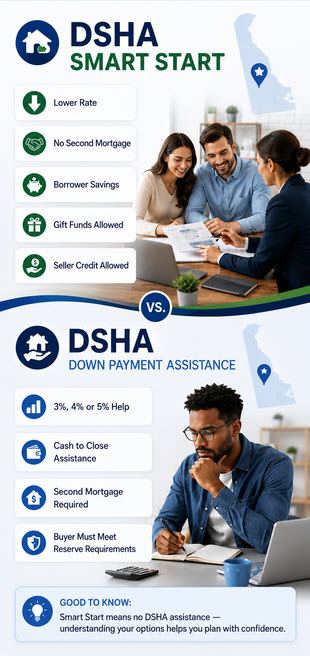
Here is the rule I actually give people, and it has held up across two decades of originating DSHA loans in Delaware. If you want the lowest DSHA rate in your track and you are comfortable bringing more money to the closing table, take the Smart Start Home Loan. If you are short on funds to close, then we need to pick one of the DSHA home loan programs with down payment assistance, either the 3 percent, the 4 percent or the 5 percent.
That sounds almost too simple, but the reason it works is that the assistance is not free money and it is not a grant. It is a real second mortgage that gets repaid, and its cost shows up as a higher rate on the first mortgage for as long as you keep the loan. So the question is not “is assistance good,” it is “do I need it.” A buyer with enough verified savings who takes 5 percent assistance anyway is paying roughly a point in rate for cash they did not need. A buyer who is genuinely short and takes Smart Start anyway does not get to closing at all.
- Smart Start tends to fit buyers with their own savings, buyers receiving a documented family gift, buyers who negotiated a meaningful seller credit, VA and USDA buyers whose loan type already covers the down payment, and Open Door buyers, where assistance is priced steeply.
- An assistance option tends to fit buyers whose savings will not cover the down payment plus closing costs, buyers who would drain their reserves to close, and Welcome Home buyers where 3 percent costs only about a quarter point.
One more thing worth saying plainly: emptying your savings to get the lower rate is usually the wrong move. Lenders want to see reserves after closing, and a house generates expenses in its first year that a rental never did. If taking Smart Start means arriving at closing with nothing left, the assistance option is doing its job.
What It Means to Close Without a DSHA Second Mortgage
The DSHA assistance products are zero-interest second mortgages with no monthly payment. Nothing is due month to month, and repayment is deferred until you sell, refinance, transfer title, or stop using the home as your primary residence. That structure is genuinely borrower-friendly, and it is why so many Delaware buyers use it.
Smart Start leaves that lien off entirely, and there are a few practical consequences worth understanding before you decide:
- One loan, one closing package. You sign for a first mortgage only, rather than a first and a second simultaneously.
- Nothing to satisfy at refinance. If rates fall and you want to refinance later, there is no deferred balance to pay off or negotiate around as part of that transaction.
- Nothing to settle at sale. Your payoff at closing is the first mortgage balance, without a second lien coming due out of proceeds.
- Cleaner title picture. Fewer liens on the property generally means fewer moving parts in any future transaction.
None of this makes the assistance products a bad deal. A deferred, zero-interest second that gets you into a home years earlier can easily be worth a rate step. But buyers deserve to know that the second mortgage is real and that it comes due eventually, rather than discovering it when they are trying to refinance.
What Will You Need to Bring to Closing?
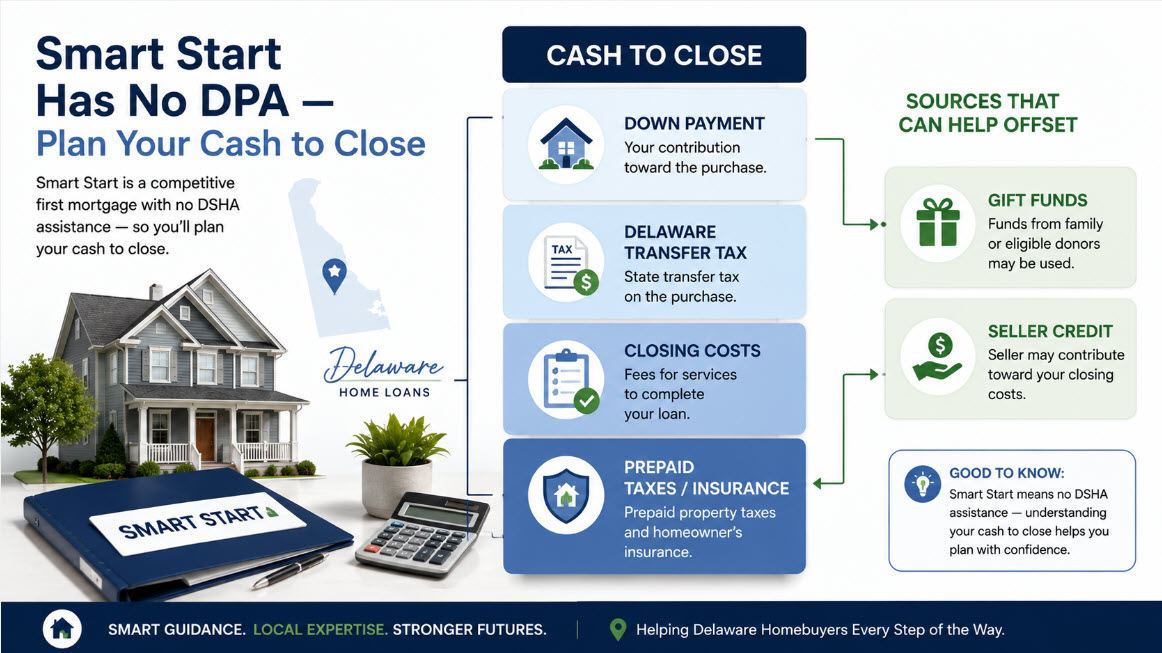

Because Smart Start supplies no assistance, cash to close is the deciding practical question. The illustration below shows the statutory and standard components on a $350,000 Delaware purchase using FHA as the underlying loan type. This is an illustration of how the pieces stack up, not a quote, and it deliberately excludes interest rate and monthly payment.
| Component | Basis | Illustration on a $350,000 purchase |
|---|---|---|
| FHA minimum down payment | 3.5% of purchase price | $12,250 |
| Delaware transfer tax, buyer share | 2% under the standard DAR contract | $7,000 |
| Lender, title, settlement and third-party fees | Varies by file | Not estimated here |
| Prepaid insurance, taxes and escrow deposit | Varies by closing date and county | Not estimated here |
| Seller credit, if negotiated | Reduces buyer cash, subject to loan-type caps | Deduct as applicable |
Example: a Newark buyer with a family gift versus the same buyer taking assistance
Take two versions of the same New Castle County buyer on that $350,000 FHA purchase. In the first version she has $9,000 saved and a documented $12,000 gift from a parent, which covers the $12,250 down payment and most of the buyer transfer tax, so she uses Smart Start and takes the lowest rate DSHA offers within the Welcome Home track. In the second version there is no gift, and her savings will not cover the down payment plus her share of the transfer tax and prepaids, so she uses one of the assistance options instead, accepts the rate step that comes with it, and closes on the same house. Same buyer, same property, same program family. The only variable that moved was the cash position, and that is the variable that decides the product. This is an illustration of how the decision is made, not a quote.
Two Delaware-specific notes that change these numbers materially. First, the standard Delaware Association of Realtors contract splits the 4 percent state transfer tax evenly, 2 percent buyer and 2 percent seller, but builders frequently write their own contracts requiring the buyer to pay the full 4 percent. On a $350,000 new construction purchase that is a $7,000 swing, and it can wipe out the entire benefit of choosing Smart Start over an assistance option. Ask who pays transfer tax before you sign anything on new construction. Second, eligible first-time buyers may qualify for a reduction on the state portion, which is covered on our Delaware first-time home buyer transfer tax exemption page.
Two funding sources make Smart Start workable for buyers who do not have the full amount sitting in savings. Documented gift funds from family are permitted, subject to a gift letter and a clean paper trail, and our gift funds and gift of equity guidelines page walks through what underwriting expects. Seller credits negotiated into the contract can cover closing costs up to the limits set by your underlying loan type, which our seller paid closing costs page explains. Between a gift and a seller credit, plenty of buyers reach the Smart Start rate without having saved every dollar themselves.
Using Smart Start in New Castle, Kent and Sussex Counties
Smart Start is the same product statewide, but the limits it runs against and the practical pressure on your cash to close are not the same in all three counties.
- New Castle County – Newark, Bear, Middletown, Hockessin, Pike Creek. The highest DSHA thresholds in the state, at $122,700 in Welcome Home income for a 1 to 2 person household and a $659,385 purchase price ceiling. For most starter homes here the price limit is not the binding constraint, so the decision usually comes down purely to whether your savings cover the down payment and closing costs. See our Newark mortgage guide for local market context.
- Wilmington. Several Wilmington census tracts are DSHA-designated targeted areas, which raise the income and purchase price limits and waive the first-time buyer requirement. That can be the difference between qualifying and not. Ask for a targeted-tract check on a specific address before writing an offer rather than after, and see the Wilmington mortgage guide.
- Kent County – Dover, Smyrna, Milford. The lower limit tier applies, at $111,400 in Welcome Home income for a 1 to 2 person household, but the $566,354 purchase price ceiling is rarely a constraint at Kent County prices. Smart Start competes well here against standard financing for buyers who have their down payment together.
- Sussex County – Lewes, Rehoboth, Seaford, Georgetown. Interior Sussex works comfortably inside the limits. The coastal towns are where the $566,354 purchase price ceiling starts to bind, and where closing-cost pressure is highest, so seller credits negotiated into the contract matter more here than anywhere else in the state. USDA financing is also more widely available in rural Sussex, and a USDA loan taken as Smart Start is one of the lowest cash-to-close structures available in Delaware.
When the Smart Start Home Loan Is Not a Good Fit
I would rather route someone to the right program than push Smart Start because it sounds better on paper. These are the situations where it is genuinely the wrong choice:
- You do not have the down payment and closing costs available. This is the main one. Take First State, Keys4You or Take5 instead, and get to closing.
- Closing would leave you with no reserves. Draining savings to buy a lower rate tends to create problems in the first year of ownership, and reserves are often part of the underwriting picture anyway.
- You are buying a fixer-upper that needs repairs. Diamond in the Rough pairs 5 percent assistance with FHA 203(k) Limited renovation financing, which Smart Start cannot do.
- Your income or purchase price exceeds the DSHA limits for both tracks. DSHA is capped with no stretch provision. A standard FHA, VA, USDA or conventional loan outside the DSHA program is the path.
- You are buying an investment property, second home or vacation home. DSHA requires primary residence occupancy across the board.
- You have strong credit and 20 percent or more to put down on a conventional loan. At that profile a non-DSHA conventional loan without mortgage insurance may cost less overall than any DSHA option. Ask for a side-by-side rather than assuming the DSHA rate wins.
- You are buying a manufactured home and cannot meet the overlays. DSHA requires a 660 minimum score, FHA as the underlying loan type, and double-wide or larger. Our FHA manufactured home loans page covers the underlying requirements.
Common Mistakes Buyers Make With Smart Start
- Assuming no assistance means no income limits. Smart Start is still a DSHA program and still tests against the same county and household-size income limits and purchase price caps as the assisted options.
- Reading “no down payment and closing costs assistance” as “no down payment.” It means no help with those costs, not the absence of them.
- Adding up the whole household’s income and ruling themselves out. Since April 15, 2025 only borrower income on the Note and Mortgage counts under Welcome Home, and only qualifying income on the application under Open Door.
- Taking maximum assistance without checking whether they need it. Under Welcome Home the 5 percent options currently price about a full point above Smart Start. That is a real cost for cash a buyer with savings did not require.
- Choosing Smart Start and arriving at closing with nothing left. Reserves after closing matter to underwriting and to your first year of ownership.
- Not asking who pays transfer tax on new construction. The standard Delaware Association of Realtors contract splits it 2 percent buyer and 2 percent seller, but builder contracts often push the full 4 percent onto the buyer, which can erase the entire benefit of the lower Smart Start rate.
- Assuming a targeted area means a better rate. Targeted tracts raise limits and waive the first-time requirement; they currently price above standard Welcome Home, not below it.
- Working with a lender who is not DSHA-approved. Using an internet lender or an out-of-state bank that is not on the approved list means losing access to DSHA pricing entirely.
- Looking up pre-April-2026 DSHA content. Older sources still say Home Again instead of Open Door, and some still present the Mortgage Credit Certificate as available when it ended August 15, 2025.
How Do You Apply for the DSHA Smart Start Home Loan?
Smart Start runs through a DSHA-approved lender. DSHA does not accept loan applications directly, and using an internet lender or an out-of-state bank that is not on the approved list means losing access to DSHA pricing entirely. The John Thomas Team with AnnieMac Home Mortgage is a DSHA-approved lender in Newark, Delaware.
- First conversation, 15 to 30 minutes. We go through your income, county, credit, household size and what you actually have available to close. By the end you will know whether you are a Welcome Home or an Open Door buyer, and whether Smart Start or an assistance option fits your cash position.
- Application. Apply online or by phone with the team, and we collect income documentation, bank statements and identification.
- Credit and pre-approval. We underwrite to a DSHA pre-approval letter that goes out with your offers.
- House shopping. Tell your Realtor you are using a DSHA loan so the offer is written correctly, including transfer tax language.
- Under contract. Appraisal and title work begin. If your score is 620 to 659, start the 8-hour HUD-approved counseling course now rather than the week before closing.
- DSHA approval and clear to close. The file goes to DSHA for program approval in addition to standard lender approval, which is an extra review step in the process.
- Closing. With Smart Start you sign one mortgage rather than a first and a second.
Timing depends on your contract terms, the appraisal, title work, underwriting, DSHA program review and how quickly borrower documentation comes back, so I do not quote a closing timeline in the abstract. New construction generally runs longer because the builder sets the closing date. Buyers working in and around Newark and across New Castle, Kent and Sussex counties are all served from the Newark office.
Related Delaware DSHA and Mortgage Guides
- DSHA Loan Programs in Delaware – the full breakdown of every active DSHA first mortgage and assistance product.
- DSHA Welcome Home Mortgage Loan – the first-time buyer track, with all five assistance options compared.
- DSHA Open Door Loan Delaware – the first-time and repeat buyer track with higher income limits.
- DSHA First State Home Loan – the 3 percent assistance option, available in both tracks.
- DSHA Keys4You Home Loan – the 4 percent assistance option, available in both tracks.
- Take5 Home Loan Delaware – the 5 percent assistance option, Welcome Home only.
- DSHA Diamond in the Rough – 5 percent assistance plus FHA 203(k) Limited renovation, Welcome Home only.
- Delaware Down Payment Assistance Programs – every Delaware assistance option, including municipal programs outside DSHA.
- Delaware First Time Home Buyers Guide – the complete first-time buyer pillar.
- Getting a Mortgage After Bankruptcy in Delaware – waiting periods and re-established credit rules by loan type.
FAQ: DSHA Smart Start Home Loan Delaware
What is the DSHA Smart Start Home Loan?
The DSHA Smart Start Home Loan is a 30-year fixed-rate first mortgage from the Delaware State Housing Authority taken without any down payment or closing cost assistance attached. It sits on top of an FHA, VA, USDA or Freddie Mac conventional loan and carries an interest rate set by DSHA through its bond program rather than by the individual lender. Because no assistance is layered on, DSHA prices Smart Start below every assisted option in the same track. It was previously known in the industry as the DSHA unassisted loan and is available statewide in all three Delaware counties.
Does Smart Start mean I do not need a down payment?
No. Smart Start means there is no down payment assistance, not that no down payment is required. Whatever your underlying loan type requires still applies and you supply it yourself. FHA still requires its 3.5 percent minimum and Freddie Mac conventional still requires its minimum contribution. VA and USDA are zero-down loan types in their own right, so an eligible veteran or eligible rural buyer using Smart Start may put nothing down, but that comes from the underlying loan rather than from Smart Start. Closing costs also come from your own funds, a documented gift, or a negotiated seller credit.
How much lower is the Smart Start rate than the DSHA assistance options?
On the DSHA rate sheet dated September 14, 2026, within the Welcome Home track on a government loan, Smart Start prices at 5.625 percent, the 3 percent First State option at 5.875 percent, Keys4You at 4 percent at 6.125 percent, and Take5 or Diamond in the Rough at 5 percent at 6.625 percent. That is a quarter point, a half point and a full point respectively for the assistance. On conventional the Welcome Home steps are 0.25, 0.375 and 0.875 of a point. Under Open Door the steps cost more: 0.625 of a point to reach 3 percent and 0.75 to reach 4 percent, on top of a Smart Start rate that already starts 1.25 to 1.375 points above Welcome Home. These figures are for product comparison, not a quote, not an APR and not a rate lock, and APR will be higher. DSHA reprices on its own schedule, so call 302-703-0727 for the current sheet before you decide.
Can I use gift funds with the Smart Start Home Loan?
Yes. Documented gift funds from family members or other approved donors may be used for the down payment and closing costs on a Smart Start loan, subject to a gift letter confirming the money is not a loan and a paper trail showing the funds clearing into your account before closing. Gifts from interested parties such as the seller, the listing agent or the builder are not permitted. For many buyers a family gift is exactly what makes Smart Start workable, because it delivers the cash position Smart Start requires while still capturing the lowest DSHA rate tier.
What credit score do I need, and what if I am below 620?
DSHA requires a minimum 620 credit score for Smart Start, and 660 for manufactured homes. Borrowers scoring 620 to 659 must complete an 8-hour HUD-approved housing counseling course, typically around $125, before closing. Borrowers at 660 and above are exempt. If you are below 620 you cannot use any DSHA program regardless of which option you choose, though FHA financing outside DSHA may still be available at lower scores. In many cases 30 to 90 days of targeted credit work moves a borrower above the 620 floor, so it is worth a conversation before assuming you are out.
Can I get a DSHA Smart Start loan after a Chapter 7 bankruptcy?
Often yes, depending on timing and re-established credit. FHA underlying loans generally look for two years from the discharge date with credit rebuilt to at least the DSHA minimum of 620, and VA underlying loans commonly use a similar two-year benchmark. Chapter 13 works differently and some buyers qualify before discharge with court approval and a record of on-time payments. Recent collections, charge-offs or judgments get evaluated case by case in underwriting. Because a Smart Start borrower also needs their own funds to close, bankruptcy recovery and savings recovery usually need to line up together.
Does Smart Start still have income limits even though there is no assistance?
Yes. Smart Start is a Delaware State Housing Authority program, and DSHA income limits apply to it exactly as they apply to the assisted options. This surprises a lot of buyers who assume that declining assistance removes the program rules. Your income is tested against the limit for your track, your county and your household size, and the purchase price of the home is tested against the county purchase price cap. As of the limits effective June 8, 2026, Welcome Home allows $122,700 for a 1 to 2 person household in New Castle County and $111,400 in Kent and Sussex, with Open Door running higher. If your income exceeds both tracks, standard FHA, VA, USDA or conventional financing outside DSHA is the path.
Is Smart Start available in New Castle County, or only Kent and Sussex?
Smart Start is available statewide in all three Delaware counties, including New Castle County. Some third-party websites incorrectly state that the program is limited to Kent and Sussex County residents, which appears to trace back to an outdated summary. What does vary by county is the income limit and the purchase price limit. As of the limits effective June 8, 2026, New Castle County carries higher thresholds than Kent and Sussex on both measures, reflecting the difference in local incomes and home prices.
Can I use Smart Start on a manufactured home in Delaware?
Yes, but with three constraints layered on top of the standard rules. DSHA requires a minimum 660 credit score for manufactured homes rather than the usual 620, FHA must be the underlying first mortgage type, and the home must be double-wide or larger. Single-wide manufactured homes are not eligible. The home must also be titled as real estate rather than personal property and meet HUD permanent foundation requirements. Diamond in the Rough is not available for manufactured homes at all, so a manufactured home buyer needing renovation financing has a narrower set of options.
I am a repeat buyer. Is Smart Start still worth considering?
Often it is the strongest case of all. Repeat buyers use the Open Door track, and assistance is priced more steeply there than under Welcome Home. On the September 14, 2026 DSHA sheet, stepping from Open Door Smart Start at 7.000 percent to the 3 percent First State option at 7.625 percent costs 0.625 of a percentage point, against 0.25 of a point for the same step under Welcome Home, so an Open Door buyer still pays roughly two and a half times as much rate for the same 3 percent of help. A repeat buyer with equity from a prior sale or savings in hand is frequently better served taking Smart Start and keeping the lower rate. Qualified veterans are a separate case and may be able to use Welcome Home even as repeat buyers. Rates shown are for comparison, not a quote or a rate lock; call 302-703-0727 for the current sheet.

About the Author
Branch Manager & Division Vice President of Sales, John Thomas Team with AnnieMac Home Mortgage
John R. Thomas is a DSHA-approved mortgage loan officer and Branch Manager and Division Vice President of Sales with the John Thomas Team with AnnieMac Home Mortgage in Newark, Delaware. He has been originating Delaware State Housing Authority loans for more than 20 years, through every rebrand of the program and every change to the assistance menu, and has helped over 3,000 Delaware buyers. The rule he gives buyers weighing Smart Start against assistance is the same one he has used for years: if you want the lowest DSHA rate in your track and you are comfortable bringing more money to closing, take Smart Start, and if you are short on funds to close, pick one of the assistance programs at 3, 4 or 5 percent instead.
John holds a Bachelor of Science in Physics Education from the University of Delaware and a Master of Science in Curriculum and Instruction from Delaware State University. He is the author of Your Guide to Buying Your First Home in Delaware and specializes in DSHA programs, FHA, VA, USDA and first-time buyer financing across Delaware and Maryland. Licensed in 17 states (AL, DC, DE, FL, GA, IN, KS, MD, MN, MO, NC, NJ, OH, PA, SC, TN, VA); operational service area for this site is Delaware and Maryland.
20+ Years in Delaware Mortgages | 3,000+ Buyers Helped | 1,000+ DSHA Loans Closed | DE & MD Service Area | CMP, Certified Mortgage Planner | Newark, DE Office
John Thomas Team with AnnieMac Home Mortgage
John R. Thomas, NMLS #38783 | 248 E Chestnut Hill Rd, Newark, DE 19713 | 302-703-0727 | team@johnthomasteam.com | Schedule Appointment | About John Thomas | See John Thomas Team on Google
YouTube · Facebook · Instagram · TikTok · X / Twitter · LinkedIn
Ready to Compare Smart Start Against DSHA Down Payment Assistance?
The decision comes down to one question: do you have the funds to close comfortably, or not? Bring me your actual numbers and we will run Smart Start against the 3, 4 and 5 percent assistance options side by side so you can see what the lower rate is worth in your situation. We will walk through the options together before you decide whether to apply.
Last Updated: September 2026 · John Thomas Team with AnnieMac Home Mortgage · Mortgage content reviewed by John R. Thomas, NMLS #38783.
Income and purchase price limits verified against the Delaware State Housing Authority and unchanged on September 13, 2026. Program rates taken from the DSHA rate sheet dated September 14, 2026, operator-supplied. Rates shown are for product comparison, are not a quote, not an APR and not a rate lock, and APR will be higher; DSHA reprices on its own schedule, so call 302-703-0727 for the current sheet before you lock. Video walkthrough published August 8, 2026.
John R. Thomas, NMLS #38783 | AnnieMac Home Mortgage NMLS #338923 | 248 E Chestnut Hill Rd, Newark, DE 19713 | 302-703-0727 | delawaremortgageloans.net
(c) 2026 John R. Thomas. All Rights Reserved.
