ITIN Conventional Loan in Delaware: Buy With 5% Down Through Fannie Mae
An ITIN conventional loan in Delaware is a standard Fannie Mae mortgage for non-U.S. citizens who file taxes with an ITIN or Social Security number and can prove they are legally in the U.S. at closing. With a Desktop Underwriter approval, buyers of a one-unit primary residence can put as little as 5% down. Current as of October 2026.
You live here, you work here, you file your taxes every year with an ITIN, and you’ve saved for a home. Then a lender tells you that an ITIN means a specialty loan with 15% to 25% down and a higher rate. For many legally present buyers that isn’t the whole story. I’m John Thomas, NMLS #38783, and my goal on this page is to show you how a regular Delaware conventional loan can work with an ITIN and a valid visa or work permit, with as little as 5% down, and how to tell in one conversation whether it fits you. If you can’t document legal presence, our ITIN home loan program page covers the Non-QM option instead.
Have an ITIN and a Visa or Work Permit? Find Out If You Qualify for 5% Down
Send us your ITIN letter, your immigration document and your last two years of tax returns. We’ll run your file through Fannie Mae’s Desktop Underwriter and tell you whether the conventional path works before you start making offers.
Table of Contents
What Is an ITIN Conventional Loan?
An ITIN conventional loan is a regular Fannie Mae mortgage made to a borrower who uses an Individual Taxpayer Identification Number instead of a Social Security number. It follows the same credit, income and asset rules as any conventional loan, provided the borrower is legally present in the U.S. at closing and receives a Desktop Underwriter approval.
Fannie Mae’s Selling Guide section on general borrower eligibility requires that “each borrower have a valid Social Security number or Individual Taxpayer Identification Number (ITIN),” in addition to meeting legal residency and documentation requirements. Its section on non-U.S. citizen borrowers says Fannie Mae buys loans made to lawful permanent and non-permanent residents on the same terms available to U.S. citizens.
“ITIN conventional loan” isn’t an official program name. It’s the plain way to describe a standard Fannie Mae loan for a borrower who uses an ITIN. The ITIN itself is a tax number. The IRS explains on its ITIN page that it is issued for federal tax purposes only and does not authorize work or change immigration status. That’s why the conventional path needs two things together: the ITIN (or SSN) for taxes and credit, and a separate document showing you’re in the U.S. legally. Put simply, the ITIN answers “who are you for tax purposes” and the immigration document answers “are you here lawfully.”
Who Qualifies for a Conventional Loan With an ITIN?
Non-U.S. citizens who live and work in the United States, hold a valid ITIN or Social Security number, and can document legal presence at closing can qualify. Each borrower still needs stable income, an acceptable credit history and enough verified assets, and the file must receive an Approve/Eligible finding from Fannie Mae’s Desktop Underwriter.
- Tax ID: a valid ITIN or Social Security number for every borrower on the loan.
- Legal presence: proof that you’re lawfully in the U.S. on the day of closing (the documents are listed in the next section).
- Automated approval: an Approve/Eligible recommendation from Fannie Mae’s Desktop Underwriter (DU). This program is evaluated through DU only, not Freddie Mac’s Loan Product Advisor.
- Same underwriting as any buyer: stable monthly income, an acceptable credit history and verified funds for the down payment and closing costs, measured the same way for an ITIN borrower as for a citizen.
- Where you live and work: your primary residence and employment are in the United States.
Most of the buyers I talk with about this loan have filed taxes with an ITIN for years, have steady jobs, and were told somewhere else that an ITIN automatically meant a Non-QM loan. In my experience the ITIN is rarely what decides the file. What decides it is whether the credit report has enough history for DU to approve, and whether the immigration document will still be valid on closing day. Those are the two things I check in the first conversation.
What Documents Prove Legal Presence for a Fannie Mae Loan?
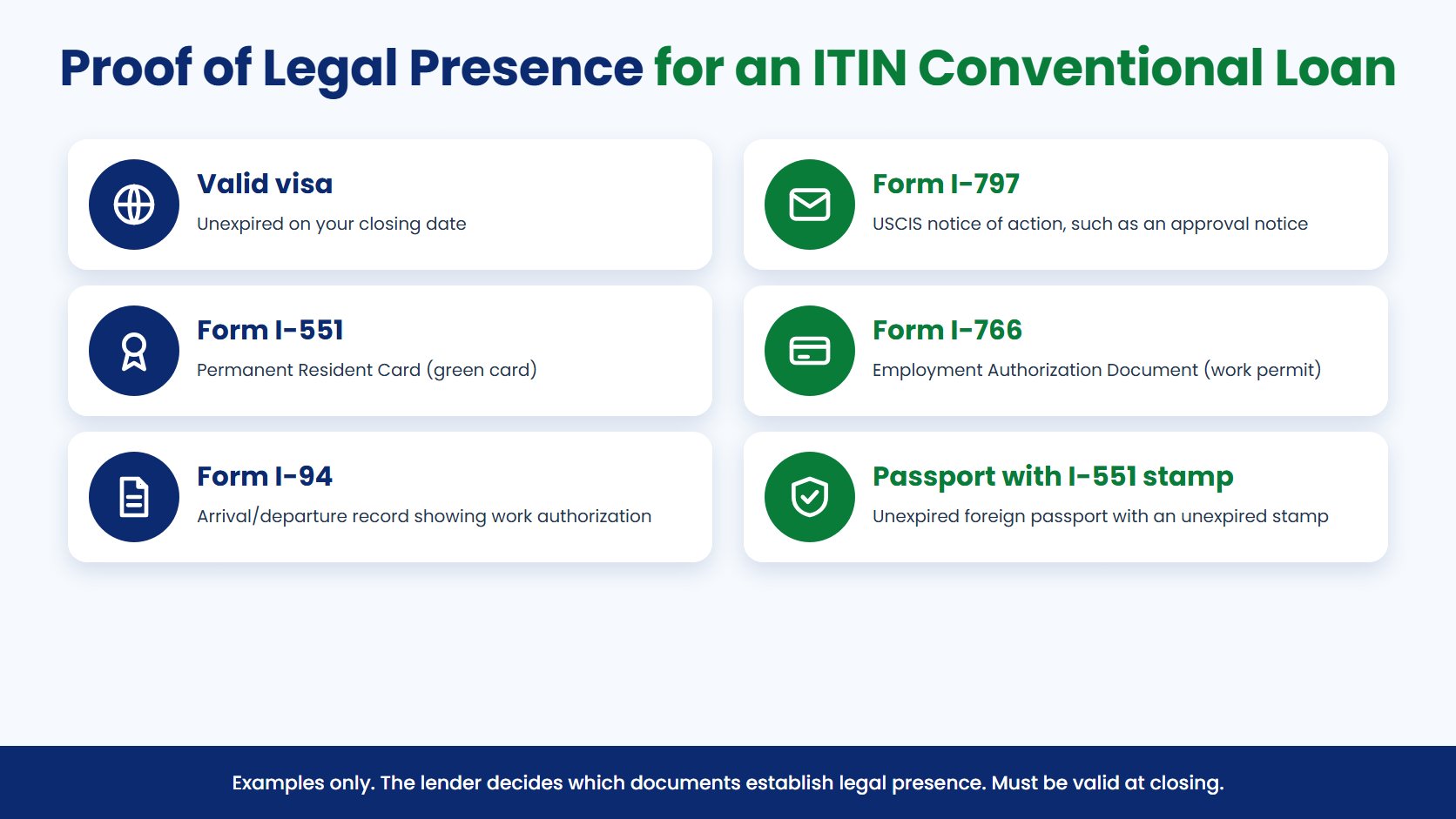
Acceptable proof of legal presence includes a valid visa, a USCIS notice of action, a green card, an employment authorization card, an arrival/departure record showing work authorization, or an unexpired foreign passport with a temporary permanent-residence stamp. The document must be valid on the closing date, not just at application.
| Document | What it is | What we check |
|---|---|---|
| Valid visa | The visa in your passport for your current status | Unexpired on the closing date |
| Form I-797 | A USCIS notice of action, such as an approval notice for a petition | That it shows the approved status and dates |
| Form I-551 | Permanent Resident Card (green card) | Unexpired card |
| Form I-766 | Employment Authorization Document (work permit), or an equivalent | Valid dates and the renewal history if it expires soon |
| Form I-94 | Arrival/departure record | That it proves work authorization |
| Foreign passport with I-551 stamp | Temporary evidence of lawful permanent residence, stamped “Processed for I-551” | Unexpired passport and an unexpired stamp that says employment is authorized |
Fannie Mae doesn’t publish one fixed list. Its guide leaves it to the lender to decide, case by case, which documents show a borrower is legally present, and the lender certifies that when it sells the loan. The table above is the list our lender works from. If your document isn’t on it, send it anyway and we’ll get an answer before you’re under contract.
How Much Down Payment Do You Need With an ITIN Conventional Loan?
As of October 2026, an ITIN borrower buying a one-unit primary residence with a conventional Fannie Mae loan can put as little as 5% down, the same as other conventional buyers. The deciding condition is a Desktop Underwriter Approve/Eligible finding; with less than 20% down, private mortgage insurance is added to the payment.
Let’s say a buyer is purchasing a $300,000 home in New Castle County to live in. With a conventional loan at 5% down, the down payment is $15,000 and the loan is $285,000, plus monthly private mortgage insurance. With a Non-QM ITIN loan at 15% down, the down payment is $45,000 and the loan is $255,000. That’s $30,000 less cash needed up front on the conventional path, before closing costs, which apply either way. Illustrative example only, not a loan offer or commitment. Rates, mortgage insurance and approval depend on the full file.
The 5% is figured on the price or appraised value, whichever is lower. Down payment money can come from your own savings or, on a primary residence, from an eligible family member under the gift funds rules. Mortgage insurance is the cost of putting less than 20% down; our page on private mortgage insurance explains how it’s priced and when it can come off.
The loan amount has to stay within the conforming limit, which is $832,750 for a one-unit home in 2026, set by FHFA; our Delaware conforming loan limits page has the details. Second homes, investment properties and two-to-four-unit homes have their own down payment rules, so ask before you assume 5% applies to them.
Is a Conventional ITIN Loan Better Than a Non-QM ITIN Loan?
For a legally present buyer whose file gets a Desktop Underwriter approval, a conventional ITIN loan usually costs less: as little as 5% down and standard Fannie Mae pricing instead of 15% or more down and Non-QM pricing. A Non-QM ITIN loan fits buyers who can’t document legal presence or whose credit DU won’t approve.
| Feature | Conventional with ITIN (this page) | Non-QM ITIN loan | Foreign national loan |
|---|---|---|---|
| Who it’s for | Non-citizens living and working in the U.S. with proof of legal presence | ITIN filers living in the U.S. who don’t fit agency rules | Buyers who live and work outside the U.S. |
| Minimum down payment | 5% on a one-unit primary residence | 15% or more, based on credit | See the foreign national page |
| Approval | Fannie Mae Desktop Underwriter Approve/Eligible | Lender’s own Non-QM guidelines | Lender’s own guidelines |
| Legal presence document | Required at closing | See the Non-QM ITIN page | Passport and visa rules apply |
| Pricing | Standard conventional pricing | Non-QM pricing, usually higher | Non-QM pricing |
| Mortgage insurance | Required under 20% down | Not typical | Not typical |
FHA used to be another option for some non-permanent residents. It isn’t anymore: HUD’s Mortgagee Letter 2025-09 removed non-permanent resident eligibility for FHA case numbers assigned on or after May 25, 2025. That leaves the conventional loan as the main low-down-payment path for a legally present buyer without a green card, which is one more reason to check it before settling on a Non-QM loan.
Why Don’t More Lenders Offer Conventional Loans to ITIN Borrowers?
Many lenders don’t offer conventional loans to ITIN borrowers because of how they sell their loans on the secondary market, even though Fannie Mae’s rules allow it. A conventional ITIN loan generally has to be delivered to Fannie Mae directly, and lenders whose investors won’t buy ITIN files can’t place it, so they offer only Non-QM.
Most lenders don’t keep the loans they make. They sell them, and many sell to a larger company, often called an aggregator, that buys loans in bulk. If that buyer won’t take ITIN files, the lender can’t make the loan, even though Fannie Mae’s guide allows it. The loan officer you’re talking to may honestly believe ITIN means Non-QM, because at their company it does. Our lender delivers these conventional loans to Fannie Mae directly, which is why we can offer it.
If another lender already told you 15% or 20% down, that quote isn’t wrong for the loan they offer. It’s just a different loan. Bring that quote with you and I’ll show you the two side by side.
What Happens If Your Visa or Work Permit Expires Soon?
Your immigration document has to be valid on the day you close. If your visa or employment authorization expires within about a year of closing, underwriting also looks at whether your income is likely to continue, using your history of past renewals and your employer’s continued sponsorship where that applies.
An expiration date coming up isn’t automatically a problem. Most of the time it means more paperwork: copies of the earlier approvals that show you’ve renewed before, a pending renewal receipt if you have one, and sometimes a letter from your employer. What does stop a closing is a document that expires before the closing date, so I look at that date before we set a contract timeline.
The same goes for your ITIN. An ITIN can expire, and the IRS explains how to renew one on its ITIN page, so make sure yours is current and that it matches the name on your tax returns and credit report before you make an offer.
How Do You Get Pre-Approved for an ITIN Conventional Loan?
Pre-approval for an ITIN conventional loan takes five steps: gather your ITIN letter and immigration document, provide two years of tax returns and recent pay records, allow a credit check under your ITIN, receive a Desktop Underwriter decision, and confirm your legal presence document will still be valid at closing.

- Gather your ITIN and immigration documents. Your ITIN assignment letter (CP565) or a recent IRS notice showing it, and the visa, card or notice that shows your status.
- Provide income records. Your last two years of federal tax returns filed under your ITIN, W-2s or 1099s, and recent pay stubs. Self-employed buyers add business records.
- Credit check under your ITIN. We pull your credit using your ITIN and review the accounts and history on the report.
- Desktop Underwriter decision. We run the file through Fannie Mae’s DU. An Approve/Eligible finding is what opens the conventional path.
- Check your document dates. We confirm your legal presence document runs past your expected closing date, and gather renewal history if it expires soon.
If DU doesn’t approve the file, you haven’t lost anything: the same documents usually work for a Non-QM ITIN pre-approval, and I’ll tell you what would need to change, often more credit history or a lower debt load, to try conventional again later. If this is your first home, our Delaware first-time home buyers guide walks through the rest of the process, from saving to closing.
When an ITIN Conventional Loan Is Not a Good Fit
An ITIN conventional loan is generally not the right tool if:
- You live and work outside the United States. This program treats you as a foreign national, who is not eligible; our foreign national loans page covers that option.
- You can’t document legal presence in the U.S. at closing. The Non-QM ITIN home loan program has its own documentation rules.
- You have diplomatic immunity. Borrowers with diplomatic immunity are not eligible for this program.
- Your credit history is too thin for Desktop Underwriter to approve. A Non-QM loan, or more time building credit, may fit better.
- Your visa or work permit expires before the closing date and a renewal isn’t approved yet.
- You’re self-employed and most of your income is written off on your tax returns. Our Non-QM loans page covers bank statement and other options.
ITIN Conventional Loan in Delaware – FAQ
Can I get a conventional loan with an ITIN instead of a Social Security number?
Yes, if you are legally present in the U.S. at closing and your file receives an Approve/Eligible finding from Fannie Mae’s Desktop Underwriter. Fannie Mae’s Selling Guide accepts a valid Social Security number or ITIN for each borrower, as of October 2026. Not every lender offers it, because the loan has to be delivered to Fannie Mae, so ask the question directly.
How much do I need to put down on a conventional loan with an ITIN?
As little as 5% on a one-unit home you will live in, as of October 2026, with private mortgage insurance until you reach the equity needed to remove it. Closing costs are separate. Second homes, investment properties and two-to-four-unit homes have different down payment rules, so we confirm the number for your purchase at pre-approval.
Will I pay a higher interest rate because I use an ITIN?
Not because of the ITIN itself. Fannie Mae buys loans to lawful non-permanent residents on the same terms available to U.S. citizens, so pricing follows the usual factors: credit score, down payment, loan amount and property type. A Non-QM ITIN loan is usually priced higher. Rates change daily and depend on your full file, so call 302-703-0727 for a current quote.
Can non-permanent residents still get an FHA loan?
No. HUD’s Mortgagee Letter 2025-09 removed non-permanent resident eligibility from FHA for case numbers assigned on or after May 25, 2025. Permanent residents with a green card are still eligible for FHA. For a legally present buyer without a green card, a conventional Fannie Mae loan is now the main low-down-payment option.
I have a green card. Is this page for me?
A green card (Form I-551) is one of the accepted legal presence documents, and permanent residents qualify for conventional loans on the same terms as citizens. Most green card holders also have a Social Security number. If you do, the ITIN question doesn’t apply to you, and our Delaware conventional loans page covers your options.
Do I need a U.S. credit score to qualify?
You need a U.S. credit history that Desktop Underwriter can evaluate and approve. Credit bureaus can report history under an ITIN, so we pull your credit with your ITIN and look at how many accounts you have and how long they’ve been open. If the history is too thin for an approval, we talk about the Non-QM option or how to build it up.
Can my spouse be on the loan if they also use an ITIN?
Yes. Every borrower on the loan needs a valid ITIN or Social Security number and proof of legal presence at closing, and each borrower’s income, credit and assets are reviewed the same way. Adding a spouse’s income can help you qualify, but their credit history and documents count too, so we look at both files together.
What if my visa or work permit expires after I close?
The document has to be valid on the day you close. If it expires within about a year of closing, underwriting looks at your history of renewals and, where it applies, your employer’s continued sponsorship to judge whether your income will continue. Send us your document dates early so we can plan the closing date around them.
Can I use a gift for the 5% down payment?
On a primary residence, gift funds from an eligible family member can cover the down payment under Fannie Mae’s gift rules, with a signed gift letter and a record of the transfer. The donor can’t be someone with a stake in the sale, such as the seller or the agent. Our gift funds guide has the details.
Can a non-U.S. citizen buy a home in Delaware with a mortgage?
Yes. A non-citizen who lives and works in the U.S. and can document legal presence can use a conventional Fannie Mae loan, with a Social Security number or an ITIN, as this page explains. A buyer who lives and works outside the U.S. is a foreign national and uses a different loan; our foreign national loans page covers that option.
About the Author – John R. Thomas

John R. Thomas is Branch Manager and Division Vice President with the John Thomas Team in Newark, Delaware, and has helped Delaware families finance homes for more than 20 years. When a buyer with an ITIN calls, John looks at two dates before anything else: when the immigration document expires and how far back the credit history goes. Those two answers usually tell him whether the conventional path is open or whether a Non-QM loan is the better fit.
John holds a BS in Physics Education from the University of Delaware and an MS in Curriculum and Instruction from Delaware State University. He is the author of Your Guide to Buying Your First Home in Delaware and a frequent host of Delaware home buyer seminars. State licensing: Look up John R. Thomas, NMLS #38783, on NMLS Consumer Access. Read more on his loan officer bio page.
Years 3,000+
Buyers Helped 1,000+
Govt Loans DE & MD
Service Area CMP
Certified Mortgage Planner
John Thomas Team with AnnieMac Home Mortgage
248 E Chestnut Hill Rd, Newark, DE 19713 | 302-703-0727 | team@johnthomasteam.com
Schedule Appointment (30 min)
See John Thomas Team on Google for reviews, directions, and local office information.
YouTube | Facebook | Instagram | TikTok | X / Twitter | LinkedIn
Send us your ITIN, your visa or work permit and your last two years of tax returns. We’ll run Fannie Mae’s Desktop Underwriter, check your document dates against a realistic closing timeline, and show you the conventional and Non-QM numbers side by side.
Last Updated: October 2026 · John Thomas Team with AnnieMac Home Mortgage · Mortgage content reviewed by John R. Thomas, NMLS #38783.
John R. Thomas, NMLS #38783 | John Thomas Team with AnnieMac Home Mortgage | AnnieMac Home Mortgage NMLS #338923 | 248 E Chestnut Hill Rd, Newark, DE 19713 | 302-703-0727 | delawaremortgageloans.net
AnnieMac Home Mortgage is an Equal Housing Lender. State licensing: Look up John R. Thomas, NMLS #38783, on NMLS Consumer Access.
(c) Copyright John R. Thomas, All Rights Reserved.
