
Mortgage Recast: How to Lower Your Payment Without Refinancing


Delaware homeowner overview: A mortgage recast lowers your required monthly payment after you make a lump-sum payment toward principal, while your interest rate, loan and payoff date stay the same. Servicers usually charge a processing fee instead of closing costs. Recasts are most common on conventional loans; FHA and VA loans usually cannot be recast. Current as of November 2026.
If you have a chunk of money coming in – a home sale, a bonus, an inheritance – and a mortgage rate you’d rather not give up, this page is for you. I’m John Thomas, NMLS #38783, and I’ve spent more than 20 years helping Delaware families with their mortgages, including homeowners weighing a recast against a HELOC or home equity loan or a payoff plan on a conventional loan. Sending a lump sum to your mortgage company feels responsible, but on its own it won’t lower your monthly payment by a dollar. A mortgage recast can. Below is the real math on a hypothetical loan, the pro move most people miss, how a recast compares with paying extra and with a refinance, and the five steps to ask your servicer for one.
Quick Answer: To recast, you pay a lump sum toward principal – servicers often require at least $5,000 to $10,000 – and ask your servicer to recalculate the payment on the new balance. On a hypothetical 6.5% loan with 28 years left, each $1,000 lowers the payment about $6.50 a month, so $100,000 drops it about $647. Your rate and payoff date stay the same; fees, minimums and eligibility vary by servicer and loan type.
Want to see your own recast numbers?
Send me your balance, rate and lump sum, and I’ll compare a recast, paying extra and a refinance side by side – no pressure, no obligation.
Table of Contents
What Is a Mortgage Recast?
A mortgage recast is a lump-sum payment toward principal followed by a request that your servicer recalculate the monthly payment on the lower balance. The interest rate, the loan and the payoff date stay the same; only the required payment drops. Most servicers charge a processing fee instead of closing costs, and eligibility depends on the loan type.
The industry word for it is re-amortization. Nothing about your loan is replaced, so there is usually no new application, no appraisal, no income check and no closing – though each servicer sets its own requirements. You send the lump sum, mark it for a recast, and the servicer spreads the smaller balance over the months you already have left. The order matters – ask about the recast before you send the money, because a payment sent as a plain extra principal payment will not lower your payment on its own.
Your servicer is the company you send your payment to every month. It is often not the lender you closed with, because loans are sold and servicing is transferred. The servicer’s name and phone number are on your mortgage statement and your online portal, and the servicer is the one who approves and processes a recast.
Watch: John Thomas runs the recast math on a hypothetical $400,000 loan, compares it with paying extra and refinancing, and walks through how to ask your servicer for one (8:41).
Does Paying Extra Lower Your Mortgage Payment?
No, not on a fixed-rate loan. An extra principal payment lowers the balance and pays the loan off sooner, but the required monthly payment stays exactly where it was set at closing. The payment only drops if you ask the servicer to recast the loan after the extra payment, or if you refinance into a new loan.
This is the mistake I see most often. Say you bought two years ago with a hypothetical $400,000 loan at 6.5%. Your principal and interest payment is about $2,528 a month. You sell a house or receive a bonus or an inheritance, and you send $100,000 to the mortgage company. Next month the statement shows a balance about $100,000 lower – and the same $2,528 payment due.
Nothing went wrong. On a fixed-rate loan the payment was locked in the day you closed, and an extra payment shortens the back end of the loan instead. That is a good outcome if your goal is to own the house outright sooner. If what you wanted was more room in the monthly budget, you tied up $100,000 and got nothing back this month. A recast is how you fix that.
What this means for you: Before you send a large payment, decide what you want it to do. A faster payoff and a lower monthly payment are two different results, and only one of them happens automatically.
How Much Does a Recast Lower Your Payment?
About $6.50 a month for every $1,000 you put down, on a hypothetical 6.5% 30-year loan with 28 years left. A $100,000 recast on a $390,800 balance drops the principal and interest payment from about $2,528 to about $1,881. The figure changes with your rate and the months remaining on your loan.
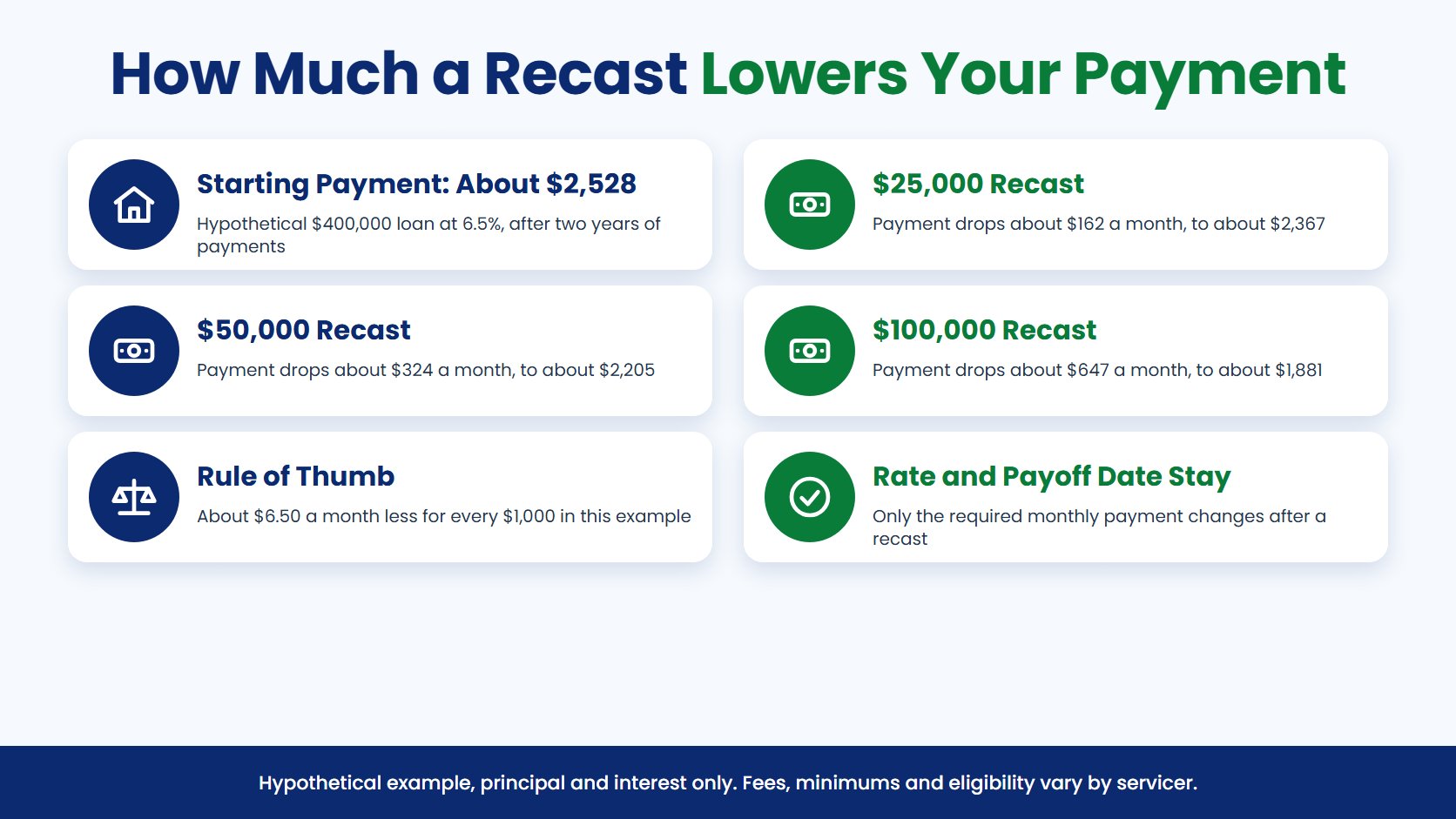
Here is the math on the same hypothetical loan. After two years of payments, about $390,800 is owed with 28 years left. Send in the $100,000, ask for a recast, and the servicer recalculates over the remaining 336 months. The new principal and interest payment is about $1,881 – roughly $647 a month less, every month for the rest of the loan. Over those 28 years you would also pay about $117,000 less in interest than if you had kept the full balance.
| Lump sum recast | New P&I payment | Monthly drop | Drop per $1,000 |
|---|---|---|---|
| $25,000 | about $2,367 | about $162 | about $6.47 |
| $50,000 | about $2,205 | about $324 | about $6.47 |
| $100,000 | about $1,881 | about $647 | about $6.47 |
The per-$1,000 rule is a handy way to estimate your own loan, but it moves with your numbers. A higher rate or more years left gives a slightly smaller drop per $1,000 than you might expect from the balance alone; a lower rate or fewer years left changes it again. If you send me your balance, rate and lump sum, I’ll run the recast side by side with simply paying extra and with a refinance, so you can see all three before you send anything.
Should You Recast or Just Pay Extra?
Pay extra if your goal is to pay the house off sooner; recast if your goal is monthly cash flow. In the hypothetical $100,000 example, paying extra and keeping the $2,528 payment ends the loan in about 15 years and saves about $293,000 in interest, while a recast drops the payment about $647 and saves about $117,000.
| Same $100,000, two choices | Pay extra only | Pay extra and recast |
|---|---|---|
| Required monthly payment | Stays about $2,528 | Drops to about $1,881 |
| Loan paid off in | About 15 more years | 28 more years (original schedule) |
| Interest saved vs. no paydown | About $293,000 | About $117,000 |
| Best for | Paying the house off sooner | More room in the monthly budget |
So the question is not which one is better. It is what you want the money to do: pay the house off faster, or open up cash every month. Both are reasonable. They just answer different goals.
The Pro Move: Recast, Then Keep Paying the Old Payment
Here’s the move I’d make if this were my own loan: recast, then keep sending the old payment anyway. Your required payment drops to about $1,881, but you keep paying the $2,528 you were already used to. The math works out the same as paying extra – in this example the loan is paid off in about 15 years and you keep the interest savings.
The difference is what happens when life gets in the way. If you lose a job, face a medical bill or the roof goes, you can drop back to the lower required payment – no phone call and no asking permission. You get the faster payoff with a lower required payment underneath it as a safety net. That’s the version I’d want.
One habit to keep: If you pay more than the required amount after a recast, check that your servicer applies the difference to principal each month. Your statement shows how every payment was split.
Can a Recast Help If You Buy Before You Sell?
Yes. Many buyers who need to move before their current home sells buy with a smaller down payment, then put the sale proceeds toward the new loan and recast. In a hypothetical $475,000 loan at 6.5%, a $100,000 recast after the old house sells drops the payment from about $3,002 to about $2,369.
This is where I see recasts used the most. Plenty of homeowners want to move but cannot sell first – they would have nowhere to live in between. So they buy the new house first with a small down payment: say a $500,000 home with 5% down and a $475,000 loan at a hypothetical 6.5%, for about $3,002 a month in principal and interest. A few months later the old house sells and they walk away with $100,000. They put it toward the new loan and recast, and the payment drops to about $2,369 – about $634 a month less.
There is often a bonus. With 5% down, most conventional buyers pay private mortgage insurance. After that paydown the balance is about 75% of the original price. The CFPB explains that you can ask to cancel PMI early once extra payments bring your principal to 80% of the home’s original value, if you ask in writing, have a good payment history, have no second mortgage and can show the value has not dropped (see the CFPB guide to removing PMI). Ask your servicer about it on the same call. Our guide to what mortgage insurance is and how PMI works covers the rest.
Some servicers require a few payments on the new loan before they will recast it, so ask when the earliest recast date is. If you need the cash from your current home before it sells, a bridge loan or HELOC is the other way to buy first; a recast is how you bring the payment back down afterward.
Should You Recast or Refinance?
Recast if you have a low rate you want to keep; refinance if today’s rates are lower than yours. A recast keeps your loan, rate and term for a servicer fee. A refinance replaces the loan with a new rate and term, closing costs, a full application and usually an appraisal.
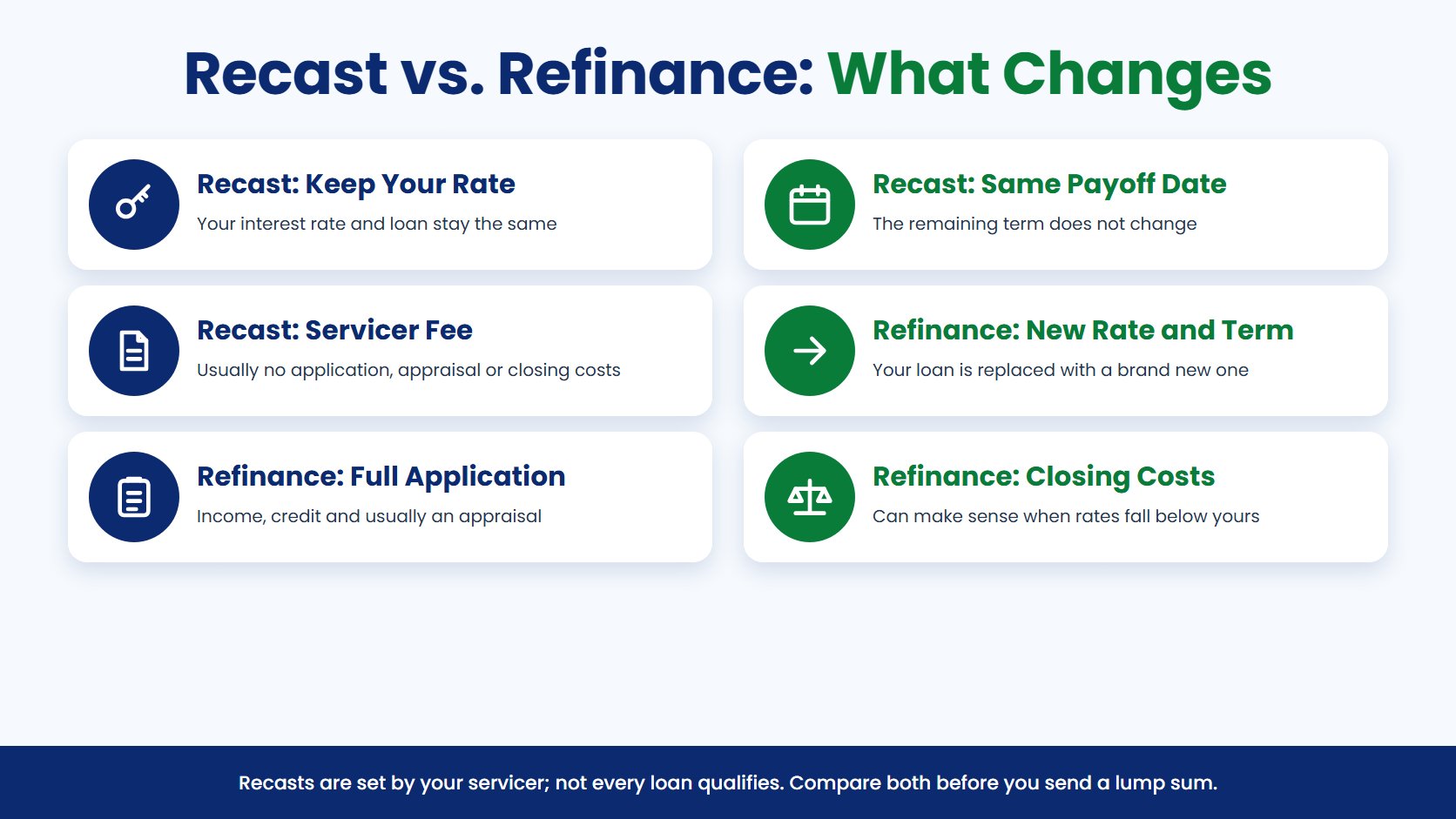
Here’s where people get hurt. Take a hypothetical $300,000 loan at 3% from five years ago. You owe about $266,700 and pay about $1,265 a month. You have $50,000 to put down. Recast, and you keep the 3% rate – the payment drops to about $1,028. Refinance the rest at a hypothetical 6.5%, and even with the $50,000 paid down the new 30-year payment rises to about $1,370, plus closing costs.
| Hypothetical 3% loan, $50,000 to put down | Recast | Refinance at 6.5% |
|---|---|---|
| Interest rate | Keeps 3% | New rate (6.5% in this example) |
| Monthly P&I payment | About $1,028 | About $1,370 |
| Cost to do it | Servicer fee | Closing costs |
| Application and appraisal | Usually none | Full application, usually an appraisal |
If you don’t have a low rate, a refinance may make more sense, and if rates drop below what you’re paying, a refinance beats a recast. That’s why it’s worth having a loan officer check both before you send anything. If your loan is FHA or VA, the rate-lowering paths are the FHA streamline refinance and the VA IRRRL. And if what you need is cash rather than a lower payment, compare a HELOC or home equity loan instead of paying the mortgage down.
Which Loans Can Be Recast?
Most recasts are done on conventional loans and some jumbo loans. Fannie Mae’s Servicing Guide lets servicers re-amortize a loan after a substantial principal payment (as of November 2026). FHA, VA and USDA loans usually cannot be recast. Each servicer sets its own minimum, fee and rules, so the answer for your loan comes from your servicer.
- Conventional loans: the most common recast candidates. Fannie Mae’s Servicing Guide C-1.2-01 covers re-amortizing a loan to reduce the payment after a substantial curtailment. See our Delaware conventional loans guide.
- Jumbo loans: some servicers recast them; ask yours. See Delaware jumbo mortgages.
- FHA, VA and USDA loans: usually not recast. Extra payments still pay the loan down faster; they just won’t lower the required payment. See Delaware FHA loans and Delaware VA loans.
- Minimums and fees: minimum lump sums are often $5,000 to $10,000, and fees range from nothing at some servicers to a few hundred dollars or more at others. Every company is different, so get the servicer’s own numbers.
How Do You Ask Your Servicer for a Recast?
Call your servicer, not your loan officer, and ask before you send any money. Confirm the loan is eligible, the minimum lump sum, the fee, how to send the payment and how long it takes. Send the lump sum marked as principal for a recast, keep paying until the new payment starts, and get the new payment in writing.
- Call your servicer. It is the company you pay every month, often not the lender you closed with. The phone number is on your mortgage statement and your online portal.
- Ask four questions before you send a dime. Say you would like to request a recast (a re-amortization after a principal payment), then ask: Is my loan eligible? What is the minimum lump sum? What is the fee? How do I send it, and how long does it take? Write the answers down with the date and the name of the person you spoke with.
- Send the lump sum the way they tell you. Make sure it is marked as a principal payment for a recast, not a regular extra payment.
- Keep making your regular payment until the new one takes effect. It can take a month or two. Don’t skip a payment early and end up with a late charge.
- Get the new payment in writing. You should receive a letter or an agreement to sign showing your new monthly payment.
What I check before a homeowner sends a recast payment
When a homeowner tells me they have a lump sum coming, I look at three numbers before anything goes to the servicer: their current rate against today’s market, how many years are left, and how much cash they keep afterward. A low rate with plenty of savings left over usually points to a recast. A high rate points to a refinance comparison first. Thin savings points to waiting. – John Thomas, NMLS #38783
When Should You Not Recast?
Skip a recast when the loan is FHA or VA, when the lump sum would wipe out your emergency savings, or when you plan to sell within a year or two. Money paid into the house comes back only by selling, refinancing or borrowing against it. Paying down versus investing is a financial-planning question.
When a Recast Is Not a Good Fit
A good loan officer should tell you when something isn’t right for you, so here it is. If you have an FHA or VA loan, you usually can’t recast – call your servicer and ask. If the lump sum would wipe out your emergency savings, don’t: once that money is in the house, getting it back means selling, refinancing or borrowing against it. If you’re planning to sell in the next year or two, the lower payment may not be worth tying up the cash. And if you’re torn between paying down the mortgage and investing the money, that part is a question for your financial planner. If you don’t have one you trust, we can introduce you to someone.
Recasting a Mortgage in Delaware
A recast works the same way in Delaware as anywhere else: your servicer handles it under its own rules and the investor’s guidelines, and there is no new loan to close. Where we come in is the comparison before you send the money – recast, pay extra, refinance or leave the money in savings.
Most of the Delaware homeowners I talk with about recasting are moving up – buying a new home in New Castle, Kent or Sussex County before the old one sells – or they have a low rate from the last few years that they don’t want to give up. If you’re buying first, our team can structure the purchase loan with the recast in mind and look at whether a conventional loan fits, since that is where recasts are most common. You can also see how taxes and insurance fit into the full payment in our guide to understanding your mortgage payment.
Key Takeaways
- Paying extra on a fixed-rate loan does not lower your monthly payment; it pays the loan off sooner.
- A recast lowers the required payment after a lump sum and keeps your rate, loan and payoff date, usually for a servicer fee.
- In the hypothetical 6.5% example, each $1,000 recast lowers the payment about $6.50 a month.
- The pro move: recast, then keep paying the old amount – a faster payoff with a lower required payment as a safety net.
- If you have a low rate, a recast can lower the payment without giving the rate up; if rates fall below yours, compare a refinance.
- FHA and VA loans usually cannot be recast; ask your servicer before you send any money.
Your Next Steps Before You Send a Lump Sum
Here’s how I’d approach it if you were sitting across from me:
- Decide what you want the money to do: a faster payoff, a lower payment, or both with the pro move.
- Find your servicer on your mortgage statement and ask whether your loan can be recast, the minimum and the fee.
- Compare the recast with paying extra and with a refinance at today’s rates before you send anything.
- Keep enough cash in savings that a surprise bill doesn’t force you to borrow against the house.
- If you’re buying before you sell, plan the recast (and the PMI question) into the purchase from the start.
Send me your balance, rate and lump sum, and I’ll show you the recast, the pay-extra path and a refinance side by side. Your numbers won’t match the examples on this page, and that’s exactly why it’s worth a short call.
Mortgage Recast FAQ
Does a mortgage recast change my interest rate?
No. A recast keeps your interest rate, your loan and your payoff date. The servicer recalculates the monthly payment on the lower balance after your lump-sum payment, so only the required payment changes. If you want a different rate, that takes a refinance, which replaces the loan with a new one.
How much does it cost to recast a mortgage?
It depends on the servicer. Many charge a processing fee of a few hundred dollars, some charge more, and a few charge nothing. There are usually no closing costs, appraisal or new application, though some servicers add small title-related fees. Ask your servicer for its fee before you send the lump sum.
What is the minimum payment to recast a mortgage?
Minimum lump sums are often $5,000 to $10,000, but every servicer sets its own. Some also require the loan to be current and a certain number of payments made first. Call your servicer and ask for its minimum and timing before you send the money.
Can I recast an FHA or VA loan?
Usually not. Most recasts are done on conventional loans and some jumbo loans, and FHA, VA and USDA loans generally are not recast. Extra payments on those loans still pay the balance down faster; they just don’t lower the required payment. Ask your servicer to confirm for your loan.
Is it better to recast or pay extra on my mortgage?
It depends on your goal. Paying extra and keeping the same payment pays the loan off sooner and saves more interest. A recast lowers the required monthly payment for more cash flow. Recasting and then continuing to pay the old amount gives you the faster payoff with the lower payment as a backup.
Is a recast better than a refinance?
If you already have a low rate, a recast usually is, because it lowers the payment without giving that rate up and costs a small fee instead of closing costs. If market rates are below your current rate, a refinance may lower the payment more. A loan officer can compare both on your numbers before you decide.
Can a recast remove my PMI?
It can help. A recast itself does not cancel private mortgage insurance, but the lump sum that comes with it may bring your balance to 80% of the home’s original value. The CFPB says you can then ask your servicer in writing to cancel PMI, if your payment history is good, there is no second mortgage and the value has not dropped.
Does a recast change my escrow payment?
No, not directly. A recast recalculates only the principal and interest part of your payment. If you pay property taxes and homeowners insurance through escrow, that part is still set by your servicer’s escrow analysis and can change when taxes or insurance premiums change, whether or not you recast.
Can I recast my mortgage more than once?
Some servicers allow more than one recast over the life of a loan, each with its own minimum lump sum and fee, and some limit how often you can do it. Ask your servicer for its rules before you plan a second lump sum.
How long does a mortgage recast take?
Often one to two billing cycles after the servicer receives the lump sum, but timing varies by servicer. Keep making your regular payment until the new payment takes effect, and get the new payment amount in writing, usually in a letter or an agreement you sign.

John R. Thomas is Branch Manager and Division Vice President with the John Thomas Team in Newark, Delaware, and has helped more than 3,000 Delaware and Maryland families finance a home over 20+ years. His job doesn’t stop at closing: he helps homeowners manage debt, equity and cash flow over time, which includes running the numbers on a recast, a refinance or paying extra before a client sends a lump sum to the servicer.
He holds a BS in Physics Education from the University of Delaware and an MS in Curriculum and Instruction from Delaware State University, and is the author of Your Guide to Buying Your First Home in Delaware. State licensing: Look up John R. Thomas, NMLS #38783, on NMLS Consumer Access. Read more on his loan officer bio page.
Years 3,000+
Buyers Helped DE & MD
Service Area CMP
Certified Mortgage Planner
John Thomas Team with AnnieMac Home Mortgage
248 E Chestnut Hill Rd, Newark, DE 19713 | 302-703-0727 | team@johnthomasteam.com
Schedule Appointment (30 min)
See John Thomas Team on Google for reviews, directions, and local office information.
YouTube | Facebook | Instagram | TikTok | X / Twitter | LinkedIn

Let’s run your recast numbers before you send the money
Recast, pay extra or refinance – I’ll show you all three on your own loan so you can pick the one that fits your goal.
Last Updated: November 2026 · John Thomas Team with AnnieMac Home Mortgage · Mortgage content reviewed by John R. Thomas, NMLS #38783.
John R. Thomas, NMLS #38783 | John Thomas Team with AnnieMac Home Mortgage | AnnieMac Home Mortgage NMLS #338923 | 248 E Chestnut Hill Rd, Newark, DE 19713 | 302-703-0727 | delawaremortgageloans.net
AnnieMac Home Mortgage is an Equal Housing Lender. State licensing: Look up John R. Thomas, NMLS #38783, on NMLS Consumer Access.
(c) Copyright John R. Thomas, All Rights Reserved.
