Buy vs Rent in Delaware: How to Compare the Real Costs

Delaware home buyer overview: Whether buying beats renting depends on how long you stay, the true monthly cost of each option, and your upfront cash. Delaware caps rental security deposits at one month’s rent on a lease of a year or more. In most of the state the total realty transfer tax is 4%; the law splits the state share equally between buyer and seller, and the local share is commonly split by contract. Current as of November 2026.
You’re paying rent every month and wondering whether that money should be going toward a home of your own. Maybe a friend just bought, or your lease renewal came with a higher number. I’m John Thomas, NMLS #38783, and I’ve helped Delaware families buy homes for more than 20 years. My goal on this page is to show you how to compare buying and renting honestly: the true monthly cost of each, the cash each one takes up front, how long you need to stay for buying to pay off, and when renting is the smarter move. If you want the bigger picture on ownership, start with the financial benefits of owning a home.
Quick Answer for Delaware Buyers: Compare the true monthly cost of owning (payment, taxes, insurance, mortgage insurance and repairs, minus the principal you pay down) with your full rent. Then add the one-time costs to buy and to sell, including transfer tax. Buying usually wins if you stay past your break-even point and still have savings after closing. Renting usually wins if you may move within a few years.
Get your real numbers before you decide
A pre-approval shows your actual payment, your cash to close and the down payment help you qualify for, so your buy vs rent comparison uses real figures. We’ll walk through it with you.
Table of Contents
Is It Better to Buy or Rent in Delaware?
It depends on three things: how long you plan to stay, what each option really costs you every month, and how much cash you need up front. Buying usually comes out ahead when you stay long enough to earn back the one-time costs of buying and selling. Renting usually wins when you may move within a few years.
Most buy vs rent comparisons go wrong because they put a monthly rent check next to a monthly mortgage payment and stop there. That leaves out most of the picture. A renter also pays renters insurance and sometimes utilities a landlord used to cover. An owner also pays property taxes, homeowners insurance, maybe mortgage insurance or an association fee, and every repair. And part of an owner’s payment isn’t a cost at all, because the principal you pay down stays yours as equity.
This page is about the comparison itself: how to line up the real costs side by side and find your own break-even point. If you want the case for why owning can build wealth over time, our guide to the financial benefits of owning a home covers it. If your question is whether to buy now or wait a year, our breakdown of the cost of waiting to buy a home works through the timing.
How I run this comparison with buyers
I taught physics before I lent full time, and I still work a buy vs rent question the way I taught a problem: write down every number on one page, label what you are assuming, and change one assumption at a time to see what moves the answer. Most of the time it isn’t the payment that decides it. It’s how long you will stay and how much cash you will have left after closing. – John Thomas, NMLS #38783
What Does Renting Cost Each Month Compared to Owning?
A renter’s monthly cost is the rent plus renters insurance and any utilities the lease puts on you. An owner’s monthly cost is principal and interest, property taxes, homeowners insurance, any mortgage insurance or association fee, and a budget for repairs. The principal portion builds equity, so it is not a true cost the way rent is.
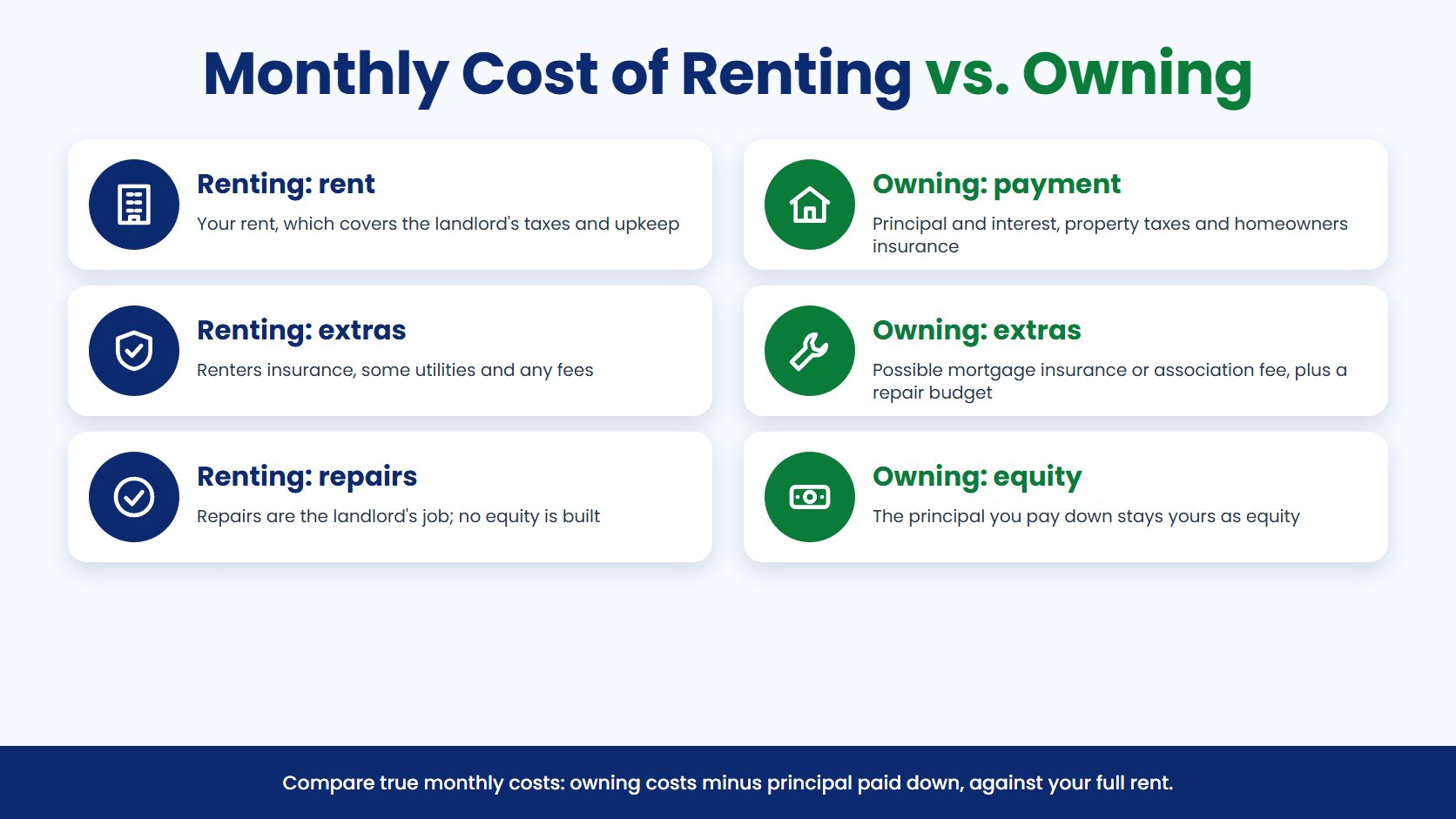
Here’s a hypothetical side-by-side for a Delaware buyer looking at a modest single-family home. These are example numbers only, not market figures. Plug in your own rent, the homes you are looking at and the payment from your pre-approval.
| Monthly cost (hypothetical) | Renting | Owning |
|---|---|---|
| Rent or principal and interest | $1,800 rent | $1,650 principal and interest (about $400 of it principal in the early years) |
| Property taxes | Paid by the landlord, built into rent | $150 |
| Insurance | $20 renters insurance | $120 homeowners insurance |
| Mortgage insurance | None | $130 (often required with less than 20% down) |
| Repairs and upkeep | Landlord’s job | $250 set aside |
| Total out of pocket | $1,820 | $2,300 |
| Comes back to you as equity | $0 | About $400 of principal |
| True monthly cost | $1,820 | About $1,900 |
Look at the last two rows. On paper the owner pays $480 more each month, but about $400 of that is principal that stays in the house. The true gap in this example is closer to $80 a month. That’s why a payment-to-rent comparison alone can scare buyers off, or talk them into a house they can’t carry. Our guides to homeowners insurance in Delaware and mortgage insurance (PMI) explain those two lines in more detail.
How Much Cash Do You Need Up Front to Rent vs Buy in Delaware?
Renting takes a security deposit, the first month’s rent and moving costs. Delaware caps the deposit at one month’s rent on a lease of a year or more. Buying takes a down payment, closing costs including your share of the realty transfer tax, the inspection and appraisal, and cash left in savings after closing.
On the rental side, Delaware’s Landlord-Tenant Code limits what a landlord can ask for. Under 25 Del. C. Sec. 5514, a landlord may not require a security deposit of more than one month’s rent when the lease is for a year or more. Add the first month’s rent, any application fees and the move itself, and a renter’s upfront cash is usually a fraction of a buyer’s.
On the buying side, Delaware’s realty transfer tax is the line that surprises people. In most of the state the total tax is 4% of the price, a state share plus a local share. Under 30 Del. C. Sec. 5402, the state share is split equally between buyer and seller, and the local share is commonly split the same way by contract. First-time buyers can cut their part of the state share by 0.5% of the price, counted on up to $400,000, which saves up to $2,000. Our guide to the Delaware first-time home buyer transfer tax exemption shows exactly how that works by county and town.
| Upfront cash | Renting | Buying |
|---|---|---|
| Deposit or down payment | Security deposit, capped at 1 month’s rent on a lease of 1 year or more | Down payment, depending on the loan program |
| First payment | First month’s rent | Usually not due until the month after closing |
| Closing or move-in costs | Application fees, moving costs | Lender and title charges, prepaid taxes and insurance, your share of transfer tax |
| Inspections | None | Home inspection, and an appraisal on most loans |
| Cash after you move in | A normal emergency fund | Reserves for repairs, since there’s no landlord to call |
The good news is that the buying column can shrink a lot. Delaware down payment assistance programs can help with the down payment and closing costs, and a seller can agree to pay part of your costs as seller-paid closing costs. When I run a buy vs rent comparison with a buyer, the down payment help available to them often changes the answer more than the payment does.
How Long Do You Need to Stay for Buying to Pay Off?
Buying pays off once what you have gained by owning covers what owning cost you extra. That break-even point depends mostly on how long you stay, how home values move, how fast rents rise, and your one-time costs to buy and sell. If prices hold steady, it can take many years. If values rise, it can come much sooner.
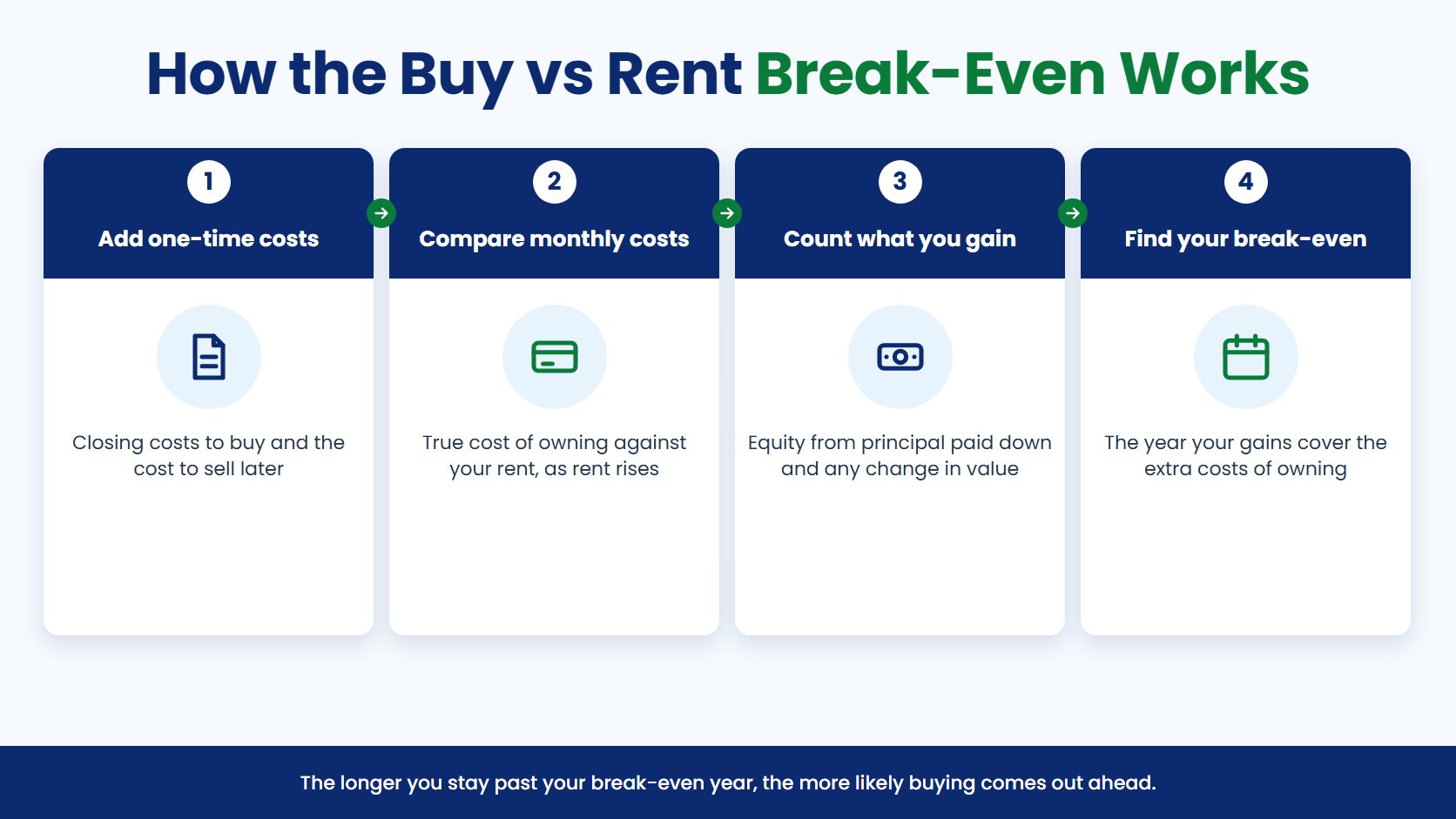
Here’s a hypothetical example using the monthly numbers above. Your down payment and the principal you pay down are not costs, because you get them back when you sell. These are the assumptions:
- Home price: $300,000
- Closing costs you won’t get back: $9,000
- Cost to sell later (agent fees and your share of the transfer tax): about 7% of the sale price
- True monthly cost of owning: about $1,900, held steady
- Comparable rent: $1,800 to start, rising 3% a year
| Home value change (hypothetical) | Ahead or behind after 3 years | Ahead or behind after 5 years | Roughly when buying breaks even |
|---|---|---|---|
| Values stay flat | About $31,600 behind | About $29,300 behind | About year 12 |
| Values rise 2% a year | About $14,600 behind | About even | About year 6 |
| Values rise 4% a year | About $3,200 ahead | About $31,100 ahead | About year 3 |
Two things jump out. First, how long you stay matters more than almost anything else, because the one-time costs of buying and selling get spread over more years. Second, home values are the swing factor, and nobody can promise you which row you’ll land in. That’s why I’d rather you buy a home you can afford to hold through a flat stretch than count on prices rising to bail out the math.
What this means for you: If there’s a real chance you’ll move within two or three years, renting usually protects you better. If you expect to stay well past your own break-even year, and the monthly cost fits your budget, buying usually comes out ahead.
What Does Delaware Law Say About Rent Increases and Deposits?
Delaware’s Landlord-Tenant Code sets notice rules, not a dollar limit on most rent increases. A landlord who plans to renew your lease at a higher rent must give you at least 60 days’ written notice before the lease ends. Security deposits are capped at one month’s rent on a lease of a year or more.
Under 25 Del. C. Sec. 5107, a landlord who wants to renew a lease on new terms, including a new rent, must give you written notice at least 60 days before the lease expires, with the new rent and the date it takes effect. Under Sec. 5106 of the same chapter, either side can end a lease at the end of its term with at least 60 days’ written notice. So as a renter you get a heads-up about a rent change, but the code doesn’t stop the rent from going up at renewal.
That’s the real trade-off in plain terms. Renting gives you flexibility, because you can leave at the end of a lease with proper notice. Owning with a fixed-rate mortgage gives you a principal and interest payment that doesn’t change for the life of the loan, although your taxes and insurance can still rise. Which one is worth more depends on how settled your next few years look.
What Costs Do Renters and Owners Forget to Count?
Renters often forget renters insurance, rent increases at each renewal, pet rent and parking, and the cost of moving every few years. Owners often forget repairs and replacements, mortgage insurance, association fees, rising taxes and insurance, and the cost of selling when they move. A fair comparison counts both lists.
These are the lines I see left out most often:
- Renters: increases at renewal. Plan for the rent to change when the lease renews, and compare against what rent will likely be in a few years as well as today.
- Renters: moving costs. Movers, truck rental, deposits and time off work add up if you move every year or two.
- Renters: fees. Pet rent, parking, amenity and application fees are real monthly costs.
- Owners: repairs. Roofs, furnaces, water heaters and appliances wear out on their own schedule. Budget for them every month.
- Owners: mortgage insurance and association fees. Both can be part of the monthly cost for years.
- Owners: taxes and insurance. These can rise even when your principal and interest stay the same.
- Owners: the cost to sell. Agent fees and your share of the transfer tax come due when you move, so they belong in the comparison from day one.
- Owners: what the down payment could have earned. Money in the house isn’t earning interest in an account. The Consumer Financial Protection Bureau has tools for weighing a purchase against your other goals.
And one owner line people overcount: taxes. Mortgage interest is deductible only if you itemize, as IRS Publication 936 explains, and many households take the standard deduction instead. Treat any tax savings as a possible bonus to confirm with a tax advisor, not as part of the payment you can afford.
When Does Renting Make More Sense Than Buying?
Renting usually makes more sense if you may move within a few years, your job or family plans are uncertain, you don’t yet have cash left over after a down payment and closing costs, or the homes that fit your needs would stretch your monthly budget. Renting while you prepare is a smart choice, not a failure.
When I Tell a Buyer to Keep Renting
I’m just being honest with you: buying isn’t the right move for everyone right now. If a job transfer or a move for family is likely in the next couple of years, if buying would empty your savings with nothing left for a repair, or if the payment only works on paper when nothing goes wrong, keep renting and keep preparing. Use the time to build savings, check your credit and learn what down payment help you qualify for. That way, when you do buy, you buy a home you can keep.
If credit is what’s holding you back, our guide to the five factors of credit scoring shows what moves a score, and our list of mortgage loan dos and don’ts covers the habits that keep you loan-ready while you rent.
When Does Buying Make More Sense Than Renting?
Buying usually makes more sense if you expect to stay well past your break-even point, the total monthly cost of owning fits your budget, you will still have savings after closing, and you want a principal and interest payment that won’t change. Down payment assistance or a seller credit can tip a close call toward buying.
These are the signs I look for when the numbers point toward buying:
- You expect to be in the area, and in a home of this size, for several years or more.
- The full monthly cost, including taxes, insurance and repairs, fits comfortably with your other bills.
- You’ll have money left in savings after the down payment and closing costs.
- Your other monthly debts are manageable, and you’ll still have an emergency fund after closing.
- Rents for the kind of home you want are close to the true monthly cost of owning it.
- You qualify for down payment help or a seller credit that cuts your upfront cash.
First-time buyers in Delaware may also qualify for a reduction on the state share of the transfer tax, which cuts the upfront side of the comparison. Our Delaware first-time home buyer programs guide covers what’s available and who qualifies.
How Do You Run Your Own Buy vs Rent Comparison?
Write down your current rent and renters costs, get pre-approved to learn your real payment and cash to close, add taxes, insurance, mortgage insurance and a repair budget, subtract the principal you’d pay down, then estimate how long you’ll stay. Compare the true monthly costs and the one-time costs over that stay.
Here’s the worksheet I’d walk through with you:
- Your renting cost today: rent, renters insurance, utilities and fees.
- Your likely rent later: what a comparable rental may cost when your lease renews.
- Your owning cost: principal and interest from a pre-approval, plus taxes, insurance, any mortgage insurance or association fee, and a repair budget.
- Your true owning cost: the owning cost minus the principal you pay down each month.
- Your one-time costs: closing costs after any assistance or seller credit, and the cost to sell later.
- Your time frame: how many years you realistically expect to stay.
- Your cushion: what’s left in savings after closing.
Online rent vs buy calculators can help with the arithmetic, but they’re only as good as the numbers you put in. The payment, the cash to close and the assistance you qualify for come from a real pre-approval, not a guess. Once you have those, the comparison usually takes one conversation.
Your Next Steps to Decide Between Buying and Renting
Here’s how I’d handle it if you were sitting across from me:
- Write down your full renting cost today, including insurance, utilities and fees.
- Get pre-approved so you know your real payment, your cash to close and your loan options.
- Ask which down payment assistance programs you qualify for, and how much they cut your upfront cash.
- Build the side-by-side monthly comparison, including repairs, and subtract the principal you’d pay down.
- Be honest about how long you’ll stay, and compare that with your break-even year.
- Decide with a cushion in mind. A home you can keep beats a home you stretch for.
Before you shop, our guides to why you need a home inspection and what a home warranty covers explain two costs and protections that come with owning, and the Delaware home buyer information hub links every buyer topic in one place.
Buy vs Rent FAQ for Delaware
Is it cheaper to rent or buy a home in Delaware?
It depends on how long you stay and your full costs. Renting is often cheaper over a short stay because buying and selling come with one-time costs, including transfer tax. Over a longer stay, buying often comes out ahead because part of each payment builds equity. Compare the true monthly cost of each, rather than rent against the mortgage payment alone.
How long should I plan to stay for buying to make sense?
There is no single answer, because it depends on home values, rents and your one-time costs. In flat markets the break-even point can be many years away, and when values rise it can come much sooner. If you may move within two or three years, renting usually protects you better.
How much do I need up front to buy a home in Delaware compared to renting?
Renting usually takes a security deposit, which Delaware caps at one month’s rent on a lease of a year or more, plus the first month’s rent. Buying takes a down payment, closing costs including your share of the transfer tax, inspections and savings left after closing. Down payment assistance can cut the buying side a lot.
Who pays the transfer tax when I buy a home in Delaware?
Delaware law splits the state share of the realty transfer tax equally between buyer and seller, and the local share is commonly split the same way by contract. The total is 4% of the price in most of Delaware. First-time buyers can get a reduction on the state share.
Can my landlord raise my rent in Delaware?
Generally yes, at renewal. Delaware’s Landlord-Tenant Code requires a landlord to give at least 60 days’ written notice before a lease is renewed with a higher rent or other changes. The code sets notice rules rather than a dollar limit on most increases.
Is renting just throwing money away?
No. Rent buys you a place to live, flexibility and freedom from repair bills. An owner also has costs that never come back, like interest, taxes, insurance and repairs. The fair comparison is rent against the true cost of owning, which is your payment and expenses minus the principal you pay down.
Do I get a tax break for buying a home?
Maybe. Mortgage interest is deductible only if you itemize, and many households take the standard deduction instead. Delaware also offers first-time buyers a reduction on the state share of the transfer tax. Confirm your situation with a tax advisor, and don’t count on tax savings to make the payment work.
Is it better to rent and invest the difference?
It can be, if you actually invest it. Renting can come out ahead when the money you would have put into a down payment, closing costs and a higher monthly cost goes into investments every month and stays there. Most people don’t keep that up, which is one reason owning often wins over a long stay. How investments might grow is a question for a financial planner.
What is the 5% rule for renting vs buying?
It is a rough rule of thumb, not a lending rule. Multiply the home price by 5% to estimate the yearly cost of owning that you never get back, such as property taxes, upkeep and the cost of the money tied up in the house, then divide by 12. On a hypothetical $300,000 home that is $15,000 a year, or $1,250 a month. If comparable rent is well below that, renting may cost less. Use it as a first screen, then run your real numbers.
How do I find out what my monthly payment would be if I bought?
Get pre-approved. A pre-approval shows your loan options, your estimated payment including taxes and insurance, and your cash to close, using your real income, credit and the down payment help you qualify for. Then you can compare that number against your rent with confidence.

John R. Thomas has helped Delaware families buy homes for more than 20 years and is Branch Manager and Division Vice President of the John Thomas Team in Newark. He taught physics and physical science at Delcastle High School for more than ten years before lending full time, which is why he lays out a buy vs rent decision one number at a time, with every assumption written down, before a buyer commits either way.
He holds a BS in Physics Education from the University of Delaware and an MS in Curriculum and Instruction from Delaware State University, and has been a Certified Mortgage Planner since 2008. John wrote Your Guide to Buying Your First Home in Delaware, the basis of our Delaware first-time home buyer guide, and teaches the first-time home buyer seminars himself. State licensing: Look up John R. Thomas, NMLS #38783, on NMLS Consumer Access. Read his loan officer bio page or meet the John Thomas Team.
Years 3,000+
Buyers Helped 1,000+
First-Time Buyers DE & MD
Service Area CMP
Certified Mortgage Planner
John Thomas Team with AnnieMac Home Mortgage
248 E Chestnut Hill Rd, Newark, DE 19713 | 302-703-0727 | team@johnthomasteam.com
Schedule Appointment (30 min)
See John Thomas Team on Google for reviews, directions, and local office information.
YouTube | Facebook | Instagram | TikTok | X / Twitter | LinkedIn
- Within 4 business hours you’ll hear from us by phone, text and email, and we keep following up for 14 days (the 4-14-24 standard).
- Once your documents arrive, a licensed loan officer reviews them for pre-approval within 24 hours.
- With a Platinum Pre-Approval, an underwriter reviews the full file before you make an offer; the appraisal and final approval remain.
- A single Loan Concierge handles your file from contract to closing and sends a Tuesday status email to everyone involved.
- New calls are answered Saturday and Sunday from 9 AM to 4 PM, for buyers writing offers on the weekend.

Ready to see whether buying beats your rent?
Get pre-approved and we’ll build your side-by-side comparison with your real payment, your cash to close and the down payment help you qualify for.
Last Updated: November 2026 · John Thomas Team with AnnieMac Home Mortgage · Mortgage content reviewed by John R. Thomas, NMLS #38783.
John R. Thomas, NMLS #38783 | John Thomas Team with AnnieMac Home Mortgage | AnnieMac Home Mortgage NMLS #338923 | 248 E Chestnut Hill Rd, Newark, DE 19713 | 302-703-0727 | delawaremortgageloans.net
AnnieMac Home Mortgage is an Equal Housing Lender. State licensing: Look up John R. Thomas, NMLS #38783, on NMLS Consumer Access.
(c) Copyright John R. Thomas, All Rights Reserved.
