Understanding Loan-to-Value (LTV): A Delaware Buyer’s Guide

Delaware home buyer overview: Loan-to-value (LTV) is your loan amount divided by the lower of the home’s price or appraised value. Agency purchase limits: up to 97% on some conventional programs, 96.5% on FHA with a 580+ score, no down payment on VA when the price isn’t above the appraisal, and the appraised value plus the guarantee fee on USDA. Conventional PMI can be cancelled at 80% of the original value and ends automatically at 78%. Current as of November 2026.
You’ve heard lenders mention LTV, or you saw it on a loan estimate and weren’t sure why it matters. Maybe you’re deciding how much to put down, or you’re using down payment help and wondering how the second loan counts. I’m John Thomas, NMLS #38783, and I’ve helped Delaware families buy homes for more than 20 years. On this page I’ll show you how LTV is calculated, the limits for each loan type, how a low appraisal or a second mortgage changes it, when it lets you drop mortgage insurance, and the ways to lower it. For the full list of buyer topics, start at the Delaware home buyer information hub.
Quick Answer for Delaware Buyers: LTV = loan amount divided by the home’s value, using the lower of the price or the appraisal on a purchase. It decides whether you pay mortgage insurance, which programs you qualify for and how your loan is priced. If you use a second mortgage for down payment help, lenders also check your combined LTV (CLTV). A low appraisal raises your LTV unless you add cash or renegotiate.
Find out your LTV and your options
A pre-approval shows the LTV limit on each program you qualify for, your mortgage insurance at your down payment, and your combined LTV if you use down payment help. We’ll walk through it with you.
Table of Contents
What Is Loan-to-Value (LTV)?
Loan-to-value, or LTV, is the size of your mortgage compared with the value of the home, shown as a percentage. Divide the loan amount by the home’s value. If you borrow $270,000 on a $300,000 home, your LTV is 90%. The other 10% is your down payment, which is your starting equity.
LTV is the flip side of your down payment. Put 3.5% down and your LTV starts at 96.5%. Put 20% down and it starts at 80%. Lenders watch the number closely because a lower LTV means you have more of your own money in the home, which makes the loan less risky for them. That’s why LTV shows up in almost every part of a mortgage: which programs you can use, whether you pay mortgage insurance, how your loan is priced, and what you can do later with a refinance or a home equity line.
This page explains LTV itself: how it is calculated, the limits for each loan type, the combined ratios used when you have a second mortgage, and how to lower it. For the insurance side of the story, our guide to mortgage insurance (PMI) covers costs and payment options in detail.
How I check LTV before you write an offer
I taught physics before I lent full time, so I like to run the numbers both ways before a buyer signs anything. I work out the LTV at the offer price, then again at a lower appraisal, and I tell the buyer how much extra cash it would take to keep the same loan if the appraisal comes in short. Knowing that number ahead of time takes most of the panic out of a low appraisal. – John Thomas, NMLS #38783
How Do You Calculate Your LTV?
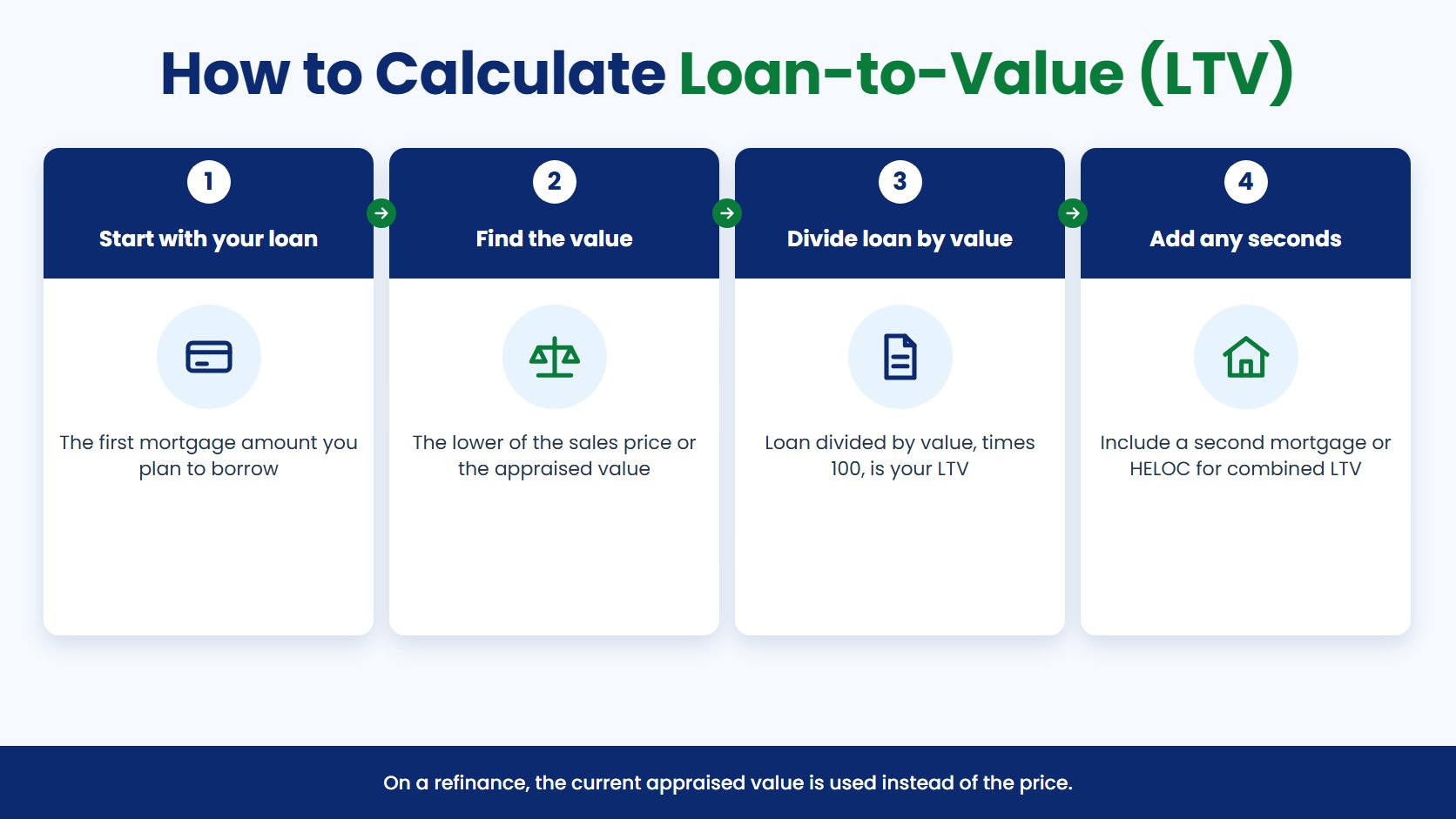
Divide your loan amount by the home’s value. On a purchase, the value is the lower of the sales price or the appraised value. On a refinance, it is the current appraised value. Fannie Mae truncates the result to two decimals and rounds up to the next whole percent, so 95.03% counts as 96%.
The formulas at a glance
- LTV = first mortgage amount divided by the home’s value, times 100
- CLTV = first mortgage + closed-end seconds + the drawn part of any HELOC, divided by the value, times 100
- HCLTV = first mortgage + closed-end seconds + the full HELOC credit line, divided by the value, times 100
- Value = the lower of the sales price or the appraised value on a purchase; the current appraised value on a refinance
- Rounding = truncate to two decimals, then round up to the next whole percent (Fannie Mae)
Sources: Fannie Mae Selling Guide B2-1.2-01, B2-1.2-02 and B2-1.2-03.
The lower-of rule is the part that catches buyers off guard. Fannie Mae’s Selling Guide spells it out in B2-1.2-01, Loan-to-Value Ratios: for a purchase, the property value is “the lower of the sales price or the current appraised value.” FHA works the same way. HUD’s Single Family Handbook 4000.1 sets the maximum loan from the Adjusted Value, which on a purchase is the lesser of the price (less any inducements to buy) or the appraised value.
Here’s what that means in a competitive market. These are example numbers only:
| Hypothetical purchase | Appraisal matches price | Appraisal comes in $10,000 low |
|---|---|---|
| Sales price | $310,000 | $310,000 |
| Appraised value | $310,000 | $300,000 |
| Value used for LTV (the lower one) | $310,000 | $300,000 |
| Down payment | $31,000 | $31,000 |
| Loan amount | $279,000 | $279,000 |
| LTV | 90% | 93% |
| Extra cash to get back to 90% LTV | None | $9,000 (loan of $270,000) |
The same down payment produces a higher LTV when the appraisal is short, because the loan is now measured against the lower value. That can push you into a different mortgage insurance tier or past a program limit. Your options at that point are to renegotiate the price, bring more cash, or accept the higher LTV. Our guide to the home appraisal in Delaware explains how the appraisal works and what to do if it comes in low.
The rounding rule matters at the edges too. Under Fannie Mae B2-1.2-01, the ratio is truncated to two decimal places and then rounded up to the nearest whole percent. A $285,000 loan on a $300,000 home is exactly 95%. Borrow $285,100 and it becomes 95.03%, which counts as 96%. A few hundred dollars can move you up a tier, so it is worth checking where your number lands before you lock in your down payment.
What Is the Maximum LTV for Each Loan Type?
Each program sets its own ceiling. Some conventional programs reach 97% LTV. FHA allows 96.5% with a 580 credit score or higher, and 90% with a score from 500 to 579. VA allows no down payment when the price isn’t above the appraised value. USDA allows up to the appraised value plus the financed guarantee fee.
| Loan type | Maximum purchase LTV | Official source |
|---|---|---|
| Conventional | Up to 97% on some programs, such as Fannie Mae HomeReady (purchase or limited cash-out refinance, fixed-rate, one-unit primary home) | Fannie Mae B5-6-01 |
| FHA | 96.5% of the Adjusted Value with a 580+ score; 90% with a score of 500 to 579 | HUD Handbook 4000.1 |
| VA | No down payment as long as the sales price isn’t higher than the appraised value (eligible veterans and service members) | VA.gov purchase loans |
| USDA guaranteed | Up to the appraised market value plus the upfront guarantee fee (or the price plus eligible costs, if lower) | 7 CFR 3555.103 |
Think of these as ceilings, not targets. Plenty of buyers qualify for the top LTV on a program and still choose a little more down to lower the payment or the mortgage insurance. Others need the full limit and use down payment help on top. Neither is wrong. The right LTV is the one that leaves you a payment you can carry and cash left in savings after closing.
Second homes and investment properties carry lower limits than a primary home, and multi-unit properties often do too. If you are buying something other than a one-unit home to live in, ask for the limit on your exact property during pre-approval. Our Delaware home buyer information hub links each program page with its full rules.
Why Does LTV Matter for Your Mortgage?
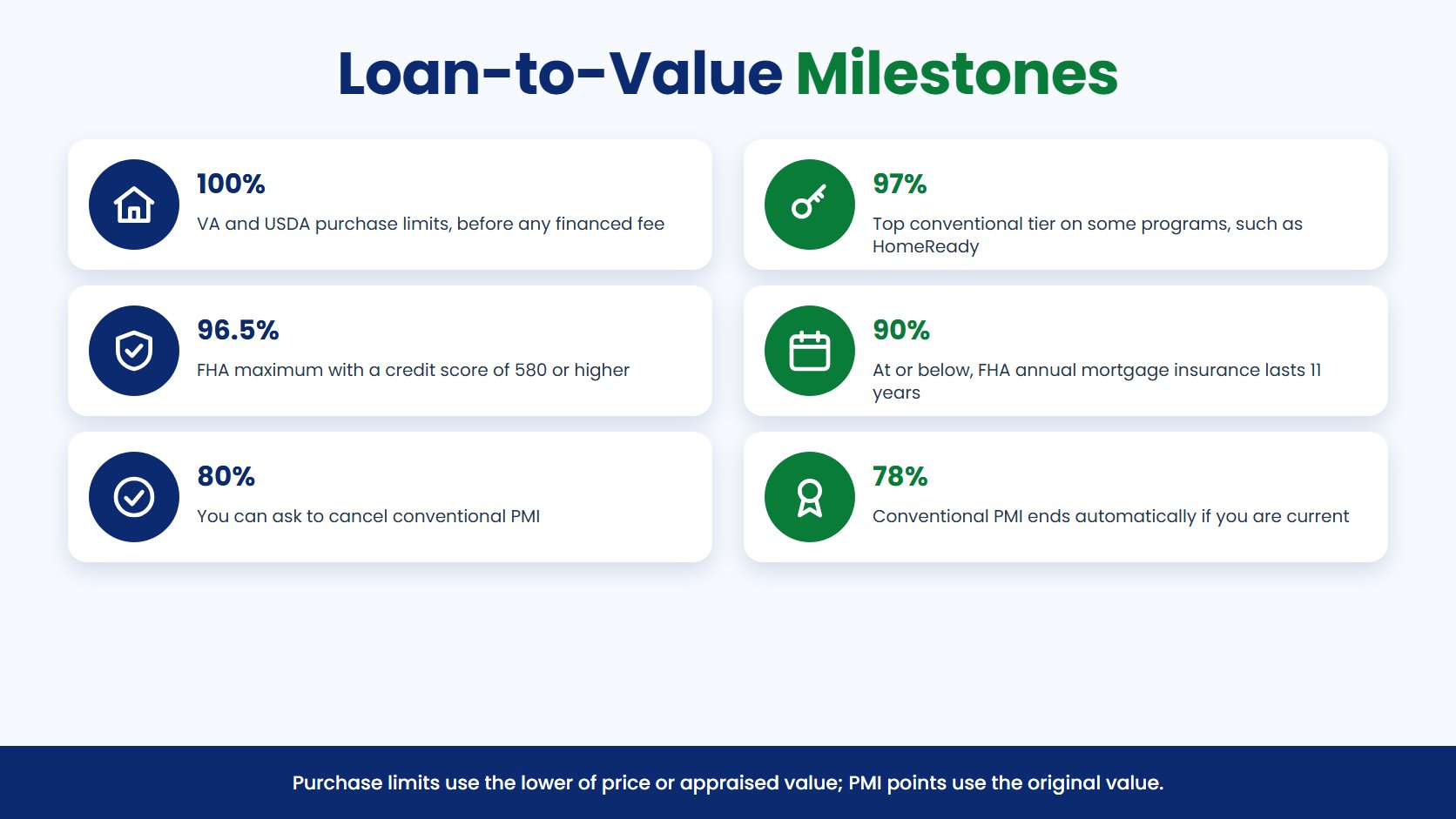
LTV decides whether you pay mortgage insurance, how long FHA mortgage insurance lasts, which programs you qualify for, and how your loan is priced. Above 80% LTV, conventional loans usually need private mortgage insurance. On FHA, putting at least 10% down, for an LTV of 90% or less, limits annual mortgage insurance to 11 years.
Lenders use LTV as a risk measure. The less of your own money in the home, the more a lender stands to lose if the loan ever goes into default and the home has to be sold. These are the four places LTV changes your loan:
- Mortgage insurance. Conventional loans above 80% LTV usually carry private mortgage insurance, and the premium is priced partly on your LTV. Our mortgage insurance guide compares the costs by loan type.
- How long FHA mortgage insurance lasts. HUD’s Handbook 4000.1 premium table shows annual mortgage insurance for 11 years when the LTV is 90% or less at the start, and for the full mortgage term above 90%.
- Which programs you can use. Each program has a ceiling, and a low appraisal or a large second mortgage can push you over it.
- Pricing. Lenders and mortgage insurers generally price a higher LTV as more risk, so a lower LTV can mean a lower cost on the same loan. We don’t quote rates on this page because they change daily and depend on your full file.
What this means for you: LTV isn’t just a number on your loan estimate. Moving from 91% to 90% on an FHA loan, or from 81% to 80% on a conventional loan, can change your monthly cost for years. Ask your loan officer to show you the cost at your LTV and at the next tier down before you settle on a down payment.
Can Your Loan Be More Than the Home’s Value?
Yes, by the amount of certain financed fees. FHA lets the upfront mortgage insurance premium be added on top of the base loan. USDA’s limit is the appraised value plus the upfront guarantee fee. VA allows the funding fee to be financed, and on a VA refinance the new loan can’t exceed 100% of the reasonable value.
These financed fees explain why a no-down-payment or low-down-payment loan can end up slightly above the home’s value on day one. Federal rules allow it on purpose:
- FHA: 24 CFR 203.18 caps the principal at a percentage of the appraised value “plus the amount of the mortgage insurance premium paid at the time the mortgage is insured.” The 96.5% purchase limit applies to the base loan, and the upfront premium can be financed on top.
- USDA: 7 CFR 3555.103 limits the loan to the lesser of the appraised market value plus the upfront guarantee fee, or the price plus eligible acquisition costs.
- VA refinance: 38 CFR 36.4306 limits a VA refinance to 100% of the reasonable value. Any part of the funding fee that would push the loan above that must be paid in cash at closing.
A loan that starts at or slightly above the home’s value has no equity cushion. Owing more than the home is worth is called negative equity, or being underwater on the mortgage. If you needed to sell in the first year or two, the costs to sell could mean bringing money to closing. That isn’t a reason to avoid these programs, since they help many families buy sooner. It’s a reason to plan on staying put for a while. Our VA residual income guide and Delaware FHA loan guide cover the other qualifying rules for those programs.
What Are Combined LTV (CLTV) and HCLTV?
Combined LTV, or CLTV, adds every mortgage on the home, including a down payment assistance second or a home equity loan, and divides by the value. HCLTV counts the full credit line of any HELOC, even the part you haven’t drawn. Lenders check all three ratios, and each one has its own limit.
Fannie Mae defines both in its Selling Guide. B2-1.2-02 figures CLTV by adding the first mortgage, the balance of any closed-end second and the drawn part of any HELOC, then dividing by the lower of the sales price or the appraised value. B2-1.2-03 figures HCLTV the same way but uses “the full amount of any HELOCs (whether or not funds have been drawn).”
Down payment assistance and CLTV
Many Delaware buyers use a second mortgage for down payment help. That second loan counts toward your CLTV even when it is deferred or forgivable. Fannie Mae allows a CLTV of up to 105% when the second is an eligible Community Seconds loan, according to B5-5.1-01. Other programs set their own CLTV limits, so the down payment help you pick and the first mortgage it pairs with both matter. Our Delaware down payment assistance programs hub compares the options.
Here’s a hypothetical example. These are illustration numbers only, not the terms of any specific program:
| Hypothetical FHA purchase with down payment help | Amount | Ratio |
|---|---|---|
| Price and appraised value | $320,000 | |
| First mortgage (3.5% down, base loan) | $308,800 | LTV 96.5% |
| Down payment assistance second mortgage | $12,800 | |
| Total of both loans | $321,600 | CLTV about 100.5% |
HELOCs and HCLTV
If you already own your home, CLTV is the number that sets the size of a home equity line. On the HELOC programs we use, a one-unit primary home can reach 95% combined LTV with a 720 credit score, as of November 2026, with lower limits at lower scores. On a $400,000 home with a $260,000 first mortgage, 95% allows $380,000 in total loans, so the line could be up to $120,000. Our Delaware HELOC guide lists every tier.
When Does LTV Let You Drop Mortgage Insurance?
On a conventional loan, you can ask your servicer to cancel PMI when your balance is scheduled to reach 80% of the original value, and it must end automatically at 78% if you are current. Original value is generally the lower of the price or the appraisal. FHA mortgage insurance follows HUD’s separate 11-year or life-of-loan rule.
The Consumer Financial Protection Bureau explains your rights under the Homeowners Protection Act. You can ask to cancel when your principal balance is scheduled to fall to 80% of the original value, or earlier if extra payments get you there. The servicer must end PMI automatically on the date your balance is scheduled to reach 78%, as long as you are current. PMI also ends at the midpoint of the loan term even if you haven’t reached 78%. If you refinanced, original value means the appraised value at the refinance.
| Hypothetical conventional loan | Amount |
|---|---|
| Original value (lower of price or appraisal) | $300,000 |
| Starting loan (90% LTV) | $270,000 |
| Balance where you can ask to cancel PMI (80%) | $240,000 |
| Balance where PMI ends automatically (78%) | $234,000 |
Extra principal payments move you toward 80% faster. A higher home value alone doesn’t trigger automatic removal, because the 80% and 78% points are measured against the original value. Some servicers will consider a new appraisal for earlier removal under their own rules, so ask yours. FHA works differently. If your FHA mortgage insurance runs for the life of the loan, the usual way out is a refinance, which our mortgage insurance guide walks through.
How Does LTV Affect a Refinance or Home Equity Loan?
On a refinance, LTV is measured against a new appraisal, so rising values can lower it even if you haven’t paid much down. Cash-out refinances carry lower LTV limits than purchases on most programs. A VA refinance can go up to 100% of the reasonable value. An FHA refinance done without an appraisal uses the value from your previous loan.
Here’s how each type of refinance looks at LTV:
- Rate and term refinance: your new loan divided by today’s appraised value, per Fannie Mae B2-1.2-01. If values have risen, you may drop below 80% and leave mortgage insurance behind.
- Cash-out refinance: on conventional and FHA loans, the cash-out limit is lower than the purchase limit, so you keep some equity in the home. The exact limit depends on the program, the property and your credit.
- VA refinance: 38 CFR 36.4306 allows a new VA loan up to 100% of the reasonable value. Our VA cash-out refinance guide and VA IRRRL guide explain the two VA options.
- FHA Streamline Refinance: HUD’s Handbook 4000.1 says that when FHA doesn’t require an appraisal, the value from the previous mortgage is used to calculate the LTV. See our Delaware FHA Streamline Refinance guide.
- HELOC or home equity loan: your first mortgage plus the new line or loan, divided by the value, must stay under the program’s combined limit. Our HELOC guide shows the tiers.
If you’re within a few points of a tier, timing can matter. A few more months of payments, a small principal paydown or a finished home improvement can move your LTV enough to change what you qualify for. I’d rather check that with you before you apply than have you miss a better tier by 1%.
How Can You Lower Your LTV?
Put more money down, use gift funds, negotiate the price down after a low appraisal, pay down principal, or let time and home value work for you before a refinance. Down payment assistance lowers your first-mortgage LTV but adds to your CLTV, and seller credits cut your cash to close, not your LTV.
Here’s what moves the number and what doesn’t:
- A bigger down payment. Every dollar you add lowers the loan and the LTV. Gift funds or a gift of equity from family can count toward it if documented properly.
- A price that matches the appraisal. If the appraisal comes in low, renegotiating the price brings the value used for LTV back in line with your loan.
- Down payment assistance. It lowers what you need from your own pocket, but if it is a second mortgage it adds to your CLTV. Check both ratios.
- Seller credits. Seller-paid closing costs lower your cash to close. They don’t lower the loan amount, so they don’t change your LTV.
- Extra principal payments. After closing, extra payments lower your balance and your LTV, and can bring PMI removal sooner.
- Rising home value. It lowers your LTV for a refinance or a HELOC, measured by a new appraisal or valuation. It doesn’t change the 80% and 78% PMI points on your current loan.
When a Lower LTV Isn’t Worth It
I’m just being honest with you: hitting 80% isn’t always the smart move. If getting to 20% down would empty your savings, I’d usually rather see you pay some mortgage insurance and keep a cushion for the furnace that quits in your first winter. A slightly higher LTV with money in the bank beats a lower LTV with nothing left. We can price it both ways so you can see the actual difference before you decide.
Your Next Steps to Know Your LTV Before You Buy
Here’s how I’d handle it if you were sitting across from me:
- Decide how much you can put down and still keep savings after closing.
- Get pre-approved so you know which programs fit and the LTV limit on each.
- Ask for your loan estimate at your LTV and at the next tier down, so you can see the cost difference.
- If you’re using down payment help, ask for both your LTV and your CLTV.
- Before you write an offer, work out how much cash you’d need if the appraisal came in short.
- After closing, track your balance against the 80% and 78% points if you have PMI.
Our guides to understanding your mortgage payment and your debt-to-income ratio cover the other two numbers lenders look at most, and the Delaware home buyer information hub links every buyer topic in one place.
Loan-to-Value FAQ for Delaware Buyers
What is a good loan-to-value ratio?
There is no single good number, but 80% or lower is the common target on a conventional loan because it usually means no private mortgage insurance. Lower LTVs also tend to get better pricing. Many buyers choose a higher LTV, using FHA, VA, USDA or a low-down-payment conventional loan, to buy sooner and keep savings.
How do I calculate my LTV?
Divide your loan amount by the home’s value. On a purchase, use the lower of the sales price or the appraised value. A $270,000 loan on a $300,000 home is 90% LTV. Fannie Mae truncates the result to two decimals and rounds up to the next whole percent.
Does LTV use the purchase price or the appraised value?
Whichever is lower, on a purchase. Fannie Mae and FHA both measure the loan against the lower of the price or the appraised value. If the appraisal comes in below your offer, your LTV goes up unless you bring more cash or renegotiate the price. On a refinance, the current appraised value is used.
What is the maximum LTV on an FHA loan?
FHA allows 96.5% of the Adjusted Value on a purchase with a credit score of 580 or higher, and 90% with a score from 500 to 579, under HUD Handbook 4000.1. The upfront mortgage insurance premium can be financed on top of the base loan. Lenders can set stricter limits.
What is the maximum LTV for a conventional loan?
Some conventional programs, such as Fannie Mae HomeReady, go up to 97% LTV on a fixed-rate purchase of a one-unit home you will live in. Other conventional loans, second homes, investment properties and cash-out refinances have lower limits. The exact limit depends on the program, your credit and the property.
Can I get a 100% LTV loan in Delaware?
Yes, through VA or USDA if you qualify. VA allows no down payment when the price isn’t above the appraised value. USDA guaranteed loans allow up to the appraised value plus the upfront guarantee fee in eligible areas. Down payment assistance can also cover the down payment on other programs, which raises your combined LTV.
What is the difference between LTV and CLTV?
LTV counts only your first mortgage. CLTV, or combined loan-to-value, adds every loan on the home, such as a down payment assistance second mortgage, a home equity loan or the drawn part of a HELOC. HCLTV counts the full HELOC credit line, even the part you haven’t used.
At what LTV does PMI come off?
On a conventional loan, you can ask to cancel PMI when your balance is scheduled to reach 80% of the original value, and it ends automatically at 78% if you are current, under the Homeowners Protection Act. FHA mortgage insurance follows separate HUD rules: 11 years if you started at 90% LTV or less, otherwise the full term.
Does down payment assistance affect my LTV?
It lowers the cash you need, but if the assistance is a second mortgage it counts toward your combined LTV, even when it is deferred or forgivable. Your first-mortgage LTV still has to meet the first loan’s limit, and the CLTV has to meet both programs’ rules.
Does a higher home value lower my LTV?
For a refinance or a home equity line, yes, because those use a new appraisal or valuation. For removing PMI on your current conventional loan, the automatic 80% and 78% points are measured against the original value, so rising values alone don’t trigger removal. Some servicers allow a new appraisal for earlier removal.

John R. Thomas has helped Delaware families buy homes for more than 20 years and is Branch Manager and Division Vice President of the John Thomas Team in Newark. He taught physics and physical science at Delcastle High School for more than ten years before lending full time, which is why he works out a buyer’s LTV, and the combined LTV with any down payment help, at the offer price and at a lower appraisal before the offer is written.
He holds a BS in Physics Education from the University of Delaware and an MS in Curriculum and Instruction from Delaware State University, and has been a Certified Mortgage Planner since 2008. John wrote Your Guide to Buying Your First Home in Delaware, the basis of our Delaware first-time home buyer guide, and teaches the first-time home buyer seminars himself. State licensing: Look up John R. Thomas, NMLS #38783, on NMLS Consumer Access. Read his loan officer bio page or meet the John Thomas Team.
Years 3,000+
Buyers Helped 1,000+
First-Time Buyers DE & MD
Service Area CMP
Certified Mortgage Planner
John Thomas Team with AnnieMac Home Mortgage
248 E Chestnut Hill Rd, Newark, DE 19713 | 302-703-0727 | team@johnthomasteam.com
Schedule Appointment (30 min)
See John Thomas Team on Google for reviews, directions, and local office information.
YouTube | Facebook | Instagram | TikTok | X / Twitter | LinkedIn
- Within 4 business hours you’ll hear from us by phone, text and email, and we keep following up for 14 days (the 4-14-24 standard).
- Once your documents arrive, a licensed loan officer reviews them for pre-approval within 24 hours.
- With a Platinum Pre-Approval, an underwriter reviews the full file before you make an offer; the appraisal and final approval remain.
- A single Loan Concierge handles your file from contract to closing and sends a Tuesday status email to everyone involved.
- New calls are answered Saturday and Sunday from 9 AM to 4 PM, for buyers writing offers on the weekend.

Ready to see your LTV and your options?
Get pre-approved and we’ll show you your LTV, your combined LTV with any down payment help, and what mortgage insurance looks like at each down payment.
Last Updated: November 2026 · John Thomas Team with AnnieMac Home Mortgage · Mortgage content reviewed by John R. Thomas, NMLS #38783.
John R. Thomas, NMLS #38783 | John Thomas Team with AnnieMac Home Mortgage | AnnieMac Home Mortgage NMLS #338923 | 248 E Chestnut Hill Rd, Newark, DE 19713 | 302-703-0727 | delawaremortgageloans.net
AnnieMac Home Mortgage is an Equal Housing Lender. State licensing: Look up John R. Thomas, NMLS #38783, on NMLS Consumer Access.
(c) Copyright John R. Thomas, All Rights Reserved.
