
What Is a Home Warranty? A Delaware Buyer’s Guide


Delaware home buyer overview: A home warranty is an optional service contract that helps pay to repair or replace covered home systems and appliances when they wear out. It is not homeowners insurance, which your lender requires, and it does not replace a home inspection. Delaware law treats a service contract as not insurance. Current as of November 2026.
Your agent just asked whether you want the seller to include a home warranty, or a postcard showed up offering one the week you closed. Maybe you’re wondering what it actually covers, whether it’s the same as your homeowners insurance, or whether it’s worth the money at all. I’m John Thomas, NMLS #38783, and I’ve helped Delaware families buy homes for more than 20 years. My goal on this page is to show you what a home warranty is and isn’t, what it usually leaves out, how a seller-paid warranty fits into your purchase, and how to read the contract before you count on it, so there are no surprises the first time something breaks.
Quick Answer for Delaware Buyers: A home warranty is a service contract, not insurance. It can help pay for covered systems and appliances that break from normal wear, for a set term and a service fee per visit. It usually excludes pre-existing conditions, so get your home inspection first and negotiate real defects before closing. Keep the homeowners insurance your lender requires, and read the contract’s caps, exclusions and cancellation terms before you rely on it.
Line up your financing before you negotiate
Get pre-approved first, so your offer, your inspection and any warranty request are about the house, not the loan. We’ll walk through your numbers and your timeline.
Table of Contents
What Is a Home Warranty?
A home warranty is a service contract you pay for that helps cover the repair or replacement of home systems and appliances that break down from normal wear and tear. It runs for a set term, often one year, and you usually pay a service fee each time a contractor comes out. It is not homeowners insurance.
The Federal Trade Commission puts it simply: home warranties are “really service contracts.” In its consumer alert on home warranties, the FTC says they typically cover things like appliances or air conditioning systems, they last for a set amount of time, and they cost extra. Delaware law treats it the same way. Under 18 Del. C. Sec. 917 and 918, a service contract to repair, replace or maintain a household product is not considered insurance and is not subject to the state’s insurance laws unless a law expressly says so.
So what does that mean for you? A home warranty is a private contract between you and the warranty company. What it pays for, how much it pays and how fast it sends someone out all come from the contract you sign, not from a state insurance policy form. That’s why reading the contract matters more here than almost anywhere else in your purchase.
How I explain the difference
Before I lent full time, I owned and ran a local SERVPRO franchise, so I learned the difference between a breakdown and sudden damage from the cleanup side. When a worn-out water heater finally fails, the water heater itself is the kind of thing a home warranty may cover. The soaked floor and drywall around it are a different question, and that one goes to your homeowners insurance. Buyers who know which is which before something breaks make much better calls when it does. – John Thomas, NMLS #38783
What Does a Home Warranty Cover?
Most home warranty plans cover the major systems, the major appliances, or both. Systems plans usually include heating, cooling, plumbing, electrical and the water heater. Appliance plans usually include the refrigerator, range, dishwasher, washer and dryer. Pools, well pumps, septic pumping and extra appliances are often add-ons for an extra cost.
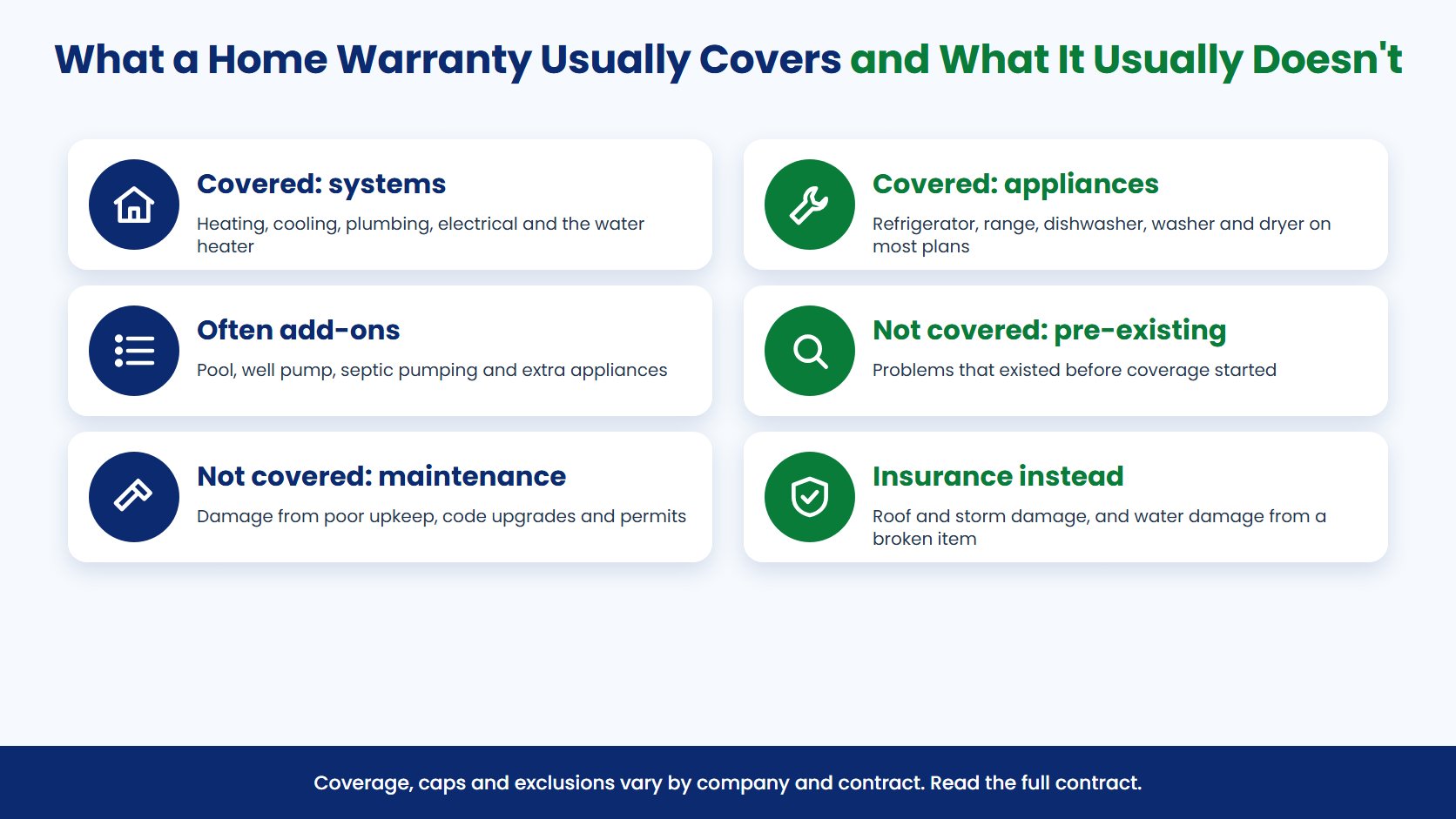
Every company sells its own plans, so the names and the lists change from one contract to the next. Here’s how the coverage usually breaks down. Check the actual contract for the exact items, the limits and the exclusions before you rely on any of it.
| Plan type | What it usually includes | What to check in the contract |
|---|---|---|
| Systems plan | Heating, air conditioning, ductwork, plumbing lines, electrical, water heater | Dollar caps per system, and whether the whole unit or only parts are covered |
| Appliance plan | Refrigerator, range or oven, dishwasher, built-in microwave, washer, dryer | Whether a second refrigerator or a garage freezer needs an add-on |
| Combination plan | The systems and the appliances together | One total cap for the year or separate caps per item |
| Optional add-ons | Pool or spa, well pump, septic pumping, sump pump, limited roof leak repair | Each add-on’s own limit, and whether it costs extra |
Delaware homes add one more check. Many homes in Kent and Sussex County, and some in rural New Castle County, run on a private well and a septic system instead of public water and sewer. If yours does, ask whether the well pump and septic pumping are covered or sold as add-ons, because a standard plan often leaves them out.
Two words matter most when you read a plan: “repair” and “replace.” Most contracts let the company decide whether to repair an item or replace it, and some let the company pay you a set amount instead of replacing it. If a replacement costs more than the plan’s cap, you pay the difference.
Is a Home Warranty the Same as Homeowners Insurance?
No. Homeowners insurance covers sudden damage from events like fire, wind or theft, and your lender requires it. A home warranty is optional and covers breakdowns from normal wear and tear. They can work side by side, but a home warranty never replaces the insurance policy your mortgage requires.
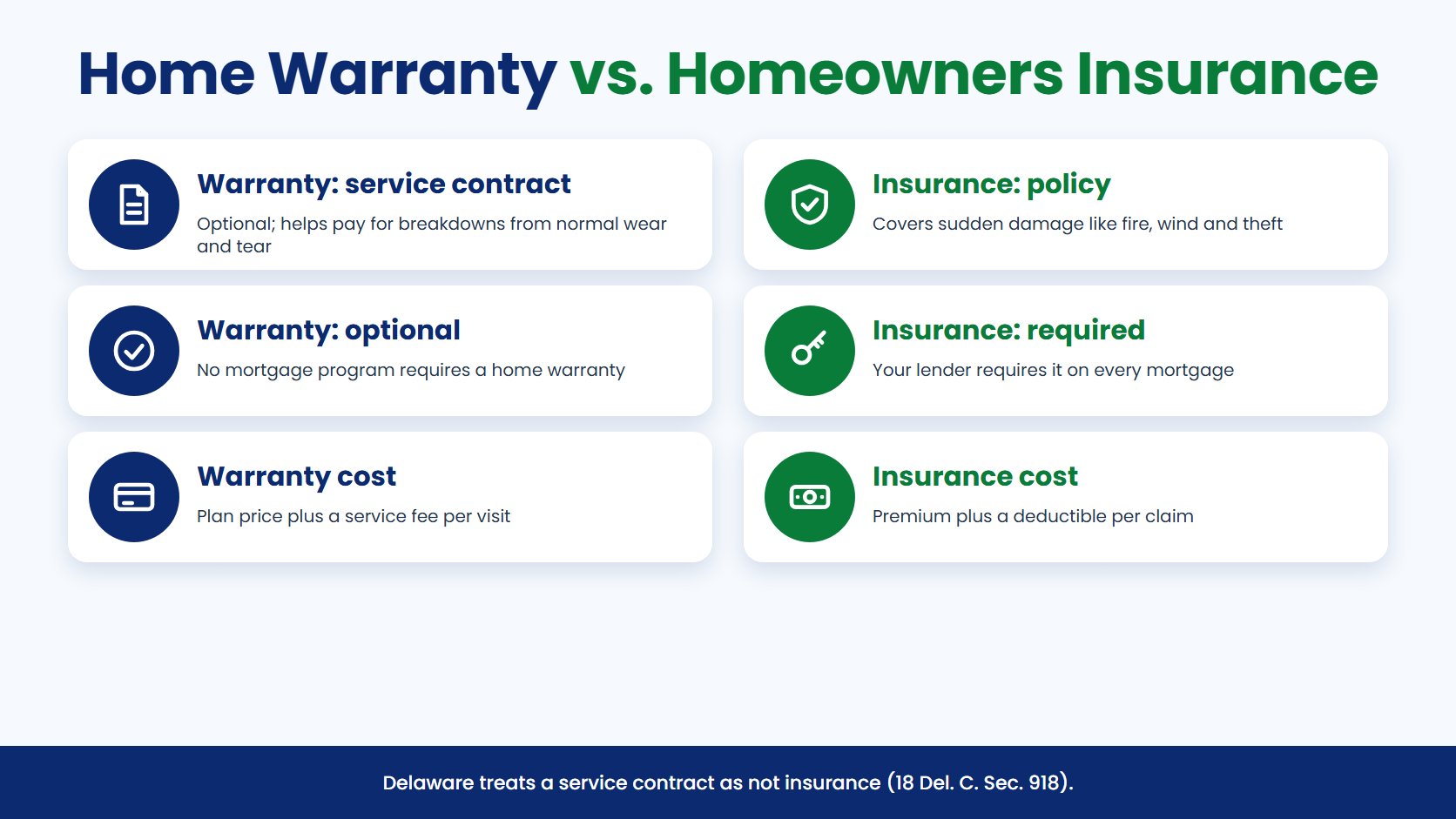
Here’s a hypothetical example. Say a pipe under your kitchen sink corrodes and bursts. A home warranty may cover repairing the pipe, if plumbing is on your plan. The water damage to the cabinets and floor is the insurance side, subject to your policy and deductible. Our guide to homeowners insurance in Delaware explains what a policy covers and why your lender requires it.
| Home warranty | Homeowners insurance | Builder’s warranty (new homes) | Seller’s disclosure report | |
|---|---|---|---|---|
| What it is | A service contract you buy | An insurance policy | The builder’s written promise on its work | The seller’s good-faith statement of known conditions |
| What it covers | Breakdowns of covered systems and appliances | Sudden damage like fire, wind, theft, and liability | Defects in the builder’s work for set periods | Nothing; it isn’t coverage |
| Required for the loan? | No | Yes, on every mortgage | No (it comes with the house) | Required from the seller in most Delaware sales |
| What you pay | The plan price plus a service fee per visit | A premium, plus a deductible per claim | Included in the price of the home | Nothing |
| Who decides a claim | The warranty company, under the contract | The insurance company, under the policy | The builder, under its warranty | Not applicable |
What Doesn’t a Home Warranty Cover?
Most home warranties exclude pre-existing conditions, damage from poor maintenance, code upgrades and permits, and anything outside the plan’s list. Roofs, foundations and the water damage a broken item causes are usually not covered, and every covered item has a dollar cap. These exclusions are where most warranty disappointments start.
These are the exclusions I’d look for first in any contract:
- Pre-existing conditions. Problems that existed before coverage started, especially ones a home inspection could have found.
- Maintenance problems. A furnace that never had a filter changed, or a water heater full of sediment, can be denied.
- Code upgrades and permits. If a replacement has to meet current code, the extra work may be yours to pay for.
- Dollar caps. Limits per item, per system or per year. A plan can approve a claim and still leave you a bill.
- Secondary damage. The water from a leaking water heater, or food lost from a dead refrigerator, is often excluded.
- Roof and structure. Many plans exclude the roof entirely or offer only limited leak repair as an add-on.
- Items not listed. If it isn’t named in the contract, assume it isn’t covered.
What this means for you: The FTC suggests asking whether there are limits on what you can be reimbursed, whether certain appliances or systems are left out, and whether there are fees to cancel. Get those answers in writing from the contract itself, not from a sales call.
How Does a Home Warranty Claim Work?
When something covered breaks, you contact the warranty company, not your own contractor. The company assigns a contractor from its network, you pay a service fee for the visit, and the company decides whether the item is covered and whether to repair it, replace it or offer a cash payment instead, under the contract.
Here’s a typical claim, using hypothetical numbers. Your air conditioning stops working in July. You file a claim online or by phone, and the company sends a contractor in its network. You pay the service fee, say $100 to $125 in this example. The contractor diagnoses the problem and reports to the warranty company, which approves the repair, approves a replacement up to the plan’s cap, or denies the claim under an exclusion. If a new system costs more than the cap, you pay the difference.
| Claim step | What happens | What to watch |
|---|---|---|
| You file the claim | Online or by phone, as soon as the item fails | Many contracts require you to report problems promptly |
| A contractor is assigned | The company sends a contractor from its network | You usually don’t choose the contractor |
| You pay the service fee | A set fee per visit or per claim | A few claims a year adds up; the FTC calls these costs that may be hidden |
| The company decides | Repair, replace, cash payment, or denial | Caps, exclusions and the company’s repair-or-replace choice |
The FTC’s point is worth repeating: a home warranty is only as good as the company responsible for coverage. Before you buy, read reviews about claims and payouts, not only the plan’s price. If you have a bad experience, you can report it to the FTC at ReportFraud.ftc.gov.
Can the Seller Pay for a Home Warranty When You Buy in Delaware?
Yes, a seller can agree to buy a one-year home warranty for you as part of the purchase. You and your agent ask for it in your offer or in your repair negotiations, and it is usually paid at settlement. Ask your loan officer how your loan program treats a seller-paid warranty alongside any other seller-paid closing costs.
Some Delaware sellers offer a home warranty to make a listing more attractive, especially on an older home. Some buyers ask for one when the inspection shows systems that work but are near the end of their life. Either way, the warranty only does its job if the details are in writing. Your agreement of sale should say who pays for it, the plan level and the price limit, and the company, if you care which one.
Here’s a hypothetical comparison. Say the inspection shows a 14-year-old furnace that still runs. You could ask the seller to replace it, ask for a credit, or ask the seller to pay for a home warranty instead. The warranty costs the seller less, but a pre-existing condition can be excluded, and the furnace may only be covered up to the plan’s cap. If the inspector found a real defect, a repair or a credit usually protects you better than a warranty.
What this means for you: A seller-paid warranty is a nice extra, not a substitute for a repair request. Ask for repairs or a credit on real defects first, and treat the warranty as help with the breakdowns nobody can predict.
Does a Home Warranty Replace the Home Inspection?
No. A home inspection tells you the condition of the house before you buy it, and a home warranty helps pay for future breakdowns after you own it. Because most warranties exclude pre-existing conditions, the inspection is what protects you from problems that are already there. Get the inspection first, then decide on a warranty.
This matters more in Delaware than buyers expect. The seller’s property condition report is a good-faith disclosure, and 6 Del. C. Sec. 2574 says it is not a warranty of any kind. A home warranty company won’t take on problems that were already in the house either. That leaves the home inspection as your one real look at the house before you are committed. Our guide to why you need a home inspection in Delaware covers what an inspector checks and what to do with the report.
The two work best together. Use the inspection report to ask for repairs, a credit or a lower price on the defects it finds. Then use a home warranty, if you want one, for the working systems and appliances that could still fail in the first year. Keep a copy of the inspection report, because it shows the condition of each item when you bought the home.
Do You Need a Home Warranty on a New Construction Home?
Usually not right away. A new home typically comes with the builder’s own warranty, and the FTC says builder coverage is often one year for workmanship and materials, two years for heating, cooling, plumbing and electrical, and up to ten years for major structural defects from some builders. Appliances usually carry their manufacturer’s warranty.
Read the builder’s warranty the way you’d read any contract. The FTC’s guide to warranties for new homes notes that builder warranties usually don’t cover household appliances, small cracks in brick, tile, cement or drywall, or the cost of moving out during a major repair. Put repair requests in writing and keep records. A third-party home warranty can make more sense once the builder’s one-year and two-year coverage ends.
If you’re building, our guide to the one-time close construction loan covers how the financing works while the house goes up.
Is a Home Warranty Worth It?
A home warranty can be worth it if your home has older systems and appliances and a surprise repair bill would strain your budget. It is less useful on a new home, on a home where you already replaced the big items, or if you would rather keep the money in a repair fund. The math depends on your house.
Here’s a simple way to think about it, with hypothetical numbers. Say a plan costs $600 for the year and each visit costs $100. If you file two claims, you’ve paid $800. If one of those claims is a furnace repair the plan covers in full, you came out ahead. If nothing breaks, you paid $600 for peace of mind. If the claim is denied as a maintenance issue, you paid for coverage you couldn’t use.
When a Home Warranty May Not Be Worth It
I’m just being honest with you: a home warranty is not the right buy for everyone. If the home is new and still under the builder’s warranty, if the furnace, air conditioning and water heater were replaced in the last few years, or if you’re handy and already have a repair fund, a warranty may cost more than it saves. And if you were counting on a warranty to cover a problem the inspection already found, it probably won’t. In that case, negotiate the repair before closing.
Be honest with yourself about one question: if the air conditioning failed the first summer, could you cover the bill from savings? If the answer is no, a warranty is one tool, and a cash cushion is another. Our list of mortgage loan dos and don’ts covers why keeping savings intact between contract and closing matters too.
How Do You Choose a Home Warranty Company?
Compare the contracts, not the ads. Ask each company for a sample contract, then compare what is covered, the dollar caps, the service fee, the exclusions, the cancellation terms and how claims are handled. Read reviews about claims and payouts, and check how long the company has been in business before you sign.
These are the questions I recommend you ask before you buy, many of them straight from the FTC’s list:
- Can I see the full contract, not just the plan summary?
- What is the service fee per visit, and is it per visit or per claim?
- What are the dollar limits per item, per system and per year?
- Are pre-existing conditions, code upgrades or permits excluded?
- Do you repair, replace or pay cash, and who decides?
- Is there a waiting period before coverage starts?
- How do I cancel, and is there a fee or a refund?
- How long does a typical claim take from call to repair?
- What does your complaint history with the Better Business Bureau show?
Your agent may suggest a company they’ve seen work well for other buyers, and that’s a fine place to start. It’s still your contract, so pick the one whose terms you actually understand.
Your Next Steps Before You Sign a Home Warranty
Here’s how I’d handle it if you were sitting across from me:
- Get pre-approved first, so your offer and your negotiations are about the house, not the loan.
- Schedule a home inspection as soon as your offer is accepted. A warranty doesn’t replace it.
- Use the inspection report to ask for repairs or a credit on real defects.
- If you want a warranty, ask for it in writing in the agreement of sale, with the plan level and who pays.
- Read the full contract for caps, exclusions, service fees and cancellation terms before closing.
- Keep your homeowners insurance in place. Your lender requires it, and a warranty never replaces it.
Buying for the first time? Our Delaware first-time home buyer programs guide covers down payment help and the steps from pre-approval to keys, and the Delaware home buyer information hub links every buyer topic in one place.
Home Warranty FAQ for Delaware Buyers
Do I need a home warranty to get a mortgage in Delaware?
No. A home warranty is optional and no mortgage program requires one. Your lender does require homeowners insurance, which covers sudden damage like fire and wind. A home warranty is a separate service contract you can choose to add for breakdowns from normal wear and tear.
Who typically pays for a home warranty, the buyer or the seller?
Either side can. Some sellers offer a one-year warranty to make a listing more attractive, and some buyers ask for one in the offer or after the inspection. You can also buy one yourself. Whatever you agree to should be written into the agreement of sale, and your loan officer can tell you how your loan program treats a seller-paid warranty.
How long does a home warranty last?
Most home warranties run for a set term, often one year, and many can be renewed each year. The contract states the start date, the end date and the renewal terms. Some contracts have a waiting period before coverage starts when you buy outside a home sale, so check that too.
Can I buy a home warranty after closing?
Usually, yes. Many companies also sell plans to current homeowners after closing. Coverage may start after a waiting period, and pre-existing conditions are still excluded, so a plan bought later won’t cover something that was already failing.
Are pre-existing conditions covered by a home warranty?
Usually not. Most home warranties cover failures from normal wear and tear after coverage starts and exclude conditions that already existed. An issue listed in your inspection report is the clearest example of one. Negotiate inspection findings with the seller as a repair, a credit or a price change before closing instead of counting on the warranty.
Does a home warranty cover the roof?
Often not, or only in a limited way. Many plans exclude the roof and structure, and some sell limited roof leak repair as an add-on with its own cap. Roof damage from a storm is usually a homeowners insurance question instead.
Is a home warranty regulated as insurance in Delaware?
No. Under Delaware law, 18 Del. C. Sec. 918, a service contract to repair, replace or maintain a household product is not considered insurance and is not subject to the state’s insurance laws unless a law expressly makes it so. What you get depends on the contract you sign, so read it before you buy.
Should I get a home warranty on a condo or townhouse?
It can make sense for what you own inside the unit, like the heating and cooling, water heater and appliances. The roof, exterior and common areas usually belong to the association, so check the association’s coverage and the master insurance policy before you pay for overlap.
Can I transfer a home warranty when I sell my home?
Some contracts allow a transfer to the next owner, sometimes for a fee or only within a set window, and some don’t allow it at all. Check the transfer terms in your contract before you list the home. An active warranty the buyer can take over can be a small selling point.
Do manufactured homes qualify for a home warranty?
Some companies cover manufactured homes and some limit or exclude them, so ask before you buy. Check whether the plan covers the home’s specific heating system, water heater and appliances, and keep the home’s own maintenance records, since maintenance exclusions still apply.

John R. Thomas has helped Delaware families buy homes for more than 20 years and is Branch Manager and Division Vice President of the John Thomas Team in Newark. He taught physics and physical science at Delcastle High School for more than ten years before lending full time, and he owned and ran a local SERVPRO franchise, which is why he walks buyers through who pays when something in the house breaks: the warranty company, the insurance company or the homeowner.
He holds a BS in Physics Education from the University of Delaware and an MS in Curriculum and Instruction from Delaware State University, and has been a Certified Mortgage Planner since 2008. John wrote Your Guide to Buying Your First Home in Delaware, the basis of our Delaware first-time home buyer guide, and teaches the first-time home buyer seminars himself. State licensing: Look up John R. Thomas, NMLS #38783, on NMLS Consumer Access. Read his loan officer bio page or meet the John Thomas Team.
Years 3,000+
Buyers Helped 1,000+
First-Time Buyers DE & MD
Service Area CMP
Certified Mortgage Planner
John Thomas Team with AnnieMac Home Mortgage
248 E Chestnut Hill Rd, Newark, DE 19713 | 302-703-0727 | team@johnthomasteam.com
Schedule Appointment (30 min)
See John Thomas Team on Google for reviews, directions, and local office information.
YouTube | Facebook | Instagram | TikTok | X / Twitter | LinkedIn
- Within 4 business hours you’ll hear from us by phone, text and email, and we keep following up for 14 days (the 4-14-24 standard).
- Once your documents arrive, a licensed loan officer reviews them for pre-approval within 24 hours.
- With a Platinum Pre-Approval, an underwriter reviews the full file before you make an offer; the appraisal and final approval remain.
- A single Loan Concierge handles your file from contract to closing and sends a Tuesday status email to everyone involved.
- New calls are answered Saturday and Sunday from 9 AM to 4 PM, for buyers writing offers on the weekend.

Ready to buy with fewer surprises?
Get pre-approved before you shop, so your negotiations are about the house. We’ll go over your numbers, your cash cushion for repairs and the loan that fits.
Last Updated: November 2026 · John Thomas Team with AnnieMac Home Mortgage · Mortgage content reviewed by John R. Thomas, NMLS #38783.
John R. Thomas, NMLS #38783 | John Thomas Team with AnnieMac Home Mortgage | AnnieMac Home Mortgage NMLS #338923 | 248 E Chestnut Hill Rd, Newark, DE 19713 | 302-703-0727 | delawaremortgageloans.net
AnnieMac Home Mortgage is an Equal Housing Lender. State licensing: Look up John R. Thomas, NMLS #38783, on NMLS Consumer Access.
(c) Copyright John R. Thomas, All Rights Reserved.
