Delaware First Time Home Buyers: Programs, Help & Who Qualifies in 2026
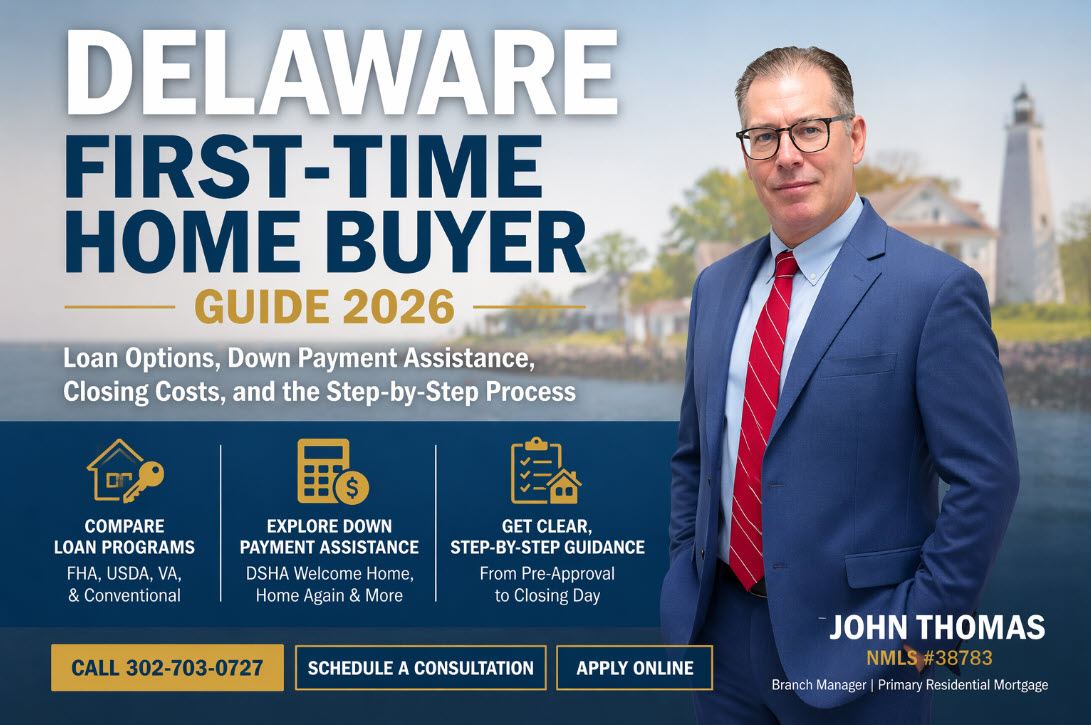

Delaware first time home buyers can choose FHA (3.5% down), conventional (3% down), VA or USDA (0% down when eligible), and pair them with DSHA’s Welcome Home or Open Door first mortgage and up to 5% in deferred down payment assistance. Over DSHA’s income limits? NextKey adds 3.5% or 5% of the price on an FHA loan with no income limit. DSHA counts you as first-time if you haven’t owned a home in three years. Current as of October 2026.
You’re paying rent that keeps going up, you’ve started looking at listings, and every guide you read seems to say something different about how much money you need and which programs still exist. I’m John Thomas, NMLS #38783, and my goal on this page is to give you the whole picture for Delaware in one place: who counts as a first-time buyer, which loans fit, what the state’s down payment help really looks like, and what you’ll need in cash to get the keys. If you already know you want down payment help, our Delaware down payment assistance programs guide goes deeper on every program by county.
Buying Your First Home in Delaware? Start With a Plan
Tell us where you want to buy, roughly what you earn and what you have saved. We’ll show you which loan and DSHA program fit, what your cash to close could look like, and whether the home you like sits in a targeted area.
Table of Contents
Who Counts as a First Time Home Buyer in Delaware?
For DSHA’s Welcome Home program, a first-time home buyer is anyone who hasn’t owned their primary residence at any time in the three years before the loan’s note is signed, as of October 2026. Qualified veterans and buyers of homes in DSHA targeted areas can use Welcome Home even if they owned recently.
That rule comes from DSHA’s Delaware Mortgage Program Notice, effective June 8, 2026. So if you sold a home four years ago and you’ve been renting since, you can count as a first-time buyer again for Welcome Home. A veteran exception needs the DD-214 showing a discharge other than dishonorable. If you don’t fit any of these, DSHA’s Open Door program is built for repeat buyers and has higher income limits.
Here’s where it gets confusing. Delaware’s transfer tax break for first-time buyers uses a stricter test. Under Title 30, section 5401 of the Delaware Code, you qualify only if you have never held a direct legal interest in residential real estate anywhere, and you move in within 90 days. So a buyer who owned a condo six years ago can be first-time for Welcome Home and still not get the transfer tax reduction. FHA, VA, USDA and conventional loans don’t require you to be a first-time buyer at all.
| Rule | Who counts as first-time | Exceptions |
|---|---|---|
| DSHA Welcome Home | No ownership of a primary residence in the 3 years before the note is signed (usually at closing) | Qualified veterans; homes in DSHA targeted areas |
| DSHA Open Door | Not required: first-time and repeat buyers | None needed |
| Delaware first-time transfer tax reduction | Never held a direct legal interest in residential real estate, and moves in within 90 days | None |
| FHA, VA, USDA, conventional | Not required | Some conventional first-time options have their own rules |
What Are the Steps to Buying Your First Home in Delaware?
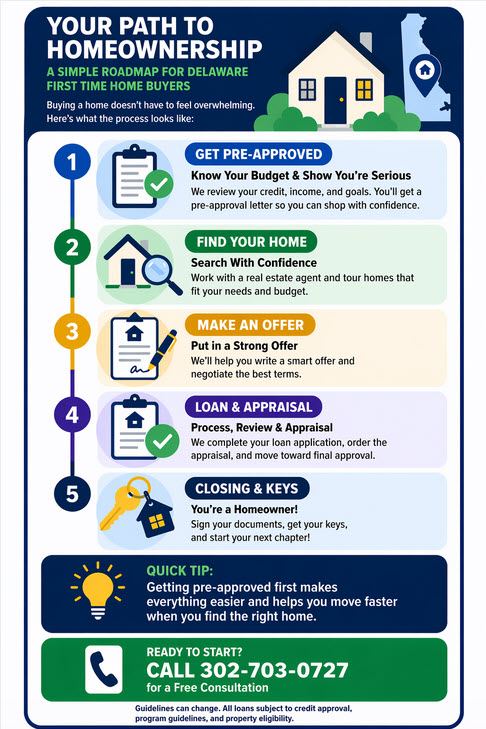
Buying a first home in Delaware usually takes seven steps: check your credit, get pre-approved, choose a loan and any DSHA program, shop with an agent, sign a contract, finish the appraisal and underwriting, then close. Buyers using DSHA assistance with a credit score at or below 659 also complete a homebuyer education course first.
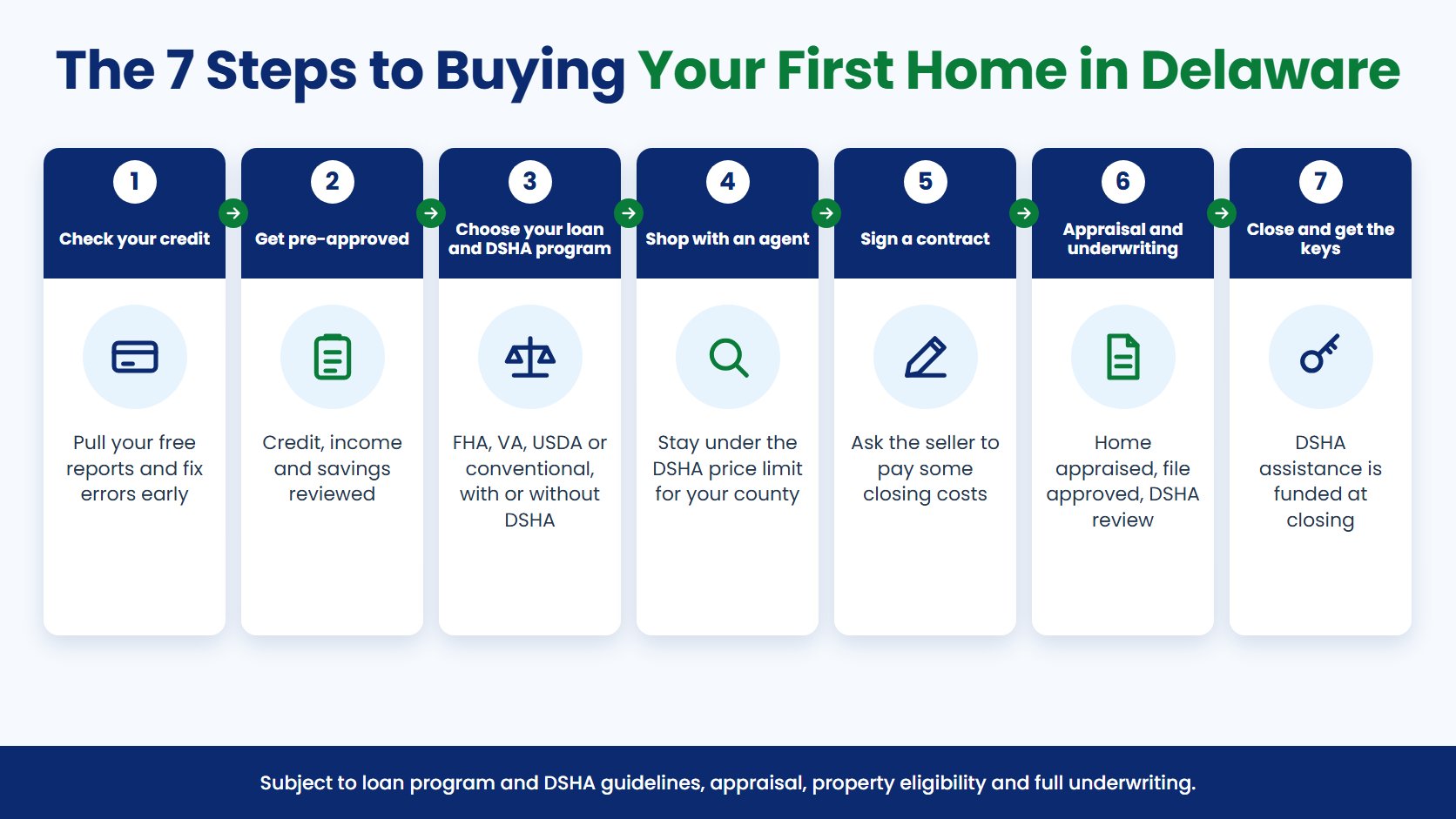
- Check your credit. Pull your reports at AnnualCreditReport.com and fix errors early. Our guide to the five factors of credit scoring explains what moves a mortgage score.
- Get pre-approved. We review your credit, income and savings, and you’ll know your price range before you look.
- Choose your loan and DSHA program. FHA, VA, USDA or conventional, with or without Welcome Home or Open Door and a down payment assistance option.
- Shop with an agent. Stay under the DSHA purchase price limit for your county if you’re using DSHA, and check whether a home is in a targeted area.
- Sign a contract. Your offer can ask the seller to pay some closing costs, within your loan program’s limits.
- Appraisal and underwriting. The home is appraised, your file is approved, and DSHA reviews its part of the file before closing.
- Close and get the keys. You sign at the title company, and any DSHA assistance is funded at closing.
The biggest myth I hear at my monthly first-time buyer seminars is that you need 20% down. That’s the number that avoids mortgage insurance on a conventional loan. It isn’t the number you need to buy. One small step you can take this week: pull your three credit reports and gather your last 30 days of pay stubs and two years of W-2s. Those are the first things any lender, and DSHA, will ask for. Many clean files close in 21 days or less once you’re under contract, depending on appraisal timing.
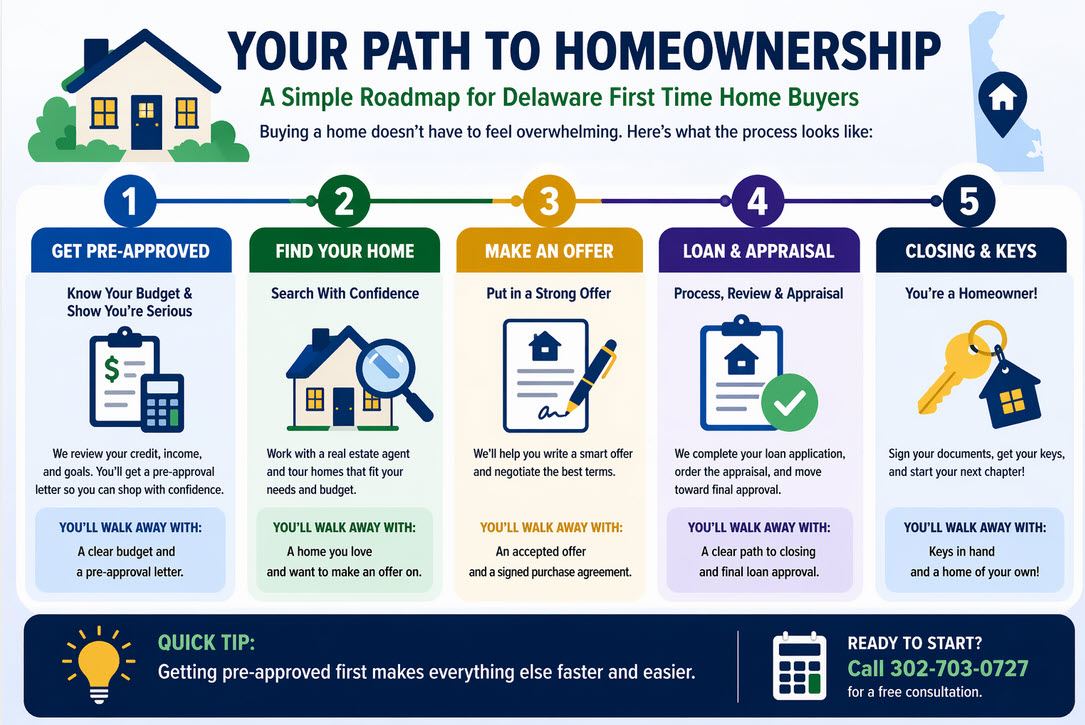
Which Loan Programs Can Delaware First Time Buyers Use?
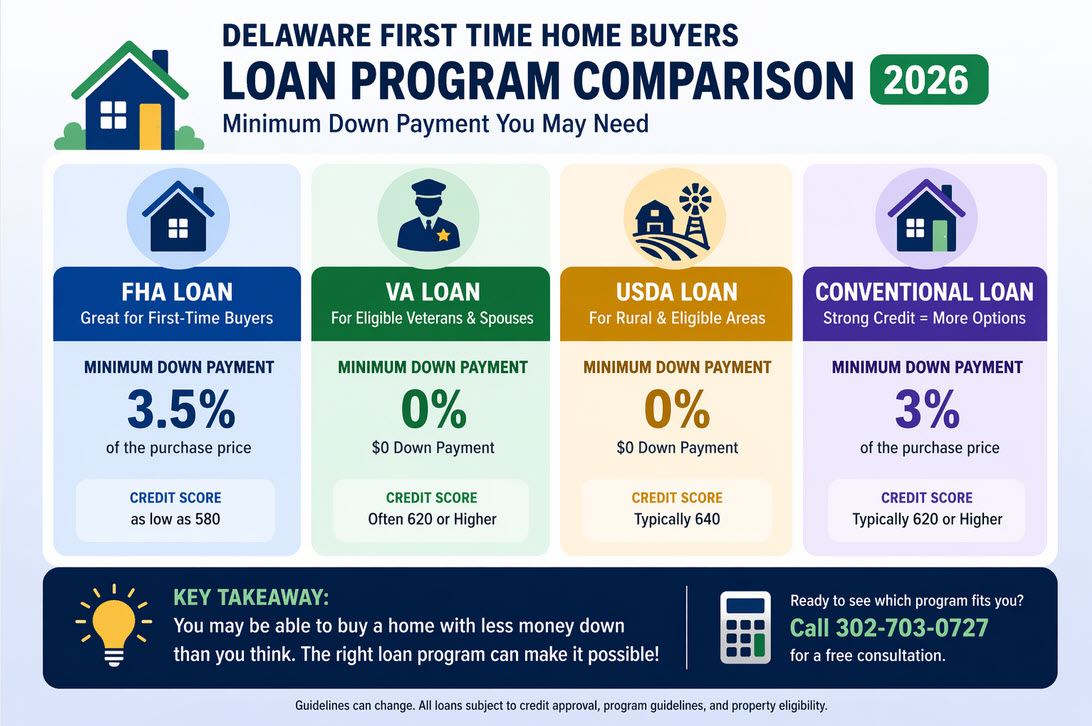
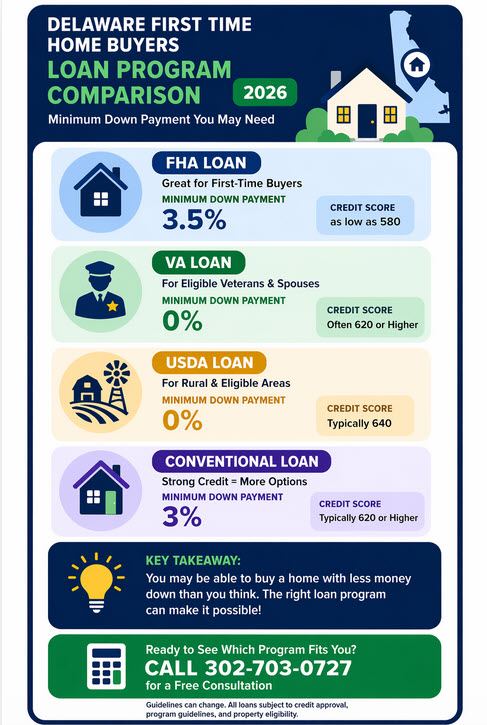
As of October 2026, Delaware first-time buyers mostly use four loan types: FHA with 3.5% down, conventional with as little as 3% down, VA with 0% down for eligible veterans, and USDA with 0% down in eligible areas. Any of them can pair with a DSHA first mortgage when income and price limits are met.
| Loan | Minimum down payment | Credit score | Mortgage insurance | Income limits |
|---|---|---|---|---|
| FHA loan | 3.5% with a 580+ score | HUD allows 500-579 with 10% down; lenders set their own minimum | Upfront premium plus monthly premium; stays for the life of the loan with less than 10% down | None |
| Conventional loan | 3% (HomeReady, Home Possible and other 97% options); 5% standard | Lenders set their own minimum; DSHA conventional loans need 620 | Private mortgage insurance under 20% down, removable later | Only on some 3% down options |
| VA loan | 0% with full entitlement | VA sets no minimum; lenders set their own | None; a VA funding fee applies unless exempt | None |
| USDA loan | 0% | 640 for an automated approval; lower scores get a manual review | Upfront and annual guarantee fees | Yes, by county and household size |
HUD sets the FHA 3.5% minimum on its FHA loans page. Freddie Mac’s Home Possible and Fannie Mae’s HomeReady allow 3% down. VA explains the funding fee and who is exempt on its funding fee page, and you can check whether a home is in a USDA area with USDA’s property eligibility lookup. Each program page linked in the table covers that loan in detail.
Which one fits depends on more than the down payment. With a strong score and 3% to 5% saved, conventional often costs less over time because its mortgage insurance can come off. With a lower score or a higher debt load, FHA is often the easier approval. If you’ve served, look at VA first. Ask yourself one question: how long will I keep this loan? That answer usually decides the FHA versus conventional choice, and we run both side by side before you pick.
How Much Money Do You Need to Buy Your First Home in Delaware?
Your cash to close is the down payment plus closing costs, minus any seller credit, gift or down payment assistance. As of October 2026 that can be close to zero with VA, USDA or DSHA assistance, or 3% to 3.5% of the price plus closing costs with conventional or FHA and no help.
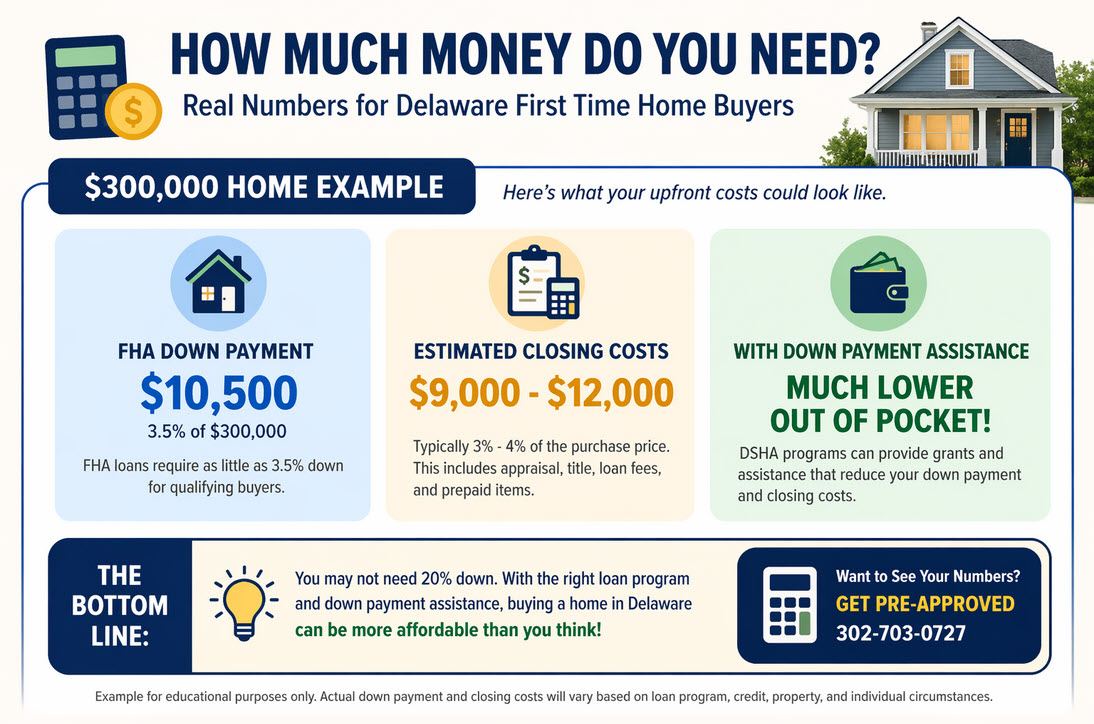

Put simply: cash to close = down payment + closing costs – seller credits – gifts – assistance. Closing costs include lender and title charges, Delaware transfer tax, and prepaid property taxes, homeowners insurance and interest. They depend on the price, the county and the loan, which is why we give you a written Loan Estimate instead of a rule of thumb.
Let’s say a first-time buyer is purchasing a $300,000 home with an FHA loan through DSHA Welcome Home and Keys4You. The 3.5% down payment is $10,500, so the base loan is $289,500. Keys4You is 4% of the final first mortgage amount, which on $289,500 would be $11,580, enough to cover the down payment with the rest going toward closing costs. If FHA’s upfront mortgage insurance premium is financed, the final loan amount and the 4% rise with it. The buyer still needs to meet DSHA’s Kent County income limit and the $566,354 price limit. Illustrative example only, not a loan offer or commitment.
Seller credits can also cover closing costs when the contract asks for them and the appraisal supports the price. FHA lets the seller pay up to 6% of the price toward your costs under HUD Handbook 4000.1, and conventional loans with less than 10% down cap seller contributions at 3% under Fannie Mae’s interested party contribution rules. Our page on seller paid closing costs shows how to write that into an offer, and gift money from family is covered in our gift funds guide.
Any loan with less than 20% down carries some form of mortgage insurance, and it’s part of your monthly payment. Our guides to mortgage insurance and your monthly mortgage payment walk through how principal, interest, taxes and insurance add up.
How Do DSHA’s Welcome Home and Open Door Programs Compare?
As of October 2026, DSHA’s Welcome Home is for first-time buyers, qualified veterans and targeted-area homes, with up to 5% in assistance. Open Door is for first-time or repeat buyers, with up to 4% and higher income limits. Both are 30-year fixed loans that need a 620 credit score and a Delaware primary residence.
| Feature | Welcome Home | Open Door |
|---|---|---|
| Who it’s for | First-time buyers (no ownership in 3 years), qualified veterans, homes in targeted areas | First-time and repeat buyers |
| Smart Start (no assistance) | Yes | Yes |
| First State Home Loan | 3% of the first mortgage | 3% of the first mortgage |
| Keys4You Home Loan | 4% of the first mortgage | 4% of the first mortgage |
| Take5 Home Loan | 5% of the first mortgage | Not offered |
| Diamond in the Rough | 5%, with an FHA 203(k) Limited repair loan and a 640 score | Not offered |
| Income counted | All income of everyone on the Note and/or Mortgage | Qualifying income on the loan application |
| Minimum credit score | 620; education course at 659 or below | 620; education course at 659 or below |
| Loan types | FHA, VA, USDA, conventional (HFA Preferred / HFA Advantage) | FHA, VA, USDA, conventional (HFA Preferred / HFA Advantage) |
Every DSHA assistance option is a second mortgage at 0% interest with no monthly payment. It’s repaid when you refinance, sell, transfer the title or stop living in the home, or after 30 years, whichever comes first. That’s not a gift, and I want you to plan for it: if you sell in year five, the assistance comes out of your sale proceeds. Our DSHA loan programs guide covers each option, and the program pages go deeper on Welcome Home, Open Door, First State, Keys4You and Take5.
DSHA income limits (household size, effective for reservations on or after June 8, 2026):
| Program and area | County | 1-2 person household | 3+ person household |
|---|---|---|---|
| Welcome Home, non-targeted | New Castle | $122,700 | $141,105 |
| Welcome Home, non-targeted | Kent and Sussex | $111,400 | $128,110 |
| Welcome Home, targeted area | New Castle | $147,240 | $171,780 |
| Welcome Home, targeted area | Kent and Sussex | $133,680 | $155,960 |
| Open Door | New Castle | $147,240 | $184,050 |
| Open Door | Kent and Sussex | $133,680 | $167,100 |
| DSHA purchase price limit (single-family) | New Castle County | Kent and Sussex Counties |
|---|---|---|
| Non-targeted areas | $659,385 | $566,354 |
| Targeted areas | $805,916 | $692,211 |
How Does DSHA Count Your Household Income?
For Welcome Home, DSHA counts all income of everyone on the Note and/or Mortgage, including bonus, overtime and child support, as of October 2026. For Open Door, it counts the qualifying income on your loan application. Household size, including people not on the loan, sets which income limit applies.
What does that mean? A spouse, partner or parent who isn’t on the loan doesn’t add to the income DSHA counts, but they do count toward household size, which can move you to the higher 3+ person limit. On Welcome Home, income you aren’t using to qualify still counts if the borrower earns it. On Open Door, overtime you aren’t using to qualify generally doesn’t count. Here’s a hypothetical: two buyers apply together, one earning a base salary and the other a base salary plus overtime they don’t need to qualify. Welcome Home counts both salaries and the overtime; Open Door counts only the income used on the application, so the overtime can stay out. A third adult living with them who isn’t on the loan adds nothing to the income DSHA counts, but makes it a three-person household. In my experience, buyers who assume they earn too much for Welcome Home are often adding in someone who won’t be on the loan, so we work out who will sign before we pick the program.
What Is a DSHA Targeted Area, and Is Your Home in One?
A DSHA targeted area is a census tract where Welcome Home allows higher income and purchase price limits and waives the first-time buyer requirement. As of October 2026 there are nine: six in New Castle County, one in Kent and two in Sussex. DSHA also posts lower Welcome Home rates for targeted-area homes.
- New Castle County census tracts 0006.02, 0019.02, 0021.00, 0023.00, 0029.00 and 0030.02
- Kent County census tract 0425.00
- Sussex County census tracts 0505.03 and 0507.11
To check an address, enter it in the FFIEC Geocoding and Mapping System, which DSHA points buyers to on its homeownership loans page, and compare the census tract number it shows with the list above. If it matches, the targeted-area limits in the tables above apply, and a buyer who owned a home recently can still use Welcome Home. DSHA publishes its current targeted-area rates on its interest rates page. Rates change daily, so call us for today’s rate before you count on one.
Enter the street address of the home. The address is sent only to the U.S. Census Bureau’s public geocoder to find its census tract; we don’t receive or save it.
Can Delaware First Time Buyers Get Down Payment Assistance?
Yes. As of October 2026, DSHA provides 3%, 4% or 5% of the first mortgage amount as a 0% deferred second mortgage for buyers who meet its income, price and credit rules. NextKey adds 3.5% or 5% on an FHA loan with no income limit. Some counties and cities run their own programs too.
DSHA's options are First State (3%), Keys4You (4%), Take5 (5%, Welcome Home only) and Diamond in the Rough (5% with an FHA 203(k) Limited loan, Welcome Home only). You can use one DSHA assistance option per loan. New Castle County, the City of Wilmington, the City of Dover and Sussex County have offered their own assistance, each with its own income rules and amounts, and they change more often than DSHA's. Our Delaware down payment assistance programs page lists every current program by county.
If your income is over the DSHA limits or your credit score is between 600 and 619, look at NextKey down payment assistance. As of October 2026, it provides 3.5% or 5% of the price as a forgivable or repayable second mortgage on an FHA loan, with no income limit and no first-time buyer requirement, subject to underwriting. It cannot be combined with DSHA assistance, so we compare the two for you.
To use DSHA assistance, your loan has to be made by a lender approved for DSHA's Delaware Mortgage Program, and the John Thomas Team is one. If your score is 659 or below, you'll take a homeownership education course through a HUD-approved housing counseling agency in Delaware before closing. Even if you're above that line, I recommend it.
Do First Time Home Buyers Pay Transfer Tax in Delaware?
Yes, but less. Delaware's realty transfer tax is usually 4% of the price, split equally between buyer and seller. As of October 2026, a qualifying first-time buyer's share of the state tax drops by 0.5% of the price, up to $400,000 of value, so the savings can reach $2,000.
The state rate is 2.5% where the county or town has its own full 1.5% tax, which is how most Delaware buyers end up at 4% in total, and the law splits the tax equally between seller and buyer under 30 Del. C. 5402. The first-time reduction in section 5402(c) comes off the buyer's share only. Let's say a qualifying first-time buyer pays $300,000: the reduction would be 0.5% of $300,000, or $1,500 (a hypothetical example; your title company confirms the amount). Remember the stricter definition from earlier: you must never have owned residential real estate. Our Delaware first-time buyer transfer tax page covers the details.
New construction is where buyers get surprised. Builders write their own contracts, and in my experience they frequently require the buyer to pay the full 4% transfer tax instead of splitting it. That's an extra 2% of the price at closing. Read that clause before you sign, and have us run the numbers with it included.
Can a First Time Buyer in Delaware Buy a Home That Needs Repairs?
Yes. An FHA 203(k) loan or a conventional HomeStyle loan finances the purchase and the repairs together. As of October 2026, FHA's 203(k) Limited option covers up to $75,000 in repairs, and DSHA's Diamond in the Rough adds 5% assistance to it for Welcome Home buyers with a 640 score.
HUD raised the 203(k) Limited cap to $75,000 in Mortgagee Letter 2024-13. Homes that need work are often priced below move-in-ready homes nearby, but the repair loan adds a contractor bid, an inspection schedule and more paperwork, so plan for a slightly longer timeline. Our pages on the FHA 203(k) rehab loan, DSHA Diamond in the Rough and the conventional HomeStyle renovation loan compare them. If you're looking at a manufactured home, DSHA has its own rules for those loans, covered on our Delaware manufactured home loans page.
What Documents Do You Need to Get Pre-Approved in Delaware?
Most Delaware first-time buyers need 30 days of pay stubs, two years of W-2s, the most recent federal tax return, recent statements for every bank account, and a photo ID. Self-employed buyers usually add two years of tax returns, and veterans using VA or the Welcome Home exception need a DD-214.
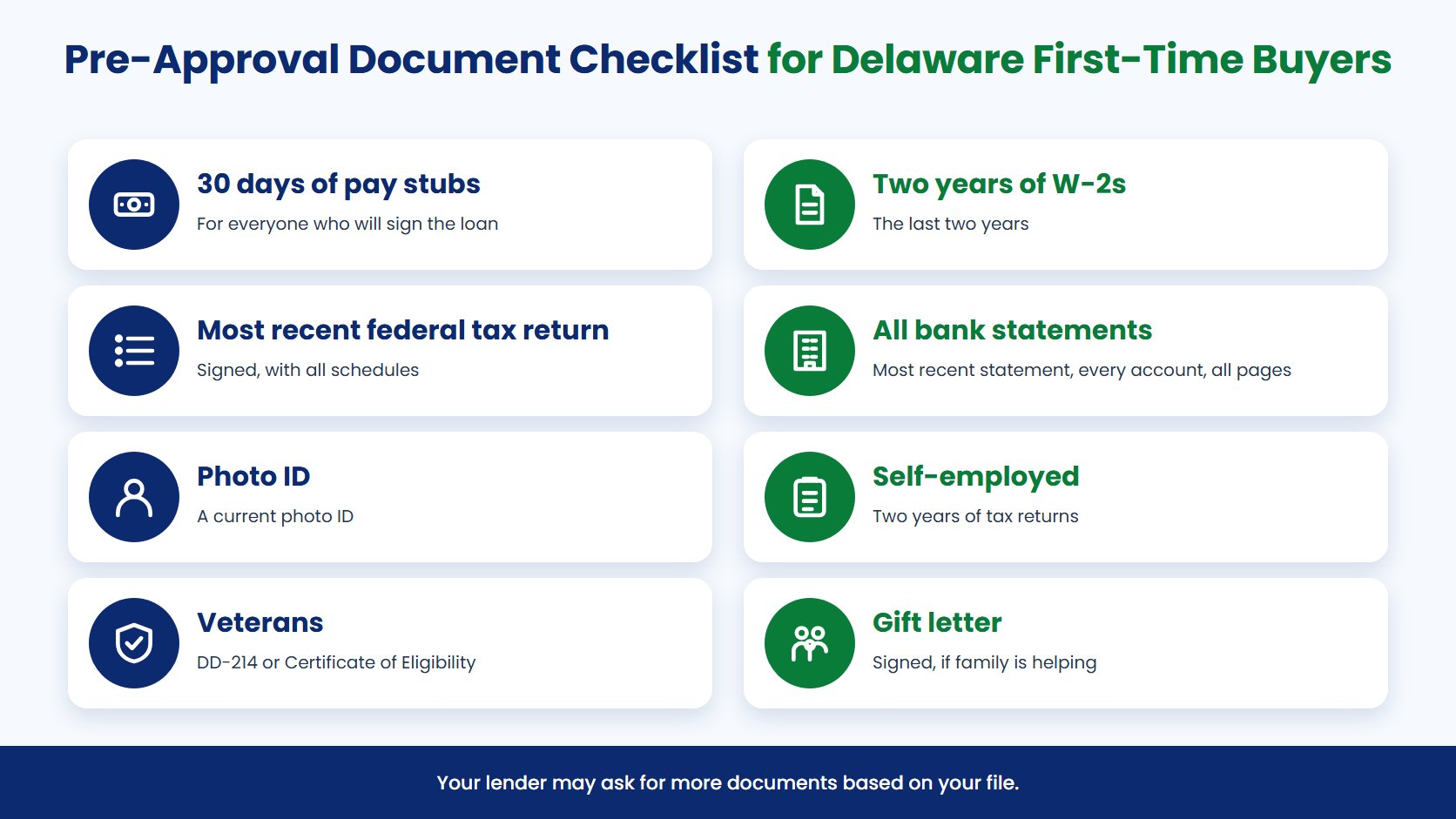
- Pay stubs covering the most recent 30 days for everyone who will sign the loan
- W-2s for the last two years
- Your most recent signed federal tax return with all schedules (two years if you're self-employed)
- The most recent statement for every bank and investment account, all pages
- A photo ID, and a DD-214 or Certificate of Eligibility if you're a veteran
- A signed gift letter if family is helping with the down payment
These are the same items DSHA asks your lender to send for its file review, so gathering them once covers both. Once you're pre-approved, keep things steady until closing: no new credit cards, car loans or job changes without calling us first. Our list of mortgage loan dos and don'ts covers the rest.
Which Delaware First Time Buyer Programs Are No Longer Offered?
As of October 2026, the Delaware Mortgage Credit Certificate, DSHA Home Sweet Home, Delaware Diamonds and Preferred Plus aren't part of DSHA's current program list. Home Again was renamed Open Door in April 2026, and DSHA's Kiss Your Landlord Goodbye site was retired. Older articles still describe them as active.
If a website, a calculator or a friend tells you about one of these, check the date. DSHA's current options are the five listed on its homeownership loans page. We keep pages up for the older names so buyers searching them land on current information: the Delaware MCC, Home Sweet Home, Delaware Diamonds and Home Again pages each explain what replaced them.
4 Common Myths About Buying a Home in Delaware
Myth 1: you need perfect credit. Not true. HUD allows FHA at 3.5% down with a 580 score, and DSHA's programs start at 620. A lower score usually means more planning, not a closed door, and many buyers who work on their credit for a few months end up qualifying.
Myth 2: a 30-year fixed is always the best loan. It's the most common choice, and DSHA's loans are 30-year fixed. Whether it's right for you depends on how long you'll keep the home and your other goals.
Myth 3: the lowest advertised rate wins. Rate is one number. Fees, mortgage insurance, the lender's ability to close on time and access to DSHA programs all change what you actually pay. A lender that can't offer DSHA assistance may cost you more than a small rate difference saves.
Myth 4: if you qualify for the payment, you can afford it. Qualifying and being comfortable are two different numbers. We go through both, using our guide to your debt-to-income ratio, before you make an offer.
Free Delaware First Time Home Buyer Seminars
Every month I teach a free first-time buyer seminar covering credit, income, savings, the loan process and down payment assistance, with time for your questions. It's the same material as my book, Your Guide to Buying Your First Home in Delaware. You can register at DelawareHomeBuyerSeminar.com, or see the seminars page and the local sessions for Newark, Wilmington and Dover.


When a First Time Buyer Program Is Not a Good Fit
I'm just being honest with you: DSHA assistance isn't the right tool for every first-time buyer. It's generally not the best fit if:
- Your household income is over the Open Door limit for your county. FHA, VA, USDA and conventional loans may still work without DSHA.
- The home is priced above DSHA's purchase price limit, or it isn't going to be your primary residence.
- You expect to sell or refinance within a few years. The assistance is repaid at that point, so a lower rate without assistance may cost less overall.
- You already have the down payment and a strong score. A standard conventional loan, without the assistance second mortgage, can be simpler.
- Your middle credit score is below 620. Start with a credit plan, and look at FHA on its own while you work on it.
First Time Home Buyers Across Delaware
We work with first-time buyers in New Castle, Kent and Sussex counties from our Newark office, and in Maryland. DSHA's limits are set by county, so where you buy changes the numbers. Our local pages cover each area:
- Wilmington DE mortgage loans
- Newark DE mortgage loans
- Bear DE mortgage loans
- Hockessin DE mortgage loans
- Pike Creek DE mortgage loans
- Middletown DE mortgage loans
- Smyrna DE mortgage loans
- Dover DE mortgage loans
- Milford DE mortgage loans
Delaware First Time Home Buyers - FAQ
I'm a veteran who owned a home a few years ago. Can I still use DSHA Welcome Home?
Yes, in most cases. DSHA's Program Notice effective June 8, 2026 lets qualified veterans use Welcome Home even if they aren't first-time buyers, so you can still reach Take5 and the other Welcome Home options. You'll need your DD-214 showing a discharge other than dishonorable, and you still have to meet the Welcome Home income and purchase price limits for your county. Many veterans compare this with a VA loan on its own, since VA can allow 0% down without DSHA. Call 302-703-0727 and we'll run both.
Do overtime and bonus income count toward the DSHA income limits?
It depends on the program. For Welcome Home, DSHA counts all income of everyone on the Note and/or Mortgage, including bonus, overtime and child support, whether or not you use it to qualify. For Open Door, DSHA counts the qualifying income on your loan application, so overtime you aren't using to qualify generally isn't counted. This is one of the first things we check, because it can decide which program you land in.
Can I use gift money from family along with DSHA down payment assistance?
Usually, yes. Gift funds follow the rules of your first mortgage (FHA, VA, USDA or conventional), and the donor has to be an eligible source such as a relative, with a signed gift letter. DSHA allows one of its own assistance options per loan, and other assistance programs have their own rules about combining. We look at the gift, the DSHA option and any county or city program together so the numbers work at closing.
Can my parents co-sign on a DSHA first-time buyer loan?
They can, but it changes the math. For Welcome Home, DSHA counts all income of everyone on the Note and/or Mortgage, and anyone on the loan also has to meet the first-time buyer rule unless a veteran or targeted-area exception applies. A parent who owns their own home would usually rule out Welcome Home, though Open Door may still work. We sort out who should be on the loan before you apply.
What credit score do I need to buy a first home in Delaware?
As of October 2026, DSHA's Welcome Home and Open Door programs need a 620 middle score, and buyers at 659 or below take a homeownership education course. Diamond in the Rough needs 640. Outside DSHA, HUD allows FHA at 3.5% down with a 580 score, and VA and conventional loans have no fixed agency minimum, so lenders set their own. Credit score is only one factor, so call 302-703-0727 and we'll tell you where you stand.
How much money do I need to buy a house in Delaware?
Your cash to close is the down payment plus closing costs, minus any seller credit, gift or assistance. VA and USDA can allow 0% down, conventional can start at 3% and FHA at 3.5%, and DSHA assistance of 3% to 5% of the first mortgage can cover much of the rest for buyers who meet its limits. Closing costs depend on the price, the county and the loan, so we give you a written Loan Estimate before you make an offer.
Do first-time home buyers pay transfer tax in Delaware?
Yes, but a qualifying first-time buyer pays less. Delaware's transfer tax is usually 4% of the price in total, split equally between buyer and seller under 30 Del. C. 5402. The first-time reduction takes 0.5% of the price, on up to $400,000 of value, off the buyer's share of the state tax, worth up to $2,000. For this reduction you must never have owned residential real estate, and builders frequently require the buyer to pay the full 4% on new construction.
Is the Delaware Mortgage Credit Certificate or Home Sweet Home still available?
No. As of October 2026, neither the Mortgage Credit Certificate nor Home Sweet Home is on DSHA's current program list, and the same goes for Delaware Diamonds and Preferred Plus. Older articles still describe them as active. DSHA's current options are Smart Start, First State, Keys4You, Take5 and Diamond in the Rough, offered through Welcome Home and Open Door.
Is DSHA down payment assistance forgivable?
No. As of October 2026, every DSHA assistance option (First State, Keys4You, Take5 and Diamond in the Rough) is a second mortgage at 0% interest with no monthly payment, but it isn't forgiven. It's repaid when you refinance, sell, transfer the title or stop living in the home, or after 30 years, whichever comes first. If you plan to move or refinance within a few years, we compare the total cost with and without assistance.
How long does it take to buy a first home in Delaware?
Getting pre-approved can take a day or two once your documents are in. After you're under contract, many clean files close in 21 days or less, depending on appraisal timing, the title work and how quickly documents come back. DSHA reviews its part of the file before closing, so loans with DSHA assistance need a few business days for that review. We give you a target closing date when you sign the contract.
About the Author - John R. Thomas

John R. Thomas is Branch Manager and Division Vice President with the John Thomas Team in Newark, Delaware, and has helped Delaware families buy homes for more than 20 years. With a first-time buyer, John starts with who will sign the loan and where they want to buy, because those two answers decide the DSHA income limit, the price limit and whether a targeted area or the veteran exception opens up Welcome Home.
John holds a BS in Physics Education from the University of Delaware and an MS in Curriculum and Instruction from Delaware State University. He is the author of Your Guide to Buying Your First Home in Delaware and teaches monthly first-time buyer seminars. State licensing: Look up John R. Thomas, NMLS #38783, on NMLS Consumer Access. Read more on his loan officer bio page.
Years 3,000+
Buyers Helped 1,000+
First-Time Buyers DE & MD
Service Area CMP
Certified Mortgage Planner
John Thomas Team with AnnieMac Home Mortgage
248 E Chestnut Hill Rd, Newark, DE 19713 | 302-703-0727 | team@johnthomasteam.com
Schedule Appointment (30 min)
See John Thomas Team on Google for reviews, directions, and local office information.
YouTube | Facebook | Instagram | TikTok | X / Twitter | LinkedIn
We start with a soft credit pull, so there's no hit to your score. Then we'll tell you which loan and DSHA program you qualify for, check whether the homes you like are in a targeted area, and show you your cash to close before you make an offer.
Last Updated: October 2026 · John Thomas Team with AnnieMac Home Mortgage · Mortgage content reviewed by John R. Thomas, NMLS #38783.
John R. Thomas, NMLS #38783 | John Thomas Team with AnnieMac Home Mortgage | AnnieMac Home Mortgage NMLS #338923 | 248 E Chestnut Hill Rd, Newark, DE 19713 | 302-703-0727 | delawaremortgageloans.net
AnnieMac Home Mortgage is an Equal Housing Lender. State licensing: Look up John R. Thomas, NMLS #38783, on NMLS Consumer Access.
(c) Copyright John R. Thomas, All Rights Reserved.
