

FHA Loan Limits 2026: What You Can Borrow Based on Your County
If you want to buy a house using an FHA loan in 2026, the maximum amount you can borrow will depend on the updated FHA loan limits. These limits depend on home prices and get adjusted every year.
For 2026, we already know the updated conforming loan limits. Federal law requires FHA to base its loan limits on these numbers, so we can already predict where the 2026 limits are going, even though HUD hasn’t released the specific limits for each county yet.
Let me explain this in an easy way.
How FHA Loan Limits Work
The FHA sets loan limits as the largest amount it will back for a home loan. These limits aim to:
- Ensure the program helps regular homebuyers instead of those seeking luxury properties
- Protect the FHA insurance fund from excessive risk
- Change according to shifts in home prices
Three main rules determine your FHA loan limit:
Linked to Conforming Loan Limits
FHA loan limits depend on the conforming limits that the FHFA decides every year for Fannie Mae and Freddie Mac.
Floor and Ceiling Guidelines
- Low-cost regions (“floor”): Set at 65% of the national conforming baseline.
- High-cost regions (“ceiling”): Capped at 150% of the national conforming baseline.
Limits Vary by County
FHA limits differ for each county or metro area based on local median home prices. However:
- They cannot go below the floor amount.
- They cannot exceed the ceiling amount.
Once we learn the conforming limits for 2026, we can figure out the FHA limits pretty closely.
Key Info on 2026 FHA Loan Limits
The FHFA has already shared some key details for 2026:
- Baseline limit for conforming 1-unit homes: $832,750 (applies to most areas in the U.S.)
- High-cost limit for 1-unit homes: $1,249,125
- Specific exception zones: Alaska, Hawaii, Guam, and the U.S. Virgin Islands follow limits between $1,249,125 and $1,873,675 for 1-unit homes.
The FHA is required to base its limits on these conforming ones.
FHA Loan Limits for 2026 – National Boundaries
These limits come from the law and the FHFA’s conforming loan caps set for 2026. HUD released the 2026 FHA loan limits.
1-Unit (Single-Family Homes)
- Low-cost FHA minimum (65% of $832,750): About $541,287
- High-cost FHA maximum (150% of baseline): $1,249,125 (aligned with the conforming high-cost limit)
2–4 Unit Properties (Calculated Using the Same Guidelines)
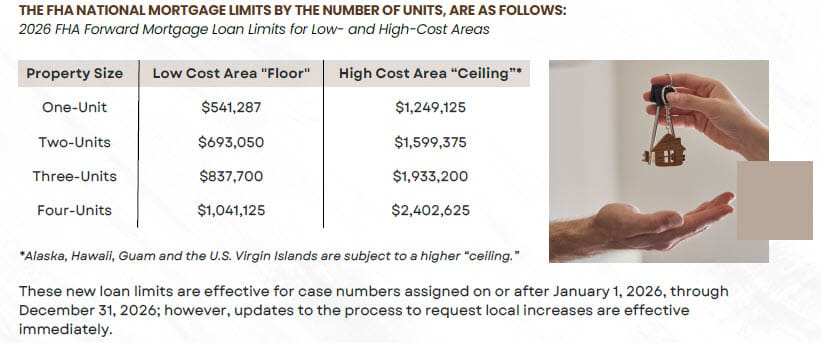
| Units | Low-Cost FHA Floor (65% of baseline) | High-Cost FHA Ceiling (150% of baseline) |
|---|---|---|
| 1-unit | $541,287 | $1,249,125 |
| 2-unit | $693,062 | $1,599,375 |
| 3-unit | $837,720 | $1,933,200 |
| 4-unit | $1,041,137 | $2,402,625 |
Comparison of 2026 and 2025 FHA Limits
To give you an idea, here is what FHA set in 2025 for 1-unit homes across the continental U.S.:
- 2025 FHA low-cost limit (floor): $524,225
- 2025 FHA high-cost limit (ceiling): $1,209,750
Since FHFA is increasing the conforming loan limit from $806,500 in 2025 to $832,750 in 2026, which is a 3.26% rise, FHA’s limits for both the floor and ceiling have gone up in 2026.
Here’s what that means:
- Budget-friendly areas: FHA may offer more borrowing power than in 2025.
- Expensive coastal cities (like NYC, SF Bay Area, DC metro): FHA loan limits are expected to rise to align with the new $1,249,125 maximum, giving buyers extra flexibility before reaching jumbo loan territory.
How 2026 FHA Loan Limits Affect Your Budget
Keep in mind that the loan amount differs from the cost of the home. With a credit score of 580 or above, FHA allows down payments as low as 3.5%.
Here’s what the projected 2026 limits mean when it comes to home prices:
In an Average Lower-Cost Area
- Max FHA loan for 1-unit homes: About $541,287
- With a 3.5% down payment, FHA covers 96.5% of a home’s cost.
Approximate max home value = 541,287 ÷ 0.965 = around $560,900.
By 2026, in an affordable county, someone using FHA with the smallest down payment could afford a home in the mid-$500,000s, if they meet income, credit, and debt requirements.
In a Higher-Cost Area
- Maximum FHA loan for a single unit: $1,249,125
- With a 3.5% down payment, that lets buyers afford something around:
1,249,125 ÷ 0.965, which is about $1.29 million.
This shows how FHA now fits more than just “starter homes” in pricey metro areas.
Main takeaway: The limit shows the biggest loan amount allowed. But you still need to qualify based on things like credit, income, debt, and the type of home. FHA doesn’t hand out loans up to the limit to everyone.
Who Gains the Most From Higher FHA Limits in 2026?
These are the groups most likely to benefit when FHA limits go up:
- First-time buyers in areas where basic homes now range between $400k and $600k
- Move-up buyers looking for FHA’s easier credit requirements
- Buyers with previous credit problems who might not qualify for traditional loans
- Buyers relying on down payment help, as FHA’s 3.5% minimum down payment and more flexible debt-to-income rules may work better
In expensive regions, higher limits let more buyers avoid jumbo loans, which have stricter rules and demand bigger cash reserves.
2026 FHA Rules You Still Need to Follow (Limits Are Just One Factor)
Even though loan limits are rising, FHA’s main requirements stay the same. You still have to meet the program’s rules for a FHA Loan.
Credit Score
- 580+ FICO: You qualify to pay 3.5% down.
- 500–579 FICO: You will need to pay 10% down, along with a stronger overall financial profile.
(Some lenders might apply stricter requirements.)
Debt-to-Income Ratio (DTI)
- FHA aims at about 43% or less.
- They may accept higher ratios, up to 46.9%/56.9%, if you have strong factors like solid savings or excellent credit.
Property Requirements
- Homes with 1 to 4 units qualify.
- The home must serve as your primary residence.
- Properties need to pass an FHA appraisal and meet specific FHA housing standards.
Loan Limit Compared to Price
- The FHA loan amount must stay within your county’s limit based on the number of units.
- You can still purchase a home priced above the FHA limit, but you’ll need to make a large enough down payment to ensure the loan amount is within the FHA limit.
Step-by-Step Guide: How to Include 2026 FHA Loan Limits in Your Plan
This is how I guide buyers as a loan officer:
Step 1 – Check Your 2026 FHA County Limit
HUD released the 2026 Loan Limits for Case numbers on or after January 1, 2026, you can use this website to look up county loan
- Visit HUD’s FHA Mortgage Limits page.
- Select your state and your county.
- Write down the 1–4 unit FHA limit listed for 2026.
Since HUD hasn’t shared the 2026 list yet, we base estimates on the 2025 limit and apply the federal formula.
Step 2 – Figure Out Your Ideal Price Range
We work backward by looking at:
- Your income and current debts
- The amount you plan to use as a down payment
- How comfortable you feel about the monthly payments
Afterward, we confirm if that price range falls below your area’s estimated 2026 FHA limit.
Step 3 – Get Pre-Approved (Not Pre-Qualified)
To look at 2026 offers, especially if you’re pushing your budget, you should aim to get a fully underwritten pre-approval. This means verifying things like:
- Income (pay stubs, W-2s, tax documents, or paperwork for self-employment)
- Credit scores and reports
- Money available for the down payment and closing costs
- Any funds from gifts or grants
Step 4 – Add In Down Payment Assistance If You Need It
Plenty of state and local DPA programs work with FHA loans, and with FHA’s higher limits in 2026, you could:
- Purchase in nicer school districts
- Keep your upfront cash manageable
- Avoid going into non-QM or higher-rate loan products
Step 5 – Decide Between FHA and Conventional for 2026
FHA loan limits are based on a percentage of conforming loan limits, which means the difference between FHA and conventional loans changes every year. Looking at 2026:
- Conventional limit baseline: $832,750
- Estimated FHA floor: About $541,287
A conventional loan may save you more on mortgage insurance costs if you have strong credit and good financial reserves, even if both loan types work for your budget.
We can walk you through a side-by-side comparison to figure this out.
Debunking Myths About FHA Loan Limits (2026 Edition)
Myth 1: FHA Loans Are Just for Inexpensive Homes.
That’s not true. By 2026, FHA high-cost limits will allow some homes to reach seven-figure prices, provided you qualify.
Myth 2: You Can’t Use FHA If the Home Price Exceeds the FHA Limit.
Not necessarily. Making a bigger down payment to bring your loan amount within your county’s FHA limit can make an FHA loan an option.
Myth 3: Loan Limits Mean You Will Get Approved for That Amount.
Not true. The limit is just the highest amount you can borrow, not a promise of approval. Your income, debts, credit history, and the property still need to qualify.
Myth 4: FHA Loan Limits Are Equal Everywhere.
That’s incorrect. HUD determines these limits per county each year, based on a range between a national minimum and maximum.