Quick Answer: 2026 Conventional Loan Limits
Beginning January 1, 2026, the baseline conventional (conforming) loan limit for a 1-unit property in the United States will be $832,750 unless the property is in a high cost area. In designated high-cost areas, the 2026 high-cost / super-conforming limit for a 1-unit property will be $1,249,125, which is 150% of the new baseline limit.
County-by-county limits for 1–4 unit properties are set by the Federal Housing Finance Agency (FHFA) and published on their website at the following link:
Conforming Loan Limit Values Map
.
If you’re shopping in Delaware, Maryland, Pennsylvania, or almost any other state, these new limits help determine how much you can borrow with a standard conventional loan before you move into jumbo financing.
What Are the Conventional Loan Limits for 2026?
Conventional loans are mortgages backed by Fannie Mae or Freddie Mac, not by a government agency like FHA, VA, or USDA. When a loan amount is at or below the FHFA’s limit for your county, it’s called a conforming loan. Anything above that is term a jumbo loan.
For 2026, FHFA announced the following for 1-unit homes:
- Baseline conforming loan limit: $832,750
- High-cost area / super-conforming ceiling: $1,249,125 (150% of $832,750)
This means:
- In most U.S. counties, a 1-unit home can be financed with a standard conventional loan up to $832,750.
- In certain high-cost counties, the 1-unit limit can go above the baseline, up to $1,249,125.
- For 2–4 unit properties, the limits are higher and also vary by county.
If you’re not sure whether your county uses the baseline or a high-cost limit, you can check it in seconds on the FHFA map, or my team can do it for you.

How Much Did the 2026 Loan Limits Increase?
The 2026 baseline limit moved from $806,500 to $832,750 for a 1-unit home.
That’s an increase of $26,250, or about 3.26% over 2025.
FHFA raises the conforming loan limits using a formula tied to its House Price Index (HPI).
Under the Housing and Economic Recovery Act of 2008 (HERA), FHFA compares home prices over the last four quarters and then adjusts the baseline loan limit each year based on that change.
- The limit can go up as home prices rise.
- If prices fall, the baseline limit does not go down; it stays at the higher number.
That’s why conforming limits have moved up steadily since they started increasing again in 2016.
Conventional Loan Limits Since 2016 (1-Unit Baseline)
Here’s how the national baseline 1-unit conforming limit has changed over time:
- 2016: $417,000
- 2017: $424,100
- 2018: $453,100
- 2019: $484,350
- 2020: $510,400
- 2021: $548,250
- 2022: $647,200
- 2023: $726,200
- 2024: $766,550
- 2025: $806,500
- 2026: $832,750
This trend shows that more homes now fit inside conforming loan guidelines than in the past, which can help buyers avoid jumbo loans in many price ranges.
What Is a High-Cost Area and a Super-Conforming Loan?
A high-cost area is a county where 115% of the local median home value is higher than
the national baseline conforming limit for that year. In those counties, FHFA allows a higher limit, up to
150% of the baseline.
For 2026, that ceiling is:
- High-cost / super-conforming ceiling for 1-unit: $1,249,125
These higher limits are sometimes called:
- High-balance loans
- Super-conforming loans
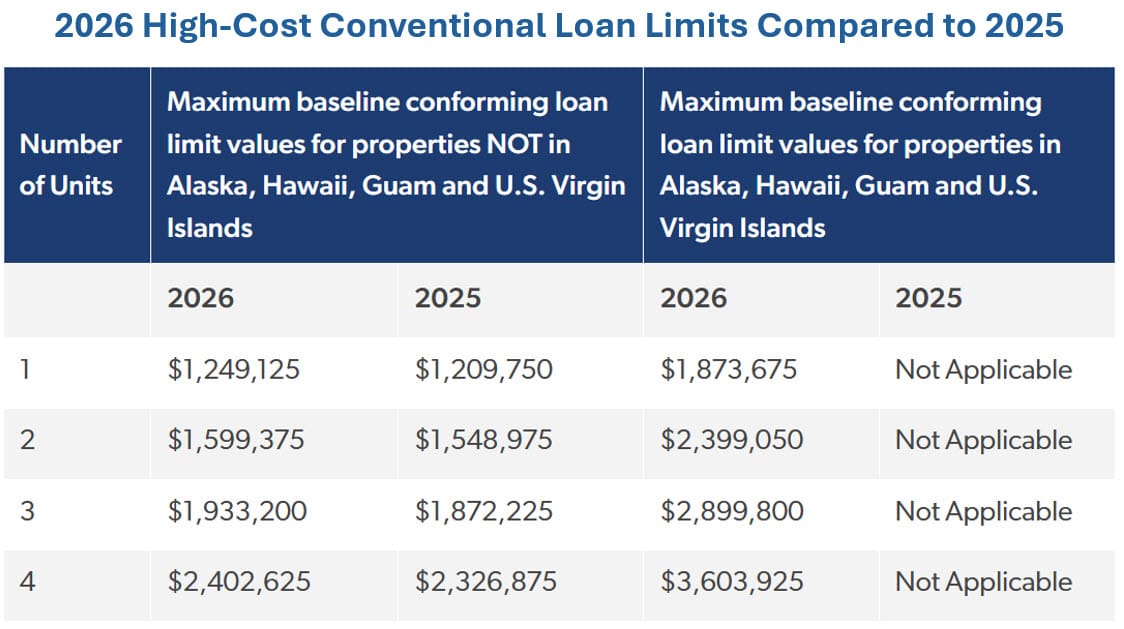
They are still conventional loans sold to Fannie Mae or Freddie Mac, but they often have slightly higher interest rate adjustments and some extra underwriting guidelines. Special statutory areas like Alaska, Hawaii, Guam, and the U.S. Virgin Islands also have higher baseline and ceiling limits than the rest of the country.
Where To Find Your Exact 2026 County Loan Limit
FHFA publishes all the county-level 2026 limits in one place. You can:
- Go to the FHFA Website at the following link:
Conforming Loan Limit Values Map
. - Enter your state and county.
- See the loan limits for 1–4 unit properties for 2026.
For direct data files, the FHFA site also has downloadable spreadsheets and PDFs with all counties and unit counts.
If you’d like, my team will pull your county’s 2026 limit for you and show exactly what that means for your
maximum purchase price and down payment.
What If You Need a Loan Amount Above the 2026 Conventional Loan Limit?
If your needed loan amount goes above your county’s 2026 conforming limit, you usually have two main options:
- Jumbo loan
- Conforming first mortgage + second mortgage (piggyback)
Example Scenario
Let’s say you are looking at this situation:
- Purchase price: $1,300,000
- Down payment (20%): $260,000
- Total loan needed: $1,040,000
If your county uses the baseline 1-unit limit of $832,750, then:
- You cannot do one single conforming loan for $1,040,000.
- Instead, you could:
- Take a jumbo loan for $1,040,000, or
- Do a conforming first mortgage at $832,750 plus a
second mortgage for the extra $207,250.
The best setup depends on your credit score, income, reserves, and goals. Sometimes the jumbo is better; sometimes the 1st/2nd combo gives you a lower blended payment or lets you keep the first mortgage conforming.
This is exactly the kind of math we walk through with you during a consultation.
How the 2026 Loan Limits Help Buyers in Delaware & Maryland
In Delaware, all three counties (New Castle, Kent, and Sussex) have used the
national baseline conventional limit in recent years. Unless FHFA designates a Delaware county as “high-cost,” the 2026 limit for a 1-unit home will match the new $832,750 baseline.

In Maryland, things are more mixed:
- Some counties, especially those closer to Washington, D.C., have historically qualified for
higher, high-balance conforming limits. - Other Maryland counties stick with the baseline loan limit like Delaware.
What this means for Maryland and Delaware buyers:
- More homes now fall under conforming guidelines, not jumbo.
- Many buyers can still use low down payment options (as little as 3% down on certain conventional programs)
at higher price points. - Sellers can reach a wider pool of financed buyers because more buyers can qualify with standard conventional loans.
If you’re looking in Newark, Wilmington, Dover, Middletown, Elkton, or Baltimore, we can quickly show you:
- Your county’s 2026 loan limit
- How that limit translates to a target price range
- Whether you’re in conforming, high-balance, or jumbo territory
Step-by-Step: How To Use the 2026 Loan Limits in Your Home Search
Step 1 – Look up your county’s 2026 limit.
Use the FHFA Conforming Loan Limit Values Map, select your state and county, and note the loan limit for a 1-unit home (and 2–4 units if you’re considering multi-units).
Step 2 – Decide on your target price range.
Work backward from your monthly budget and your available down payment.
Remember, the loan limit applies to the loan amount, not the purchase price.
You can buy above the limit if your down payment is large enough to keep the loan at or below the cap.
Step 3 – Get a full pre-approval, not just a quick pre-qual.
With the John Thomas Team, a true pre-approval means:
- We review your income, assets, and credit.
- We run your loan through Fannie Mae/Freddie Mac automated underwriting.
- We confirm whether a conforming or jumbo route makes more sense.
Step 4 – Compare conforming vs jumbo vs 1st/2nd.
We’ll show you:
- Interest rate differences
- Payment differences
- How much cash you’ll need at closing for each option
Step 5 – Coordinate with your real estate agent.
Once we know your maximum conforming loan amount and approved price range, your agent can target homes
that fit both your budget and the 2026 loan limits. This is especially important if you need
seller-paid closing costs, which we explain in detail in our guide
Understanding Seller Paid Closing Costs
.
Common Myths About Conventional Loan Limits
Myth #1: The loan limit is based on the purchase price.
Fact: The conforming limit is based on the loan amount, not the price.
You can buy above the limit if your loan stays at or below the cap with a larger down payment.
Myth #2: You can’t buy above the loan limit unless you put 20% down.
Fact: You may be able to go above the limit using a jumbo loan or a
conforming first + second mortgage, often with less than 20% down, depending on your full profile.
Myth #3: Loan limits are the same everywhere in the U.S.
Fact: Loan limits vary by county and number of units. Some counties use
high-cost limits that are much higher than the national baseline.
Myth #4: Higher loan limits automatically mean you qualify for more.
Fact: Higher limits simply mean the guidelines allow a larger conforming loan amount.
You still must qualify based on your income, debts, credit, and assets.
Myth #5: Delaware and Maryland always share the same limit.
Fact: Delaware counties have matched the baseline limit in recent years,
while some Maryland counties have qualified for high-balance limits. Always check by county.
How the John Thomas Team Helps You Use the 2026 Limits
As a branch manager and Certified Mortgage Planner with Primary Residential Mortgage, Inc. (PRMI),
I don’t just quote the new numbers and send you on your way. My team’s job is to help you:
- Understand how much home you can buy with a 2026 conforming loan.
- Decide whether conventional, FHA, VA, USDA, or jumbo is your best path.
- Use seller-paid closing costs and, when available, down payment assistance to save cash at closing.
- Structure your financing so it still makes sense years down the road, not just on day one.
We lend in Maryland, Delaware, Pennsylvania, and most other states nationwide (except New York)
through Primary Residential Mortgage, Inc.
Serving Maryland & Delaware Homebuyers
If you’re buying in:
- Newark, Wilmington, Dover, Middletown, Smyrna, Bear, or anywhere in Delaware, or
- Baltimore, Elkton, Harford County, Cecil County, or throughout Maryland,
we know both the local real estate market and the full set of loan options that work with the new 2026 conventional loan limits.
You’ll get:
- A clear loan strategy session
- A written total cost breakdown
- A strong pre-approval your agent can rely on when writing offers
How To Apply for a 2026 Conventional Loan
If you want to see how the 2026 conventional loan limits apply to your situation:
- Call the John Thomas Team at
302-703-0727, or Apply online using the secure application on our website.
We’ll walk you through:
- Your county’s 2026 limits
- Your maximum conforming loan amount
- Whether a conforming, high-balance, or jumbo loan is the better fit
- A clear plan to become pre-approved and home-shopping ready
You won’t get hype. You’ll get a simple, honest plan to buy or refinance using the new 2026 loan limits.
Conventional Loan Limits 2026 – FAQ
1. What is the 2026 conventional loan limit for a 1-unit home?
For most U.S. counties, the 2026 conventional (conforming) loan limit for a 1-unit home is $832,750.
2. What is the 2026 high-cost / super-conforming limit?
In designated high-cost areas, the 2026 ceiling for a 1-unit home is $1,249,125, which is 150% of the baseline limit.
3. When do the 2026 loan limits take effect?
The new FHFA loan limits apply to loans acquired by Fannie Mae and Freddie Mac in calendar year 2026 and are effective for lenders on January 1, 2026 for new originations. Lenders will close the loans now with the higher loan limits and just wait till January 1st to have the loans bought by Fannie or Freddie.
4. Do loan limits change for 2–4 unit properties?
Yes. Two-, three-, and four-unit properties have higher 2026 loan limits than 1-unit homes, and those limits also vary by county. You can see the exact numbers on FHFA’s conforming loan limit map or in their 2026 spreadsheets.
5. Are the 2026 loan limits the same in every state?
No. The 2026 conforming loan limits are set by county, not just by state. Many counties use the national baseline limit, while some high-cost counties are allowed higher limits up to the ceiling.
6. What are the 2026 loan limits in Delaware?
Delaware’s three counties have followed the national baseline conforming limit in recent years. For 2026, that baseline is $832,750 for a 1-unit home, but you should confirm your county’s limit using the FHFA map.
7. How do I find my county’s 2026 conforming loan limit?
You can find your county’s 2026 conforming loan limit by using FHFA’s Conforming Loan Limit Values Map, which lets you select your state and county and view limits for 1–4 unit properties.
8. What if I need a loan above the 2026 conforming limit?
If your loan amount is above your county’s 2026 conforming limit, you typically need either a jumbo loan or a conforming first mortgage combined with a second mortgage. A lender can compare both options for you.
9. Can I use down payment assistance with a 2026 conventional loan?
Many state and local down payment assistance programs can be combined with a 2026 conventional loan, as long as the loan amount stays within the conforming limit and program guidelines are met.
10. How do I apply for a 2026 conventional loan with the John Thomas Team?
You can apply by calling the John Thomas Team at 302-703-0727 or by submitting a secure online application. We’ll review your profile, confirm your county’s 2026 loan limit, and help you build a clear plan to buy or refinance.