
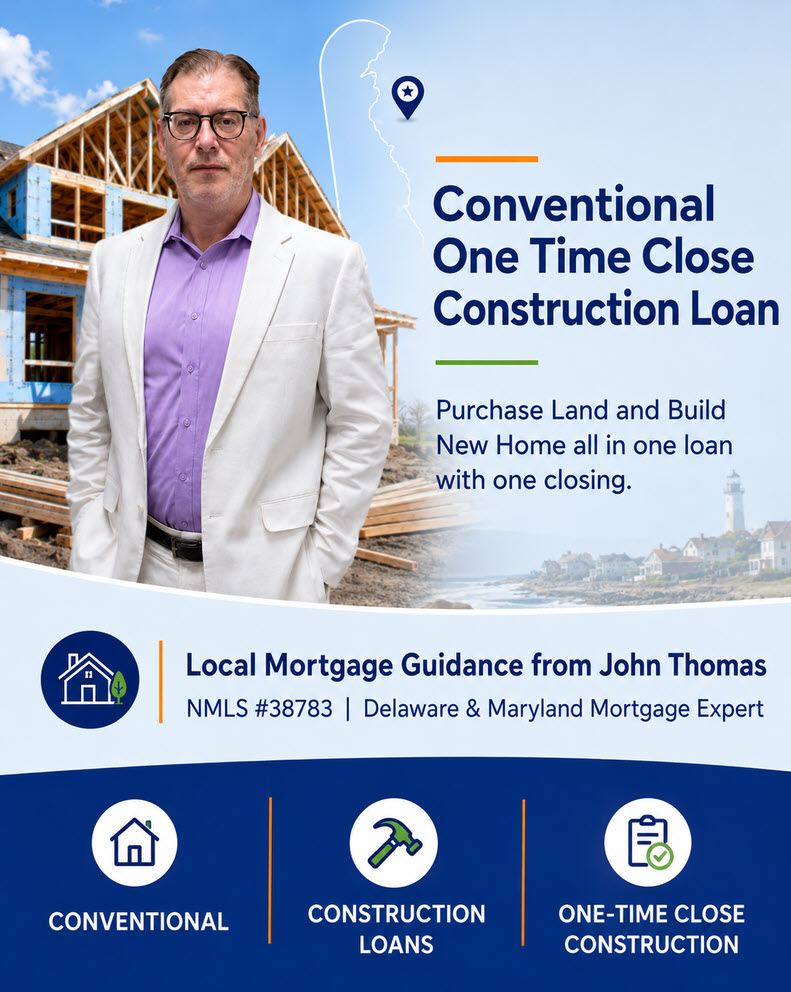
Conventional One-Time Close Construction Loan in Delaware: Build Your Home With One Loan and One Closing
Quick answer (current as of July 2026): A Conventional One-Time Close construction loan lets eligible Delaware buyers finance the lot, the build, and the permanent mortgage in one closing. You make no payments during construction because the builder carries the interest, built into the build cost – your first payment begins after completion. The permanent rate is capped up front and can float down before completion.
Building your own home in Delaware should not mean juggling two loans, two sets of closing costs, and the risk of re-qualifying halfway through. The Conventional One-Time Close construction loan combines the purchase of your lot, the construction of the home, and your permanent mortgage into one first mortgage with a single closing. It is a strong fit for buyers with solid credit who are working with a licensed builder and want the certainty of locking their permanent loan terms before the first shovel goes in the ground. If you want to talk through whether a conventional OTC is the right structure for your build, call the John Thomas Team at 302-703-0727 – I have originated construction financing for Delaware buyers for more than 20 years, and I will walk you through the whole path before you sign a builder contract.
Ready to price out your Delaware build?
John Thomas, NMLS #38783 | Newark, Delaware | 20+ years | 3,000+ buyers helped | 4.8 / 285 Google reviews
Table of Contents
What Is a Conventional One-Time Close Construction Loan?
A Conventional One-Time Close construction loan – also called a conventional single-close or construction-to-permanent loan – is a mortgage that finances your lot purchase, the construction of the home, and your permanent 30-year or 15-year mortgage in one loan with one closing. It follows Fannie Mae conventional guidelines rather than a government program, so it is generally aimed at borrowers with stronger credit who want a conforming loan and, when they put less than 20 percent down, private mortgage insurance (PMI) that can eventually be cancelled – something FHA mortgage insurance does not do.
Because it is a single close, you sign your closing documents before construction begins. You make no payments during construction – the builder carries the construction-phase interest and it is built into the build cost, so nothing comes out of your pocket while the home is being built. Once the home is finished and the certificate of occupancy is issued, your permanent mortgage is put in place – no second application, no second closing, and generally no re-qualifying for the permanent loan (a re-verification of employment is typically done before conversion). For a broader look at conventional financing outside of construction, see our Delaware conventional loans guide.
Some lenders and searchers write it as a Conventional One Time Close Construction Loan without the hyphens – it is the same product. The structure follows Fannie Mae’s construction-to-permanent rules; you can review those directly in the Fannie Mae Selling Guide (B5-3.1-02).
At a Glance
Key Features
Example: a $500,000 land-plus-build project at 5% is $25,000 down before closing costs.
This page focuses on the conventional version of the One-Time Close. If you have lower credit, are an eligible veteran, or are building in a rural area, an FHA, VA, or USDA OTC may fit better – the comparison below shows where each one wins.
Conventional OTC vs. Two-Time Close Construction Loan
Most lenders that advertise construction financing offer a two-time close: a short-term construction loan first, then a separate permanent mortgage you have to close (and re-qualify for) after the home is built. The one-time close collapses that into a single transaction. Here is how the two structures compare.
| Feature | Conventional One-Time Close | Two-Time Close |
|---|---|---|
| Number of closings | One | Two |
| Closing costs | Paid once | Paid twice |
| How the permanent rate is set | Capped before construction; finalized at completion via float-down | Set after construction is complete |
| Re-qualification after the build | Not required (employment re-verified) | Required – a new approval |
| Risk if your job or credit changes mid-build | Lower – loan is already closed | Higher – you must re-qualify |
| Appraisals | One | Often two |
| Payments during construction | None – the builder carries the interest, built into the build cost | Interest payments during construction |
Conventional OTC Benefits and Requirements
Why Choose This Loan
Benefits
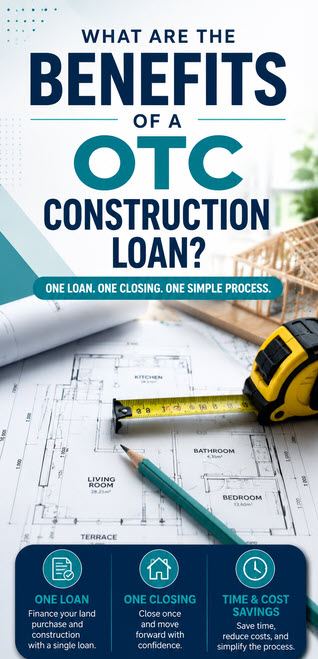
- ✓Single closing – save on closing costs versus the two-loan process
- ✓Rate is capped up front and can float down before completion, never up
- ✓No payments during construction – the builder carries the interest, built into the build cost
- ✓Finance land, construction, and the permanent mortgage in one loan
- ✓Conventional, FHA, and VA construction options available
- ✓Build on your own lot or purchase a new one
- ✓Choose your own builder (must meet qualification standards)
- ✓Only one appraisal required – see understanding the home appraisal
- ✓PMI can be cancelled at 80% LTV, unlike FHA mortgage insurance
What You Need
Requirements
- •Minimum credit score of 620
- •5% minimum down payment (95% LTV); land equity, owned or gifted, can cover part or all
- •Licensed, insured general contractor or builder required
- •Detailed construction plans, specifications, and budget
- •Builder must meet the lender’s qualification standards
- •Construction timeline up to 12 months
- •Land must be purchased or already owned
- •Appraisal based on plans and specifications (subject-to-completion appraisal)
Final loan approval is subject to underwriting.
Who Can Qualify for a Conventional One-Time Close Loan?
The Conventional OTC construction loan is available to borrowers who meet the qualifying criteria for a Fannie Mae conventional loan plus the added requirements for a construction-to-permanent loan. The core requirements are:
- You are purchasing the land at closing, or you already own the lot.
- You have a contract with a home builder that is licensed as a general contractor.
- Your total loan amount fits within the conventional conforming limit set for your county and state.
- Amortization of the permanent mortgage begins no later than the first of the month following 60 days from the final inspection or issuance of the certificate of occupancy.
- Your credit meets the 620 minimum for the conventional program, and your income and reserves meet the automated-underwriting (DU) guidelines. There are no income limits on this program.
- Eligible homes are single-family residences, detached PUDs, and double-wide manufactured homes on a permanent foundation. The home must be an owner-occupied primary residence or second home; condos, 2-to-4-unit homes, single-wide manufactured homes, and investment properties are not eligible.
A pattern I see with Delaware lot owners. In more than 20 years originating construction financing here, one of the most useful things buyers do not realize going in is that the equity in land they already own can count toward the down payment. If you bought a lot in New Castle or Sussex County a few years ago and it has appraised up, that equity often does real work on the cash side of a conventional OTC – I walk lot owners through how their appraised land value maps to the down payment before they lock in a builder contract, because it can change how much cash they actually need to bring. It is a scenario-by-scenario calculation, not a guarantee, but it is worth checking early. If you are still shopping for land, our Delaware land loans page covers financing the lot on its own.
How the Conventional OTC Construction Process Works
Knowing the mechanics up front removes most of the surprises. Here is how a conventional one-time close typically moves from approval to move-in for buyers building across New Castle, Kent, and Sussex counties. Before the build starts, your lot needs to be build-ready – clear title, local permits pulled, and utilities (or an approved well-and-septic plan) in place.
Builder approval
You build with an approved general contractor. Builders complete a registration process covering experience, insurance, financials, and licensing (where applicable) before loan approval, and the lender reviews the construction contract along with the plans, specs, and budget. Owner-builder projects are not permitted – the builder acts as the general contractor and completes the home, and you cannot be involved in the construction work. This keeps the build on a defined budget and timeline for you and the lender.
The appraisal is “subject to completion”
Because the home does not exist yet, the appraiser establishes an “as-completed” value from the plans, specs, and lot rather than an existing house. When the build is finished, a completion report (Form 1004D) confirms the home matches the approved plans before the loan converts to permanent financing.
Draw schedule and inspections
Funds are released to the builder in a series of draws tied to construction milestones – typically foundation, framing, rough-ins, drywall, trim, and final – with each draw generally confirmed by an inspection. During this phase you make no payments – the construction-phase interest is built into the build cost rather than billed to you month to month, and your first payment begins after the home is complete.
Construction timeline
The construction term is 12 months to start, with two 3-month extensions available if needed (up to 18 months total). Most Delaware builds finish well inside that window – plan for roughly 6 to 12 months depending on the home and the site. In the rare case a build runs past the limit, the loan is refinanced into a new permanent loan once the home is complete.
Change orders and reserves
If costs rise mid-build – a change order or an overrun – the change generally needs lender approval and may require additional borrower funds or contingency reserves. Building a contingency into your budget from the start keeps a surprise from stalling the project.
Completion and conversion
When construction is complete, all liens are satisfied, and the certificate of occupancy is issued, the loan automatically converts to your permanent mortgage with no second closing. A re-verification of employment is typically done before conversion.
What I tell buyers to expect. In my experience the two things that catch first-time builders off guard are the draw-and-inspection rhythm and change orders, so before a Delaware buyer signs a builder contract I walk through how draws release, what triggers an inspection, and why a contingency line matters. Setting that expectation early is usually the difference between a smooth build and a stressful one.
What Is the Interest Rate on a Conventional OTC Construction Loan?
A One-Time Close is really two loans – construction financing and your permanent mortgage – combined into a single closing. On the conventional single-close you close before construction begins and make no payments during construction – the builder carries the construction interest and it is built into the cost of the build. Because there is effectively no permanent loan in force while the home is being built, market rates can move up or down during construction, so we protect your permanent rate with a Cap Interest Rate Lock with a Rate Float-Down Feature.
At closing we lock a capped permanent rate – the cap is set 1 percent above the current program rate, and that capped rate is what you qualify, lock, and close at. When construction is complete – as defined by your construction loan agreement – your permanent rate is automatically set to the lower of the then-current offered rate for the program and pricing OR the capped rate you locked. You never have to request the float-down, and there is no fee for it. In other words, between closing and completion your rate can only stay the same or move down – never up.
Example: rate ends lower after the house is built
Say the current program rate is 6%. Your capped rate is set 1 percent higher, at 7%, and you qualify and close at that 7% cap. If the market rate at completion is 6.25%, your permanent rate floats down to 6.25%.
Example: rate ends higher after the house is built
Using the same 7% cap, if the market rate at completion has risen to 8%, your rate stays at 7% – it cannot rise above the cap you qualified and closed at. Because you qualify at the capped rate, your approval already accounts for the higher number; if rates fall, you simply get the lower payment.
The figures above are illustrative examples to show how the float-down works – they are not current rates, a rate quote, or an offer of credit. Rates move daily and depend on the market, the program, and your profile; call 302-703-0727 for a current quote.
2026 Delaware Conventional (Conforming) Loan Limits
Because a conventional OTC follows conforming guidelines, your total loan amount has to fit within the conforming loan limit for your county. For 2026, the one-unit conforming limit is $832,750 across all three Delaware counties (New Castle, Kent, and Sussex), per the Federal Housing Finance Agency. If your total project cost – land plus construction – would push your loan above the conforming limit, a jumbo construction option may be the better route. Ask us and we will point you to the right program for your build.
How Conventional OTC Compares to FHA, VA and USDA OTC
We originate one-time close construction loans across every major program. The right one depends on your credit, your down payment, your service history, and where you are building. Here is a high-level comparison so you can see where conventional fits.
| Program | Best for | Down payment | Mortgage insurance |
|---|---|---|---|
| Conventional OTC | Credit 620+, wants conforming loan and cancellable PMI | From 5% (land equity can count) | PMI if under 20% down – can be cancelled at 80% LTV |
| FHA OTC | Lower credit or smaller down payment | As little as 3.5% | FHA MIP – does not auto-cancel |
| VA OTC | Eligible veterans and active-duty service members | 0% down (eligible borrowers) | No monthly MI (funding fee may apply) |
| USDA OTC | Building in an eligible rural area, income limits apply | 0% down (eligible areas) | USDA guarantee fee |
When a Conventional OTC Loan Is Not a Good Fit
A conventional OTC is a great tool for the right borrower, but it is not the best answer for everyone. It may not be the right fit if:
- Your credit is on the lower end. An FHA One-Time Close loan has more flexible credit and debt-to-income guidelines.
- You are an eligible veteran. The VA One-Time Close loan offers 0 percent down for those who qualify.
- Your total project cost exceeds the county conforming limit. A jumbo construction option would apply instead.
- You want to act as your own general contractor. Conventional OTC is not available for owner-builders – an approved builder must act as the general contractor, and you cannot be involved in the construction work.
- You are renovating rather than building new. A renovation loan such as HomeStyle Renovation is designed for improving an existing home.
| Best fit | May not fit |
|---|---|
| Credit at or above 620 | Credit below 620 |
| Working with a licensed builder | Owner-builder project |
| Building new construction | Renovating an existing home |
| Loan within the conforming limit | Jumbo-level build |
| Wants cancellable PMI | Better served by FHA, VA, or USDA |
What This Means for You
If you have solid credit, a licensed builder lined up, and either a lot under contract or one you already own, a Conventional One-Time Close construction loan gives you the simplest path to a new home: one application, one closing, one appraisal, and a permanent rate capped before construction starts and finalized at completion under the float-down feature. The next step is a conversation about your credit profile, your down payment (including any land equity), and your builder’s cost estimate – that tells us whether conventional OTC is your best structure or whether an FHA, VA, or USDA OTC would serve you better. First-time buyers can also start with our Delaware first-time home buyer resources and down payment assistance options.
How Do You Apply for a Conventional OTC Construction Loan?
If you are considering a One-Time Close construction loan to build a new home, you can apply with the John Thomas Team of Primary Residential Mortgage, who are certified in One-Time Close construction lending. You will select a builder as part of the pre-qualification process and provide the builder’s cost estimate so we can complete an accurate pre-qualification. Get started by calling us at 302-703-0727, scheduling a consultation, or applying online. Whether you are building in Newark, Wilmington, or anywhere across the state, we can walk you through every step.
What to have ready before we talk
Gathering a few things ahead of time lets us give you a faster, more accurate read on your build:
- Your lot address or land contract (and whether you already own the lot)
- Your builder’s name and contact information
- The builder’s estimated cost to build
- Plans and specs, if you have them
- An approximate down payment (including any land equity)
- Basic income and asset documents
Conventional One-Time Close Construction Loan FAQs
What is a conventional one-time close construction loan?
It is a conventional (Fannie Mae) mortgage that finances your lot, the construction of your home, and your permanent mortgage in one loan with a single closing. You close before construction begins, make no payments during construction (the builder carries the interest, built into the build cost), and your permanent mortgage is put in place when the home is complete – with no second closing and no re-qualifying for the permanent loan.
How much do I need to put down on a conventional OTC construction loan?
The conventional OTC needs a minimum 5% down (95% LTV). Land equity you already own – or land gifted to you – can cover part or all of that down payment, and closing costs can often be financed in. Ask us to run your specific scenario.
What credit score do I need for a conventional OTC loan?
The conventional program requires a minimum credit score of 620. If your credit is below that, an FHA One-Time Close loan is often the better path since it allows a lower score. Call us and we will confirm where you stand for your scenario.
Do I make payments during construction?
No – you make no payments during construction. The builder carries the construction-phase interest and it is built into the cost of the build, so nothing comes out of your pocket while the home is being built. Once the home is complete and the certificate of occupancy is issued, your permanent mortgage is put in place and you begin making regular principal-and-interest payments.
What happens if construction takes longer than expected?
Conventional single-close construction has timing limits: under Fannie Mae’s rules the construction period cannot exceed 12 months in a single period, and the total period cannot exceed 18 months. Most Delaware builds finish well within that window. If a build is heading toward those limits, we work through the options early – the key is to flag delays as soon as they appear rather than at the deadline.
Can change orders affect my loan approval?
They can. A significant change order or cost overrun generally needs lender approval and may require additional borrower funds or contingency reserves, because it changes the budget the loan was underwritten on. Building a contingency into your budget from the start is the simplest way to keep a mid-build change from slowing the project.
What happens if my project costs more than the conforming loan limit?
A conventional OTC has to fit within the conforming loan limit for your county – $832,750 for a one-unit home in all three Delaware counties in 2026. If your total project cost (land plus construction) would push the loan above that limit, a jumbo construction option may apply instead. We can help you determine which program fits your budget.
Can I act as my own general contractor?
No. The conventional OTC requires an approved general contractor who completes the home, and the borrower cannot be involved in the construction work – so owner-builder projects are not eligible, even if you hold a contractor license. This keeps the build to professional standards on a defined budget and timeline.
What if I cannot qualify for a conventional OTC loan?
You have options. An FHA One-Time Close loan has a lower minimum credit score and can allow a higher debt-to-income ratio. Eligible veterans can look at the VA One-Time Close loan with 0 percent down, and buyers in eligible rural areas can consider the USDA One-Time Close loan. With any of these One-Time Close programs you make no payments during construction. Call us at 302-703-0727 and we will match you to the right program.
How do the interest rates work during construction on a conventional OTC?
At closing we lock a capped permanent rate, then apply a Cap Interest Rate Lock with a Rate Float-Down Feature: when the home is complete your rate is set to the lower of the current market rate or the capped rate – so it can float down if rates improve but never rise above the cap you locked. Rates move daily and depend on your profile and the market, so call for a current quote.

John R. Thomas is a Branch Manager and mortgage loan officer with Primary Residential Mortgage, Inc. (NMLS #38783) and has helped Delaware families finance and build homes for more than 20 years. He holds a BS in Physics Education from the University of Delaware and an MS in Curriculum and Instruction from Delaware State University, and he is the author of Your Guide to Buying Your First Home in Delaware.
On construction files, the detail John flags earliest is how a buyer’s existing land equity maps to the down payment on a conventional OTC – because getting that right up front often changes how much cash a Delaware lot owner actually needs to close. He works with buyers across New Castle, Kent, and Sussex counties to match each build to the right one-time close program.
Licensed in 17 states (AL, DC, DE, FL, GA, IN, KS, MD, MN, MO, NC, NJ, OH, PA, SC, TN, VA) – credential only; Delaware and Maryland are the primary service area.
John Thomas Team – Primary Residential Mortgage, Inc.
248 E Chestnut Hill Rd, Newark, DE 19713
Phone: 302-703-0727 | Email: JohnThomasTeam@primeres.com
NMLS #38783 | See John Thomas Team on Google
Learn more about John Thomas, Delaware mortgage loan officer.
Let’s build your Delaware home the simple way – one loan, one closing.
Last Updated: July 1, 2026. Mortgage content reviewed by John R. Thomas, NMLS #38783.
John Thomas Team – Primary Residential Mortgage, Inc. | 248 E Chestnut Hill Rd, Newark, DE 19713 | 302-703-0727 | NMLS #38783
(c) 2026 John R. Thomas. All Rights Reserved.
