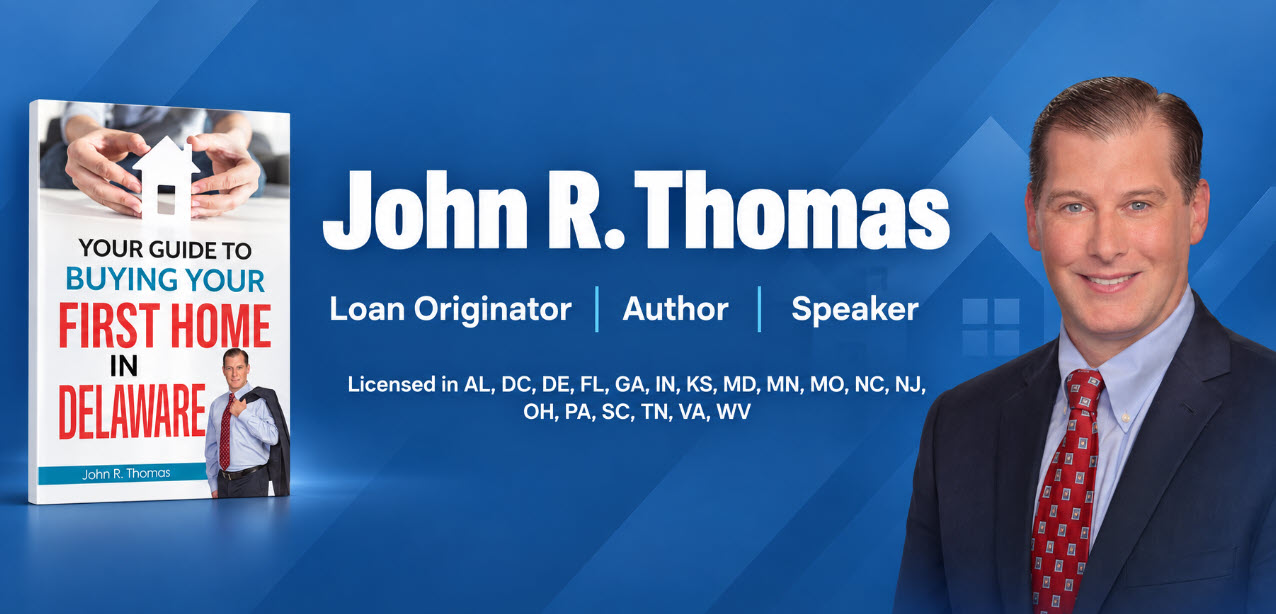
Delaware Mortgage Loans | John Thomas Team with AnnieMac Home Mortgage
Delaware Mortgage Lender Specializing in FHA, VA, USDA & DSHA Loan Programs – Helping Homebuyers Across New Castle, Kent, and Sussex County
Not sure where to start? Read the Delaware First-Time Home Buyer Guide
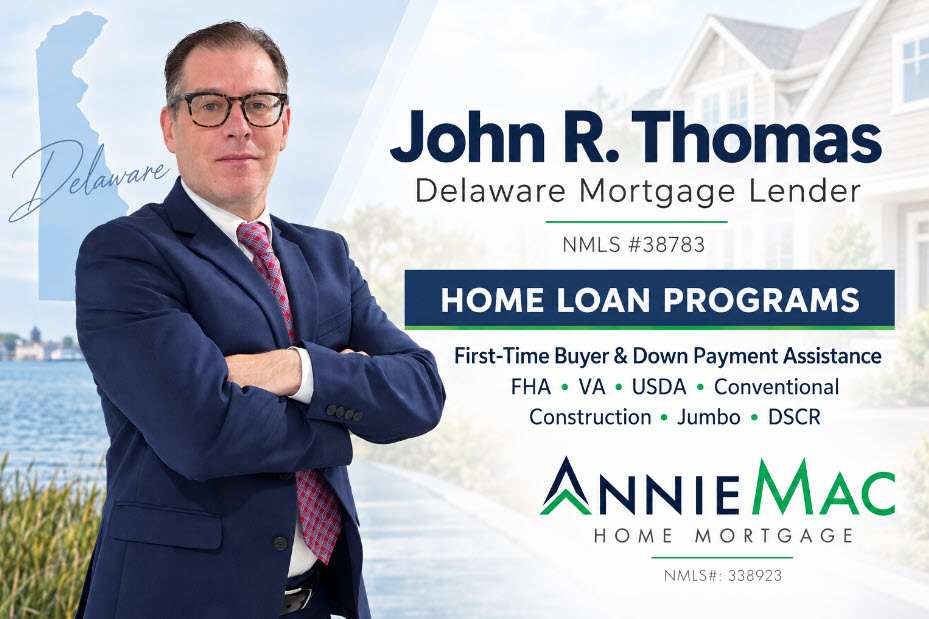
Delaware Mortgage Loans – Quick Answer: John Thomas (NMLS #38783) is a local Delaware mortgage loan officer with the John Thomas Team with AnnieMac Home Mortgage, 248 E Chestnut Hill Rd, Newark, DE 19713. The John Thomas Team helps buyers across New Castle, Kent, and Sussex County with FHA, VA, USDA, DSHA Welcome Home, DSHA Open Door, Conventional, renovation, construction, and Non-QM loans. Rated 4.8 stars on Google as of September 2026. Current as of October 2026. Call 302-703-0727 or apply online.
NMLS #38783
Licensed Loan Officer
20+ Years
Delaware Mortgage Experience
All 3 Counties
New Castle · Kent · Sussex
4.8 Stars
on Google (as of September 2026)
Delaware mortgage loan officer John Thomas of the John Thomas Team with AnnieMac Home Mortgage helps homebuyers across New Castle, Kent, and Sussex County understand and compare Delaware mortgage loans, including FHA, VA, USDA, DSHA, conventional, renovation, construction, and Non-QM financing. This page explains who qualifies, how much you may need for a down payment, and how to choose the right loan based on your credit, income, and goals. If you’re a first-time buyer, you may also qualify for Delaware down payment assistance programs that can reduce what you need at closing.
Most Delaware buyers qualify for more than one loan option – the right choice depends on your credit, income, and how much you want to bring to closing.
Table of Contents
Looking for the Best Mortgage Lender in Delaware?
The best mortgage lender in Delaware is one who offers the right loan program for your situation, communicates clearly, and can help you structure a strong offer in a competitive market. Local Delaware mortgage lenders often provide more personalized service, faster response times, and better knowledge of programs like DSHA compared to national call centers.
What to Look for in a Delaware Mortgage Lender (Key Factors)
- Loan program options – FHA, VA, USDA, DSHA, Conventional, and Non-QM solutions
- Local market knowledge – understanding Delaware counties, pricing, and competition
- Clear communication – fast updates during pre-approval and underwriting
- Offer strategy support – helping structure offers that get accepted
- Experience with your scenario – first-time buyer, veteran, investor, or renovation
Many Delaware homebuyers work with John Thomas because of his experience with first-time buyers, DSHA programs, and complex loan scenarios.
Choosing the right mortgage lender in Delaware can make a significant difference in your experience, your loan options, and even your ability to get your offer accepted.
Some lenders operate as national call centers, while others are local Delaware loan officers who understand the market, work closely with real estate agents, and help you structure your offer to win.
John Thomas is a Delaware-based mortgage lender who has helped hundreds of homebuyers navigate everything from first-time purchases to complex loan scenarios. With over 20 years of experience and access to a wide range of loan programs, you’ll have options – and a clear path forward.
Delaware Mortgage Loan Programs
FHA Loans Delaware
3.5% down with a 580+ credit score or 10% down with 500+ Credit Score. Flexible underwriting for first-time buyers and those rebuilding credit. FHA203k Renovation, FHA OTC Construction, and FHA Streamline Refinances.
VA Loans Delaware
Zero down payment for eligible veterans and active-duty service members. No MI, competitive rates, VA Renovation, OTC Construction, and VA IRRRL Refinances available. Access 100% Financing with Full Entitlement!
USDA & DSHA Loans
100% Financing in eligible rural areas. Delaware State Housing Authority programs with down payment assistance and first time home buyer programs.
Conventional & DSCR Loans
As little as 3% Down Conventional Loans and DSCR Investor Loans for real estate investors purchasing or refinancing in Delaware. Renovation and Construction loans available.
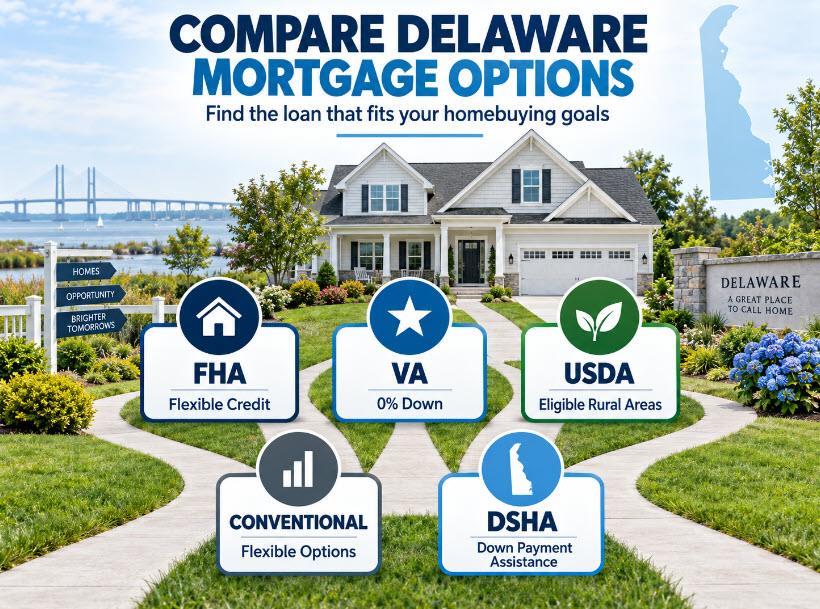
Compare Delaware Mortgage Loan Options (FHA, VA, USDA, Conventional, DSHA)
The most common Delaware mortgage loan options include FHA, VA, USDA, Conventional, and DSHA down payment assistance programs. Each loan type has different credit score requirements, down payment options, and long-term costs, so the right choice depends on your financial profile and homebuying goals.
Here is a side-by-side comparison of the most common mortgage loan options in Delaware:
| Loan Type | Min Down Payment | Min Credit Score | Best For | Mortgage Insurance | Key Benefit |
|---|---|---|---|---|---|
| FHA Loan | 10% 3.5% |
500+ 580+ |
First-time buyers or lower credit | Required (monthly + upfront) | Flexible credit guidelines |
| VA Loan | 0% | No official minimum | Veterans & active military | None | No down payment, no MI |
| USDA Loan | 0% | 600+ | Rural & suburban buyers | Lower than FHA | 100% financing in eligible areas |
| Conventional Loan | 3% – 5% | 620+ | Stronger credit borrowers | Can be removed | Lower long-term cost |
| DSHA Program | 0% – 0.5% | 620+ | Delaware first-time buyers | Depends on loan type | Up to 5% down payment assistance |
FHA Loan
3.5% with 580+ credit score
VA Loan
USDA Loan
Conventional Loan
DSHA Program
How to Choose the Right Mortgage Loan in Delaware
Most Delaware homebuyers qualify for more than one loan program. The right option depends on your credit score, income, down payment, and long-term goals.
- FHA loans are best for buyers with lower credit scores or limited savings
- VA loans are ideal for eligible veterans who want zero down payment
- USDA loans work well for buyers purchasing in eligible rural or suburban areas
- Conventional loans are a strong option for buyers with higher credit and stable income
- DSHA programs help Delaware buyers reduce upfront costs with down payment assistance
The best way to choose the right Delaware mortgage loan is to review your full scenario, including credit, income, and cash to close, before getting pre-approved.
What Type of Mortgage Do You Qualify For in Delaware?
Most Delaware homebuyers qualify for FHA, VA, Conventional, USDA, or DSHA down payment assistance programs depending on their credit score, income, and how much they want to bring to closing.
Buyers with strong credit may qualify for Conventional loans with lower long-term costs, while those with lower credit scores often use FHA loans for more flexible guidelines. Veterans may qualify for VA loans with no down payment, and eligible rural buyers can use USDA loans for 100% financing.
If your income doesn’t fit traditional guidelines, you may still qualify using Non-QM loan options like bank statement, DSCR, or asset-based programs.
Most buyers in Delaware qualify for more than one of these options – the right choice depends on your credit, income, and how much you want to bring to closing. Minimum credit scores can vary based on lender guidelines and overall loan profile.
How Much Do You Need to Buy a Home in Delaware?
The amount you need to buy a home in Delaware depends on the loan program, the purchase price, and whether you qualify for down payment assistance. Some buyers can purchase with little money out of pocket, while others may need funds for down payment, closing costs, and reserves.
FHA loans can require as little as 3.5% down, Conventional loans may start at 3% down, and VA and USDA loans can offer 100% financing for eligible borrowers. Delaware homebuyers who qualify for DSHA programs may also be able to reduce the amount needed at closing by using down payment assistance.
In addition to the down payment, buyers should also plan for closing costs, prepaid taxes and insurance, and home inspection or appraisal expenses. The best way to know what you need is to review your full scenario based on your credit, income, and target price range.
Not sure how much you need to buy in Delaware? Call John Thomas at 302-703-0727 or start your application online to get a personalized estimate.
Explore Delaware Mortgage Loan Options
Every homebuyer’s situation is different. Learn more about the most common mortgage programs available in Delaware:
FHA Loans – flexible credit and low down payment options
Learn more about Delaware FHA loans
VA Loans – 100% financing for eligible veterans
Learn more about Delaware VA loans
First-Time Home Buyer Programs
Learn more about Delaware First Time Home Buyer Programs
Down Payment Assistance Programs
Learn more about Delaware Down Payment Programs
Delaware First-Time Home Buyer Guide
Learn more about Delaware First Time Home Buyer Guide
Comparing Mortgage Lenders in Delaware: What Matters Most
When comparing mortgage lenders in Delaware, most homebuyers focus on interest rates – but that’s only part of the picture.
The right lender will help you:
- Choose the right loan program
- Structure your offer to compete
- Navigate underwriting smoothly
- Close on time without surprises
Local experience, communication, and access to multiple loan options often matter more than small differences in rate. If you’re comparing mortgage lenders in Delaware, working with a local expert like John Thomas gives you access to more loan options, faster communication, and a smoother closing process.
Work With a Local Delaware Mortgage Lender vs Online Lenders
Many homebuyers start their search online and consider large national lenders or call centers. While these options may seem convenient, they often lack the local knowledge and personal communication needed to navigate a competitive Delaware real estate market.
Working with a local Delaware mortgage lender means:
- Direct communication with your loan officer
- Faster response times when submitting offers
- Strong relationships with local real estate agents
- Better understanding of Delaware-specific programs like DSHA
If you’re comparing mortgage lenders in Delaware, choosing a local expert can make the difference between a smooth closing and unnecessary delays.
Delaware Mortgage Rates: What You Need to Know
Delaware mortgage rates are not one-size-fits-all. The rate you qualify for depends on several factors specific to your loan profile – and understanding what drives your rate is just as important as shopping for the lowest number.
What Affects Your Delaware Mortgage Rate
Several factors influence the mortgage rate you’ll be offered in Delaware:
- Credit score – higher scores typically qualify for lower rates across all loan types
- Loan type – FHA, VA, USDA, and Conventional loans all have different rate structures and mortgage insurance costs
- Down payment – a larger down payment on a Conventional loan can reduce your rate and eliminate mortgage insurance
- Loan term – 15-year loans carry lower rates than 30-year loans but higher monthly payments
- Debt-to-income ratio – lower DTI ratios typically result in better pricing
- Property type – primary residences, second homes, and investment properties are priced differently
- Market conditions – rates move daily based on economic data, the Federal Reserve, and bond market activity
Rate vs. Total Cost: What Most Buyers Miss
The lowest advertised rate is not always the lowest cost loan. Two Delaware homebuyers with different credit scores, loan types, and down payment amounts can receive identical rates but have very different total monthly payments due to mortgage insurance, points, and fees.
For example, a Delaware buyer using a VA loan with no mortgage insurance may have a lower effective monthly cost than a buyer with a lower rate on an FHA loan that includes both an upfront mortgage insurance premium and monthly MI. The full picture – rate plus MI plus fees – is what determines your true cost of borrowing.
How to Get the Best Mortgage Rate in Delaware
- Get pre-approved early so you know exactly what rate tier your credit and income qualify for
- Compare loan types – not just lenders – to find the lowest total cost, not just the lowest rate
- Ask about discount points and whether buying down your rate makes sense for your timeline
- Lock your rate once you’re under contract to protect against market movement during underwriting
- Work with a local Delaware loan officer who can compare options across multiple loan programs, not just one product
What Is the Current Mortgage Rate in Delaware?
Mortgage rates in Delaware change daily based on market conditions. The rate you qualify for depends on your credit score, loan type, down payment, and debt-to-income ratio – not just the published average.
Published rate averages from sources like Freddie Mac or Bankrate reflect national survey data and often don’t reflect what Delaware buyers with specific loan profiles actually qualify for. VA loan rates, for example, are typically priced differently than Conventional rates even when the published averages look similar.
The best way to get an accurate Delaware mortgage rate is to get pre-approved based on your actual credit, income, and loan scenario. Call John Thomas at 302-703-0727 for a no-obligation rate review or apply online to get started.
Delaware Mortgage Rate by Loan Type
Different loan programs in Delaware carry different rate structures. Here is a general overview of how rates compare across the most common loan types:
- VA Loans – typically among the lowest rates available with no mortgage insurance, exclusively for eligible veterans and service members
- USDA Loans – competitive rates with low mortgage insurance for eligible rural and suburban areas in Delaware
- Conventional Loans – rate depends heavily on credit score and down payment; mortgage insurance can be removed once equity reaches 20%
- FHA Loans – more flexible credit requirements but include both upfront and monthly mortgage insurance that affects total cost
- DSHA Programs – below-market rates are available through the Delaware State Housing Authority for eligible buyers, which can reduce the effective rate below what is available on the open market
- Non-QM Loans – rates are typically higher than agency loans due to the alternative documentation and flexible guidelines, but may be the only qualifying option for self-employed buyers or investors
Ready to find out what rate you qualify for? Call John Thomas at 302-703-0727 or apply online to get a personalized rate quote based on your actual loan profile.
How the Delaware Mortgage Process Works
Understanding the mortgage process in Delaware before you start shopping helps you move faster, avoid surprises, and close with confidence. Here is what to expect from pre-approval to closing:
Step 1: Get Pre-Approved
Pre-approval is the first and most important step. Your loan officer will review your credit, income, assets, and debt to determine which loan programs you qualify for and how much you can borrow. A strong pre-approval letter makes your offer competitive and signals to sellers that your financing is solid. The John Thomas Team starts with a soft credit pull only – no hard inquiry until you are ready to move forward with the complete pre-approval.
Pro Tip – What is the difference between a Pre-Qualification & Pre-Approval?
Pre-qual is only a credit check and lender gets information that you provide. Nothing is verified by the lender so a pre-qual doesn’t hold much weight for listing agent and also means you could still get denied for a loan once the lender reviews all your documents. The pre-approval needs a hard credit pull and must review all your loan documents such as pay stubs, w-2 forms, 1099 forms, tax returns, bank statements, photo ID, etc. Income and employment are verified through 3rd party.
The pre-approval is the gold standard and protects you, the home buyers from being turned down 2 weeks prior to closing and losing any money you spent and possibly being homeless. It is NOT recommended to work with a lender who will not take the time and effort to go through a full pre-approval before you go shopping for a home.
Step 2: Find a Home and Go Under Contract
Once pre-approved, you work with your real estate agent to find a home and submit an offer. When the seller accepts, you are under contract and the formal loan process begins. Your loan officer can provide an updated pre-approval letter specific to the purchase price and help your agent structure the offer correctly.
Pro Tip – Your lender should call the listing agent when your offer is submitted by your agent. A good lender will sell the listing agent on taking your offer and answer any questions they have about your ability to close and to close on time. This is exactly what John Thomas does to increase the odds of his buyer’s offer getting accepted.
Step 3: Loan Application and Disclosures
Your loan officer provides you with the official mortgage application and Loan Estimate (LE) based on the terms of the ratified sales contract. The LE document outlines your rate, monthly payment, closing costs, and loan terms. The official mortgage application date is written into the contract and you must make application by this date or you will be in breach of the contract.
Pro Tip – Work with a lender that will get your mortgage application done within 24-48 hours of having your offer accepted. You can’t afford any delays in the loan process and you want to make sure you don’t miss the mortgage application date you agreed to when you signed the contract.
Step 4: Home Appraisal and Inspection
Once you have made official mortgage application the lender submits your file to the loan processor. The processor will order a Home Appraisal Report to confirm the home’s value supports the loan amount and to determine if any lender required repairs. You will also need to schedule a home inspection with your real estate agent if you included it in the contract. The processor will submit a title request to the Delaware attorney or Maryland title company you selected to represent you in the transaction. You will also need to get a home owners insurance quote at this time.
Pro Tip – Work with a lender that will process your loan within 48 hours of receiving your signed loan application. Time is of the essence so the appraisal and title search need to be ordered ASAP so that there are no delays. The John Thomas Team processes all files within 48 hours of receiving the signed loan application and provides weekly Tuesday Status Updates every week so you always know what is happening on your loan file.
Step 5: Underwriting
An underwriter reviews your full file – income documents, credit, appraisal, title, and insurance – and issues a decision. You may receive a Conditional Approval, which means the underwriter needs additional documents or clarification before issuing a final Clear to Close. Responding quickly to underwriting conditions is the most important thing you can do to stay on schedule.
Pro Tip – Work with a lender that can underwrite your file fast so that you meet the mortgage commitment date that is in the sales contract. This is the date you agree to provide the seller with a commitment from your lender to provide the loan to purchase the home. Missing the commitment date puts you in breach of the contract and you will need to negotiate with the seller to extend or they can cancel the contract.
Step 6: Clear to Close
Once all conditions are satisfied, the underwriter issues a Clear to Close. You receive a Closing Disclosure (CD) at least three business days before closing that outlines the final numbers. Review it carefully and confirm the figures match your last Loan Estimate (LE).
Pro Tip – Make sure you confirm with your real estate agent that a Final Walk Through has been schedule for 24-48 hours prior to the closing day so that you can verify the property is in the condition you agreed to buy it and that the seller has moved out all of their belongings.
Step 7: Closing Day
On closing day, you sign the final loan documents, pay any remaining closing costs and down payment, and receive the keys. In Delaware, closings typically occur at an attorney’s office. The entire process from ratified contract to closing typically takes 21 to 30 days with a pre-approval already in place. In Maryland you can close anywhere as it is not an attorney state.
How Long Does It Take to Close a Mortgage in Delaware?
Most Delaware home purchases close in 21 to 30 days from a ratified contract when the buyer is already pre-approved. Getting pre-approved before you start shopping is the single most effective way to shorten the timeline and strengthen your offer.
The John Thomas Team also offers rescue closings in 10 to 14 days for buyers whose deals are falling through with another lender. Call 302-703-0727 if you need to move fast.
Have questions about the Delaware mortgage process? Call John Thomas at 302-703-0727 or read the Delaware First-Time Home Buyer Guide for a complete walkthrough from start to finish.
Why John Thomas Is a Trusted Mortgage Lender in Delaware

Work With a Delaware Mortgage Lender Who Teaches the Process
Buying a home in Delaware requires more than just finding a rate – it requires a clear strategy. You need to understand credit guidelines, income calculations, debt-to-income ratios, and down payment options as well as local Delaware Down Payment Assistance Programs for first-time home buyers.
As a Delaware mortgage loan officer with over 20 years of experience, John R. Thomas helps buyers:
- Understand eligibility before applying
- Compare FHA, VA, USDA, and Conventional options
- Review down payment assistance opportunities
- Plan construction and renovation projects
- Evaluate investor financing strategies
Our approach is education-first. That’s why we host monthly homebuyer seminars and consumer workshops across Delaware and Maryland.

Delaware First-Time Home Buyer Programs
Delaware offers several first-time home buyer programs that can help you buy with less out of pocket, including low down payment loans and down payment assistance options.
Options May Include:
- FHA Loans with only 3.5% Down
- Conventional 3% Down Programs
- USDA 100% Financing (eligible rural areas)
- VA Loans for eligible veterans for 100% financing
- Delaware Down Payment Assistance Programs
See all program details and eligibility requirements here:
Delaware First-Time Home Buyer Programs Page
If you’re just getting started, read the Delaware First-Time Home Buyer Guide to understand the full process before applying.

DSHA Loan Programs in Delaware
The Delaware State Housing Authority (DSHA) offers state-backed mortgage programs and down payment assistance for eligible Delaware homebuyers. In April 2026, DSHA rebranded its single-family lending program as the Delaware Mortgage Program, with two main first-mortgage tracks:
- DSHA Welcome Home – for first-time homebuyers (no primary residence ownership in the past 3 years)
- DSHA Open Door – for repeat buyers and buyers above Welcome Home income limits (formerly the DSHA Home Again program before the April 2026 rebrand)
Either Welcome Home or Open Door can be paired with one of four down payment assistance options:
- First State Home Loan – 3% DPA (zero-interest deferred second), pairs with Welcome Home or Open Door
- Keys4You – 4% DPA (zero-interest deferred second), pairs with Welcome Home or Open Door
- Take5 – 5% DPA (zero-interest deferred second), pairs with Welcome Home only
- Diamond in the Rough – 5% DPA + FHA 203(k) Limited renovation financing, pairs with Welcome Home only
Eligibility for any DSHA program is based on:
- Household income limits (vary by county and household size)
- Purchase price limits (vary by county)
- Primary residence requirement (must occupy as primary home)
- Minimum 620 credit score (housing counseling required if 620-659)
- HUD-approved homebuyer education completion
For Welcome Home, only the income of borrowers on the Note and Mortgage is counted toward the income limit (this changed in April 2025). For Open Door, only the qualifying income on the loan application is counted. We will review your full scenario and identify which DSHA pairing fits – or whether a non-DSHA option is the better path.
For complete details on every active DSHA program and the full DPA pairing matrix, see our Delaware Down Payment Assistance Programs hub. Or call John Thomas at 302-703-0727 or apply online to get started.

Delaware Renovation & Construction Loans
Looking to buy, build, or renovate a home in Delaware?
You don’t need separate loans to purchase and improve a property. Renovation and construction loans allow you to finance everything together – including the home, repairs, upgrades, or even a ground-up build – with one loan and one closing.
These programs are ideal for buyers who want to customize a home, investors improving property value, or homeowners planning major upgrades.
Who These Loans Are Best For
Renovation or construction financing may be a good fit if you:
- Found a home that needs repairs or updates
- Want to renovate after closing instead of paying out of pocket
- Are building a home from the ground up
- Own land and want to construct a new home
- Are upgrading a current home with major improvements
- Want to roll renovation costs into your mortgage

Popular Renovation & Construction Loan Options
Here are some of the most common programs available in Delaware:
- FHA 203(k) Loans – Finance both purchase and renovation with flexible credit requirements
- VA Renovation Loans – Eligible veterans can finance home improvements with no down payment
- Conventional HomeStyle(R) Loans – Renovation financing for primary, second homes, or investment properties
- CHOICERenovation(R) Loans – Conventional renovation option with flexible improvements
- One-Time Close Construction Loans – Build a home with a single closing and lock in your rate
Explore Renovation Loan Options →
Learn how to buy and renovate a home with one loan using FHA 203(k), HomeStyle®, and more.
Explore Construction Loan Options →
Build your dream home with a one-time close construction loan and avoid multiple closings.
Why Renovation & Construction Loans Are Different
Traditional mortgages only finance the home as-is.
These programs allow you to finance the future value of the property – meaning you can buy a home that needs work or build from scratch while keeping everything in one loan.
That means:
- You don’t need separate financing for repairs or construction
- You can customize your home the way you want
- You may increase the property’s value through improvements
- You can avoid multiple closings and additional fees
Talk to a Delaware Renovation & Construction Loan Specialist
Every project is different, and the right loan depends on your goals, timeline, and budget.
Not sure if you should renovate, build, or buy move-in ready? We’ll walk you through the best option for your situation.
Call John Thomas at 302-703-0727 or start your application online to review your options and build the right plan for your situation.
Delaware Investor & Non-QM Mortgage Loans
If you don’t qualify for a traditional mortgage, you still have options.
Non-QM (Non-Qualified Mortgage) loans are designed for Delaware homebuyers and real estate investors who don’t fit into standard income or credit guidelines. These programs allow you to qualify using alternative documentation like bank statements, rental income, or assets instead of tax returns.
Whether you’re self-employed, investing in rental property, or recently had a credit event, these loan options can open the door to financing when conventional loans won’t.
Who Non-QM Loans Are Best For
Non-QM financing may be a good fit if you are:
- Self-employed and write off a large portion of your income
- A real estate investor buying or refinancing rental property
- Using 1099 income instead of W-2s
- Looking to qualify based on assets instead of income
- Rebuilding after a bankruptcy, foreclosure, or credit event
- A foreign national or ITIN borrower
Popular Non-QM Loan Options in Delaware
- Bank Statement Loans – qualify using deposits instead of tax returns
- DSCR Loans – qualify based on rental income
- ITIN Home Loans – financing options without a Social Security number
- Asset Qualifier Loans – use assets instead of income
- 1099 Income Loans – designed for independent contractors
- View all Non-QM loan programs – https://delawaremortgageloans.net/non-qm-loans/
Why Non-QM Loans Are Different
Traditional mortgage loans rely heavily on tax returns, W-2 income, and strict debt-to-income ratios.
Non-QM loans take a more flexible approach by allowing alternative ways to verify your ability to repay the loan.
That means:
- You may qualify even if your tax returns show lower income
- You can use real cash flow instead of adjusted income
- You have more flexibility with credit history and recent events
Talk to a Delaware Non-QM Loan Specialist
Every Non-QM loan is different, and the right strategy depends on your income structure, credit profile, and goals.
Call John Thomas at 302-703-0727 or start your application online to review your options and find the best loan for your situation or APPLY ONLINE
Whats the Best Loan for Your Situation?
Not sure which loan program is right for you? Most buyers in Delaware qualify for more than one option – it just depends on your credit, income, and goals.
Here’s a quick guide to help you understand what might fit your situation best.
If You’re a First-Time Homebuyer
You may benefit from:
- FHA Loans – flexible credit and low down payment
- DSHA Programs – down payment assistance up to 5%
- Conventional 3% Down Loans – lower long-term cost with stronger credit
These options are ideal if you’re trying to minimize upfront costs and get into your first home.
If You Want to Buy With Little or No Money Down
You may benefit from:
- VA Loans – 0% down with no mortgage insurance for eligible veterans
- USDA Loans – 100% financing in eligible areas
- DSHA Assistance Programs – cover most or all of your down payment
These programs are designed to reduce out-of-pocket costs as much as possible.
If You Have Lower Credit or Are Rebuilding
You may benefit from:
- FHA Loans – more flexible credit requirements
- Non-QM Loan Options – alternative qualification methods
- Manual underwriting options depending on your situation
These programs can help you qualify even if your credit isn’t perfect.
If You’re Self-Employed or Don’t Show Income on Tax Returns
You may benefit from:
- Bank Statement Loans – qualify using deposits instead of tax returns
- 1099 Income Loans – designed for contractors
- Asset Qualifier Loans – qualify using savings or investments
These programs focus on real cash flow instead of traditional income documentation.
If You’re Buying an Investment Property
You may benefit from:
- DSCR Loans – qualify based on rental income
- Non-QM Investor Loans – flexible qualification options
- Conventional Investment Loans – for stronger credit profiles
These options are designed specifically for real estate investors.
If You Want to Renovate or Build
You may benefit from:
- FHA 203(k) Loans – purchase and renovate with one loan
- Conventional HomeStyle(R) Loans – flexible renovation options
- One-Time Close Construction Loans – build with a single closing
These programs allow you to finance improvements or construction into your mortgage.
Not Sure Which Option Fits You Best?
Every situation is different, and the right loan depends on how all the pieces come together.
Call John Thomas at 302-703-0727 or start your application online to review your options and build the right plan for your situation.
Serving Homebuyers Across Delaware
We work with buyers and investors across the entire state of Delaware for purchasing or refinancing a home whether it is your primary residence, a second home or an investment property:
John Thomas works with homebuyers throughout Delaware, including:
- Newark
- Wilmington
- Pike Creek
- Hockessin
- Bear
- Middletown
- Dover
- Smyrna
- Lewes
- Rehoboth Beach
- Milford
- Seaford
Whether you’re buying in New Castle County, Kent County, or Sussex County, you’ll have access to a local Delaware mortgage lender who understands the market, works closely with real estate agents, and helps you navigate the process from pre-approval to closing.
Not Buying in Delaware?
If you are purchasing outside of Delaware, John Thomas is licensed as a mortgage loan officer in 17 states: Alabama, the District of Columbia, Delaware, Florida, Georgia, Indiana, Kansas, Maryland, Minnesota, Missouri, North Carolina, New Jersey, Ohio, Pennsylvania, South Carolina, Tennessee, and Virginia (AL, DC, DE, FL, GA, IN, KS, MD, MN, MO, NC, NJ, OH, PA, SC, TN, VA). The company is licensed in additional states beyond John’s individual licensing – please call to confirm coverage in your specific state.
View our full Mortgage Loan Programs page for national loan options: Mortgage Loan Programs
Delaware Mortgage Loans FAQ
What credit score do I need for a mortgage in Delaware?
Minimum credit scores vary by loan type. FHA loans allow as low as 500 with 10% down, or 580 with 3.5% down. VA loans technically have no minimum credit score, though most lenders look for 580-620. Conventional loans typically require 620 or higher. USDA loans require a minimum 600 credit score. Non-QM loans generally require 600 or higher. Chattel loans for manufactured homes on leased land can go as low as 550. Reverse mortgages have no minimum credit score. Minimum scores can also vary based on overall borrower profile and loan-level factors.
How much down payment do I need to buy a home in Delaware?
Down payment requirements depend on the loan program. VA loans offer 0% down for eligible veterans. USDA loans offer 0% down in eligible rural areas. FHA loans require 3.5% down (with options to pair with down payment assistance for 100% financing). Conventional loans start at 3% down. DSHA’s Welcome Home and Open Door programs can be paired with one of four down payment assistance options – First State (3%), Keys4You (4%), Take5 (5%, Welcome Home only), or Diamond in the Rough (5% + FHA 203k Limited, Welcome Home only). Eligibility for any DPA program depends on income, credit, and property location.
What is the DSHA program in Delaware?
The Delaware State Housing Authority (DSHA) offers state-backed mortgage programs through its Delaware Mortgage Program (rebranded April 2026). The two umbrella first-mortgage programs are Welcome Home (for first-time buyers with no primary residence ownership in the past 3 years) and Open Door (for repeat buyers and buyers above Welcome Home income limits). Either can be paired with First State (3% DPA), Keys4You (4% DPA), Take5 (5% DPA, Welcome Home only), or Diamond in the Rough (5% DPA with FHA 203k Limited renovation, Welcome Home only). All DSHA loans are 30-year fixed-rate, require a minimum 620 credit score, and require HUD-approved homebuyer education.
Does John Thomas offer VA loans in Delaware?
Yes. John Thomas specializes in VA loans for Delaware veterans, active-duty service members, and qualifying surviving spouses. We offer VA purchase loans, VA renovation loans, VA One-Time Close construction loans, VA IRRRL streamline refinances, and VA manufactured home loans. VA loans require no down payment with full entitlement, no monthly mortgage insurance, and competitive interest rates.
How long does it take to close a mortgage in Delaware?
Most Delaware purchases close in 21 to 30 days from a ratified contract when the buyer is already pre-approved. Getting pre-approved before you start shopping is the single most effective way to shorten the timeline. The John Thomas Team can also close a rescue loan in 10 to 14 days if your deal is falling out with another lender or mortgage broker. Closing timelines depend on appraisal turnaround, title work, and how quickly the buyer responds to underwriting conditions.
Can I buy a home in Delaware with bad credit?
It depends on your full financial profile, not just the credit score. FHA loans allow scores as low as 500 with 10% down or 580 with 3.5% down. VA loans have flexibility for eligible veterans. Non-QM loan options can sometimes work for buyers rebuilding credit after a recent event. The best first step is a no-pressure conversation to review your credit report, income, and goals – we always start with a soft credit pull only, so there’s no impact on your score.
What areas does John Thomas serve in Delaware?
John Thomas serves all three Delaware counties – New Castle County, Kent County, and Sussex County – as well as Maryland. The team is based at 248 E Chestnut Hill Rd in Newark, DE, with both in-person and virtual consultations available. Common service cities include Newark, Wilmington, Bear, Middletown, Hockessin, Pike Creek, Dover, Smyrna, Lewes, Rehoboth Beach, Milford, and Seaford.
What is the FHA loan limit in Delaware for 2026?
For 2026, the FHA loan limit for a one-unit property is $630,200 in New Castle County and $541,287 in Kent County and Sussex County. Two-unit limits are $806,750 (New Castle) and $693,050 (Kent and Sussex). HUD updates these limits annually. See the Delaware FHA Loan Limits 2026 page for full details on multi-unit and high-balance options.
Do you offer construction loans in Delaware?
Yes. We offer FHA, VA, USDA, and Conventional One-Time Close construction loans for eligible borrowers. One-Time Close means a single closing for both the construction loan and the permanent mortgage – you lock your rate up front, and the loan converts automatically once construction is complete. We also offer renovation loans (FHA 203k, VA Renovation, Conventional HomeStyle, CHOICERenovation) for buyers who want to purchase and renovate a home with a single mortgage.
Can I combine DSHA Welcome Home with FHA 203k renovation?
Yes. The DSHA Diamond in the Rough program is specifically designed for this – it pairs DSHA Welcome Home with an FHA 203k Limited renovation loan and 5% down payment assistance. The 203k Limited is for non-structural repairs and improvements (cosmetic updates, mechanical systems, kitchens, baths, roofing) up to the FHA 203k Limited cap. Diamond in the Rough is only available with Welcome Home (not Open Door), and DSHA does not allow FHA 203k on manufactured homes.
How do I choose the best mortgage lender in Delaware?
To choose the best mortgage lender in Delaware, compare experience, loan program access, communication style, and local market knowledge – not just the published rate. A lender who understands DSHA programs, works closely with local agents, and can structure your offer to get accepted often delivers more value than a slightly lower rate from a national call center. Ask about responsiveness, weekly status updates, and how the lender communicates with the listing agent on your behalf when offers are submitted.
Can I get a Delaware mortgage after a Chapter 7 bankruptcy?
Yes – but the waiting period depends on the loan type. FHA requires 2 years from discharge. VA requires 2 years from discharge. USDA requires 3 years from discharge. Conventional loans typically require 4 years from discharge (or 2 years with documented extenuating circumstances). Some Non-QM programs allow as little as 1 day from discharge with a larger down payment and reserves. We start with a soft credit pull to confirm your discharge date and identify which programs you qualify for today versus what you may qualify for after a brief waiting period.
Can I use 1099 or self-employment income for a Delaware mortgage?
Yes. Self-employed buyers and 1099 contractors have several options in Delaware. Conventional and FHA loans typically require 2 years of tax returns plus year-to-date profit and loss. If your tax returns show low net income because of write-offs, Non-QM bank statement loans let you qualify based on 12 or 24 months of business or personal bank deposits instead of tax returns. We also offer 1099-only loan programs for independent contractors and asset qualifier loans that use your investment accounts to qualify. The right program depends on how you document income and how aggressively you write off expenses.
Can I use gift funds for my down payment in Delaware?
Yes – gift funds are allowed for down payment and closing costs on FHA, VA, USDA, and Conventional loans, with limits depending on program and occupancy. The gift must come from an acceptable donor (typically a family member, fiance, or close personal friend with a documented relationship), must be documented with a signed gift letter, and the funds must be sourced and seasoned in the donor’s account before transfer. For Conventional loans on a primary residence, 100% of the down payment can come from gift funds. For FHA and VA, all of the borrower’s required minimum investment can come from gift funds. Gift funds must be deposited into the buyer’s account before the closing disclosure is issued.
Can I buy a home in Delaware with no money down?
Yes – several programs allow eligible Delaware buyers to purchase with no money out of pocket. VA loans offer 100% financing with no down payment for eligible veterans and active-duty service members. USDA loans offer 100% financing in eligible rural and suburban areas. DSHA Welcome Home or Open Door paired with Take5 (5% DPA) can effectively cover the FHA 3.5% down payment plus a portion of closing costs. Combining DPA with seller-paid closing costs (typically up to 6% on FHA, 4% on Conventional, 4% on VA) can result in $0 out of pocket at closing for qualifying buyers.
Talk to a Delaware Mortgage Lender Today
If you’re planning to buy a home in Delaware, the best next step is a quick conversation to review your options.
Ready to explore your Delaware mortgage loan options? Call John Thomas at 302-703-0727, schedule a 30-minute appointment online, or start your application to find out what you qualify for and how to move forward. We always start with a soft credit pull only – no impact on your score until you’re ready to move forward.
Ready to Get Your Delaware Mortgage?
Talk to John Thomas – no obligation, no sales pitch. Get straight answers about what you qualify for and what the process looks like. Soft credit pull only until you’re ready to move forward.
Last Updated: October 2026 · John R. Thomas, NMLS #38783 · John Thomas Team with AnnieMac Home Mortgage · 248 E Chestnut Hill Rd, Newark, DE 19713 · 302-703-0727 · delawaremortgageloans.net
Copyright © John R. Thomas, All Rights Reserved.
John R. Thomas, NMLS #38783 | John Thomas Team with AnnieMac Home Mortgage | AnnieMac Home Mortgage NMLS #338923 | 248 E Chestnut Hill Rd, Newark, DE 19713 | 302-703-0727 | delawaremortgageloans.net
AnnieMac Home Mortgage is an Equal Housing Lender. John R. Thomas, NMLS #38783, is licensed in 17 states (AL, DC, DE, FL, GA, IN, KS, MD, MN, MO, NC, NJ, OH, PA, SC, TN, VA); look up NMLS #38783 on NMLS Consumer Access.
(c) Copyright John R. Thomas, All Rights Reserved.
Licensed by the Delaware State Bank Commissioner. This is not a commitment to lend. All loans subject to credit approval. Company licensing disclosures
